
1. Background
Rhythmic gymnastics has been defined “the perfect combination of sport and art” by the national Australian governing body for gymnastics (1). This Olympic sport is based on the athlete’s morphokinetic abilities evaluated on the basis of well-coded aesthetic requirements. Participants use their bodies and equipment (ropes, hoops, balls, clubs and scarves) combining the movements of gymnastics with music (2).
Success in rhythmic gymnastics is strongly conditioned by physical appearance. The physical appearance of elite athletes is determined by the combination of a reduced and controlled diet with intense physical exercise that leads to a lean, almost anorexic physique (3). Therefore, the athletes’ appearance is judged in addition to their performance. These athletes reduce their body weight and fat mass for aesthetic reasons, although the reduction of fat mass also allows an increase in performance (4).
Several studies have reported a prevalence of body dissatisfaction among athletes practicing aesthetic sports (5-7). According to Borrione et al. (8) and in contrast to previous studies, elite gymnasts are not at risk of developing eating disorders, despite their thinness, because their body satisfaction is greater than that of their own population. In addition to the inconsistent results emerging from the literature, another interesting aspect to consider is the “body satisfaction transiency” (9), which leads some athletes to be satisfied with their body in everyday life, as their thinness is in accordance with Western standards, while they may be dissatisfied with their athletic body image due to much more restrictive body requirements in the sport practiced (10). Thus, when considering athletes, it is important to analyze separately the general ideal body image and the ideal body image for that particular sport.
2. Objectives
It should also be noted that previous studies on body dissatisfaction in gymnasts did not adequately assess their possible misperception based on their actual anthropometric characteristics. In order to fill this gap in the research, we conducted a study on pre-menarcheal rhythmic gymnasts (RG) with the following objectives: (i) to determine the body image perception of RG testing the differences between competitive and non-competitive girls and in comparison to a sample of schoolgirls who do not practice any aesthetic sport; (ii) to assess the degree of dissatisfaction, considering both gymnasts’ general ideal body image and the ideal body image specific to RG in comparison with the actual body image; (iii) to evaluate the consistency between perceived weight status and actual anthropometric characteristics.
3. Methods
3.1. Participants
The study was carried out on a total sample of 135 Italian gymnasts and schoolgirls. All the participating athletes were recruited using a convenience sampling method among those who were currently practicing rhythmic gymnastics in sports clubs in the Emilia-Romagna region (Northern Italy; Rimini and Ferrara districts). Among them, 64 athletes fulfilled the following inclusion criteria: (i) being female; (ii) being in the sport categories foreseen under 13 years of age (up to the category “Allieve”); (iii) being apparently healthy and free from musculoskeletal diseases; (iv) continuous training in the past year; (v) having completed all the questions and all the anthropometric measurements. The group of 64 preadolescent RG (mean age 10.1 ± 1.8 years) included 36 competitive and 28 non-competitive girls.
As a control group (C), we used a sample of 71 schoolgirls (mean age 11.4 ± 0.3 years) attending middle schools in the same region (Rimini and Ferrara districts). These baseline data were available from a larger project for the obesity prevention in Emilia-Romagna children (11). Inclusion criteria for the control group were: (i) being female; (ii) being within the same age range of RG; (iii) having completed all the questions and all the anthropometric measurements; (iv) not practicing any aesthetic sport. Detailed information regarding the sampling and the recruitment procedures of the control group are reported in the study of Tripodi et al. (11).
Participation in the survey was voluntary and anonymity and confidentiality were assured. Only subjects who received written consent from their parents and agreed to participate were recruited. The study was performed in accordance with the Helsinki Declaration and was approved by the local ethical committee.
3.2. Demographic and Anthropometric Data
All the participants filled in a brief questionnaire with basic personal and demographic data. The information included: date of birth and testing, age at the start of rhythmic gymnastics training, competitive or non-competitive practice, hours/week of training (last three items reserved for RG). Controls were asked to indicate if they were engaged in any aesthetic sport.
Anthropometric data were collected by a well-trained anthropometrist following standard procedures (12). The anthropometric measures were: stature (cm), weight (kg), triceps and subscapular skinfold thicknesses (mm), upper arm and waist circumferences (cm). Measurements detectable from both sides of the body were recorded on the left (13).
Stature was measured using an anthropometer (GPM, Swiss), body weight (light clothing, without shoes) using a calibrated electronic scale (SECA, Swiss), skinfold thickness with a Lange skinfold caliper (Beta Technology Inc., USA), upper arm circumference with a non-stretchable tape at the same level as the triceps skinfold thickness and waist circumference at the narrowest point between the lowest rib and the iliac crest.
Body Mass Index (BMI) was used to assess the weight status of each participant (underweight, normal weight, overweight and obese) according to Cole’s cut-offs points (14, 15). Body composition parameters, %F, fat mass (FM, kg), fat free mass (FFM, kg), were calculated from the two measured skinfolds using the equations proposed by Slaughter et al. (16).
3.3. Body Image Perception
The children’s body silhouette chart proposed by Collins et al. (17) was used to assess body image perception based on the perceived and desired body image. This chart consists of seven female child figures that differ in the degree of body weight and leanness, ranging from very thin to obese. Each participant was asked to indicate which silhouette represents her ideal body and which represents her actual perceived body. Only the RG were requested to specify which silhouette represents their ideal for rhythmic gymnastics.
The FID (Feel-minus-Ideal-Discrepancy) (18) score was calculated by subtracting the ideal from the perceived silhouette. The extent of discrepancy represents the degree of dissatisfaction in body image perception.
Moreover, for RG only, we calculated a new index, named FIDSport, to evaluate the discrepancy between the figure that they perceived as actual and the figure that they considered ideal for their sport by subtracting the ideal gymnast figure chosen by each participant from the actual perceived figure: score 0 indicates a correspondence between the actual figure and the ideal RG figure, scores < 0 indicate that the actual figure is leaner than the ideal RG figure, scores > 0 indicate that the actual figure is more robust than the ideal RG figure. When the score is different from 0, the discrepancy amount reflects the degree of dissatisfaction.
FAI (Feel weight status-minus-Actual weight status-Inconsistency) (19) score evaluates the discrepancy between the perceived weight status and the objective weight status assessed by measured stature and weight. The FAI was calculated by subtracting the conventional code assigned to the actual weight status of the participant (1: underweight; 2: normal weight; 3: overweight; 4: obese) from the code assigned to the silhouette chosen as perceived (1: silhouettes 1 and 2; 2: silhouettes 3, 4 and 5; 3: silhouette 6; 4: silhouette 7) (20). A 0 score of FAI indicates no inconsistency in weight status perception, a positive score that weight status is overestimated, a negative score that weight status is underestimated.
3.4. Statistical Analysis
Descriptive statistics (means ± SD and frequencies) were performed for all variables and for each study group.
The normality of variables was checked by the Shapiro-Wilk test. Comparisons between RG and C and between competitive and non-competitive gymnasts were performed by analysis of covariance (ANCOVA), controlling for age. The Wilcoxon matched pair test was used to test the differences between non-normally distributed variables in the same group (i.e. body image traits). Differences in the prevalence of categorical data (weight status) were tested by the chi-square test.
After checking for multicollinearity using the variance inflation factor (VIF), a multiple regression analysis adjusted for age was performed, testing the association between the ideal figure, used as dependent variable, and BMI, waist circumference, arm circumference, %F and group membership as independent variables.
P < 0.05 was considered statistically significant. Statistical analyses were performed with Statistica.V.11.0 (StatSoft, Tulsa, OK).
4. Results
The competitive RG were on average significantly older than non-competitive ones (10.7 ± 1.6 years vs. 9.4 ± 1.9 years respectively); in addition, they started practicing rhythmic gymnastics earlier and they had a significantly higher amount of weekly training (13.1 ± 4.9 hours vs. 4.5 ± 2.7 hours, P < 0.0001).
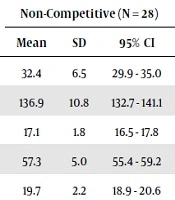
Anthropometric characteristics of the RG are reported in the upper part of Table 1, body image characteristics below. The ANCOVA adjusted for age shows that competitive RG were on average significantly taller and had smaller skinfolds than non-competitive ones. Moreover, the former presented a different body composition: they had a significantly lower FM and %F than the latter.
Table 1.
Descriptive Statistics of the Study Group Divided by Competitive and Non-Competitive Gymnasts
| Traits | Non-Competitive (N = 28) | Competitive (N = 36) | F | P | ||||
|---|---|---|---|---|---|---|---|---|
| Mean | SD | 95% CI | Mean | SD | 95% CI | |||
| Weight, kg | 32.4 | 6.5 | 29.9 - 35.0 | 34.0 | 8.9 | 31.0 - 37.0 | 3.3939 | 0.0703 |
| Stature, cm | 136.9 | 10.8 | 132.7 - 141.1 | 140.6 | 12.2 | 136.4 - 144.7 | 4.0270 | 0.0492 |
| BMI, kg/m2 | 17.1 | 1.8 | 16.5 - 17.8 | 16.9 | 1.8 | 16.3 - 17.5 | 2.2974 | 0.1348 |
| Waist circumference, cm | 57.3 | 5.0 | 55.4 - 59.2 | 57.4 | 4.3 | 56.0 - 58.9 | 2.6038 | 0.1118 |
| Arm circumference, cm | 19.7 | 2.2 | 18.9 - 20.6 | 19.7 | 2.0 | 19.0 - 20.4 | 3.7029 | 0.0590 |
| Triceps skinfold, mm | 14.5 | 3.6 | 13.2 - 15.9 | 11.0 | 2.9 | 10.0 - 12.0 | 12.7461 | 0.0007 |
| Subscapular skinfold, mm | 8.5 | 4.0 | 6.9 - 10.0 | 6.2 | 1.4 | 5.7 - 6.7 | 8.5678 | 0.0048 |
| %F | 20.6 | 4.8 | 18.7 - 22.5 | 16.4 | 3.3 | 15.2 - 17.5 | 13.0163 | 0.0006 |
| FM, kg | 6.8 | 2.3 | 5.9 - 7.7 | 5.6 | 2.1 | 4.9 - 6.4 | 10.4108 | 0.0020 |
| FFM, kg | 25.7 | 5.1 | 23.7 - 27.6 | 28.4 | 7.2 | 26.0 - 30.8 | 0.7389 | 0.3934 |
| Actual figure | 3.4 | 1.3 | 2.9 - 3.9 | 2.9 | 1.0 | 2.6 - 3.3 | 2.2421 | 0.1395 |
| Ideal figure | 3.4 | 1.1 | 2.9 - 3.8 | 2.5 | 0.7 | 2.3 - 2.7 | 10.1127 | 0.0023 |
| Ideal gymnast figure | 2.5 | 0.8 | 1.9 - 3.1 | 2.0 | 0.6 | 1.7 - 2.3 | 3.5141 | 0.0703 |
| FAI | -0.3 | 0.7 | -0.5 - 0.0 | -0.2 | 0.6 | -0.4 - 0.0 | 0.0021 | 0.9637 |
| FID | 0.0 | 1.1 | -0.4 - 0.4 | 0.4 | 0.9 | 0.1 - 0.8 | 1.0511 | 0.3093 |
| FIDSport | 0.4 | 0.9 | -0.4 - 1.1 | 1.1 | 1.1 | 0.7 - 1.5 | 3.2337 | 0.0819 |
Mean values of BMI in both subgroups fell into the normal weight status. No significant difference was detected in weight status distribution between competitive and non-competitive RG, even if there was a higher percentage of overweight subjects in non-competitive RG (14% vs. 3%).
As regarding body image parameters, the mean actual figure was similar in both subgroups and consistent with their weight status, as highlighted by the mean value of FAI close to zero.
The mean ideal figure chosen by the competitive RG was significantly skinnier than that chosen by the non-competitive ones. Furthermore, the competitive RG chose a significantly thinner ideal figure than that chosen as actual and an even thinner figure as their ideal body for a gymnast. Conversely, no differences were detected in the non-competitive subgroup. Mean values of FID and FIDSport were similar in the two subgroups, but within each subgroup the comparison between FID and FIDSport was significant (P = 0.0015 in competitive and P = 0.0431 in non-competitive). The analysis of FID showed a similar frequency of athletes satisfied of their condition (45% with FID = 0) in both subgroups, but there was a higher percentage of athletes with FID > 0 (45%) in the competitive RG (only 10% of them showed FID < 0). Conversely, the non-competitive subgroup had a similar proportion of athletes with FID scores < 0 or > 0 (about 25%).
Table 2 shows that in comparison between RG and C, RG were significantly lighter, with smaller circumferences and skinfolds, less fat mass and fat-free mass. Mean values of BMI in both groups fell into the normal weight status, but a significant difference was detected in weight status distribution by sport practice due to a higher prevalence of overweight/obese girls in C (Table 3). Actual (as expected) and ideal figures chosen by RG were significantly skinnier than those chosen by C, and only in C the mean ideal figure was significantly skinnier than actual one. The analysis of FID in C showed that 50% of the girls were unsatisfied because they wanted to be thinner (FID > 0), 40% of them were satisfied with their body image (FID = 0) and only 10% were unsatisfied because they would have liked to be stouter.
Table 2.
Comparison Between Gymnasts and Control Group
| Gymnasts (N = 64) | Controls (N = 71) | F | P | |||
|---|---|---|---|---|---|---|
| Mean | SD | Mean | SD | |||
| Weight, kg | 33.3 | 7.9 | 42.8 | 9.0 | 15.5617 | 0.0001 |
| Stature, cm | 139.0 | 11.7 | 148.1 | 7.3 | 3.5930 | 0.0602 |
| BMI, kg/m2 | 17.0 | 1.8 | 19.5 | 3.5 | 16.0241 | 0.0001 |
| Waist circumference, cm | 57.4 | 4.6 | 64.9 | 6.9 | 30.1629 | < 0.0001 |
| Arm circumference, cm | 19.7 | 2.1 | 22.6 | 3.2 | 18.7051 | < 0.0001 |
| Triceps skinfold, mm | 12.5 | 3.7 | 13.1 | 5.2 | 3.0576 | 0.0827 |
| Subscapular skinfold, mm | 7.2 | 3.0 | 11.5 | 5.7 | 27.9598 | < 0.0001 |
| %F | 18.2 | 4.5 | 21.0 | 5.9 | 12.9405 | 0.0004 |
| FM, kg | 6.1 | 2.3 | 9.3 | 4.2 | 18.9933 | < 0.0001 |
| FFM, kg | 27.2 | 6.4 | 33.5 | 5.4 | 9.7602 | 0.0022 |
| Actual figure | 3.1 | 1.1 | 4.6 | 1.1 | 51.7118 | < 0.0001 |
| Ideal figure | 2.9 | 1.0 | 3.9 | 1.0 | 50.1175 | < 0.0001 |
| FAI | -0.23 | 0.61 | -0.01 | 0.52 | 1.1364 | 0.2884 |
| FID | 0.3 | 1.0 | 0.6 | 1.2 | 1.1364 | 0.3344 |
Table 3.
Composition of the Sample by Weight Status (Percentages in Brackets)
| Weight status | Gymnasts | Controls | P |
|---|---|---|---|
| Underweight | 7 (10.9) | 7 (9.9) | |
| Normal weight | 52 (81.3) | 45 (63.4) | |
| Overweight | 5 (7.8) | 15 (21.1) | |
| Obese | 0 (0) | 4 (5.6) | |
| Total | 64 (100) | 71 (100) | 0.0228 |
FAI was similar between the two groups, with mean values slightly negative, denoting a trend to underestimating their condition.
Table 4 shows the results of the multiple regression analysis used to investigate whether the mean ideal figure chosen could be explained by the practice of rhythmic gymnastics and by the girls’ anthropometric characteristics. The results underline that the practice of rhythmic gymnastics was a significant predictor of the ideal figure, since being a RG involves the choice of a thinner body. However, among the anthropometric characteristics used as independent variables, only BMI was significantly and negatively predictive of the ideal figure, because an increase in the BMI values implies a decrease in the ideal figure chosen. Conversely, other traits showed a positive but not significant correlation with the ideal figure. The total variance explained by the model was 28%.
Table 4.
Predictors of Ideal Figure: Results of Multiple Regression Analyses
| Traits | β | t | P | VIF | |
|---|---|---|---|---|---|
| Group | RG | -0.5324 | -5.8049 | 0.0001 | 1.561 |
| BMI | -0.3778 | -1.8769 | 0.0428 | 7.520 | |
| Waist circumference | 0.2298 | 1.2309 | 0.2206 | 6.467 | |
| Arm circumference | 0.1939 | 1.0584 | 0.2919 | 6.228 | |
| %F | 0.0918 | 0.7939 | 0.4288 | 2.484 | |
| R2 | 0.3158 | ||||
| Adjusted R2 | 0.2835 | ||||
| P | < 0.0001 | ||||
5. Discussion
Previous research investigated rhythmic gymnastics competitors and highlighted their peculiar anthropometric characteristics due to early specialization, specific training and sports recruitment based on factors that have an impact on performance (21-23). In particular, their early recruitment leads to both an influence on their anthropometric characteristics and a delay in sexual maturation (24, 25).
Positive effects of sports activity on children’s perception of body image have been reported (5, 26). However, as hypothesized by the literature, athletes engaged in aesthetic sports have different body image ideals and are subjected to stronger pressure in regard to their body than non-athletes. This is because they need to adhere to the ideals and norms of that sport, with consequent greater risks of body image disturbances and eating disorders (6, 27-29). Nevertheless, the results reported by the literature are not always consistent with this hypothesis. In particular, previous studies reported a greater or equal body satisfaction in gymnasts than in the general population (8, 30). Moreover, a study conducted by Kosmidou et al. (31) demonstrated that body image dissatisfaction in RG changed over time, as former RG athletes had more positive body esteem than current athletes because they suffered more pressure to be thin by their parents.
Our main purpose was to assess body image perception of pre-menarcheal RG compared to a control group of schoolgirls, as well as the influence of competitive RG practice. There were no significant differences in weight status and in the muscular component (FFM) between competitive and non-competitive RG, while significant differences were found when the adiposity indicators (%F, FM and skinfolds) were compared, as they were greater in the latter subgroup. From an anthropometric point of view, the non-competitive RG were also significantly shorter. No significant difference was found in body image perception between competitive and non-competitive RG, with the exception of the ideal figure, which was significantly greater in the latter. In addition, all the gymnasts examined had a similar consistency in the perception of their bodies (using FAI) and tended to underestimate their weight status choosing an actual figure thinner than their actual weight status: so they mitigated their dissatisfaction (8, 30).
In contrast, anthropometric characteristics and body image perception were significantly different between RG and C. In particular, RG were leaner and a little less tall than C, in line with their allegedly slower development and growth and with the demands of the discipline (32, 33).
In our study, both RG and C wished to have a thinner body image. However, this was conditioned by the significantly lower values in RG for the figure perceived as actual. The ideal gymnast body image showed even lower values, especially in competitive girls, confirming that the ideal figure in sport does not coincide with the ideal figure in everyday life (10, 34). Therefore, when evaluating the body dissatisfaction of athletes, it is essential to take into consideration not only the “general” ideal body image but also the ideal “sport” body image, especially when examining aesthetic sports, where physical appearance may be negatively related to measures of psychological well-being (35). Recent studies that examined the sport-related body dissatisfaction found it a better predictor of eating disorders than the general body dissatisfaction (36, 37). Moreover, these studies also reported a gender difference in the discrepancy between general body dissatisfaction and “sport” body dissatisfaction, underlining that male athletes are less subject to this incongruity (37, 38).
In this light, we developed a new index, FIDSport, that takes into account the ideal sports figure by simply quantifying the difference between this figure and the figure perceived as representative of one’s own body and then measuring the dissatisfaction for those who want to achieve certain physical goals within their sports discipline. As can be seen from the comparison between FID and cambiare, the RG examined in our study are aware of being thin in daily life, as their appearance was suited to the demands of Western culture promoting an ideal of slimness (39); however, they thought that an even thinner body would improve their performance in their sport.
In line with the findings of other studies on young athletes (10), the level of satisfaction of these pre-menarcheal RG was similar to that of C (FID), even if RG have index values closer to 0 (complete satisfaction). Poudevigne et al. (40) also found that the body image dissatisfaction of beginning gymnasts, aged 4 - 8 years, did not differ significantly from controls. However, it is important to point out that body ideals change with age (especially during adolescence) and thus dissatisfaction may emerge in gymnasts at a later age. Pressure from coaches must also be considered, since it can induce RG to engage in dieting even without a real state of body dissatisfaction (6, 37), persuading them that “thin is going to win” (10).
Moreover, this constant pressure, just in an important period of development of self-image, could lead to a constant preoccupation and idealization of an unachievable body shape. This, in turn, could have longer term consequences in the way that these athletes conceptualize and view their own bodies, even after their retirement from the sport (41).
The results of the multivariate regression analysis showed that engagement in rhythmic gymnastics was an important correlate of the child’s ideal body image. The most informative adiposity predictor was BMI. Since the total variance explained by the model was < 30%, factors other than fatness indicators may have influenced the ideal image of these girls.
In addition to the anthropometric evaluation, a simple survey of perception of body image by calculation of the perception indexes (FID, FIDSport, FAI), showing the level of satisfaction of one’s body image and of correct perception of body size, is a fundamental aspect that needs to be taken into consideration in gymnasts in order to avoid the occurrence of eating disorders. A longitudinal study of these variables during adolescence could reveal any change or critical situation through monitoring of the individual health status and risk factors associated with an incorrect/unsatisfactory perception of body image. In addition to its cross-sectional design that limits causal inferences, another limitation of this study was the sample size.
5.1. Conclusions
In conclusion, our results underlined that anthropometric traits and body composition parameters can discriminate between young competitive and non-competitive rhythmic gymnasts: the competitive gymnasts were taller and had lower FM in comparison to the non-competitive gymnasts. With regard to body image perception, our results confirmed the importance of the assessment of the “sport” body image dissatisfaction for the athletes involved in aesthetic sports, rather than a general body image dissatisfaction. In this light, we developed a new index, FIDSport, that allows to quantify and compare the dissatisfaction and the discrepancy in body image related to a specific sport with the general dissatisfaction. This is the first study, to our knowledge, quantitatively examining the discrepancy between actual and ideal figure for their sport. Our findings should be taken into consideration for future analyses as the suggested need for a thin body to achieve success in this sport was felt at an early age by competitive gymnasts, increasing the risk of body image disturbance and eating disorders.
Further studies on larger samples are needed to investigate possible changes in body image with age and competitive level.