1. Background
Professors, students, and the educational environment are the inherent elements of academic education, and the disruption of these elements causes a decline in the quality of education (1). Learning in students is widely believed to be the cornerstone of any educational system and is fundamentally the pivot of all the other educational issues (2, 3). One of the pillars of learning is the attendance and attentiveness of students in class (2). University classes provide an appropriate environment for the transfer of knowledge and experience from the professors to the students, which in turn result in the better understanding of educational concepts and materials (4-6). The completion of the cycle of the experience and knowledge transfer from professors to students requires the active participation of students in university classes (7).
Interaction between students and teachers yields positive outcomes, such as cognitive skills and positive behavioral/attitudinal changes in the students (1). Several studies in this regard have shown that class attendance could significantly decrease the academic failure of students (3, 7) and increase their ability to fulfill future assignments (6, 8), whereas class absenteeism and inattentiveness to lessons could disrupt the learning process (2, 3), thereby leading to low grades and academic failure (3, 9).
Recently, the absence of students in the classroom has been reported to be a growing concern in universities, especially medical universities (1, 5, 6, 10). Unattendance in the class disrupts the dynamic environment of teaching and learning and downgrades the class to a boring and unpleasant place (5-7). Research suggests that factors such as professors’ performance, interest in the field of study, and coed classes could encourage students to attend classes (3, 6, 11).
Numerous factors contribute to student absenteeism in university classes, such as teaching methods, self-confidence of professors, impracticality of the presented materials, low academic level of the class, large and crowded classes, traditional classroom management, unwillingness of students to participate in class discussions, carelessness of professors regarding the presence/absence of the students, disinterest of students in the subjects, and difficult commute of students (4, 9-13).
According to the literature, teacher-related factors play a key role in student absenteeism. With the appropriate and innovative combination of various elements in the educational system, teachers could lead students to high aspirations or deprive them of achieving their goals (14). Therefore, special attention must be paid to the preferences of students in the presentation of the course materials in order to improve satisfaction and learning (15). Improving the learning conditions in the educational environment results in sustainable and continuous learning (16).
Given the importance of the attendance of students as the future medical science graduates, inattention to this issue could lower the scientific level of these scholars in the future. Considering the gap in the research in this regard at Guilan University of Medical Sciences and the fact that the absence of medical students from classes adversely affects their ability to fulfill their assignments, the present study aimed to improve the presence of students in the classroom and solve the issue that may lead to their absenteeism.
2. Objectives
The present study aimed to discover the root causes of absenteeism among medical students and assess the correlation between the causes of absenteeism and demographic variables.
3. Methods
This descriptive-analytical study was conducted on 127 medical students of basic sciences at Guilan University of Medical Sciences, Iran in the academic year 2015 - 2016. The subjects were selected via census sampling. The inclusion criteria were studying at the time of the research and willingness to participate, and the exclusion criteria were unwillingness to participate and incomplete questionnaires.
Data were collected using the questionnaire developed by Nabavi et al. (2), which consisted of two sections. The first section contained demographic data, and the second section had 24 items, which comprised of four key components regarding absenteeism, including students’ personal and family issues (items 1 - 6), issues concerning educational planning (items 7 - 12), professors’ performance (items 13 - 18), and the status of medical sciences in the community (items 19 - 24). The participants were asked to mark their answers on a six-point Likert scale within the score range of Never-Always. The minimum and maximum scores of each component were six and 36, respectively.
The reliability and validity of the questionnaire were calculated. To compute the content validity, the instrument was submitted to 10 faculty members of the university as experts in the field. After collecting their comments and minor revisions, the instrument was finalized (S-CVI/Ave = 0.93), and the content validity ratio of all items was higher than Lawshe table number (0.62). In addition, the reliability of the questionnaire was estimated at 91% using internal consistency and Cronbach's alpha.
Data analysis was performed in SPSS version 21 using descriptive statistics (frequency, percentage, mean, and standard deviation) and inferential statistics (Mann-Whitney U test, Kruskal-Wallis test, Spearman's correlation-coefficient, and Pearson's correlation-coefficient) at the significance level of 0.05.
4. Results
In this study, the majority of the students were female (58.3%), single (94.5%), non-native to Guilan (77.2%), and unemployed (84.3%). In addition, the mean age of the majority was 20.34 ± 1.46, and they lived in the dormitory (57.5%), had an average financial state (66.9%), and the mean grade point average of 15.39 ± 1.80. Most of the students expressed that they benefited from only 30 minutes of the class time (43.3%), slept more than eight hours per day (62.2%), and envisaged average job prospects for themselves (55.9%). In addition, they believed that their interest in their field of study had declined compared to the time of their university admission (40.2%) and regarded attendance at the university classes unnecessary for learning educational concepts and teaching materials (40.9%). The students also reported slight interest in attending general course classes (69.3%), described professors’ competence and presentation skills as the most significant influential factors in teaching quality (63%), and believed that their families were barely aware of their academic status and university performance (40.2%).
The participants stated that on average, they studied less than one hour per day (36.2%) and had the slightest interest in attending the university classes at 8 - 10 in the morning (66.1%). Moreover, they claimed that they were unwilling to attend the university classes and less attentive in the first two days of the week (57.5%). For the most part, they stated that they would not attend their classes more than four times during the term if the professors did not check their regular attendance (39.4%).
Among the four influential factors in the absenteeism of the students, teachers' performance in the class (mean score: 18.26 ± 7.12) had the most significant effect, and students' personal and family issues (mean score: 14.89 ± 6.76) had the least significant effect on the students' absenteeism in the university classes. In the viewpoint of the students, the effects of students' personal and family issues, issues pertaining to educational planning, professors' performance in the classroom, and the status of medical sciences in the community on absenteeism were insignificant (70.9%), moderate (56.7%), and substantial (62.2% and 59.1%), respectively.
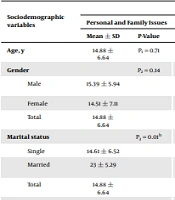
The investigation of the correlations between the components of absenteeism and sociodemographic variables indicated significant correlations between the status of medical sciences in the community with age (P = 0.006), marital status (P = 0.04), and housing occupancy status (P = 0.01). Furthermore, the students' personal and family issues had a significant correlation with their marital status (P = 0.01), while the professors' performance in the class had a significant correlation with the students' grade point average (P = 0.04). Partially significant associations were also observed between the housing occupancy status and components of the students' personal and familial issues (P = 0.06) and professors' performance (P = 0.07) (Table 1).
Table 1.
Mean Components Contributing to Absenteeism in Terms of Sociodemographic Variables a
| Sociodemographic variables | Components of Absenteeism | |||||||
|---|---|---|---|---|---|---|---|---|
| Personal and Family Issues | Issues Concerning Educational Planning | Professors’ Performance in Class | Status of Medical Sciences in Community | |||||
| Mean ± SD | P-Value | Mean ± SD | P-Value | Mean ± SD | P-Value | Mean ± SD | P-Value | |
| Age (year) | 14.88 ± 6.64 | P1 = 0.71 | 17.75 ± 5.47 | P1 = 0.39 | 18.65 ± 7.01 | P1 = 0.18 | 15.19 ± 6.16 | P1 = 0.006 b |
| Gender | P2 = 0.14 | P2 = 0.99 | P2 = 0.70 | P2 = 0.20 | ||||
| Male | 15.39 ± 5.94 | 17.63 ± 5.64 | 18.32 ± 5.66 | 16.09 ± 6.62 | ||||
| Female | 14.51 ± 7.11 | 17.85 ± 5.38 | 18.88 ± 7.86 | 14.54 ± 5.76 | ||||
| Total | 14.88 ± 6.64 | 17.75 ± 5.47 | 18.65 ± 7.01 | 15.19 ± 6.16 | ||||
| Marital status | P2 = 0.01b | P2 = 0.17 | P2 = 0.82 | P2 = 0.04 b | ||||
| Single | 14.61 ± 6.52 | 17.66 ± 5.51 | 18.62 ± 7.07 | 14.99 ± 6.14 | ||||
| Married | 23 ± 5.29 | 20.75 ± 3.09 | 19.50 ± 5.20 | 21.25 ± 2.99 | ||||
| Total | 14.88 ± 6.64 | 17.75 ± 5.47 | 18.65 ± 7.01 | 15.19 ± 6.16 | ||||
| Grade point average | 14.88 ± 6.64 | P3 = 0.29 | 17.75 ± 5.47 | P3 = 0.34 | 18.65 ± 7.01 | P3 = 0.04 b | 15.19 ± 6.16 | P3 = 0.67 |
| Nativity | P2 = 0.32 | P2 = 0.60 | P2 = 0.65 | P2 = 0.11 | ||||
| Native | 14.49 ± 6.09 | 17.72 ± 5.40 | 18.76 ± 7.24 | 14.67 ± 5.79 | ||||
| Non-native | 16.20 ± 8.20 | 17.89 ± 5.78 | 18.25 ± 6.26 | 16.94 ± 7.10 | ||||
| Total | 14.88 ± 6.64 | 17.75 ± 5.47 | 18.65 ± 7.01 | 15.19 ± 6.16 | ||||
| Housing occupancy status | P4 = 0.06 | P4 = 0.33 | P4 = 0.07 | P4 = 0.007 b | ||||
| Dormitory | 16.72 ± 8.09 | 17.69 ± 5.80 | 18.57 ± 6.60 | 16.28 ± 6.53 | ||||
| Personal | 13.52 ± 5.27 | 17.51 ± 5.38 | 18.32 ± 7.49 | 13.86 ± 5.45 | ||||
| Rental | 16.75 ± 6.83 | 19.88 ± 4.56 | 21.40 ± 4.50 | 20.10 ± 6.54 | ||||
| Total | 14.88 ± 6.64 | 17.75 ± 5.47 | 18.65 ± 7.01 | 15.19 ± 6.16 | ||||
| Financial state | P4 = 0.41 | P4 = 0.99 | P4 = 0.75 | P4 = 0.27 | ||||
| Favorable | 15.77 ± 7.56 | 17.96 ± 5.20 | 18.98 ± 6.54 | 14.80 ± 6.59 | ||||
| Average | 14.35 ± 6.17 | 17.66 ± 5.68 | 18.59 ± 7.25 | 15.16 ± 5.93 | ||||
| Poor | 18.33 ± 6.66 | 18 ± 3.61 | 16 ± 7.55 | 21 ± 6.25 | ||||
| Total | 14.88 ± 6.64 | 17.75 ± 5.47 | 18.65 ± 7.01 | 15.19 ± 6.16 | ||||
| Employment | P2 = 0.65 | P2 = 0.34 | P2 = 0.80 | P2=0.67 | ||||
| Yes | 15.50 ± 9.70 | 16.68 ± 6.50 | 17.73 ± 5.91 | 14.55 ± 6.08 | ||||
| No | 14.76 ± 5.95 | 17.96 ± 5.26 | 18.82 ± 7.21 | 15.31 ± 6.20 | ||||
| Total | 14.88 ± 6.64 | 17.75 ± 5.47 | 18.65 ± 7.01 | 15.19 ± 6.16 | ||||
a1, Spearman's correlation-coefficient; 2, Mann-Whitney U test; 3, Pearson's correlation-coefficient; 4, Kruskal-Wallis test.
bSignificance of P ≤ 0.05.
5. Discussion
The findings of the current research demonstrated that among the four components that were assumed to contribute to absenteeism, professors' performance and the issues pertaining to educational planning had the most significant effects on the students' absenteeism, while the students' personal and family issues had the least significant impact on their absenteeism. The majority of the students believed that they could only learn within the first 30 minutes of the class time and envisaged an average professional future. In addition, they admitted to the fact that their interest in their field of study had declined sharply compared to the time of university admission, and they did not feel the need to attend classes for learning, which further emphasized their diminished interest in attending general courses. The students also considered the professors' competence and presentation skills to be the most significant influential factors in the quality of teachers' performance. They also stated that their families were hardly aware of their academic status at the university, expressing no interest in attending the classes on the first two days of the week at 8-10 in the morning of all the weekdays. Consistently, Nabavi et al. investigated the contributing factors to the absenteeism of medical students in Tehran (Iran), reporting that among the four components of absenteeism, professors’ performance and educational planning problems were the most significant factors (2).
In a similar study, Wadesango et al. evaluated the causes of students' absence and the consequences in South African countries, and the findings indicated that the students' disinterest in the lessons, inappropriate teaching strategies, unsuitable learning environment, students' part-time employment, and poor interactions with the professors were the main reasons behind the students' absenteeism. In addition, the mentioned study showed an indirect, negative correlation between the students' absence and their academic performance (12).
The results of the study by Vakili et al. on medical students indicated that 39% of the students cut their class for two hours per each credit of the course, while 22.4% of the students were absent for four hours per each credit of the course, and 38.6% stated that they would never cut the classes, except in emergency situations. In the mentioned research, the students viewed inappropriate teaching methods, lack of sound sleep during the night and its concomitant fatigue and tiredness, and issues of professors’ presentation skills as the most important factors involved in their absenteeism, while disinterest in the field of study was considered to be the least significant contributing factor in this regard (4).
The findings of a study by Hughes revealed the main causes of students' absence in classes to be family problems, appointments with doctors/dentists, disinterest in lessons, and avoidance of assignment submission (11). Among the other influential factors in student absenteeism in the literature are teaching methods, professors' self-confidence, uselessness of the materials presented in classes, low academic level of classes, traditional classroom management, students' non-participation in class activities, and professors' inattention to the attendance of students (4, 9-12).
Contrary to the results of the present study, the study by Hughes et al., which was conducted in the United Kingdom on sophomore nursing students, indicated that the main reasons for students' absence were family issues, appointments with doctors/dentists, disinterest in the subject, and absence/indifference at the time of assignment (11). Furthermore, the research by Jortof et al., which was performed on pharmacy students at the University of Chicago, demonstrated the main reasons for absenteeism to be the low academic level of classes, commuting between the university and home, no presentation of new materials, adherence of professors to textbooks/pamphlets, and class size (13).
Professors could lead students to high aspirations or deprive them of achieving their goals with the appropriate and innovative combination of the elements of the educational system. Therefore, they play a pivotal role in motivating students to attend classes. The conflicting results of the present study with the previous findings in this regard could be due to the differences in the research community, geographical areas, and educational systems.
Our findings indicated significant correlations between the status of medical education as a contributing factor to absenteeism and the variables of age, marital status, and housing occupancy status. Furthermore, such correlations were observed between the personal and family issues of the students (absenteeism component) and marital status, as well as the issues pertaining to the professors' performance and students' grade point average. In this regard, the results obtained by Azmoudeh et al. showed a significant difference between the two genders in terms of the characteristics of the teacher, environment, and students. The field and degree of education were also reported to have significant associations with the influential factors in student attendance (6). Karami et al. also observed significant correlations between the influential factors in the attendance of students and gender variable, as well as the influential factors in their absenteeism and educational degree (7).
The results of the present study could be justified by the fact that the married students and those of the older age often have a broader, more realistic and forward-looking view, which lead them to pay closer attention to their field of study and its career prospects in the future. As such, the correlations between the status of medical education, age, and marital status could be confirmed as married students have more concerns and family issues. We also observed a correlation between the component of personal and family issues and marital status of the students.
Considering that students with a higher GPA put more effort into learning and obtaining higher grades, they also pay more attention to the classes and applied teaching methods, which justifies the association between the issues pertaining to the professors' performance with the GPA of the students in the present study. The discrepancies between the findings in this regard could be attributed to the differences in the influential factors in absenteeism, as well as the research tools and variables.
One of the limitations of our study was the data collection instrument, which was a questionnaire; the students’ problems and causes of absenteeism could have been more comprehensively identified and better solutions could have been put forward if interviews with open-ended questions had been used instead. Therefore, it is suggested that qualitative studies be designed and conducted in the future.
5.1. Conclusion
According to the results, student absenteeism may have multiple causes, while the most important factors were observed to be the issues associated with the performance of the professors in the viewpoint of the students. Therefore, special attention should be paid to this aspect, and it is recommended that professors, educational planners, and policymakers consider the mentioned factors as the main causes of students' absenteeism, so that students would become more willing to attend educational environments and the teaching-learning process would be promoted. Furthermore, free discussion sessions could be implemented to let students freely express their problems, and motivational classes could help solve these problems and motivate students.