
1. Background
Producing science through research is one of the primary missions of every university (1). The role of research in the comprehensive development of society is evident in line with the research policies of our country in knowledge production (2). Therefore, activities aimed to prioritize research at both national and regional levels in Iran by the Supreme Council of Cultural Revolution (3) and the Ministry of Health, treatment, and medical education (4). In recent years, the centers for the study and development of medical science education in educational assistants also deal with the research category in education and the research assistants of the universities (2). The process of determining research priorities in the country has been mainly based on the opinions of executive directors and researchers without the systematic use of study resources or needs assessment. For this reason, this process has not been effective in practice (4). The consequences of this process cause researchers to tend to descriptive, short-term, and taste-based research without considering the needs of society and real priorities (5). On the other hand, research priorities should be determined to optimally use these limited resources due to the severe lack of financial resources in the field of research (6, 7).
Today, four areas for research management in medical sciences are considered: Management and coordination of research activities, determination of research priorities, formulation of strategies and policy making, and information management (8). This work aims to determine research priorities and direct the flow of research toward preferred options. It is necessary to identify the beneficiaries, analyze the existing situation (community health, care, service delivery system, and education and research system in medical sciences), and specify the research topics with one of the agreed methods to set preferences. Qualitative methods such as brainstorming, focus group discussion, Delphi, and quantitative methods such as voting and scoring based on criteria are necessary (9).
Education research is an influencing factor in guiding the educational strategies of institutions due to its capacity to produce knowledge and information about educational subjects. Hence, it is considered the basis of development and improvement activities in educational institutions (10). In the educational institutions of developing countries, which are often in transition, the subject of research in education faces many problems that have caused weakness in the production of thought and cultivation (11). As one of the broadest fields of research in human sciences, educational research has the complex and sensitive task of guiding education (12). Centers for the study and development of medical science education intend to uniquely promote education research, focusing on academic staff members, students, educational programs, and infrastructures (13).
The research committee in education is one of the subsets of the centers for the study and development of medical science education. This committee aims to improve the quality and quantity of educational research by expanding the research culture, targeting educational research, providing research consultations, and providing a platform for educational decisions using the results of practical plans and increasing access to medical education resources in the university (14). The research committee’s goals in education and educational development offices (EDO) of colleges and educational and therapeutic centers are to target research in university education, support researchers, develop the use of applied research results in solving problems and increase community awareness (15). This critical process begins with a logical solution, determining research priorities in educational fields (16). Determining priorities is an essential step in the research management of countries whose importance increases in the conditions of financial and human resource limitations. In addition to guiding the proposed research topics toward priorities, this work provides the context for the targeted use of limited financial resources.
2. Objectives
The present study aimed to determine research priorities in education from the point of view of education officials and experts at Kermanshah University of Medical Sciences.
3. Methods
In this descriptive and qualitative study, the study population was all the key people and experts in education at Kermanshah University of Medical Sciences, Iran, who were identified by the goal-based method (purposive). These people (27 people) included officials of study and education development centers, educational assistants, and officials of education development offices of colleges and hospitals. The need to carry out the plan and its goals were explained and investigated through group discussions and debates by the primary researcher and two colleagues in the form of the research committee in education.
After obtaining the consent, all members were asked to submit the proposed research titles of their sub-category using the Delphi method (classic Delphi: A systematic method for extracting the opinions of a group of experts on a subject or a question) through three stages of correspondence (17). Then, about 105 research titles were collected in the educational needs assessment form. The next stage discussed the criteria for scoring research titles during a meeting. Four criteria were determined: Non-repetition, feasibility, matching the unit’s needs, and effectiveness in improving the quality level of medical education. In the mentioned form, four criteria with a scoring scale between one and four were considered for each section. Thus, the maximum number of points for each subject was 16 points. The proposed titles cover all areas of education related to faculty members, students, and educational programs. At this stage, the needs assessment form, including the proposed research priorities, research areas, and scoring criteria for the priorities, was finalized. In addition, the researchers re-edited the topics mentioned as research priorities. During the next few meetings, the designed form was provided to all the Research in Education Committee members. The members did a ranking of the proposed priorities. The data were analyzed by calculating the score of each section, using descriptive statistics methods (percentage, frequency, and average) scores given in each section were determined. In the next step, the titles were arranged in descending order based on the final score, and 16 final priorities were selected.
4. Results
A needs assessment form was designed to collect suggestions from 27 experts, and the research committee members were rated in education (15 people) to calculate the average points. Among the 105 initially proposed titles, 30 items with a higher average score were selected after removing duplicates and similar items. Then again, 30 issues were presented to the members to prioritize them in order of importance. Finally, 16 cases were determined as the most critical research challenges in university education (Table 1). The priorities were in six fields, including the field of learning (five titles), educational management (four titles), lesson planning (three titles), educational evaluation (two tags), professional ethics (one title), and empowerment (one title).
Table 1.
The Essential Research Challenges in University Education
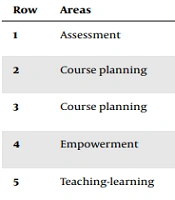
| Row | Areas | Titles of Priorities |
|---|---|---|
| 1 | Assessment | Applying various methods of evaluating students' academic progress (clinical, theoretical, and practical) in face-to-face and virtual education |
| 2 | Course planning | Factors related to the quality and quantity of face-to-face and virtual educational programs (infrastructure, management, human resources, and scientific associations) |
| 3 | Course planning | Suitability of curricula and educational system with educational goals and job needs of learners (the gap between theoretical and practical training) |
| 4 | Empowerment | Factors related to the empowerment and performance of professors in education (virtual education, clinical skills, etc.) and practical improving solutions (educational needs) |
| 5 | Teaching-learning | The effectiveness of different educational methods and learning styles in different educational levels and outpatient and clinical departments |
| 6 | Education management | Challenges related to self-governing campus students and foreign students |
| 7 | Course planning | Supporting academic progress (consulting professors, student counseling, revising programs, tailoring courses) |
| 8 | Ethics | The role of professional ethics, spiritual health, medical commitment, moral values, social responsibility, and ethics rounds in the quality of education and related factors in professors and students |
| 9 | Teaching-learning | The role of the corona pandemic and other inhibiting factors on the teaching-learning system (obstacles and challenges, the platform of practical training in virtual education) |
| 10 | Assessment | The performance and effectiveness of the development offices and the study and development center in promoting creativity, critical thinking, innovation, research, and educational processes of professors and students (the level of knowledge of the professors and students about the development center and its various committees) |
| 11 | Teaching-learning | Investigating interdisciplinary education and using the working group method in education (experiences of students and professors in virtual education, etc.) |
| 12 | Teaching-learning | Motivational factors in interest in different courses (students' mental health, thesis selection, participation, and satisfaction of students) |
| 13 | Teaching-learning | The role of information technology in updating medical education (virtual education and development of tools in education) |
| 14 | Education management | Challenges of management and leadership in educational units (standardization in the admission of academic staff, promotion of the position and rank of academic staff members, and participation in the university's macro decision-making) |
| 15 | Education management | Creating a suitable platform for moving toward third and fourth-generation universities (economics of education, transformation plan in education, and institutionalizing inter-departmental cooperation) |
| 16 | Education management | Factors related to students' motivation and professors' satisfaction (immigration of elites, hope for the future, health, vitality, and happiness among students and professors, professors' motivation and job satisfaction, and graduates' career prospects) |
5. Discussion
The priorities of research in the Center for the Study and Development of Medical Sciences Education of Kermanshah University of Medical Sciences were determined in six areas and 16 topics using the Delphi technique and brainstorming and focus group methods. A prominent characteristic of this study was its reliance on critical people and experts in the field of education and its determination of research priorities involving all stakeholders. Ghodusi Moghadam and Taghian examined the priorities of research in education from the point of view of officials and educational experts of Mashhad University of Medical Sciences in 2013. The results showed that 24 cases were the essential research priorities in educational planning, management, and evaluation in university education. The determined priorities were clinical skills, cost-effectiveness in education, educational planning, outpatient education, professors' performance, students’ educational needs, and teaching and learning methods in medical education. Although these results were generally in line with the results of our study, there were also differences. In this study, the priorities were divided into six areas, and 16 priorities were found to have the necessary points to be included in the list. The selected titles were also different and more comprehensive than this study (18).
Nemati et al. prioritized research topics in the medical education of Gilan University of Medical Sciences using the Delphi method in 2013. The results showed that 89 research titles were placed in six fields (respectively, educational planning 39 titles, educational evaluation 19 titles, faculty members 13, continuing education five, educational management 10, and talented students three titles). Finally, four items were determined in each field, and three items were selected in brilliant talents, totaling 19 titles. This study had similarities and differences with the current results, the number of areas was 6, and two areas of continuous education and brilliant talents were among their innovations, which were not addressed in the current study. In other areas, there were similarities with the titles of the results. In this research, the innovation prioritized moral discussions as hope for the future and issues related to elite immigration (19).
In other cases, most of the studies and works in this field are located on the sites of study centers of medical sciences universities. The importance of recognizing these priorities is determined by the region and type of university, taking into account the differences in these priorities:
Kashan University of Medical Sciences has eight areas, including educational planning and responsive education (24 titles), virtual education (13 titles), educational evaluation (25 titles), educational leadership and management (ten titles), and professional ethics (nine titles), the economics of education (four titles), third generation university (four titles), and transformation and innovation plan in medical science education (12 titles). New areas such as responsive education, education economy, and third-generation university differed from our results, but the rest of the areas, such as professional ethics, evaluation, and educational management, were similar to the present study (20).
Arak University of Medical Sciences has ten fields, including virtual education fields (ten titles), educational planning (four titles), educational evaluation field (five titles), faculty members (five titles), educational management and culture (four titles), students and brilliant talents (three titles), responsive education (nine titles), educational management and leadership (five titles), professional ethics (five titles), evaluation and educational planning (nine titles), third generation university (eight titles), and economics of education (two titles). The results were similar to Kashan's and differed from the present study regarding the number of fields and titles. Things like the economics of education, responsive education, and cultural issues were beyond the present study, which is significant (21). Some universities also used other titles for committees and priorities. For example, Isfahan University of Medical Sciences presented priorities through innovative education plans and introduced six areas. Compiling and revising educational programs (three titles), teaching and learning (four titles), educational evaluation (students, faculty, and program) (five titles), educational management and leadership (three titles), e-learning (four titles) and design and production of educational products (two titles) were introduced, which were utterly different from the present study regarding form (22). At Mashhad University of Medical Sciences, research priorities in education include 15 titles, similar to the present study. This university was different in terms of the economics of education, artificial intelligence in education, production of educational aid products, and revision of curricula (23).
At Shahid Beheshti University of Medical Sciences, the priorities are in four areas, including ethical challenges in medicine (ten priorities), structural improvement of the medical science education content (nine priorities), virtual education, and internationalization of medical science education (nine priorities), and classified mission and authority in medical education (ten priorities). These priorities have been rated according to capacity and wealth production indicators, morality, responsive and justice-oriented education, and expanding the boundaries of knowledge and foresight. The layout is similar to Isfahan University's, which is innovative in presenting scientific authority, wealth generation, and responsive education (24). Ardabil University prepared priorities in seven areas of the curriculum: Planning, student evaluation, course and faculty evaluation, educational management and leadership, student counseling, and support, teaching and learning, and e-learning. Each area includes some sub-areas and specific priorities of that area. Teaching-learning and electronic learning have been considered separately, as well as counseling and student support. These results were consistent with those of the present study (25).
5.1. Conclusions
Using the opinions of educational experts made education priorities at the education of Kermanshah University of Medical Sciences comprehensive, and many educational problems and issues were clarified for researchers.