
1. Background
Today, experts believe that one of the key reasons for the development of advanced countries is the attention and effort these countries put into training creative and effective individuals (1). In other words, the cultural, economic, and social progress of any country depends on the training of expert forces, leading to scientific growth and increased awareness among the population. Therefore, improving the quality of the educational system is considered the most effective factor in a country's development (2). Students are the chosen workforce and future builders of a country, with their academic success being a primary goal of educational programs (1). However, students often experience high levels of stress due to factors such as being away from family, entering large and tense groups, economic problems, a heavy course load, and intense competition (3). According to the Student Health Association in America, the first two weeks of university are a critical time for students to adapt (4). A lack of preparation in critical situations can lead to panic, conflict, or avoidance (5). In addition to general stress factors, medical students face unique challenges such as physical and mental pressures, dealing with patient issues, special clinical training, and the risk of contracting infections such as AIDS and hepatitis (6). Every year, a significant number of medical science students are suspended, drop out, or fail to complete their studies on time (7). Depression is characterized by feelings of discouragement, sadness, hopelessness, lack of motivation, or indifference towards life (8). Factors such as unfamiliarity with the university environment, cultural differences for nonnative students, separation from family, lack of interest in the field of study, and interpersonal conflicts can lead to depression and negatively impact student performance (9, 10). Research has shown that high levels of stress in students can impair their thinking process, problem-solving abilities, sleep patterns, and decision-making skills (11). Studies on medical sciences students have indicated high stress levels (12). University environments can be stressful for students as they navigate different cultures and beliefs, transitioning from private family settings to public ones (13). The shift from high school to university marks a challenging period of academic demands and separation from family, with the first year of university often being the most stressful (14). Identifying sources of stress in students can help mitigate these factors, enhance their adaptability, and create a conducive learning environment (15). Crisis management and support are crucial factors in alleviating stress (16). There remains a critical gap in targeted interventions; crisis management training offers a promising mechanism to enhance adaptability and mitigate these factors, yet its specific impact on reducing stress, anxiety, and depression levels among first-semester students has been underexplored.
2. Objectives
Given the prevalence of stress and anxiety among first-semester students and its negative impact on their physical, mental, and academic well-being, this study aimed to explore the effects of university entrance crisis management training on stress, anxiety, and depression levels in undergraduate students.
3. Methods
3.1. Study Design and Participants
This study was an experimental intervention conducted on two groups, an intervention group and a control group, at three different time points: Before, immediately after, and one month post-intervention. The statistical population for this research included all first-semester students (80 individuals) in nursing, midwifery, and paramedicine at Rafsanjan University of Medical Sciences. Sampling was performed through random minimisation, and the students were divided into two groups: Control and intervention. The inclusion criteria consisted of willingness to participate, being aged 18 - 25 years, having good hearing and vision, experiencing mild to high levels of anxiety, stress, and depression, no prior crisis management training, no drug addiction, no use of psychoactive drugs, no diagnosed mental illness, first-time university entry, ongoing undergraduate status, and no recent acute issues in the past 6 months. The criteria for study withdrawal included student dropout, transfer to another university, the use of certain medications, experiencing a new crisis or acute stress, and an unwillingness to continue.
3.2. Data Analysis
The sample size was calculated using the statistical formula ( ) α = 0.05, β = 10%, d = 4, σ = 5.4, n = 38.3 (17). In the sample size formula, α = 0.05 denotes the Type I error rate (significance level), reflecting a 5% probability of erroneously rejecting the null hypothesis; β = 0.10 indicates the Type II error rate, corresponding to 90% statistical power (1 – β); σ = 5.4 represents the estimated population standard deviation of the primary outcome variable; and d = 4 denotes the minimum detectable effect size (or clinically meaningful difference) between the intervention and control groups on the primary outcome measure. The estimated number of participants in each group was 38.3, which was rounded to 40 due to potential exclusions.
3.3. Research Measurements
The data collection tool was a questionnaire consisting of two parts: A personal information section and the Depression, Anxiety, and Stress Scale-21 (DASS-21) questionnaire. The DASS-21 assesses depression, anxiety, and stress levels, with scores ranging from 0 (lowest) to 3 (highest) for each question. This questionnaire contains 21 questions in three subscales: Depression, anxiety, and stress (Table 1). The validity and reliability of this questionnaire in Iran were confirmed by Samani and Joukar (18).
Table 1.
The Minimum and Maximum Scores for Each Subscale of the DASS-21 Questionnaire, Along with Corresponding Severity Levels
| Severity Level | Depression | Anxiety | Stress |
|---|---|---|---|
| Normal | 0 - 9 | 0 - 7 | 0 - 14 |
| Mild | 10 - 13 | 8 - 9 | 15 - 18 |
| Moderate | 14 - 20 | 10 - 14 | 19 - 25 |
| Severe | 21 - 27 | 15 - 19 | 26 - 33 |
| Extremely severe | 28+ | 20+ | 34+ |
3.4. Data Collection
After obtaining permission and ethical approval (IR.RUMS.REC.1398.109), the researcher visited the faculty members to conduct the study. Students were selected based on their levels of stress, anxiety, and depression measured through the Depression, Anxiety, and Stress Scale-21 (DASS-21) questionnaire. Those with mild to high levels of anxiety, stress, and depression were randomly chosen (Table 1). Crisis management training was delivered by a psychologist to the intervention group in four weekly sessions (each lasting 1.5 hours), whereas the control group received no intervention and participated only in a neutral orientation session introducing the academic discipline, accompanied by a nature walk. Educational goals for each session were outlined, focusing on interpersonal communication, anxiety management, depression control, and stress management. The educational objectives for each session were as follows: Session 1 focused on interpersonal communication, including interactions with students, peers, and staff, as well as familiarization with university rules and regulations. Session 2 addressed anxiety control and management by introducing self-regulation techniques to alleviate anxiety, increasing self-awareness to identify and challenge threat-related beliefs, and encouraging the search for evidence to support less threatening appraisals of stressful situations. Session 3 centered on depression control and management, employing self-regulation exercises to enhance awareness of situational triggers and the thoughts associated with depression, anxiety, or anger, thereby aiming to prevent their onset. Session 4 involved education on stress and coping strategies, with an emphasis on recognizing stress symptoms, identifying stress-inducing factors, learning effective coping mechanisms, and understanding the relationship between stress and performance. Additionally, an orientation tour was organized to acquaint participants with the physical environment, cultural context, and geography of the medical sciences faculties, as well as the broader urban setting of Rafsanjan. The questionnaires were administered immediately after and one month after the intervention in both groups. The researcher-maintained contact with participants throughout the study period and provided a phone number for any questions or concerns.
4. Results
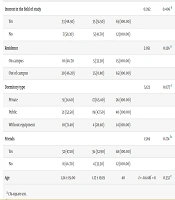
The demographic findings showed that most of the participants in both groups were female, single, had an average economic status, and were interested in their field of study. The differences in all demographic characteristics were not statistically significant (Table 2).
Table 2.
Comparison of the Absolute and Relative Frequency Distributions of the Studied Groups According to Demographic Characteristics
| Variables | Innervation Group | Control Group | Sum | X2 | P-Value |
|---|---|---|---|---|---|
| Sex | 0.228 | 0.406 a | |||
| Male | 14 (53.80) | 12 (46.29) | 26 (32.50) | ||
| Female | 26 (48.10) | 28 (51.90) | 54 (67.50) | ||
| Financial ability | 0.346 | 0.406 a | |||
| Yes | 34 (51.50) | 32 (48.50) | 66 (100.00) | ||
| No | 6 (42.90) | 8 (57.10) | 14 (100.00) | ||
| Habitat | 2.051 | 0.406 a | |||
| Native | 10 (66.70) | 5 (33.30) | 15 (100.00) | ||
| Nonnative | 30 (46.20) | 35 (53.80) | 65 (100.00) | ||
| Interest in the field of study | 0.392 | 0.406 a | |||
| Yes | 33 (48.50) | 35 (51.50) | 65 (100.00) | ||
| No | 7 (58.30) | 5 (41.70) | 12 (100.00) | ||
| Residence | 2.051 | 0.126 a | |||
| On campus | 10 (66.70 | 5 (33.30) | 15 (100.00) | ||
| Out of campus | 30 (46.20) | 35 (0.80) | 65 (100.00) | ||
| Dormitory type | 5.123 | 0.077 a | |||
| Private | 9 (34.60) | 17 (65.40) | 26 (100.00) | ||
| Public | 21 (52.50) | 19 (47.50) | 40 (100.00) | ||
| Without equipment | 10 (71.40) | 4 (28.60) | 14 (100.00) | ||
| Friends | 1.569 | 0.174 b | |||
| Yes | 32 (47.10) | 36 (52.90) | 68 (100.00) | ||
| No | 8 (66.70) | 4 (33.30) | 12 (100.00) | ||
| Age | 1.24 ± 19.00 | 1.17 ± 19.19 | 40 | t = -0.648; f = 8 | 0.332 c |
a Chi-square test.
b Fisher’s exact test.
c Independent t-test.
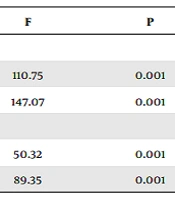
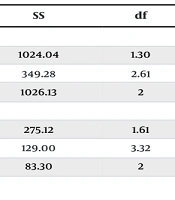
In Table 3, to investigate the impact of time, group, and the interaction between time and group on stress, anxiety, and depression scores, a two-way repeated-measures ANOVA was conducted. Mauchly's test of sphericity indicated a rejection of the assumption of sphericity (P < 0.001), leading to the use of the Greenhouse-Geisser correction coefficient for reporting the P value. The multivariate test revealed a significant interaction effect between time and group (P < 0.001) and a statistically significant effect of time (P < 0.001). The between-subject effect test demonstrated a significant group effect (P = 0.001). Statistical modelling was then employed to delve more deeply into the interaction between time and group, enabling a detailed analysis of changes in stress, anxiety, and depression scores across different groups and time points, allowing for comparisons. No errors were detected.
Table 3.
The Average Stress, Anxiety, and Depression Scores of People in the Two Intervention and Control Groups in the Three Stages Before, Immediately After, and one Month After the Intervention
| Variables and Time of Intervention | Intervention | Counter | Two-Way Repeated Measures ANOVA | ||||||
|---|---|---|---|---|---|---|---|---|---|
| The Source of Variation | The Sum of Squares | The Mean of the Squares | Degrees of Freedom | F | Effect Size | P-Value | |||
| Stress | |||||||||
| Before | 19.50 ± 50.32 | 17.40 ± 57.23 | Time | 627.700 | 427.516 | 1.468 | 53.276 | 0.406 | < 0.0001 |
| After | 13.60 ± 97.32 | 17.40 ± 35.19 | Time * group | 526.633 | 358.681 | 1.468 | 44.698 | 0.364 | < 0.0001 |
| One month after | 11.60 ± 62.53 | 17.40 ± 25.13 | |||||||
| Anxiety | |||||||||
| Before | 12.50 ± 70.13 | 10.50 ± 70.59 | Time | 256.525 | 176.483 | 1.454 | 27.123 | 0.258 | < 0.0001 |
| After | 8.40 ± 35.50 | 11.50 ± 20.41 | Time * group | 470.425 | 323.642 | 1.454 | 49.739 | 0.389 | < 0.0001 |
| One month after | 7.40 ± 32.00 | 11.50 ± 62.16 | |||||||
| Depression | |||||||||
| Before | 16.60 ± 40.50 | 14.40 ± 57.55 | Time | 423.358 | 323.307 | 1.309 | 31.798 | 0.290 | < 0.0001 |
| After | 11.40 ± 50.43 | 14.50 ± 85.19 | Group | 579.825 | 442.902 | 1.309 | 43.560 | 0.358 | < 0.0001 |
| One month after | 9.60 ± 55.41 | 15.50 ± 15.49 | |||||||
Significant differences were observed pre-intervention, immediately post-intervention, and at the one-month follow-up (P < 0.001). The interaction effect between time and group was also notable (P < 0.001), indicating a more substantial decrease in stress, anxiety, and depression scores in the intervention group than in the control group. The educational intervention effectively lowered stress, anxiety, and depression levels among students. Group effects on research variable scores were also significant, highlighting consistent differences in average scores between the intervention and control groups regardless of the measurement time (P < 0.001).
Table 4.
Results of Pairwise Comparisons of the Mean Changes and Standard Errors of Stress, Anxiety, and Depression According to Time in the Intervention and Control Groups
| Group and Time | Mean ± SD | Bonferroni P-Value |
|---|---|---|
| Stress | ||
| Intervention | ||
| Immediately and before | 5.00 ± 7.54 | < 0.0001 |
| One month later and before | 7.00 ± 42.66 | < 0.0001 |
| Immediately and one month later | 2.00 ± 35.37 | < 0.0001 |
| Control | ||
| Immediately and before | 0.00 ± 22.54 | 1.000 |
| One month later and before | 0.00 ± 32.66 | 1.000 |
| Immediately and one month later | 0.00 ± 1.37 | 1.000 |
| Anxiety | ||
| Intervention | ||
| Immediately and before | 4.00 ± 35.47 | < 0.0001 |
| One month later and before | 5.00 ± 70.60 | < 0.0001 |
| Immediately and one month later | 1.00 ± 35.33 | < 0.0001 |
| Control | ||
| Immediately and before | 0.00 ± 50.47 | 0.897 |
| One month later, and before | 0.00 ± 92.60 | 0.391 |
| Immediately and one month later | 0.00 ± 42.33 | 0.642 |
| Depresstion | ||
| Intervention | ||
| Immediately and before | 4.00 ± 90.66 | < 0.0001 |
| One month later, and before | 6.00 ± 85.66 | < 0.0001 |
| Immediately and one month later | 1.00 ± 95.30 | < 0.0001 |
| Control | ||
| Immediately and before | 0.00 ± 27.66 | 1.000 |
| One month later, and before | 0.00 ± 57.68 | 1.000 |
| Immediately and one month later | 0.00 ± 30.30 | 0.975 |
Table 4 displays a notable difference in the interaction between depression scores and groups at various times for the intervention group. The average depression score before and after the intervention was significantly different (P < 0.00001). There was a significant difference between the scores before the intervention and one month after the intervention (P < 0.00001) and between the scores after the intervention and one month after the intervention (P < 0.00001). However, there was no significant difference in the control group at any point (P = 1). Similarly, there was a significant difference in the interaction effect between anxiety score and group at different times for the intervention group. The average anxiety scores before and after the intervention were significantly different (P < 0.00001), as were the scores before the intervention and one month after the intervention (P < 0.00001), and after the intervention and one month after the intervention (P < 0.00001). Once again, there was no significant difference in the control group at any time. Moreover, there was a significant difference in the interaction effect between stress score and group at different times for the intervention group. The average stress scores before and after the intervention were significantly different (P < 0.00001), as were those before the intervention and one month after the intervention (P < 0.001), and after the intervention and one month after the intervention (P < 0.00001). However, there was no significant difference in the control group at any time (P = 1).
5. Discussion
Students play a crucial role in shaping the future of the nation, with academic success being a key goal of education. However, academia can also present challenges to mental well-being, such as adjusting to university culture, feeling homesick, a lack of interest in studies, and social conflicts. All of these issues can lead to problems such as depression that can impact performance. Teaching ways to cope can help students feel better, perform better, and have a more positive self-image. A study conducted at Rafsanjan University of Medical Sciences aimed to help new students deal with stress and anxiety. This study analysed the impact of crisis management training on stress, anxiety, and depression levels. The results showed a significant decrease in stress scores after the intervention. This finding aligns with previous research suggesting that promoting an understanding of crisis management can have a positive effect on mental health (19). Interventions such as cognitive-behavioral therapy, coping skills training, and social support have been effective in reducing stress and anxiety in students (20). Crisis management training helps individuals recognize threats, seize opportunities, and solve problems, which ultimately lowers anxiety levels (21). Depression counselling notably increased self-confidence and comfort levels among students. Research on crisis interventions has shown their positive impact on alleviating posttraumatic stress symptoms (22). Lee E and Lee H (23) and Yazdani et al. (24) conducted a study on reducing stress levels in students through training. The results showed that students experienced a significant decrease in stress levels after the intervention. Crises can cause stress, anxiety, and depression in those affected, disrupting their normal state. However, with proper training in managing and simulating critical events, individuals can adapt and reduce stress levels during crises (25). The results of the study show a notable disparity in the average anxiety scores of the intervention group before, immediately after, and one month after the intervention. Song et al. (2014) (26) conducted a study that demonstrated how mindfulness-based stress reduction (MBSR) effectively reduced depression, anxiety, and stress. Moreover, according to Yusufov et al. (27), cognitive-behavioral therapy, coping strategies, and social support interventions were successful in decreasing stress and anxiety levels among students. The latest research supports these findings. Learning crisis management enables individuals to identify threats and opportunities, resulting in decreased anxiety levels as they tackle crisis-related challenges.
5.1. Conclusions
Overall, the results of this study demonstrate that crisis management training significantly improved the levels of stress, anxiety, and depression among undergraduate students at Rafsanjan University of Medical Sciences. This positive impact was observed immediately after the training and continued one month later. Despite its limitations, crisis management training for new university students not only reduces feelings of depression, stress, and anxiety but also helps identify students who may be at risk. Therefore, we recommend that educational institutions incorporate this practical and beneficial training for students and seriously consider it in their higher education policies. Introducing this type of practical and effective training would be advantageous for students.
This study had several limitations. The control group received only one session on orientation to the academic discipline, which disrupted the balance of exposure between groups and may attribute the observed effects to attention rather than the intervention itself. Furthermore, the absence of blinding for participants, the researcher, and the data analyst could introduce bias. The outcomes were also based on self-report measures, which possess limited sensitivity and objectivity.