


1. Background
Educational psychologists have classified teaching and learning activities into three domains: "Cognitive", "Affective", and "Psychomotor". In 1956, Benjamin Bloom first presented a classification in the cognitive domain, proposing six different levels: (1) Remembering (knowledge); (2) understanding (comprehension); (3) application (utilization); (4) analysis; (5) synthesis, and (6) evaluation. Following Bloom, David Krathwohl et al. focused on the affective domain, which relates to interests, attitudes, and feelings. Another psychologist, Anita Harrow, developed the psychomotor domain, which deals with practical and psychomotor skills.
In 2001, a group of psychologists revised Bloom’s proposed six classes as follows: (1) Remembering; (2) understanding; (3) application; (4) analysis and synthesis; (5) evaluation, and (6) creation (2). This classification is used in designing various exam tests, including MCQs (3). In medical sciences, Bloom’s cognitive categories have been divided into the following three taxonomies (4-11). Medical students need to enhance their skills in these three areas to learn and practice patient management (8, 10). Some verbs used for patient management in these three categories include: "Reminding", "Interpreting", and "Problem-solving" (Table 1) (5).
Table 1.Some Verbs Are Used for Patient Management in Three Categories
| Remembering (Recall) | Thinking Process Verbs | Problem-Solving |
|---|---|---|
| Remembering the following points: Definitions; facts, contents, concepts, themes and rules; causes and pathogenesis; epidemiological points; risk factors; facilitating factors; signs and symptoms; ways of diagnosis; diagnosis and differential diagnoses; treatment methods include: Drug therapy, knowledge of pharmacology, non-pharmacological treatments, psychotherapy, surgical approaches, herbal therapy, approved alternative medicine; prevention and control ways; follow-up tips; prognosis and etc. | Analysis; calculate; categorization; choosing; comparing; comprehension; conclusion; connecting; criticizing; decision-making; deduction; description; determining; diagnosis; differentiation; discovering; estimate; evaluation; exemplification; find out; imagine; integration; interpretation; judgment; notice; perceive; presumption; prioritization; reasoning; recognizing; reflection; understanding and etc. | Patient management (targeting, designing, planning, implementing, monitoring, and supervising treatment and care measures), including: Prescribing/medication (drug therapy); using modalities of psychotherapy; surgery; the other invasive interventions; blood transfusion; rehabilitation interventions; using approved complementary/alternative medicine; adjust calories and diet; patient education; skill training; follow-up; counseling; creation and innovation in the field of interventions and etc. |
The triple taxonomy technique (TTT) includes the following six parts:
- Part 1: A short case (an educational piece/bit or slice) designed around a health problem or a disease.
- Part 2: A set of 10 to 20 questions characterized by blank spaces and "dotted lines". These questions are designed in three categories: "recalling", "interpretation/analysis", and "problem-solving".
- Part 3: A number of options, including correct, incorrect, irrelevant, or conflicting options, are placed in a box below the case stem.
- Part 4: Answers (providing answers to the questions by filling in the blanks).
- Part 5: Explanation and discussion. This description is for feedback to the audience on: (A) where they should recall the relevant subjects and use their memory; (B) where they should think, interpret, analyze, criticize, explain, reason, and conclude; (C) finally, according to the conditions, what intervention(s) they should choose to solve the problem.
The unique value of the TTT lies not only in its structured six-part case design but, more importantly, in its explicit pedagogical focus: Enabling the simultaneous engagement of students in recall, interpretation, and clinical problem-solving. This tri-level integration differentiates TTT from traditional case-based or problem-based learning, which often address these cognitive domains in isolation.
Bloom’s taxonomy has served as a foundational framework in medical education for structuring cognitive objectives. However, many conventional methods, such as lectures or basic case-based learning (CBL), often address these domains sequentially or partially, limiting their impact on deeper clinical reasoning. The TTT was developed to address this pedagogical gap by allowing simultaneous assessment and reinforcement of knowledge recall, data interpretation, and clinical problem-solving in a single integrated format.
2. Objectives
The main purpose of this study is to evaluate the TTT method on components and activities related to the patient management process from the students’ perspectives.
3. Methods
In this cross-sectional descriptive study, we designed several clinical case scenarios using the TTT and used them to teach 512 medical students during two academic years (from 2022 to 2024). The initial required sample size was calculated as 642 using the G*Power 3.1 software, based on expected effect sizes, significance level (α = 0.05), and desired statistical power (1-β = 0.80). However, due to practical limitations such as student availability and participation rates, the final sample included 512 students. Nonetheless, this sample size exceeds the minimum required number (approximately 218) calculated using Cochran’s formula with a 95% confidence level and 5% margin of error, thus maintaining adequate statistical power for the analyses.
In the first stage (case design), each clinical scenario was designed to contain 10 to 20 questions, based on the complexity of the topic and the need to adequately cover all three cognitive levels of Bloom’s taxonomy: Recall, interpretation, and problem-solving. This range was chosen to ensure balanced cognitive engagement without causing overload. To address cognitive load concerns, a pilot test of two sample cases was conducted among a group of 20 medical students. Their feedback confirmed that the case length was appropriate and did not lead to mental fatigue or disengagement.
The work progress method was as follows:
- Teaching a subject based on the curriculum.
- Providing a short introduction to the TTT to students.
- Presenting a pre-designed case (a replacement test technique) related to the lesson in TTT format.
- Asking students to think about the questions for 10 to 15 minutes, depending on the complexity of the case, and fill in the blanks using the given options.
- Providing feedback on the components of the case in the three categories of "Remembering", "Interpretation", and "Problem-Solving" by the teacher.
- After this individual exercise, students were given a quick response code (QR code) to access an electronic questionnaire and asked about the effectiveness of this method on their learning.
We used the websites “Porsline.ir” to design the electronic questionnaire and “B2n.ir” to prepare the QR code. To evaluate the face validity of the questionnaire, 10 experts from community medicine, internal medicine, medical education, social factors of health, and infectious diseases were asked to study the items to evaluate the readability, comprehensibility, and clarity of the items. Additionally, to ensure the appropriateness of the instrument for the studied population, 20 medical students read the draft of the questionnaire and evaluated the clarity, readability, and wording of this instrument. The internal consistency of the questionnaire was high, with a Cronbach’s alpha of 0.95. To ensure reliability across cognitive dimensions, subscale analyses were conducted, yielding the following results: Recall: α = 0.91, interpretation: α = 0.89, and problem-solving: α = 0.93.
The study variables included evaluating the effectiveness of using the TTT method in strengthening the thinking process, understanding concepts, interpreting data, analyzing data, calculating, clinical reasoning, diagnosis, choosing treatment methods, and solving patients’ problems from the students’ points of view. No missing data were present in this study. The online questionnaire was designed on the Porsline.ir platform in a way that submission was only possible after answering all required questions. Therefore, only complete responses were collected and analyzed.
Data were analyzed using SPSS version 27, with descriptive statistics and confidence intervals set at 95%. Where appropriate, chi-square tests were applied to explore differences by gender and types of medical students. The study was approved by the Ethics Committee of Islamic Azad University, Tehran Medical Sciences Branch.
4. Results
A total of 512 medical students participated in this study, with 43.75% (n = 224) being men and 56.25% (n = 288) being women. Among them, 50.6% (n = 259) were in the internship phase, and 49.4% (n = 253) were in pre-internship courses. The distribution of case fields was as follows: 15.4% COVID-19 and Influenza, 41.6% vaccination, and 43% patient safety.
The summary of the students’ opinions was as follows:
- This method was new and interesting for 92.6% of the students.
- More than 90% of students agreed with the following: This case-oriented technique is practical and applicable, and it assesses memory, comprehension, interpretation, and problem-solving abilities simultaneously. It leads to receiving diverse information about the subject and strengthens permanent learning and the ability to analyze, compare, criticize, make clinical judgments, and reason clinically; it also increases the audience's problem-solving power.
Regarding the results, refer to Table 2. The sum of negative and neutral opinions exceeded 30% only in the case of three items: Six (fairness of scoring), 10 (reducing the possibility of fraud), and 11 (lack of additional information) (Table 3 and Figure 1).
Table 3.The Numbers and Percentages of Students’ Opinions, Agreeing with the Positive Educational Effects of Triple Taxonomy Technique
| Variables | No. (%) |
|---|---|
| Positive vs. negative and neutral opinions | |
| It is a practical method | 487 (95.2) |
| It introduces real cases to us | 494 (96.5) |
| In the feedback section, it provides a lot of information | 479 (93.6) |
| It is a new approach | 474 (92.6) |
| It is an interesting method | 474 (92.6) |
| It is effective in the learning process | 482 (94.2) |
| The answers are based on evidences | 451 (88.2) |
| It improves the following abilities | |
| Remembering relevant contents | 485 (94.9) |
| Critical thinking (criticizing) | 462 (90.4) |
| Analysis | 485 (94.9) |
| Compare of concepts | 485 (94.9) |
| Clinical reasoning and judgment | 477 (93.3) |
| Diagnosis | 459 (89.8) |
| Selection best treatment | 433 (84.7) |
| Decision making | 467 (91.4) |
| Problem-solving | 476 (93) |
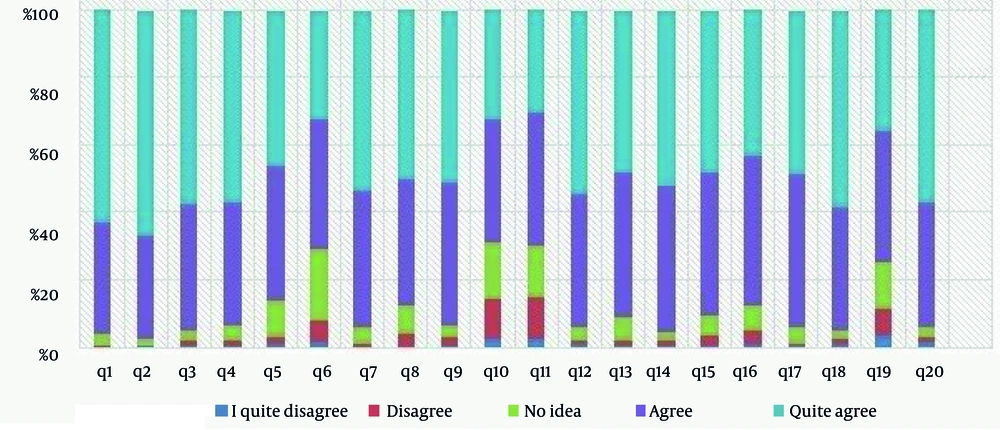
Figure 1.
Frequency of answers to questions 1 to 20
The chi-square test showed a statistically significant relationship between the students’ answers to all 20 questions and the academic stage of the medical student (student or intern) and their gender (Table 4). Complete agreement with the items was more prevalent among students than interns and among females more than males (P < 0.001).
Table 4.The Relationship Between the Items that Must be Observed in the Design of the Questions and the Variables Under Study a
| Row | Questions | Negative and Neutral | Positive | P-Value b | ||||||
|---|---|---|---|---|---|---|---|---|---|---|
| F | M | I | S | F | M | I | S | |||
| 1 | With this training technique, the power of remembering, and all abilities of understanding, interpreting, and solving problems will be measured "together". | 0 | 8.9 | 7.7 | 0 | 100 | 91.10 | 92.2 | 100 | ≤ 0.001 |
| 2 | Due to the case-oriented and practical nature of these exercises, the contents are remembered more by the audience. | 7 | 4.9 | 4.3 | 0.8 | 99.3 | 95.1 | 95.70 | 99.2 | |
| 3 | The exercises are completely practical. | 0 | 10.2 | 8.9 | 1.6 | 98.6 | 89.7 | 91.10 | 98.4 | |
| 4 | Conflicting options make the audience more able to "decide". | 1.4 | 13.8 | 12.0 | 1.6 | 98.6 | 86.1 | 88.0 | 98.4 | |
| 5 | These practical cases have the capability to adapt to the subjects included in the curriculum. | 5.9 | 24.6 | 21.2 | 6.7 | 94.1 | 75.4 | 78.8 | 93.3 | |
| 6 | The scoring of these exercises is fair due to flexibility. | 14.3 | 48.2 | 41.7 | 16.2 | 85.7 | 51.8 | 58.3 | 83.80 | |
| 7 | These exercises are accompanied by feedback from the teacher, and students receive a lot of information at this stage. | 2.4 | 11.2 | 12.0 | 0.4 | 97.6 | 88.8 | 88.0 | 99.6 | |
| 8 | Answers are designed based on scientific evidence. | 7.6 | 18.3 | 23.90 | 0.4 | 92.3 | 81.7 | 76.10 | 99.6 | |
| 9 | Such exercises can be used both in student teaching and evaluating. | 5.5 | 8.0 | 11.1 | 2.0 | 94.5 | 92.0 | 88.80 | 98.0 | |
| 10 | If these exercises are used, the possibility of cheating is reduced. | 25.7 | 38.4 | 33.2 | 29.20 | 74.3 | 61.6 | 66.8 | 70.70 | |
| 11 | These exercises do not contain additional information. | 26.4 | 35.7 | 30.9 | 30.0 | 73.6 | 64.3 | 69.1 | 70.0 | |
| 12 | They strengthen judgment and clinical reasoning ability in students. | 3.4 | 10.3 | 10.80 | 2.0 | 96.5 | 89.7 | 89.20 | 98.0 | |
| 13 | They strengthen the audience’s ability to criticize. | 3.8 | 16.1 | 15.10 | 3.6 | 96.20 | 83.9 | 84.9 | 96.8 | |
| 14 | They increase the ability to analyze issues and compare cases with each other in the audience. | 3.5 | 6.7 | 8.1 | 1.6 | 96.6 | 93.3 | 91.9 | 98.4 | |
| 15 | They increase the ability to diagnose diseases in the audiences. | 6.6 | 13.4 | 15.50 | 3.6 | 93.4 | 86.6 | 84.5 | 96.4 | |
| 16 | They increase the ability to choose the best treatment for the patient. | 9.0 | 16.5 | 14.3 | 10.2 | 91.0 | 83.5 | 85.7 | 89.8 | |
| 17 | They increase the ability to solve problems in the audience. | 2.40 | 11.2 | 10.5 | 2.0 | 97.60 | 88.8 | 89.5 | 98.0 | |
| 18 | If they are used in teaching sessions, they have a noticeable effect on students’ learning. | 1.7 | 9.8 | 8.5 | 2.0 | 94.3 | 90.2 | 91.5 | 98.0 | |
| 19 | It will be useful for evaluating the audiences. | 14.60 | 39.3 | 42.1 | 8.30 | 85.4 | 60.7 | 57.9 | 91.70 | |
| 20 | Overall, this teaching method is new and interesting for me. | 2.8 | 10.3 | 8.9 | 3.2 | 97.2 | 89.70 | 91.10 | 96.8 | |
a Values are expressed as percent.
b Correlation is significant at 0.01 levels.
5. Discussion
Clinical teaching is essential for the continuity of education of healthcare professionals. Developing teaching skills is highly required to communicate efficiently and transfer experience and knowledge to others (12). Diagnostic error is a critical patient safety issue that can be addressed in part through teaching clinical reasoning. Medical schools with clinical reasoning curricula tend to emphasize general reasoning concepts (e.g., differential diagnosis generation) (13). The CBL is a widely used and important method to improve student engagement, understanding of concepts, enhancement of learning motivation, critical and analytical thinking, clinical and reflective judgment, problem-solving, and teamwork (14-17).
In this study, we investigated several educational indicators in a case-based approach, such as applicability, interestingness, and being based on evidence, as well as skills resulting from this approach, such as analytical and critical thinking, interpretation, comparison, reasoning, clinical judgment, diagnosis, decision-making, choosing the best treatment, and problem-solving. In this study, students’ acceptance of the presented method was unique and promising (more than 92%). Between 84% and 96% of the students stated that TTT is a new, interesting, and practical method that improves their learning ability, proper use of knowledge, critical thinking, analysis, comparison of concepts, clinical reasoning, diagnosis, choosing the best therapeutic modality, decision-making, and solving patients’ problems.
In our sample, there was a statistically significant difference in the answers of students based on gender and educational level; however, the sensitivity analysis showed that these variables did not affect our overall results. According to Montane et al.’s study, the academic year was not an effective variable on medical students’ opinions about their learning process during their academic years (18). The results of Alghamdi et al.’s study showed no difference between male and female students regarding the importance of the methods used in teaching anatomy, and both agreed that in teaching anatomy, cadaver dissection helps to deeply understand the human body. In general, women considered cadaver dissection as a help to acquire clinical skills and men as a help in recognizing anatomical diversity (19). However, the possibility should also be taken into account that maybe the cause of this difference is some kind of avoidance of giving a negative opinion in female and less experienced students in our sample.
Using students’ opinions is a suitable and logical way to evaluate educational methods. They have a lot of motivation to improve learning processes and make necessary changes. They demanded innovative teaching methods to improve and advance the learning process in medical courses (18). Fernandez-Rodriguez et al. pointed out that health includes the broad concept of physical, mental, and social well-being, as well as the ability to function properly in the environment and the ability to take actions to protect and promote one’s health. So with this point of view, in the initial training of doctors, attention should be paid to issues beyond ensuring the physical health of patients. According to the results of their study, only using lectures is a very inappropriate educational method to increase and improve the necessary professional skills in modern health systems (20). Aljilji and Kurejsepi showed in their research that there is a strong need to use new methods in the teaching process in all educational institutions because the new generations need new methods and initiatives in this field for better learning and education that agree with the changes of the world (21).
In this study, we used case-based exercises (specific scenarios and problems designed based on the context of clinical patients) in combination with feedback afterward. In CBL, students’ communication skills and critical thinking are developed through receiving participation feedback in case analysis, improving learning through a case-based approach (22). The CBL is used at different levels, including bachelor’s, master’s, and above. In the field of surgery, they use CBL at all levels (23). A study in Germany addresses the design problems of beginning a CBL curriculum for medical students and points out that there is a need for these programs (24). Case-based learning bridges theory and practice in medical curricula and induces deeper learning. As a practical and efficient teaching method, CBL will be part of the curriculum in the fields of medicine and health (23). The CBL improves critical thinking skills, problem-solving, memory retention, and test preparation, and is an advanced instructional approach to stimulate and enhance student learning. The CBL improves students’ conceptualization, clinical reasoning, and analytical thinking and prepares them for clinical examinations and clinical practice (25). Further studies show that this method helps foster critical thinking and problem-solving abilities. This confirms the results of previous studies that CBL increases the capacity for deeper learning (26). The results of the implementation of CBL sessions by Kaur et al. reported a significant difference in the students’ academic performance, which improved their performance (27). In addition, it has been found that CBL in medical education increases student performance, critical thinking abilities, and learning efficiency in medical education, and improves diagnostic competencies (25). In summary, according to the results of previous studies, CBL is a successful educational strategy and helps to improve the educational performance of students and the performance and results of clinical examinations and creates a conceptual bridge between theory and practice (28). Based on the review of studies from 2012 to 2022 regarding the use of the CBL approach in science education, it was determined that the CBL learning approach is included in other approaches such as problem-based, question-based, and project-based, and it creates effective results (29).
The structure of the observed learning outcome (SOLO) classification is still widely used in various fields, including education and medicine, to assess and evaluate learning outcomes. According to Dharmasaroja’s study, a medical educator can use the SOLO taxonomy to design educational activities to promote higher levels of thinking and understanding. In addition, the SOLO taxonomy can be used to improve the effectiveness of teaching strategies and provide targeted feedback to medical teachers (30). Different learning methods such as CBL, evidence-based medicine, and problem-based learning, address individual learning differences and enable students to develop their professional thinking and knowledge by improving logical and critical thinking, clinical reasoning, and time management. Currently, medical curricula must be flexible and balance traditional teaching methods with modern educational requirements (31).
Based on the results of this research, we believe that similar advantages and applications can be considered for TTT; although it is certain that more studies are needed in each case. While several studies have highlighted the value of CBL in clinical reasoning, such as those based on the SOLO taxonomy (30), the TTT provides a structured, integrated approach that uniquely evaluates and enhances three cognitive levels — recall, interpretation, and problem-solving — simultaneously. Unlike standard CBL methods, which often emphasize higher-order reasoning without explicit scaffolding of foundational recall and interpretation, TTT ensures a progressive cognitive engagement aligned with Bloom’s taxonomy. This technique is designed not only to challenge students at the level of complex reasoning but also to reinforce their factual knowledge and conceptual understanding at earlier cognitive levels. By intentionally incorporating all three domains into each case scenario, TTT encourages learners to activate prior knowledge, make sense of clinical data, and apply reasoning in a cohesive and sequential manner. This layered design helps prevent superficial engagement with the material and promotes deeper, more durable learning. Furthermore, the clarity of structure in TTT makes it easier for educators to both teach and assess students’ thinking processes at multiple levels within a single session. This integrated approach may lead to more meaningful and measurable improvements in students’ clinical competencies compared to traditional CBL strategies. Approximately 30% of participants expressed neutral views regarding the scoring fairness and potential reduction of fraudulent responses, indicating a need for iterative refinement of case scenarios to improve clarity and assessment equity.
5.1. Conclusions
The TTT is a promising case-based approach designed to enhance skills in recalling relevant points to the problem, analyzing various aspects of the problem — including interpretation of findings, clinical reasoning, decision-making, and problem-solving — within a structured framework for systematic learning. The superiority of this technique over others requires comparative studies. It is suggested that this technique be used in clinical settings and that comparative studies be conducted.
The TTT appears to be a promising approach for enhancing clinical reasoning by integrating recall, interpretation, and problem-solving skills. Based on student perceptions, it may offer a more structured framework for learning. However, in the absence of objective comparative data, its superiority over traditional methods such as CBL cannot be definitively established. Future studies should aim to validate its effectiveness through empirical performance metrics. Meanwhile, institutions interested in TTT implementation should support faculty development and case design to ensure consistent and pedagogically sound application.
5.2. Limitations
Designing and setting the cases correctly, so that the three levels of recall, analysis, and problem-solving are included, is somewhat time-consuming, which poses an obstacle to generalizing this method. We acknowledge the possibility of response bias, particularly self-selection bias, as students with higher academic engagement or interest in clinical reasoning might have been more willing to respond to the questionnaire. However, due to ethical limitations and data privacy regulations, we did not collect or match students’ academic scores (e.g., exam results) with their survey responses. Therefore, we could not directly examine correlations between perceived effectiveness and actual academic performance.
Limitations such as the self-reported nature of data, lack of objective performance metrics, and the time-consuming nature of TTT case development should be discussed. One of the key limitations of this study is the reliance on self-reported measures of efficacy, without corroborating these perceptions with objective academic data such as exam scores or performance assessments. While students reported perceived improvements in understanding and application, future research should validate these outcomes by comparing TTT-trained groups with control groups using standardized academic performance metrics.
Another limitation of the study is the time-consuming nature of designing detailed and structured cases for the TTT method. To address this challenge, future work could focus on developing standardized templates or utilizing artificial intelligence tools to streamline and accelerate the case creation process, thereby making the method more practical and scalable in educational settings.
