Dear Editor,
We recently read the article contributed by Safari and Fakharyan with great interest (1). They quantitatively surveyed the capability preparedness of implementing flipped classroom teaching in a medical school in Iran and found that the curriculum-related factors were prepared for the flipped classroom, while the other factors (abilities of professors, educational equipment and supplies, student activity, educational rules and regulations, and internet access) were not yet prepared. The main idea is illustrated by Figure 1. We appreciated the authors’ work, which not only added value to the understanding of the preparedness of the flipped classroom but also implied the future developmental paths of relevant parties.
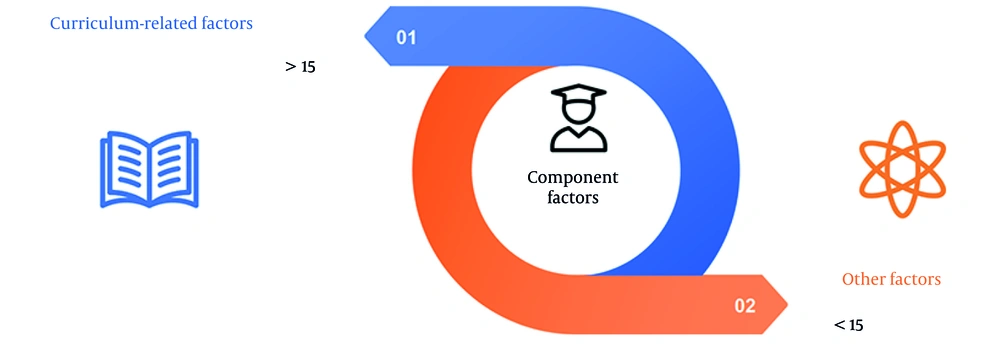
Figure 1.
The main idea of the study by Safari and Fakharyan (1)
On top of the original findings, we would like to address some further comments, particularly regarding the component factor of “abilities of professors”. The determined value was 14.79 ± 3.20, which was not significantly different (P > 0.05) from the midpoint value (15). In other words, the preparedness of the abilities of professors could be viewed as vague and marginal. According to the original paper, noticeably, the academic position distribution of 119 responsive participants was as follows: 80 (67.3%) were instructors or assistant professors, and 39 (32.7%) were associate professors or professors. Judged by the academic positions, the majority of participants were perceived as junior academics or early-career researchers (ECRs) (2). Generally, the entire competency of ECR is under development (3). Although it should be noted that teaching experience is not solely determined by academic rank, and many ECRs may indeed possess substantial teaching experience, they might still rate a score towards the “abilities of professors” lower than senior colleagues. This does not imply that ECRs are less capable teachers, but rather that their self-assessment or perception of institutional readiness may differ from that of more senior faculty. As a result, for a group with ECR being the majority, the component factor of “abilities of professors” would probably be averaged below the midpoint value. This possibly explained the results in the study and had been preliminarily discussed by the authors.
If the survey were conducted predominantly among senior professors, the “abilities of professors” factor might exceed the midpoint value, which could lead to this factor being classified as “prepared”. The collected questionnaires responded to by senior academics can be delicately categorized and extracted, or follow-up questionnaires can be specifically delivered to senior educators to accurately exhibit their attitudes. By this means, the contribution of senior professors will stand out. This thought experiment is intended to guide future directions rather than represent meaningless data manipulation. Subsequently, if the “abilities of professors” factor is recognized as “prepared” in the group of senior educators who possess more teaching experience and mature tutoring abilities, it will be advisable for the university to invite them to launch a pilot project for flipped classroom teaching. Certainly, the other component factors like equipment and hardware should be considered in this pilot project, but it is feasible to address them by temporarily rearranging the resources. In such a pilot project, ECRs can participate in class visits to learn the modules and modalities of the flipped classroom. In due course, we believe that the preparedness of ECRs can be gradually improved. Notwithstanding the above comments, we perceive that the authors performed a reasonable survey and analysis; we just do not need to be overly pessimistic regarding the current results.
In addition, it was revealed that “internet access” was scored below the midpoint value. We advocate for the government and university to increase financial support to establish a more facilitated internet infrastructure for teachers and students. Additionally, contributions from enterprises are appreciated. The flipped classroom is a creative pedagogy designed to enhance educational outcomes by deconstructing the conventional paradigm of the classroom (4, 5), and the efforts of the authors to investigate the preparedness for it are highly admired. We hereby propose some further considerations to the authors for reference. We look forward to reading the follow-up studies and good news from Safari and Fakharyan.