
1. Background
Medical students often struggle to choose a specialty due to inadequate information and external pressures, leading to poor decisions and decreased service quality (1). Numerous internal and external factors influence the motivation of healthcare professionals in the workplace, categorized as economic, psychological, social, managerial, and organizational determinants (2). Residents often choose their specialty based on their interest in the field, which may stem from previous experiences, a desire for learning and research, and innovations in the medical field (3). Psychological support and counseling can help residents manage work-related stress and pressure, thereby maintaining their motivation (4). Positive feedback and regular evaluations boost residents' motivation and promote improvement (5). Internal and external factors greatly influence resident motivation; fostering a supportive environment can enhance job satisfaction and service quality (6).
Given the complexities and challenges of healthcare, there is a growing need for a systematic approach to identifying and assessing the factors that influence healthcare worker motivation (7). Examining the motivations and reasons for residents' specialty choices can be effective in developing dedicated physicians and improving the health of society (8). In recent years, the Iranian medical education system has faced a notable challenge in filling available residency positions. According to official reports, more than 1,600 residency seats in specialty training programs remained vacant across Iranian medical universities in 2024, indicating the inability to fully utilize the training capacity in several fields despite annual increases in overall capacity. This situation suggests a growing mismatch between healthcare workforce needs and the motivations or preferences of medical students and physicians, highlighting an urgent need to understand the factors that influence specialty choice in order to inform workforce planning and policy (9).
2. Objectives
This cross-sectional study aims to quantitatively evaluate and rank the factors influencing the motivation to choose a medical specialty among medical students and specialists, by estimating the relative weights of decision criteria using the Fuzzy analytic hierarchy process (FAHP) approach, and to compare the priorities and motivations between these two groups. This ensured that a broad range of perspectives was captured and that all relevant ideas were represented in the study.
3. Methods
3.1. Study Design
This cross-sectional study was conducted at TeMS.C., Islamic Azad University, Tehran, Iran, during 2023 - 2024. The primary objective was to identify and rank factors influencing the motivation of medical specialists and students in choosing their specialty, using the FAHP to quantify relative importance based on expert judgment.
3.2. Participants and Sampling
A total of 50 participants were included in this study, comprising 30 medical students and 20 specialists from Tehran Azad University of Medical Sciences. The sample size was determined based on methodological recommendations for analytic hierarchy process (AHP) studies, which suggest that a moderate number of experts is sufficient for reliable pairwise comparisons and prioritization of criteria. Participants were recruited through purposive sampling using predefined eligibility criteria to ensure relevant expertise. Including both students and specialists allowed for a comparative assessment of factors influencing specialty choice across different stages of medical training and professional experience. Participants were selected through purposive sampling based on predefined eligibility criteria to ensure relevant expertise:
- Specialists: Minimum of 5 years of clinical experience; active involvement in teaching or mentoring medical students; experience with advising or guiding specialty choice.
- Medical students: Enrollment in clinical years (years 4 - 7); completion of multiple specialty rotations; exposure to specialty choice decisions.
Eligible participants were invited via email and personal contact. Response rates and nonparticipation were recorded to ensure transparency.
3.3. Criteria and Checklist Development
Factors influencing specialty choice were classified into three main categories:
(1) Economic factors: Salary, job market, work independence, financial background, and welfare facilities.
(2) Psychosocial factors: Social status, interest, personal and family reasons, job security, competition, years of education, and on-call status.
(3) Managerial and organizational factors: Societal needs, educational opportunities, suitable work environment, workload, availability of necessary tools and equipment, insurance coverage, and working hours.
These factors were identified through qualitative interviews and literature review, then structured into a hierarchical framework including the primary objective, criteria, sub-criteria, and alternatives.
3.4. Fuzzy Analytic Hierarchy Process/Analytic Hierarchy Process Procedure
The FAHP analysis was structured into four levels:
(1) Goal: Prioritize factors influencing medical specialists’ and students’ motivation in choosing a specialty.
(2) Criteria (3 main categories): Economic Factors, Psychosocial Factors, Managerial and Organizational Factors
(3) Sub-criteria: Economic:
- Salary, job market, work independence, financial background, welfare facilities
- Psychosocial: Social status, interest, personal and family reasons, job security, competition, years of education, on-call status
- Managerial/Organizational: Societal needs, educational opportunities, suitable work environment, workload, availability of tools, insurance coverage, working hours
(4) Alternatives: Not applicable in this study; the focus was ranking sub-criteria within each main criterion.
Pairwise comparisons were expressed using Triangular Fuzzy Numbers (TFNs) to capture uncertainty in expert judgment. The fuzzy scale was defined as follows (Table 1).
Table 1.
Fuzzy Scale
| Linguistic Term | TFN (l, m, u) |
|---|---|
| Equal importance | (1, 1, 1) |
| Slightly more important | (2, 3, 4) |
| Moderately more important | (4, 5, 6) |
| Strongly more important | (6, 7, 8) |
| Extremely more important | (8, 9, 9) |
3.5. Computation Steps
(1) Pairwise comparisons: Experts completed matrices for each criterion using the fuzzy scale.
(2) Fuzzy aggregation: Geometric means of TFNs were calculated separately for specialists and students.
(3) Defuzzification: Centroid method: D = (l + m + u)/3
(4) Weight computation: Normalized weights computed using the geometric mean method.
(5) Ranking: Sub-criteria ranked from highest to lowest weight.
(6) Consistency check: CR ≤ 0.1 considered acceptable; inconsistent matrices were revised by participants.
(7) Software: Expert Choice version 11.
3.6. Pairwise Comparison Validity
For each main category of factors (Economic, Psychosocial, and Managerial/Organizational), pairwise comparison matrices were constructed. Each matrix shows how experts compared every criterion against all other criteria within the same category using Saaty’s 1 - 9 scale (or the corresponding triangular fuzzy numbers in FAHP). The entries in the matrix represent the relative importance of the row criterion compared to the column criterion. Geometric means of responses were calculated separately for specialists and students, and the resulting values were used to compute the relative weights (mean weight) of each criterion (Tables 2 -4).
Table 2.
Economic Factors
| Criterion | Salary | Job Market | Job Independence | Financial Background | Welfare Facilities | Mean Weight |
|---|---|---|---|---|---|---|
| Salary | ||||||
| Job market | ||||||
| Job independence | ||||||
| Financial background | ||||||
| Welfare facilities |
Table 3.
Psychosocial Factors
| Criterion | Social Status | Interest | Personal and Family Reasons | Job Security | Competition | Years of Education | On-Call Status | Mean Weight |
|---|---|---|---|---|---|---|---|---|
| Social status | ||||||||
| Interest | ||||||||
| Personal and family reasons | ||||||||
| Job security | ||||||||
| Competition | ||||||||
| Years of Education | ||||||||
| On-call Status |
Table 4.
Managerial and Organizational Factors
| Criterion | Societal Needs | Educational Opportunities | Suitable Work Environment | Workload | Availability of Tools | Insurance Coverage | Working Hours | Mean Weight |
|---|---|---|---|---|---|---|---|---|
| Societal needs | ||||||||
| Educational opportunities | ||||||||
| Suitable work environment | ||||||||
| Workload | ||||||||
| Availability of tools | ||||||||
| Insurance coverage | ||||||||
| Working hours |
- Consistency ratio (CR): Calculated for each defuzzified matrix. Matrices with CR > 0.1 were revised.
- Separate group analysis: Comparisons were done separately for specialists and students. After confirming consistency, geometric means were used to produce final matrices.
- Fuzzy consistency: Assessed by defuzzifying TFNs before CR computation to ensure validity.
3.7. Data Processing
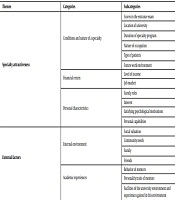
Geometric means were computed separately for specialists and students. Expert Choice 11 software was used to calculate relative weights and rank priorities for each factor. The hierarchical framework is shown in Figure 1.
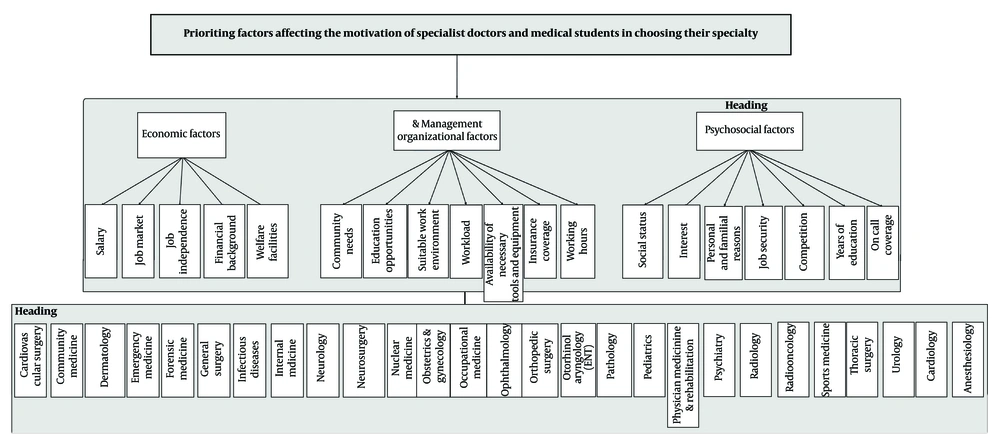
Figure 1.
Different criteria and sub-criteria under consideration and their hierarchy
4. Results
The mean age of the participants was 36.7 ± 13.839 years. Table 5 presents the demographic characteristics of the participants.
Table 5.
Demographic Characteristics of Participants a
| Criterion | Individuals |
|---|---|
| Place of residence | |
| Tehran | 48 (96) |
| Karaj | 2 (4) |
| Marital status | |
| Married | 30 (60) |
| Single | 20 (40) |
| Gender | |
| Male | 25 (50) |
| Female | 25 (50) |
| Education level | |
| Specialist | 20 (40) |
| Medical student | 30 (60) |
| Income level | |
| Good | 22 (44) |
| Average | 16 (32) |
| Poor | 10 (20) |
a Values are expressed as No (%).
According to Figure 2, these rankings indicate that internal medicine, pediatrics, and emergency medicine are considered the most critical specialties based on managerial and organizational factors, likely due to high societal demand, workload, and resource availability.
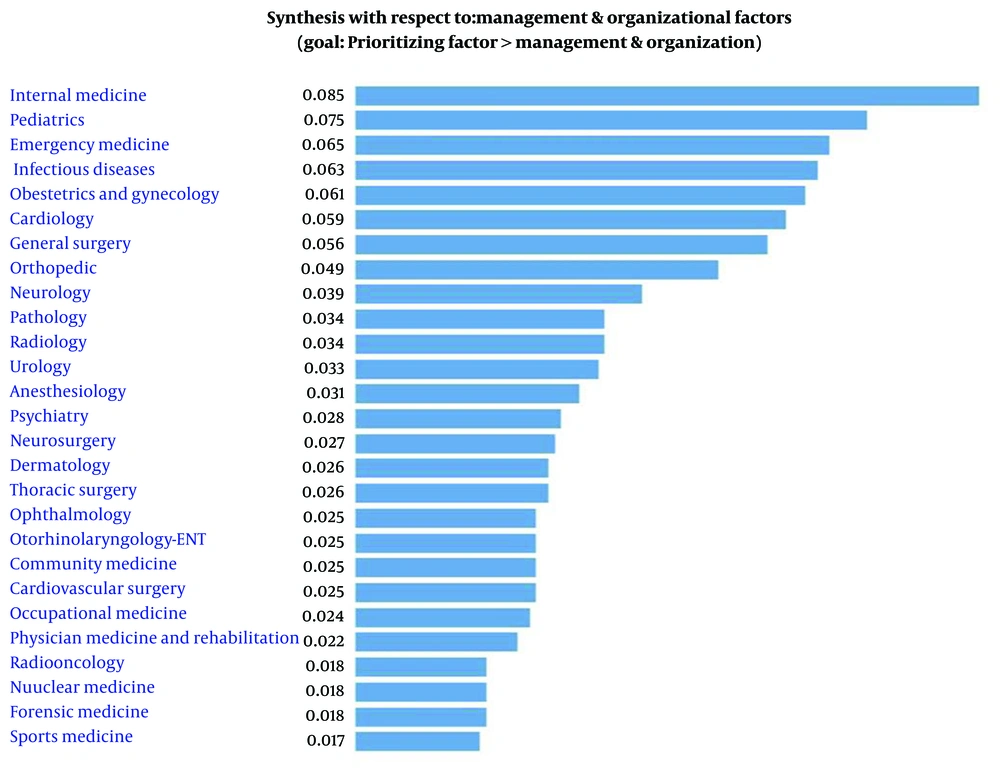
Figure 2.
Overall comparison of specialties based on managerial and organizational factors
These findings suggest that radiology, ENT, ophthalmology, orthopedics, and dermatology are among the most financially attractive specialties. This ranking likely reflects higher salaries, financial stability, market demand, and job independence associated with these fields (Figure 3).
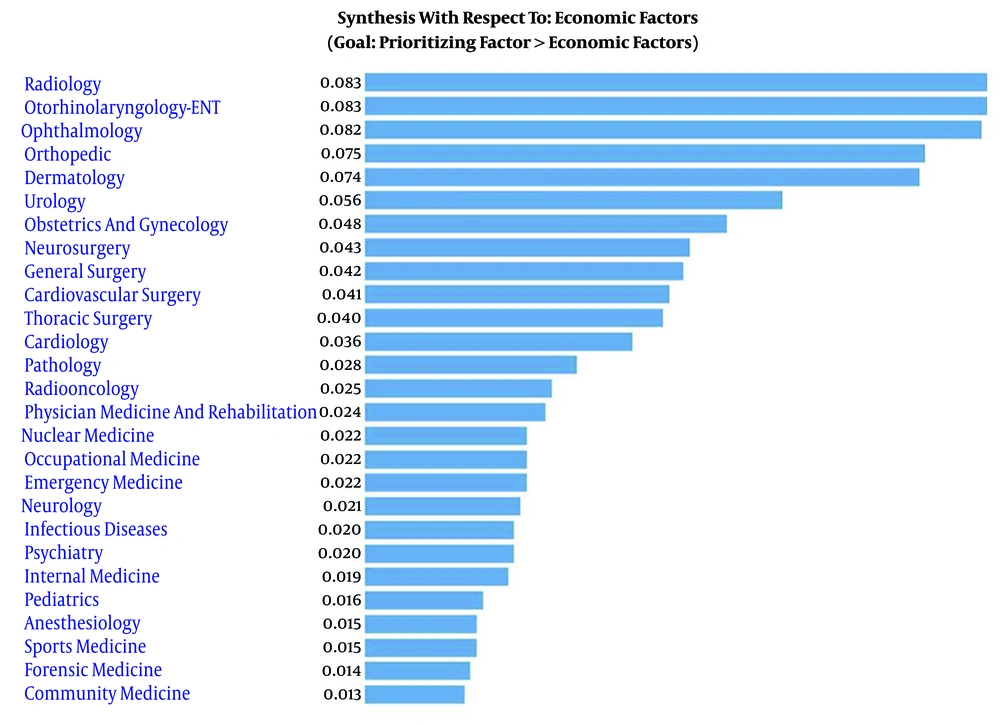
Figure 3.
Overall comparison of specialties based on economic factors
These results highlight that cardiology, neurosurgery, and orthopedics are among the most appealing specialties from a psychosocial perspective (Figure 4).
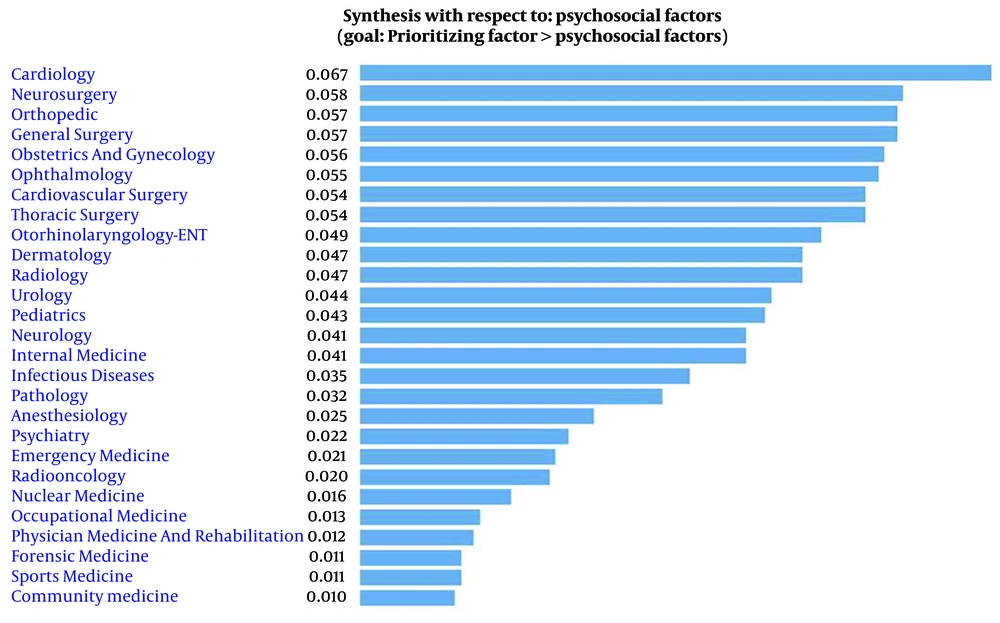
Figure 4.
Overall comparison of specialties based on psychosocial factors
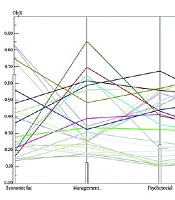
The results of this study indicate that economic factors are the most important of the three criteria examined. Managerial-organizational and psychosocial factors follow in second and third place, respectively (Figure 5).
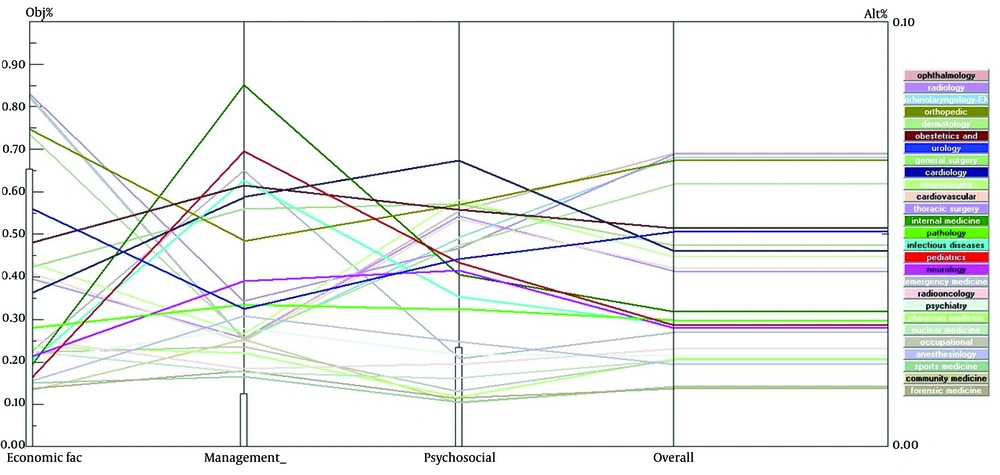
Figure 5.
Comparison of the three main factors in specialty selection
5. Discussion
In the present study, the most important motivating factor among health professionals was salary and job market prospects. This finding highlights the direct impact of financial conditions on specialty choice. The results suggest that adequate compensation and financial stability serve as fundamental drivers in attracting and retaining specialists in certain fields. Our findings are consistent with similar research that identified salary as a key determinant of specialty choice (10-12). These studies show that increased financial incentives can motivate and direct medical students toward specialties that address societal needs. In a study conducted by Rajai et al. in 2022 (13), the results also indicate that financial components ranked highly as motivational factors for health professionals. This suggests that improving financial incentives can significantly increase the motivation of healthcare workers and thus play a crucial role in improving the quality of health and medical services. Other studies similar to ours found that increased income and the provision of adequate housing, food, and clothing for workers and their families were among the important and effective factors in maintaining and improving health worker motivation. By addressing their financial needs, health workers can focus more on improving medical services (2, 14, 15). In addition, these improvements can lead to increased motivation of healthcare workers to pursue further education and enter specialized fields. In contrast to our findings, the study by Li et al. showed that a fixed salary does not have a significant effect on physician behavior. Instead, other more influential factors may affect physician motivation (16).
In our study, workload and working hours were identified as the most important managerial-organizational factors affecting residency motivation. Other factors, such as a suitable work environment and access to necessary tools, were considered less important for job satisfaction and specialty choice among medical students. Similarly, a study by Khan et al. emphasized that favorable working conditions, including reduced workload and access to modern equipment, significantly influence specialists' motivation and medical students' specialty choice (17).
Personal interests, social status, and job security have a significant impact on the motivation of specialists and residents, with personal interests being the most important factor. Our findings are consistent with Kitsios and Kamariotou research, which emphasizes that the pursuit of interests increases motivation and well-being among healthcare professionals (18). This study suggests strategies to increase resident motivation, including increasing financial support for high-priority specialties to improve health care, improving managerial and organizational conditions through training programs, creating appropriate work environments to increase physician prestige and job satisfaction, and facilitating communication to address the concerns of medical professionals and students.
5.1. Limitations
First, the study was conducted on a relatively small sample size consisting of 20 specialists and 30 medical students from a single University of Medical Sciences in Tehran, which may limit the generalizability of the results to other medical universities or healthcare systems. Second, the data were collected using self-reported judgments in pairwise comparisons, which may be influenced by subjective perceptions, response bias, or personal experiences of participants. Third, the application of the FAHP requires multiple and sometimes complex comparisons, which may increase respondent fatigue and potentially affect the consistency of responses, despite efforts to provide clear instructions. Finally, the study focused on a predefined set of economic, psychosocial, and managerial-organizational factors; therefore, other influential factors such as cultural, policy-related, or personal life circumstances were not included and should be explored in future research.
Future research could expand on our findings by including a larger and more diverse sample of medical students and specialists from multiple universities across Iran to enhance generalizability. Additionally, longitudinal studies could explore how preferences and motivating factors evolve over time, particularly as students progress through clinical training and residency. Further studies could also examine the influence of emerging healthcare trends, policy changes, and technological advancements on specialty choice.
5.2. Conclusions
The findings of this study indicate that the motivation to choose a medical specialty is influenced by a combination of economic, psychosocial, and managerial-organizational factors. Salary emerged as the most important economic factor, personal interest as the dominant psychosocial factor, and workload and work environment as the key managerial-organizational determinants. The prioritization of medical specialties using the FAHP approach revealed substantial differences in perceived attractiveness across specialties, with ophthalmology and radiology ranking highest, while social medicine, sports medicine, and forensic medicine ranked lowest. These results highlight the value of structured decision-making methods such as the FAHP in understanding specialty choice and can assist policymakers, medical educators, and health system planners in designing targeted strategies to better align workforce distribution with students’ and specialists’ motivations.