1. Background
Infertility with no reason, sometimes called idiopathic infertility, refers to failure in conception in a couple with its causes remained unknown even after an infertility work-up. Usually, the duration of infertility is more than twelve months (1). The rate of unexplained infertility varies in different cases and studies but is usually about 10 to 20% (2, 3). Unexplained infertility is not an immovable condition, it is a relative inability to conceive, and it is clear that many of these couples may conceive without treatment, but treatment will often fasten the time to conceive (4). Kisspeptin– KISS1R signaling is clearly essential for maintaining GnRH secretion. Functional polymorphisms in KISS1 and KISS1R genes can alter the hypothalamic-pituitary-gonadal (HPG) axis operation, thus can be effective in reproduction and other physiologic functions which are dependent on this gonadal axis (5, 6).
KISSPEPTIN gene was first found by Lee et al. (1996) as a metastasis suppressing gene in melanoma cell line (7). This gene encodes for a 145 amino acid protein known as kisspeptin-145 (8), and under proteolytic process produces a peptide containing 54 residues, called kisspeptin-54 or metastin. It can be cleaved into shorter amino acid sequences (identified as kisspeptin-14, kisspeptin-13 and kisspeptin-10), all contain a common structural motif (Arg-Phe-NH2) in their C-terminal (8, 9). KISS1 mRNA has been detected by in situ hybridization and also reverse transcription polymerase chain reaction (RT-PCR) in isolated regions of the forebrain such as the arcuate nucleus (ARC), the anteroventral peri-ventricular nucleus (AVPV), and the anterodorsal preoptic nucleus (APN), as well as stria terminalis and Amygdale (9, 10).
Kisspeptins are the normal ligands for GPR-54 (KISS1R) (7, 9). The discovery of kisspeptin in 1996 added a new dimension to our understanding of the physiology of the hypothalamic pituitary gonadal axis, reproduction, and fertility (11, 12). Humans and mice that contain mutations in the KISS1R gene show unusual traits in reproductive axis and function such as low levels of sex steroids, failure of pubertal development, imperfect gametogenesis, and deficiency of estrous or menstrual cycle (13, 14). Mutations and deletions of KISS1R are also related to a serious shortage in gonadotropin such as luteinizing hormone and follicle-stimulating hormone (LH and FSH) secretion which was originated from decreased secretion of GnRH (13, 15). Also similar defects have been found for KISS1 knockout (KO) mice (12, 16). Brain regulates production and secretion of pituitary gonadotropins and all of the products through GnRH neurons pathway. It is proved that kisspeptin– KISS1R signaling has a direct effect on regulating GnRH secretion. So, the interaction between kisspeptin and KISS1R has an essential role in regulating the onset of puberty and reproductive axis (17, 18).
Evidence suggests that loss of functional mutations or SNPs in KISS1 and KISS1R is related to sexual immaturity and infertility axis in humans (5, 6).
There are only few studies concerning the connection between KISS1 gene and idiopathic infertility. For the first time, polymorphism of the KISS1 gene was diagnosed in china. A total of 272 Chinese Han girls were found to be central precocious puberty (CPP) patients and 43 unrelated infertile African women as case group and 288 unrelated normal fertile Chinese Han girls as control ones. Although a novel SNP that was an amino acid substitution (P110T) was found in KISS1 and it was statistically related to infertility (6, 18).
This study was designed to discover the role of Q36R polymorphism in KISS1 gene using PCR-RFLP method in idiopathic infertile females from northern Iran, which might find useful information for female infertility future studies or molecular diagnostic tests.
2. Methods
2.1. Subjects
Unexplained infertility is regarded as idiopathic in the sense that its causes remain unknown even after an infertility work-up. The case group patients were selected from couples who attended the infertility clinic of Alzhara. They were all about 20 to 35 years old, all had a history of infertility above 12 months, and had no other genetic problems. The cases were diagnosed according to the same criteria: 1) normal results about ovulation and normal luteal phase; 2) normal results about fallopian tube; and 3) normal results in semen analysis from their partners as the rules of the world health organization.
The healthy group was selected from volunteers with no fertility problem and all had at least 1 child. Patients and controls were given necessary information about the research. A detailed medical and reproductive history was also obtained from all subjects including reproductive history and also fertility evaluation of the male partner. Patients who had normal male mates with normal reproductive history were eligible for the study. At last, 64 patients were found and selected as our idiopathic infertile case group and healthy fertile female were selected as the control group. All the case group and control group were between 25 to 40 years old. Informed consent was obtained from each participant included in the study and the study protocol conformed to the ethical guidelines of the 1975 Declaration of Helsinki as reflected in a priori approval by the institution's human research committee.
2.2. DNA Isolation, SNP Selection
From all cases (control and patient), 2 mL peripheral blood was taken and preserved into EDTA-coated venojects. Genomic DNA was extracted from peripheral white blood cells using DNA extraction kit (DNG-Plus) (Cinna Gen co. Iran) and was kept in -70°C. Extraction product quality was checked by electrophoresis on a 2.0% agarose gel and then stained with ethidium bromide to make them visible (Figure 1A).
On the basis of previous studies, one SNP was selected from the SNP database at the National Center for Biotechnology Information (NCBI,http://www.ncbi.nlm.nih.gov/SNP).
2.3. Genotyping
PCR amplification was done by using the following set of primers: 5‘-CATCCCAGCTAAGGTGATCGT-3’ and 5‘-CAGCTGGCTTCCTCTCGGT-3’. This set of primers was designed by Oligo-7 software and used to amplify a 233-bp region of the KISS1 gene. The template DNA was added to 25 µL of a mixture for the reaction containing 1 × PCR buffer (50 mM KCl, 10 mM Tris-HCl [pH 8.3], 1.5% [vol/vol] Triton X-100), 1.5 mM MgCl2, 200 mM of each deoxynucleoside triphosphate (dNTP), 50 pmol of each primer and 1 Unit a special polymerase named Taq DNA polymerase (Gen Fanavaran, Iran).
The PCR conditions started with initial denaturation at 94°C for 5 minutes, 35 cycles of denaturation of molecules at 94°C for 1 minute, annealing at 60°C for 1 minute, and the products of previous level were under extension at 72°C for 1 minute, and then a final extension at 72°C for 5 minutes in Biorad Thermocycler.
PCR products were found by electrophoresis on a 2.0% agarose gel and then stained with ethidium bromide to make them visible, and the gel was examined under UV light.
Through next level, the PCR products were subsequently digested with the Nae1 that is one of restriction enzymes (RE) and recognizes a specific sequence (e.g. a SNP site) in the DNA fragment of this study, this enzyme was selected from NEBcutter website. The PCR products were centrifuged at 1000 x g for 2 minutes of duration and the supernatants were collected for digestion. The digestions were done in the supernatants with Nae1 restriction enzyme (10 U/μL) in 10 µL final volume, containing 2 µL of Buffer 10X (Jena Bioscience), 7 µL of PCR product, and 10 units of Nae1 RE (Jena Bioscience). The digestion was set up for one hour at the recommended temperature from supplier (37°C). The generated fragments form digestion were analyzed on 2% agarose gel and compared to PCR products that were not treated. A 50-bp DNA ladder (New England Biolabs, Beverly, MA) was used (Figure 1B).
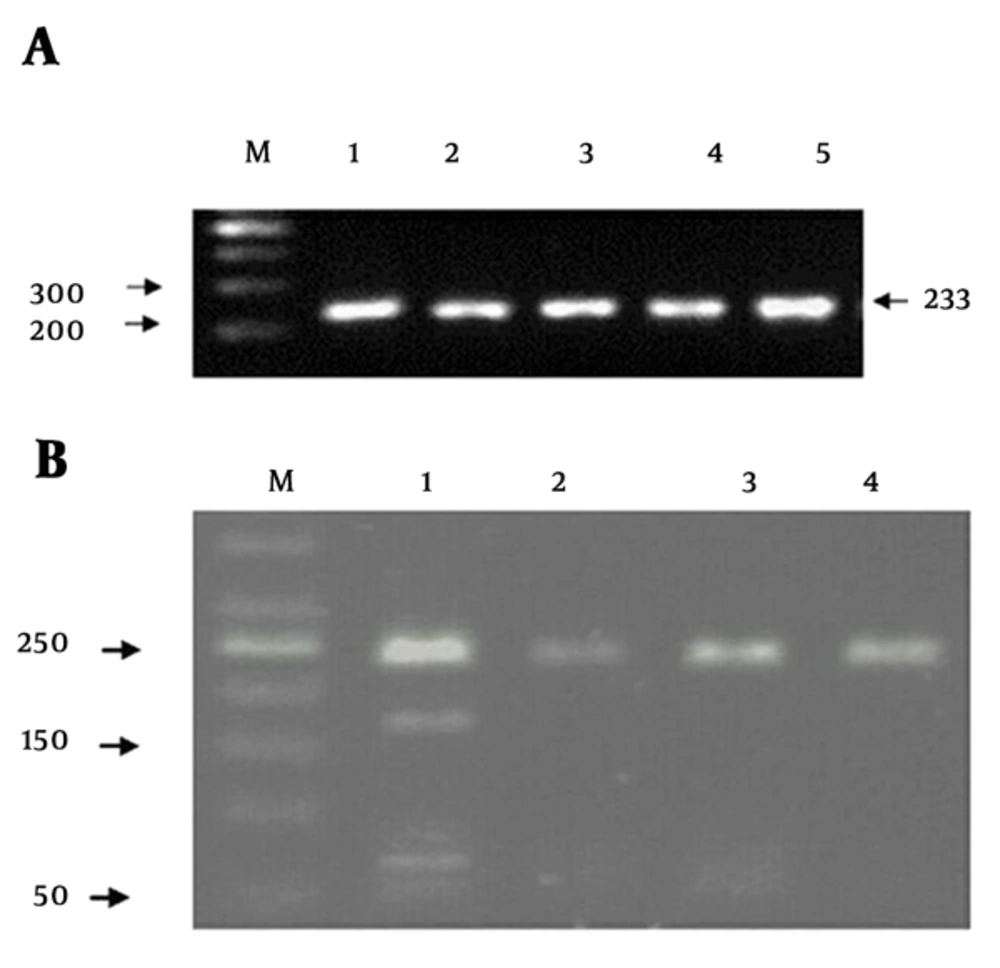
Figure 1.
Lane M, 100-bp DNA marker; lanes 1 - 5, PCR products had 233 bp; B, agarose gel electrophoresis of PCR products on 2% gel. PCR products were digested with NaeI enzyme. Lane M, DNA ladder 50-bp; lane 1, Heterozygotes AG, (233 bp, 161, 72); lanes 2, 3 and 4: Homozygotes AA.
2.4. Statistical Analysis
Difference in the distributions between groups was tested with Chi-squared tests (χ2) and the Med Calc version 12.1. A value of P < 0.05 was assumed statistically significant.
3. Results
In the first part, 64 patients with the diagnosis of idiopathic infertile cases according to the same criteria (normal results in ovulation and luteal phase analysis, patent fallopian tubes, and also normal results in semen analysis) and 60 healthy controls were selected. The mean ages of the control group and idiopathic female infertile case group were about 32.66 ± 3.44 and 34.23 ± 3.77 years old, respectively, and there was no significant different trait between control and case groups.
The length of the restriction fragments in the presence of allele A was 233 bp and in the presence of allele G was 161 and 72 bp (Figure 1B). These substitutions in nucleotide sequence results in an amino acid substitution of glutamine for arginine.
Among the case group, 58 AA (Glu homozygotes) and 6 AG (Glu/Arg heterozygotes) were identified and from the control group, 58 were AA (Glu homozygotes) and 2 were AG (Glu/Arg heterozygotes). The GG (Arg/Arg homozygotes) genotype was not detected in these groups (Table 1). The result suggested that the SNP Q36R at exon 4 KISS1 gene is not associated with female infertility in northern Iran (P value: 0.31).
Table 1.
Distribution of Q36R Kiss1 Genotypes in Idiopathic Infertile Women and Fertile Controlsa
| KISS1 SNP | Idiopathic Infertile Women (n = 64) | Controls (n = 60) n (%) | ORb (95% CI) | P Valuec |
|---|---|---|---|---|
| Aallele | 122 (95) | 118 (98) | 1 (Ref) | |
| G allele | 6 (5) | 2 (2) | 2.57 (0.48 - 13.61) | 0.44 |
| A/A | 58 (90.62) | 58 (96.66) | 1 (Ref) | |
| A/G | 6 (9.38) | 2 (3.33) | 3.00 ( 0.58 - 15.48) | 0.31 |
| G/G | 0 (0) | 0 (0) | - | - |
aValues are expressed as No. (%).
bA allele or A/A Kiss1 SNP genotypes were considered as the baseline when calculating the relative crude ORs.
cCorrected P value.
4. Discussion
Kisspeptins, different product lengths of the KISS1 gene with capability to bind KISS1R, have been recently determined as the main factors in the reproductive pathway with capability to activate the GnRH/LH axis as a part of reproductive axis (18). The GnRH neuronal cells serve as the final pathway through which the brain regulates the secretion of gonadotropin hormones from the pituitary glands (19).
As such, the activation of GnRH neurons is a crucial event for the onset of puberty (20). KISS1R is located on GnRH secreting neurons, thus, it appears that kisspeptin/KISS1R signaling within the GnRH neuronal network is important for the pubertal activation and reproduction (18, 21).
There are many studies which have focused on KISS1/KISS1R function but until now there have been few studies about finding the association between KISS1 gene and idiopathic infertility. In our study, Q36R KISS1 polymorphism has been considered in female idiopathic infertility. In idiopathic infertile women, no definitive cause for infertility can be found but dysfunction on the hypothalamus-hypophysis axis can be a main reason (22), so, it is hypothesized functional SNPs in KISS1 and its receptor may be related to idiopathic infertility. There are studies which have investigated inactivating mutations in KISS1R in idiopathic hypogonadotropic hypogonadism (IHH) cases and the lack of fertility maturation of the KISS1R null mouse; these studies have shown an unknown role for KISS1 and its receptor in the physiologic cycle of puberty, fertility, and reproduction (23, 24).
In this study, we detected Q36R polymorphism in KISS1 gene, among 64 idiopathic infertile women and 6 patients carried this SNP, and among 60 controls, 2 of them could be detected with this SNP (Chi Square: 0.203, P value: 0.31), thus Q36R polymorphism at exon 4 KISS1 gene is not associated with female infertility in northern Iran. However because of distinctive gene pools in different geographic populations, results may be different in other studies.
In a study in china, for the first time polymorphism scans of the KISS1 gene were carried out by bidirectional resequencing of the whole gene in 272 Chinese Han girls diagnosed to be central precocious puberty (CPP) patients and 43 unrelated infertile African women as case group and 288 unrelated normal fertile Chinese Han girls as control ones. By sequencing for the second time, eight new polymorphisms were found and five of them were typed forming 18 haplotypes. Although one novel SNP that was one amino acid substitution (P110T) was found in KISS1 to be statistically related to infertility (P = 0.025). Other SNPs and all the haplotypes were not found to be related to the disease (6, 18).
The other study was due to find the KISSPEPTIN gene mutations or polymorphisms in Korean girls with central precocious puberty (CPP). A total of 101 Korean girls with CPP were chosen as the case group and 51 healthy fertile Korean female adults as the control ones. All coding exons and also all exon-intron boundaries of the KISSPEPTIN gene were sequenced. As a result, p.P110T was found less frequently in CPP patients or case group than in the control group (P = 0.022). In addition, the CPP patients with p.P110T showed lower FSH peaks under GnRH stimulation than those ones without p.P110T (P = 0.002). This polymorphism was suggested to have a protective effect on puberty process and fertility; it means two completely different results have been obtained for p.P110T in Chinese and Korean girls (6, 18).
KISS1 gene variations may also be involved in cancer. In a study in Brazil, no association has been found between Q36R KISS1 gene polymorphism and head and neck cancer (25).
In conclusion, this study tried to show the connections between the special SNP in KISSPEPTIN gene and female idiopathic infertility in northern Iran. These novel mutations provide further evidence that KISS1 gene is a key regulator of reproductive function and the results would deepen our comprehension of both the KISS1 gene and the mechanism of infertility. The evaluation of reproductive hormones in these patients may further reveal the effect of kisspeptin deficiency on fertility and it is clear that studying on a bigger population and also different nationalities/races may reveal more comprehensive and accurate results. It is important that the limitation of this research calls for more future studies to confirm the actual effect of this polymorphism.