1. Background
Developing stress-tolerant crops requires a clear understanding of stress-adaptation mechanisms (1, 2). Halophytes such as S. parvula tolerate abiotic stresses, including salinity (3, 4). Closely related to Arabidopsis thaliana, S. parvula exhibits adaptive traits, including efficient photosynthesis, robust vascular systems, and sustained root growth under salinity, making it a useful model for salt-tolerance studies. Unlike A. thaliana, whose root growth is inhibited by 125 mM NaCl, S. parvula shows enhanced root development at similar concentrations (5).
Among the signaling pathways involved in growth and stress responses, the glucose-TOR (target of rapamycin) pathway is recognized as a central regulator of growth–energy balance. TOR, a highly conserved serine/threonine kinase in all eukaryotes, integrates hormonal cues, including auxins, cytokinins, abscisic acid (ABA), and brassinosteroids, with cellular energy status, nutrient availability, and environmental stimuli to regulate plant growth (6). The glucose-TOR signaling pathway has been shown to significantly modulate the expression of 2,368 genes in roots, including genes involved in ABA, auxin, and ethylene signaling (7). Several of these downstream genes regulate cell division and hormonal signaling, particularly the auxin and ethylene pathways, which are critical for root development (8). Although TOR is stress responsive and influences growth under salinity (9), its downstream regulatory network in salt-tolerant species such as S. parvula remains poorly understood.
2. Objectives
This study aimed to identify gene co-expression networks downstream of the glucose-TOR pathway that contribute to root growth in S. parvula under salt stress. Using WGCNA on time-course RNA-seq data from salt-treated and control roots, we identified salt-responsive modules and key hub genes. These findings provide new insights into the role of the TOR pathway in salt tolerance and highlight potential genetic targets for developing stress-resilient crops.
3. Methods
3.1. Identification of Downstream Genes in the Glucose-TOR Signaling Pathway in A. thaliana Roots
The list of downstream genes in the glucose-TOR signaling pathway in A. thaliana roots was obtained from the study by Xiong et al. (7), which identified 2,368 TOR-regulated genes through microarray analysis of TOR-suppressed plants. These genes, considered direct TOR targets, were extracted from the supplementary data (Table 1) of the original publication.
Table 1.
Characteristics of RNA-Seq Root Samples Used for WGCNA in Schrenkiella parvulaa
| Sample Name | Treatment | Plant Age (day) | Duration | Photoperiod (h) | Source |
|---|---|---|---|---|---|
| NaCl_7D | 12 | 7 days | 12/12 | (11) | |
| NaCl_7D_C | Control | ||||
| NaCl_7D_T | 150 mM NaCl | ||||
| NaCl_3D | 8 | 3 days | 12/12 | (11) | |
| NaCl_3D_C | Control | ||||
| NaCl_3D_T | 150 mM NaCl | ||||
| NaCl_48H | 4 | 48 h | 16/8 | (12) | |
| NaCl_48H_C | Control | ||||
| NaCl_48H_T | 175 mM NaCl | ||||
| NaCl_24H | 4 | 24 h | 16/8 | (12) | |
| NaCl_24H_C | Control | ||||
| NaCl_24H_T | 175 mM NaCl | ||||
| NaCl_3H | 4 | 3 h | 16/8 | (12) | |
| NaCl_3H_C | Control | ||||
| NaCl_3H_T | 175 mM NaCl |
a Replicates for NaCl_7D_C was 4 and for the others was 3.
3.2. Ortholog Identification in A. thaliana and S. parvula
To identify orthologs of the glucose-TOR downstream genes in the S. parvula genome, the OrthNet tool (10) was used in Python 2.7 (https://github.com/ohdongha/OrthNet). This tool requires 3 input files. First, the GFF files for A. thaliana and S. parvula were downloaded from TAIR (https://www.arabidopsis.org/) and Phytozome (https://phytozome-next.jgi.doe.gov/), respectively, and converted to GTF format using gffread (https://github.com/gpertea/gffread).
The second input file comprised within-species paralog gene clusters generated using MMseqs2 (https://github.com/soedinglab/mmseqs2). For this step, the protein and coding sequences of both species were retrieved from TAIR and Phytozome. The third input file, consisting of best-hit pairs between species, was also generated using MMseqs2. All 3 input files were then provided to the CLfinder module of OrthNet to identify orthologous relationships between genes in the 2 genomes.
3.3. Co-Expression Network Analysis
Co-expression network analysis was performed using 31 RNA-seq samples from S. parvula roots. Sample details are summarized in Table 1. Raw expression data were obtained from the Phytozome project (ID: 1263770) and BioStudies (accession: E-MTAB-12424).
A total of 1,858 orthologous genes downstream of the glucose-TOR pathway were identified in S. parvula and used for co-expression analysis. Data normalization was performed using DESeq2 (v1.44.0). WGCNA was conducted in R (v4.4.1) using the WGCNA package (v1.73). Pearson correlation matrices were computed, and a soft-thresholding power (β) was selected using the pickSoftThreshold function. Based on scale-free topology criteria, a β value of 16 was chosen. The adjacency matrix was transformed into a topological overlap matrix (TOM). Hierarchical clustering was performed using TOM-based dissimilarity (1 - TOM), and modules were detected using the dynamic tree cut algorithm with a minimum module size of 30 genes.
To examine associations between gene modules and sample traits, including salt treatment, time, and replicates, module eigengenes, defined as the first principal components, were correlated with these traits using Pearson correlation. Modules with the strongest positive correlations with salt stress were selected for further analysis.
Hub genes were identified based on module membership (kME), representing the correlation between each gene and the corresponding module eigengene. Genes with kME > 0.96 were considered hub genes. The co-expression networks were visualized using Cytoscape (v3.10.2).
3.4. Gene Ontology and Differential Expression Analysis
To infer gene functions, Gene Ontology (GO) enrichment analysis was performed using TAIR, focusing on the Biological Process category. Differential expression analysis was performed using DESeq2 (v1.44.0) in R (v4.4.1). Volcano plots were generated based on log_2 fold change and adjusted P values (padj), and heatmaps were generated to visualize expression patterns.
4. Results
4.1. Co-Expression Network Analysis of Glucose-TOR Pathway Downstream Genes in S. parvula Roots
To investigate gene co-expression under salt stress in S. parvula roots, WGCNA was performed on 1,858 genes from 31 samples (Table 1). This analysis identified 7 distinct modules by hierarchical clustering. The turquoise module was the largest, whereas the grey module contained unassigned genes. These modules group genes with highly correlated expression, suggesting shared regulation, similar functions, or involvement in common biological pathways (Figure 1).
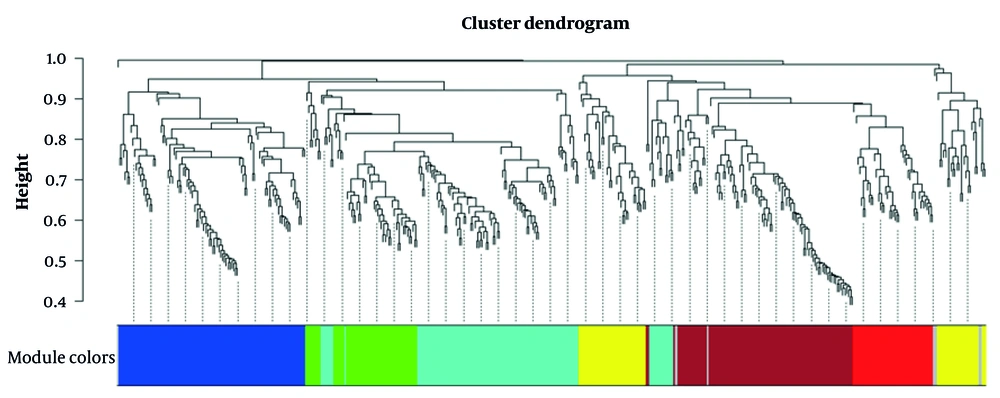
Figure 1.
Gene dendrogram produced by hierarchical clustering and the dynamic tree cut algorithm. Colored bars represent co-expression modules.
4.2. Identification of the Key Module Correlated With Salt Stress in the Glucose-TOR Pathway
Next, we examined the correlations between module eigengenes and sample traits to identify salt-responsive modules. This analysis aimed to determine which module responded consistently to salt stress across different time points.
The results showed variable expression patterns among glucose-TOR downstream genes under salt stress (Figure 2). The turquoise and green modules showed strong positive correlations with salt treatment during the early stress phase (3 hours), suggesting rapid pathway activation. The brown module showed the highest correlation under prolonged treatment (7 days). The green module showed the strongest positive correlation with salt stress. The turquoise module showed transient early activity, whereas the yellow module was strongly negatively correlated, indicating downregulation. In addition, the green module showed only a weak negative correlation with time (r = -0.49), suggesting initial activation with sustained expression. Its low correlation with biological replicates (r = +0.08) also indicates robustness and low random noise (Table 2).
Table 2.
Correlation Coefficients Between Modules and Traits (Time, Treatment, and Replicates)
| Module | Time | Salt Treatment | Replicates |
|---|---|---|---|
| Blue | -0.94729 | -0.09868 | 0.16443 |
| Brown | 0.979922 | 0.029209 | 0.174907 |
| Green | -0.49409 | 0.7575466 | -0.08272 |
| Grey | -0.077 | 0.237394 | -0.07557 |
| Red | 0.648724 | -0.21676 | -0.055409 |
| Turquoise | -0.32089 | 0.421813 | -0.06582 |
| Yellow | 0.369367 | -0.79874 | 0.01352 |
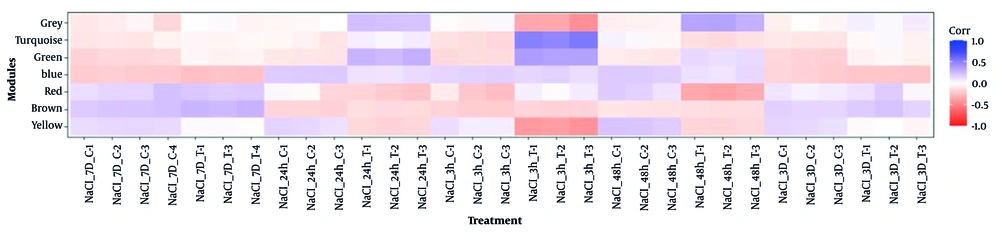
Figure 2.
Heatmap of correlations between gene expression modules and experimental samples. Blue indicates positive correlation, and red indicates negative correlation.
Given its strong and consistent correlation with salt stress, low variability, and sustained expression, the green module was selected as the key TOR-associated module in the salt-stress response.
4.3. Genes in the Key Module Likely Contribute to Salt-Stress Response
The green module contained 52 genes (Table 3). A heatmap of gene expression showed that most of these genes were upregulated in salt-treated samples, particularly at 3 and 24 hours after treatment, whereas their expression was reduced in control samples (Figure 3A). This pattern was consistent with the overall correlation results.
Table 3.
Number of Genes in Each Expression Module
| Module Name | Color | Number of Genes |
|---|---|---|
| Turquoise | Turquoise | 107 |
| Green | Green | 52 |
| Blue | Blue | 100 |
| Red | Red | 43 |
| Brown | Brown | 96 |
| Yellow | Yellow | 60 |
| Grey | Grey (unassigned) | 7 |
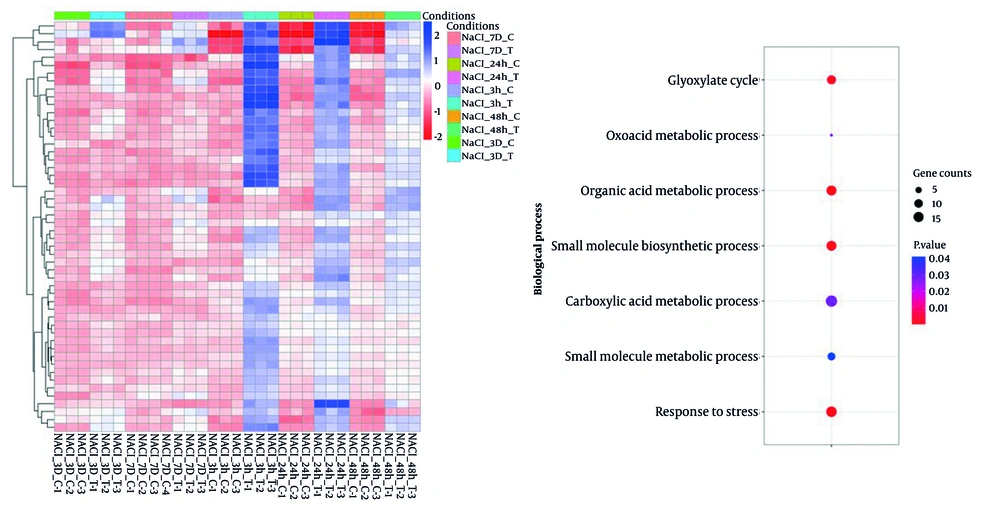
Figure 3.
A,Heatmap of expression of 52 green-module genes under salt stress. B, GO enrichment of green-module genes (Biological Process category).
GO analysis showed that the green-module genes were enriched for metabolic processes, including acid metabolism and stress responses. This finding supports their functional role in TOR-mediated salt-stress adaptation (Figure 3B).
4.4. Functional Roles of Hub Genes in the Green Module Suggest Adaptive Strategies
To identify central genes in the green module, co-expression networks were constructed in Cytoscape, and kME values were used to define hub genes. Genes with kME > 0.96 were selected, yielding 6 hub genes. Their positions in the network, particularly their connections to other genes, are shown in Figure 4. These genes not only occupied central topological positions but also showed strong interconnectivity, highlighting their regulatory significance under salt stress.
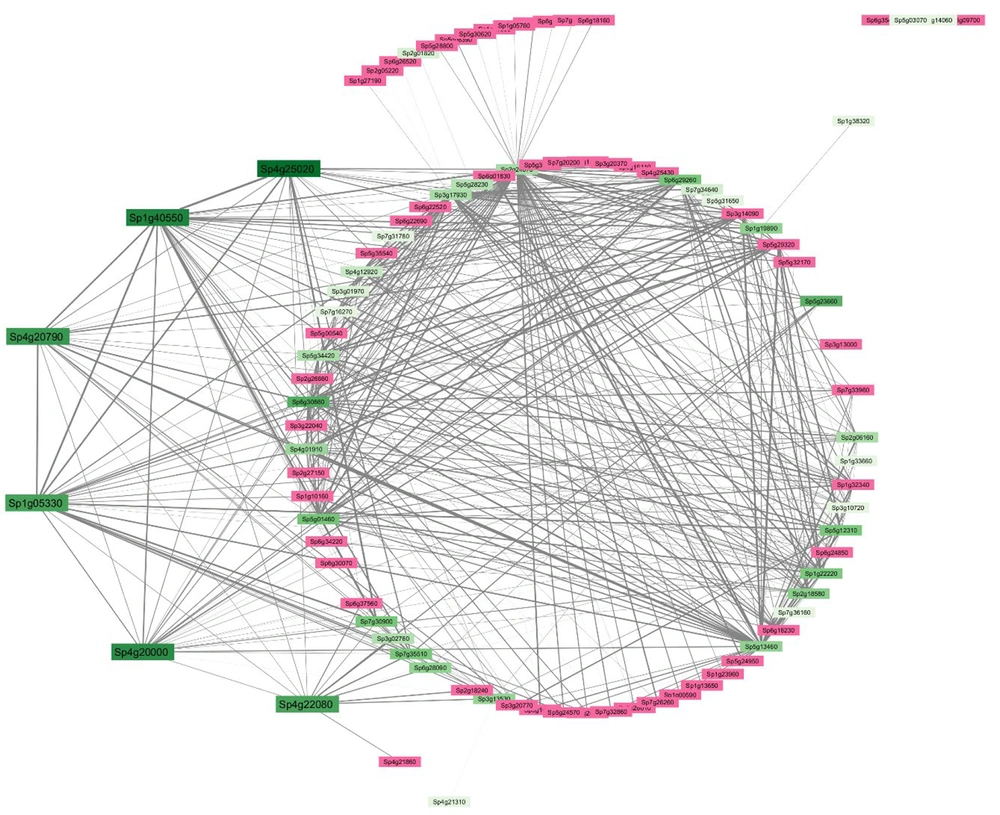
Figure 4.
Co-expression network of green-module genes in S. parvula. Nodes represent genes; thicker edges denote stronger co-expression. Dark green nodes indicate higher kME values, and hub genes are shown on the left.
Subsequent analysis of hub-gene topology and expression supported their central roles in the stress response (Table 4). Most hub genes were significantly upregulated under NaCl treatment at various developmental stages (Figure 5). Functional annotations and ortholog comparisons with A. thaliana confirmed their involvement in cell division, detoxification, root growth, and stress response.
Table 4.
Biological and Topological Characteristics of Hub Genes in the Green Module of Schrenkiella parvula
| Gene Code | kME | Degree | Mean Edge Weight | Arabidopsis Ortholog | Gene Annotation | MapMan Ontology | Gene Function | Reference(s) |
|---|---|---|---|---|---|---|---|---|
| Sp4g25020 | 0.9812 | 62 | 0.3849 | AT2G42890 | MEI2-like protein | RNA.RNA binding | Meiosis, cell division, vegetative growth, response to ABA | (13) |
| Sp1g40550 | 0.9732 | 66 | 0.3946 | AT1G54100 | Aldehyde dehydrogenase | Fermentation. Lactate dehydrogenase | Cellular detoxification, adaptation, salt tolerance, root growth | (16) |
| Sp4g20000 | 0.9702 | 62 | 0.3809 | AT2G37640 | Alpha-expansin family | Cell wall. Modification | Cell wall loosening for division and elongation | (14) |
| Sp4g20790 | 0.9662 | 66 | 0.3754 | AT2G38465 | Uncharacterized | Not assigned. Unknown | Unknown | - |
| Sp1g05330 | 0.9627 | 68 | 0.3874 | AT1G06570 | 4-hydroxyphenylpyruvate dioxygenase | Secondary metabolism. Isoprenoids. Tocopherol | Biosynthesis of plastoquinone and tocopherols, abiotic stress tolerance | (20) |
| Sp4g22080 | 0.9624 | 62 | 0.3558 | AT2G39800 | delta1-pyrroline-5-carboxylate synthase (P5CS) | Amino acid metabolism. Synthesis. Glutamate family. Proline | Proline biosynthesis, salt-stress tolerance | (17) |
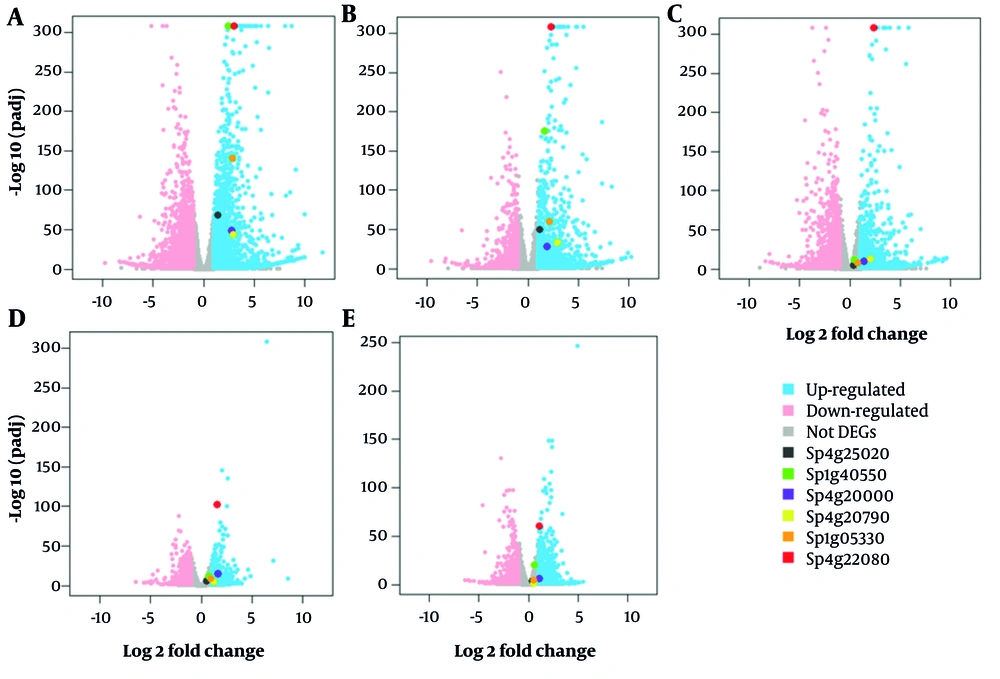
Figure 5.
Volcano plots showing expression of green-module hub genes at A, 3 hours; B, 24 hours; C, 48 hours; D, 3 days; and E, 7 days after NaCl treatment. Blue indicates upregulation, pink indicates downregulation (P < 0.05), and grey indicates no significant change.
Among the hub genes in the green module, Sp4g25020 had the highest kME value and exhibited a high degree of connectivity in the network (kME = 0.9812; degree = 62). This gene is the ortholog of AT2G42890 in A. thaliana, which encodes a protein from the MEI2-like family. This family is known to regulate meiotic and mitotic cell divisions and vegetative growth, and it also plays a role in the response to ABA (13). These characteristics underscore the importance of Sp4g25020 as a central regulator in salinity-stress adaptation.
Another gene involved in cell division is Sp4g20000, which was significantly upregulated in the roots of S. parvula under all salt-stress treatments (P < 0.01; Figure 5). The ortholog of this gene in A. thaliana belongs to the alpha-expansin family, which plays a key role in loosening the cell wall during cell division and elongation. Members of this family are expressed in the root growth zone, and their downregulation leads to reduced root growth (14). Increased expression of expansin genes in response to abiotic stresses in roots has also been reported (15). Therefore, the high expression of this gene under salinity may be associated with the structural adaptation of roots to stress conditions.
Another hub gene with high kME and degree values is Sp1g40550. This gene had the highest mean edge weight among the hub genes (mean edge weight = 0.3946), indicating stronger connectivity with co-expressed genes and a more influential role within the co-expression network. It encodes an aldehyde dehydrogenase that reduces toxic aldehyde levels by oxidizing them. Overexpression of this gene in A. thaliana has been shown to enhance tolerance to abiotic stresses, including salinity, whereas its silencing increases sensitivity to NaCl and inhibits root growth (16). The presence of this gene in the co-expression network may indicate the importance of detoxification and free-radical control in response to oxidative stress under salt conditions.
Another important hub gene in the green module is Sp4g22080. This gene was significantly upregulated under all salt treatments compared with the control (P < 0.01; Figure 5). Its ortholog in A. thaliana encodes delta1-pyrroline-5-carboxylate synthase (P5CS), a key and rate-limiting enzyme in the proline biosynthesis pathway. P5CS expression increases in roots under NaCl treatment (17). Proline functions as a major osmolyte in response to salinity, and its accumulation is associated with plant stress tolerance (18). Independent of plant hormones, this amino acid regulates cell division in the meristematic zone of A. thaliana roots and determines meristem size by modulating division-to-differentiation rates (19).
Sp1g05330 catalyzes the first step in the biosynthetic pathway of tocopherol (vitamin E) and plastoquinone, both of which are crucial for antioxidant protection in plants. Overexpression of the ortholog of this gene in sweet potato has been associated with increased tolerance to salt, drought, and oxidative stresses (20). Under salinity, preventing oxidative stress in roots is vital for maintaining structural and physiological integrity.
Among the hub genes, Sp4g20790 does not have a clearly defined function. However, its prominent network position (kME = 0.9662; degree = 66) suggests an important role that remains experimentally uncharacterized. Such genes are valuable targets for future functional studies.
These findings suggest that S. parvula employs a complex TOR-regulated network involving the coordinated control of cell division and expansion, detoxification, osmoprotectant synthesis, and antioxidant defense to maintain root growth and stress tolerance under salinity.
5. Discussion
A key distinguishing feature of the halophyte S. parvula, compared with more sensitive species such as A. thaliana, is its ability to maintain continuous root growth under saline conditions. Whereas many plants inhibit root development in response to salt stress, S. parvula sustains or even enhances root elongation, enabling efficient water and nutrient uptake. Recent studies have highlighted the central role of the glucose-TOR signaling pathway in integrating energy availability, via glucose, with cellular growth processes. TOR promotes root development by regulating translation, cell-cycle progression, and cell expansion. Therefore, investigating the expression patterns of TOR-regulated genes under salt stress in S. parvula can improve understanding of extremophyte adaptation strategies and reveal mechanisms responsible for root resilience under stress (5, 12). This study analyzed the TOR pathway in S. parvula. WGCNA identified the green module as the module most positively correlated with salt stress, suggesting a key regulatory role in maintaining growth under prolonged stress.
In addition, Sp4g20000, which encodes an alpha-expansin, is known to be regulated by LST8, a TORC1 component (21). Expansins facilitate root elongation by loosening the cell wall and are known to be upregulated under salt stress. Previous studies have linked cell elongation with salt-induced root growth and with ABA treatment in S. parvula (12, 22), highlighting the relevance of expansin and MEI2-like genes in this context. Genes involved in proline biosynthesis (Sp4g22080) and antioxidant defense (Sp1g05330) suggest that TOR functions extend beyond growth regulation to include stress adaptation. Proline, a key osmoprotectant, accumulates under salt stress and supports root-meristem activity and cell-cycle progression (19). Meanwhile, tocopherol biosynthesis by Sp1g05330 enhances reactive oxygen species scavenging, which is crucial for preserving cellular integrity under oxidative stress. Another noteworthy hub gene, Sp4g20790, lacks functional annotation but occupies a central topological position in the co-expression network. Its strong network connectivity indicates that it may have an important regulatory role and warrants future functional characterization, particularly in stress-adaptive species such as S. parvula.
5.1. Conclusions
TOR supports root growth in salt-tolerant plants such as S. parvula under saline conditions, offering a blueprint for engineering climate-resilient crops.