1. Background
Air pollution is the presence in the air of one or more pollutants, such as dust, gases, mists, fumes, and vapors, that are hazardous to human, plant, or animal life, harmful to property, or that unacceptably interfere with the better use of life and property. In another definition, pollution is the flow of waste, debris, and waste from economic systems and activities into the environment. This flow harms human well-being and ecological systems (1). Particulate matter includes suspended dust that is less than 10 micrometers in diameter and can be inhaled by humans and deposited in the lungs, especially the alveoli. In recent years, the frequency of dust storms has increased regionally and globally. Several effects have been attributed to this natural disaster, some positive for some ecosystems and some negative. Studies have divided the effects of dust storms into two general groups: Environmental and human (2). The impact of air pollution on human health ranges from no clinical symptoms to death (3). Sand and sand dust have different effects on health, one of the most important of which is lung diseases (4). Irritation of the eyes and upper respiratory tract in infants, children, adolescents, the elderly, and people with respiratory diseases such as asthma, bronchitis, and emphysema is one of the most common symptoms observed during an air pollution event (5-10). Air pollution has many health effects on people, negatively affecting the skin, eyes, and other body systems, but its most important effects are on the respiratory system. Even healthy people can suffer from air pollution, such as eye irritation and respiratory problems during outdoor activities (11). Many epidemiological studies have been conducted in recent years in different parts of the world to determine the relationship between the effects of air pollution and human health. Based on their results, the effect of increased air pollution on increased respiratory tract infections, eye sensitivity, decreased vision, chronic respiratory diseases, lung cancer, and heart diseases, and mortality was clear and significant (12, 13). Air pollution also directly binds inflammatory cell receptors through pathogenic antibodies and exacerbates inflammation (14). The risk of developing tuberculosis in childhood increases when a child is exposed to polluted air and cooking (15). Exposure to air pollution increases the risk of hospitalization. Studies show a link between air pollution levels and human health in hospital admissions, increasing admissions for respiratory and cardiovascular patients (16). The concentration of airborne microorganisms increases with increasing airborne particles, and the predominant species of these microorganisms during dust storms are Bacillus and Microsporum. As a result, these microorganisms can cause harmful biological effects on human health (17). Air pollution and climate change are driving forces for the increasing burden of allergic diseases. There are complex molecular mechanisms that drive physical, chemical, and biological interactions between air pollution, climate change, allergens, and the immune system, and this interaction can promote the development of allergies (18). Air pollution, particularly exposure to particulate matter (PM), is associated with reduced lung function and leads to an accelerated rate of lung function decline in adults. Given the geographical location of Sistan and the presence of storms and dust in this region, there is a need to investigate its effects on human health.
2. Objectives
The present study aimed to investigate the distribution of the frequency of respiratory diseases caused by dust.
3. Methods
This study is a cross-sectional descriptive study that was conducted in 2019 after receiving the ethics code IR.ZBMU.REC.1399.052. Data related to air pollutants, particulate matter, and dust were collected from the Zazabel City Meteorological Center. In this study, 71 patients referred to Amir al-Momenin Hospital in Zabol who complained of respiratory disease and dust were examined. Entry criteria: Referral to the hospital due to respiratory problems caused by dust and dust. Exclusion criteria: Having an incomplete medical record or early discharge of the patient. To collect information, a researcher-made checklist was used, the validity of which was confirmed through content validity with the opinion of experts, and its reliability was obtained using Cronbach's alpha coefficient of 0.75. For analysis, after data collection, the information was entered into SPSS software version 20.
4. Results
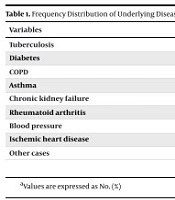
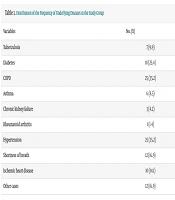
In the present study, the mean age of the patients was 58.9 ± 12.1 years. Their minimum and maximum ages were 25 and 76 years, respectively. In this study, 57.7% (41 people) of the participants were female. Most of the participants (52.1%) were engaged in agriculture and/or animal husbandry. Also, 47.9% of the patients stated that they had a laborer's job. In this study, the frequency distribution of various underlying diseases among the participants indicated that chronic obstructive pulmonary disease (COPD) (35.2%), hypertension (35.2%), and diabetes (25.4%) were among the most common underlying diseases in the patients studied (Table 1).
Table 1.
Distribution of the Frequency of Underlying Diseases in the Study Group
| Variables | No. (%) |
|---|---|
| Tuberculosis | 7 (9.9) |
| Diabetes | 18 (25.4) |
| COPD | 25 (35.2) |
| Asthma | 6 (8.5) |
| Chronic kidney failure | 3 (4.2) |
| Rheumatoid arthritis | 1 (1.4) |
| Hypertension | 25 (35.2) |
| Shortness of breath | 12 (16.9) |
| Ischemic heart disease | 10 (14.1) |
| Other cases | 12 (16.9) |
The most common clinical symptoms that led patients to visit the hospital emergency department on days with dust storms included respiratory problems such as wheezing, shortness of breath, and occasional cough (88.7%). This was followed by frequent cough (28.2%) and fever (19.7%) (Table 2).
Table 2.
Frequency Distribution of Clinical Symptoms in the Studied Patients
| Variables | No. (%) |
|---|---|
| Fever | 14 (19.7) |
| Respiratory problems (wheezing, shortness of breath, and occasional coughing) | 63 (88.7) |
| Blurred vision | 1 (1.4) |
| Respiratory distress | 14 (19.7) |
| Abdominal pain | 2 (2.8) |
| Frequent coughing | 20 (28.2) |
In this study, chronic obstructive pulmonary disease (COPD) (23.9%), followed by pneumonia (21.1%) and asthma (7%), were reported as the most common final diagnoses in the patients studied. The lowest frequencies were observed for tuberculosis, abdominal pain, unknown fevers, and asthma (Table 3).
Table 3.
Frequency Distribution of Final Diagnosis Types in the Studied Patients
| Variables | No. (%) |
|---|---|
| COPD | 17 (23.9) |
| Pneumonia | 15 (21.1) |
| Asthma | 5 (7) |
| Tuberculosis | 2 (2.8) |
| Unknown fever | 4 (5.6) |
| Unexplained abdominal pain | 3 (4.2) |
| Other cases | 25 (35.4) |
| Total | 71 (100) |
5. Discussion
Dust storms are natural phenomena in which soil particles are transported in large quantities from one area and deposited in another. This phenomenon has adverse effects on the life and health of individuals (19). Therefore, considering the importance of the aforementioned issues, the present study was conducted with the aim of distributing the frequency of respiratory diseases caused by fine dust and dirt in the Sistan region. The evidence of the present study showed that the most common reason for patients to visit was exacerbation of chronic obstructive pulmonary disease (COPD), pneumonia, and asthma. The most common clinical symptoms that caused patients to visit the hospital emergency room on days with dust storms included respiratory problems such as wheezing, shortness of breath, and occasional cough. After that, symptoms of fever and frequent cough were the most frequent. Also, the frequency distribution of various underlying diseases in the participants in the present study indicated that COPD, hypertension, and diabetes were among the most common underlying diseases in the patients studied. In this study, it was found that exposure to dust exceeding the permissible limit significantly increased the symptoms of respiratory diseases and had a great impact on the number of admissions to hospitals for respiratory diseases. This study also found that most patients who had emergency visits to the hospital due to dust were older and had agricultural/livestock or labor jobs, and were more exposed to dust on days with high pollution. Masjedi et al. also studied the correlation between air pollution and the rate of acute cardiac and respiratory attacks and showed that the main cause of visits related to acute cardiac and respiratory diseases was myocardial infarction, unstable angina, asthma attack, and exacerbation of chronic obstructive pulmonary disease (20). Another study confirmed the significant association between dust storms and increased emergency admissions of patients with asthma. In fact, this study highlights the importance of public health measures to protect people's health during dust storms and reduce the burden on health services due to dust events (21). Tam et al. also stated in their study that dust storms have an adverse effect on lung health, as it was found in this study that dust was significantly associated with an increase in admissions of COPD patients to the emergency room (22). The above findings were consistent with the findings of the present study. In this study, a direct relationship between dust levels and air concentration was observed with the exacerbation of respiratory diseases. Silva et al., evaluating respiratory patients in North Africa, showed that the relative risk of emergency hospitalization due to respiratory diseases on days with dust penetration was about 12.6%. Also, in this study, the most common cause of hospitalization of patients on days with dust masses was pneumonia (23). Also, studies conducted by Walters et al. and Namdeo et al. showed that there is a significant relationship between air pollution and exacerbation of respiratory diseases (24, 25), which is consistent with the results of this study. Also, Ebrahimi et al. showed in their study that there was a significant increase in emergency admissions for cardiovascular and respiratory diseases during dust storms in Sanandaj. In this study, it was found that there was a significant and significant correlation between the exacerbation of cardiovascular diseases and dust storm events, while the correlation between respiratory diseases and dust storm events was statistically insignificant (26). Many studies have shown that the number of airborne microorganisms (bacteria and fungi) increases during dust storms. Therefore, microorganisms in dust storms can have harmful biological effects on human health (17). This increase in the number of microbial colonies on dusty days in this city clearly indicates the important role of these events on microbial characteristics (27). In fact, after dust inhalation, many dust particles are transported to the airways. They activate macrophages, dendritic cells, and innate immune cells, initiating inflammatory immune responses, activating immune cells, and releasing many cytokines and other inflammatory molecules, which have variable pathological effects on the lung in a variety of respiratory diseases (4). Exposure to particulate matter increases lung inflammation and exacerbates respiratory symptoms in individuals, which is caused by oxidative stress and toxic damage (28, 29). These particles are very dangerous for patients who already have respiratory problems, and particulate matter can aggravate their illness. Particulate matter in the air has a very high impact on the spread of respiratory diseases and their exacerbation (30, 31). The best and most common way to protect against particulate matter is to use a mask.
5.1. Conclusions
The findings of this study indicate the fact that exposure to dust exceeding the permissible limit causes a significant increase in symptoms of respiratory diseases. Public education through the media at the community level, and equipping hospitals and emergency rooms, are important priorities that should be seriously pursued by those responsible. To reduce or eliminate the prevalence of these symptoms, plans should be made to create green spaces and plant trees suitable for the climate of these areas, so that the amount of dust in the area is reduced.