
1. Background
Cervical cancer is one of the most common malignancies in women, and its occurrence is expected to rise in the coming years (1). Human papillomavirus (HPV) infection, immunosuppression, smoking, and prolonged use of combined contraceptives are among the risk factors for cervical cancer, with HPV infection representing the greatest risk factor (2).
Treatment approaches vary according to cancer stage, tumor size, metastasis, and histology, as well as patient-related factors such as age and pregnancy status (3). Surgery — including cone biopsy, radical hysterectomy, and radical or pelvic lymphadenectomy — represents a primary treatment modality (4). However, surgical management can be associated with complications such as infection, bladder or rectal injury, and premature menopause (5). Additionally, other modalities such as radiotherapy, chemotherapy, and immunotherapy are employed in the management of cervical cancer; these treatments can have significant side effects that adversely affect quality of life (6). Therefore, the ongoing development of novel therapeutic strategies is of great importance
In the last two decades, research has increasingly explored the effects of natural products on a wide range of cancers, with several compounds showing potential anticancer activity (7). Epigallocatechin-3-gallate (EGCG) has shown anti-proliferative effects across multiple cancer types (8, 9). The EGCG is extracted from green tea extract (10) and has a broad spectrum of pharmacological characteristics, including antioxidant, anti-obesity, anti-inflammatory, and anticancer effects (11). The EGCG can modulate cancer-relevant signaling pathways, including EGFR-JAK/STAT, PI3K/AKT/mTOR, and MAPK/ERK pathways (12). In cervical cancer, EGCG has been reported to inhibit metastasis by affecting reactive oxygen species (ROS) dynamics (13), and in lung cancer, it has been shown to reduce invasion and metastasis via inhibition of EGFR signaling (14). Additionally, EGCG demonstrates anticancer impact on colorectal cancer by targeting cellular metabolism (15).
2. Objectives
This study aims to investigate the anticancer effects of EGCG in a cervical cancer cell model, with an emphasis on identifying the mechanisms of action of this natural product.
3. Methods
3.1. Cell Line Preparation and Culture
HeLa (ATCC No. CCL-2) and CaSki (ATCC No. CRL-1550TM) cell lines were obtained from the Pasteur Institute of Iran and cultured in RPMI1640 medium supplemented with 10% FBS and penicillin and streptomycin antibiotics. T25 flasks containing cells were incubated at 37°C and 5% CO2.
3.2. Cell Viability
The EGCG was purchased from Merck (CAS# 989-51-5, Germany) (dissolved in 0.1% DMSO v/v). Cells (105 per well) were cultured in 96-well plates and exposed to 5 to 80 μg/mL EGCG and incubated for 72 hours at 37°C. Then, 5 mg/mL MTT solution (Sigma) was added to the cells and incubated again for 4 hours under the above conditions, and finally, after adding 50 μL DMSO, OD was read at 570 nm.
3.3. Cell Apoptosis
The apoptosis rate of cells was measured using a flow cytometry device and the FITC Annexin V commercial kit (BD Biosciences) according to the manufacturer's instructions. The gating strategy included the sum of early apoptotic cells (positive for Annexin V and negative for PI) and late apoptotic cells (positive for both Annexin V and PI).
3.4. Gene Expression
RNAs from HeLa and CaSki cancer cells were purified using the QIAwave RNA Mini Kit (CAT# 74534, QiaGene, Germany), and after confirming its suitable quantity and quality, the cDNA was synthesized via the cDNA Synthesis Kit (ThermoFisher, USA). Primer sequences for bcl-2, CASP3, bax, CASP9, p53, and EGFR genes were designed in Primer3 software and validated by blasting on the NCBI website. Primer sequences are given in Table 1.
Table 1.
The Primer Sequences Used in this Study to Measure the Expression Levels of casp3, cap9, p53, bax, bcl-2, and EGFR Genes
| Genes | Sequence [5'-3'] |
|---|---|
| bax | |
| F | GTGGATGACTGAGTACCTGAAC |
| R | GCCAGGAGAAATCAAACAGAGG |
| CASP3 | |
| F | TGGAAAATCCCAGAAAGATCTG |
| R | AGGGCAAATTCCAGTTTCCT |
| CASP9 | |
| F | GTTTGAGGACCTTCGACCAGCT |
| R | CAACGTACCAGGAGCCACTCTT |
| bcl-2 | |
| F | GAGCAGATCATGAAGACAGGG |
| R | ATGCGCTTGAGACACTCG |
| P53 | |
| F | CCTCAGCATCTTATCCGAGTGG |
| R | TGGATGGTGGTACAGTCAGAGC |
| EGFR | |
| F | AACACCCTGGTCTGGAAGTACG |
| R | TCGTTGGACAGCCTTCAAGACC |
| GAPDH | |
| F | TTGGCTACAGCAACAGGGTG |
| R | GGGGAGATTCAGTGTGGTGG |
The qRT-PCR reaction mixture consisted of 0.5 μL each of reverse and forward primers, 10 μL Master Mix, 2 μL cDNA, and 7 μL deionized water (final volume: 20 μL). In addition, the instrument program included three cycles, the first of which was 95°C for 15 min for denaturation, and the second consisted of 40 cycles of 95°C for 15 s and 60°C for 60 s, and a final cycle of 72°C for 10 min. The gene expression data were analyzed using the 2-ΔΔCT method and normalized by the expression of the control gene (GAPDH).
3.5. Statistical Analysis
The Shapiro-Wilk test was used for checking the normal distribution of the data. Variables with a normal distribution were analyzed using two-way analysis of variance (ANOVA), and nonparametric tests were used to analyze non-normal variables, followed by pairwise comparisons using Tukey's test by considering P < 0.05 as the significance level. Data were analyzed in GraphPad Prism V.8 software.
4. Results
4.1. Cell Viability and Apoptosis Rate
The EGCG significantly reduced cancer cell viability at concentrations of 10 μg/mL (HeLa-MD: 9.33%, 95% CI: 1.85 to 16.8%, P = 0.008), 20 μg/mL (HeLa-MD: 16.67%, 95% CI: 9.19 to 24.15%, P < 0.001; CaSki-MD: 12%, 95% CI: 4.52 to 19.48%, P < 0.001), 40 μg/mL (HeLa-MD: 27.33%, 95% CI: 19.85 to 34.81%, P < 0.001; CaSki-MD: 20.0%, 95% CI: 12.52 to 27.48%, P < 0.001), and 80 μg/mL (HeLa-MD: 28.67%, 95% CI: 21.9 to 36.15%, P < 0.001; CaSki-MD: 21.67%, 95% CI: 14.19 to 29.15%, P < 0.001) relative to untreated control cells (Figures 1 and 2). The greatest reductions in viability were observed with 80 and 40 μg/mL EGCG; however, there was no statistically significant difference in viability between the 40 μg/mL and 80 μg/mL EGCG treatments for either cancer line (HeLa-MD: 1.33%, 95% CI: -6.15 to 8.81, P = 0.932; CaSki-MD: 1.67%, 95% CI: -5.81 to 9.15, P = 0.981).
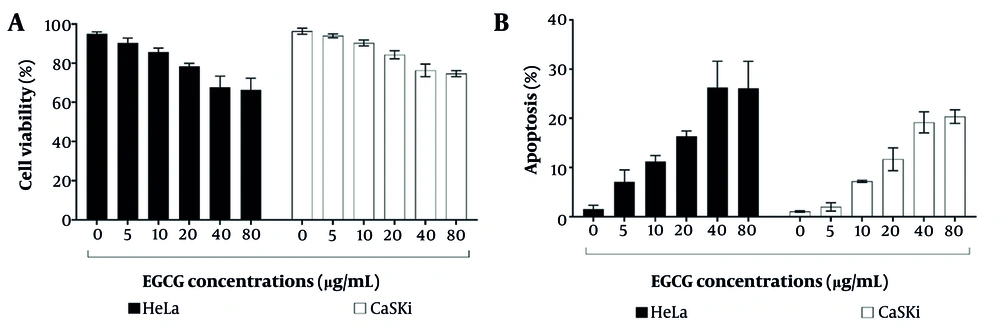
Figure 1.
The viability of HeLa and CaSki cell lines (A) and the apoptosis rate (B) after treatment with 0, 5, 10, 20, 40, and 80 µg/mL epigallocatechin-3-gallate (EGCG). Cells were treated with EGCG for 72 hours, and cell viability and apoptosis were measured by MTT assay and flow cytometry, respectively (n = 3).
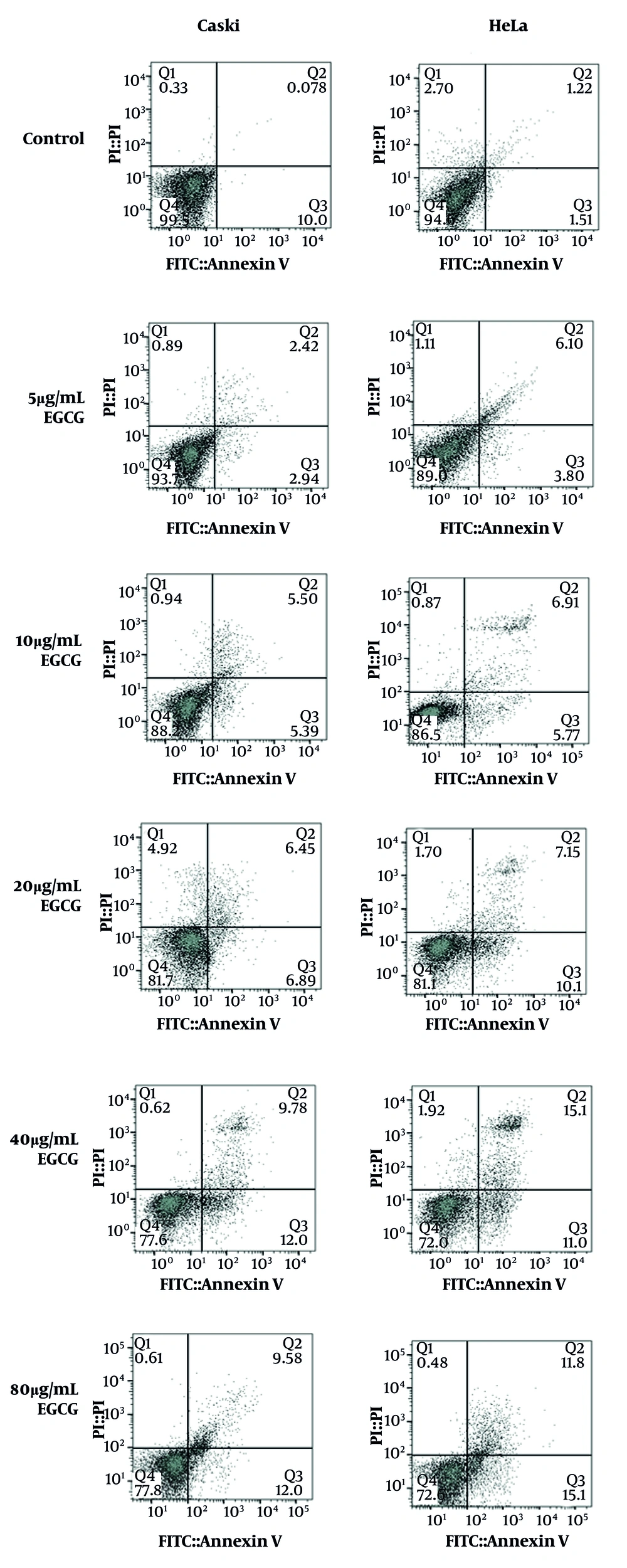
Figure 2.
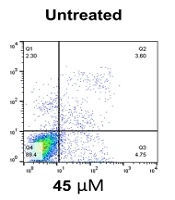
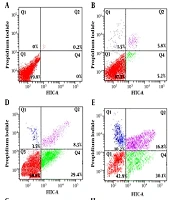
Histograms obtained from flow cytometry to measure the rates of apoptosis in the cervical cancer cells
Additionally, EGCG exposure significantly increased the apoptosis rate in cells. A significant rise in apoptosis was observed in HeLa cells at 10 μg/mL (P = 0.001) and at 20, 40, and 80 μg/mL (P < 0.0001). In CaSki cells, the increase in apoptosis at 10 μg/mL EGCG was not statistically significant (P = 0.075). Notably, there was no significant difference in the percentage of apoptosis between the two cervical cancer cell lines when exposed to 80 or 40 μg/mL EGCG (Figures 1 and 2).
4.2. Gene Expressions
4.2.1. bax and bcl-2
Both HeLa and CaSki cervical cancer cell lines showed overexpression of bax in response to EGCG, whereas bcl-2 was downregulated. In HeLa cells, EGCG at concentrations of 10 μg/mL (MD: -0.206, 95% CI: -0.399 to -0.014, P = 0.030), 20 μg/mL (MD: -0.706, 95% CI: -0.899 to -0.513, P < 0.001), 40 μg/mL (MD: -0.904, 95% CI: -1.097 to -0.711, P < 0.001), and 80 μg/mL (MD: -0.893, 95% CI: -1.097 to -0.711, P < 0.001) significantly upregulated bax compared with untreated cells. Similarly, CaSki cells showed significant bax overexpression in response to 10 (P = 0.047), 20, 40, and 80 μg/mL (P < 0.001) EGCG. Notably, the highest bax expression was observed at 40 and 80 μg/mL EGCG in both cervical cancer cell lines (Figure 3A).
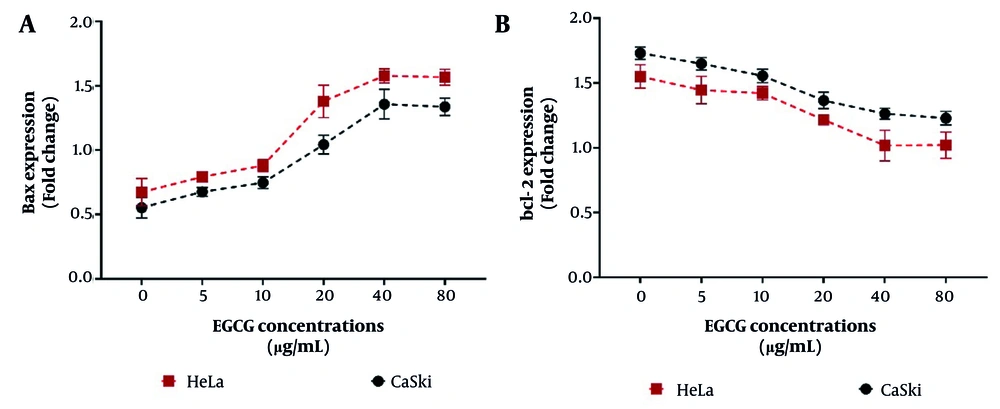
Figure 3.
The expression of bax (A) and bcl-2 (B) genes in HeLa and CaSki cell lines after treatment with 0, 5, 10, 20, 40, and 80 µg/mL epigallocatechin-3-gallate (EGCG). Cells were treated with EGCG for 72 hours, and gene expression was measured by qRT-PCR (n = 3).
Conversely, treatment with EGCG was associated with downregulation of bcl-2. In HeLa cells, exposure to 20 μg/mL (MD: 0.334, 95% CI: 0.150 to 0.517, P < 0.001), 40 μg/mL (MD: 0.533, 95% CI: 0.349 to 0.716, P < 0.001), and 80 μg/mL (MD: 0.529, 95% CI: -0.158 to 0.208, P < 0.001) EGCG resulted in significantly reduced bcl-2 expression compared with untreated cells (Figure 3B). Similarly, CaSki cells exhibited decreased bcl-2 expression in response to EGCG at 20 μg/mL (MD: 0.365, 95% CI: 0.182 to 0.549, P < 0.001), 40 μg/mL (MD: 0.467, 95% CI: 0.284 to 0.651, P < 0.001), and 80 μg/mL (MD: 0.502, 95% CI: 0.319 to 0.682, P < 0.001).
4.2.2. CASP3 and CASP9
Caspase-3 (CASP3) gene expression in HeLa cells was significantly upregulated by 40 μg/mL EGCG [mean difference (MD): -0.342, 95% CI: -0.583 to -0.100, P = 0.0025] and 80 μg/mL (MD: -0.346, 95% CI: -0.588 to -0.110, P = 0.0022). By contrast, EGCG at 5 μg/mL (P = 0.973), 10 μg/mL (P = 0.560), and 20 μg/mL (P = 0.165) had no significant effect on CASP3 expression in HeLa cells. In CaSki cells, CASP3 expression was significantly upregulated only at 40 μg/mL (MD: -0.256, 95% CI: -0.498 to -0.014, P = 0.033) and 80 μg/mL (MD: -0.245, 95% CI: -0.487 to -0.003, P = 0.044) compared with untreated cells (Figure 4A).
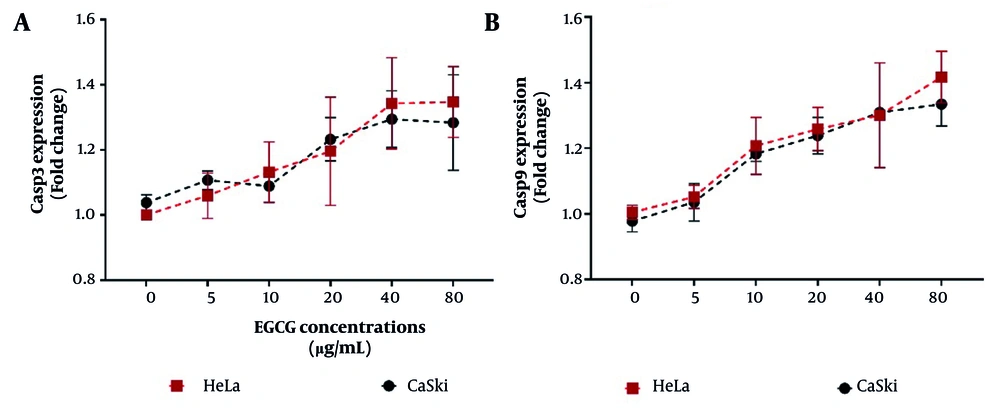
Figure 4.
The expression of CASP3 (A) and CASP9 (B) genes in HeLa and CaSki cell lines after treatment with 0, 5, 10, 20, 40, and 80 µg/mL epigallocatechin-3-gallate (EGCG). Cells were treated with EGCG for 72 hours, and gene expression was measured by qRT-PCR (n = 3).
CASP9 was significantly overexpressed in both HeLa and CaSki cells when exposed to: 10 μg/mL (HeLa: P = 0.017; CaSki: P = 0.015), 20 μg/mL (HeLa: P = 0.002; CaSki: P = 0.001), 40 μg/mL (HeLa: P < 0.001; CaSki: P < 0.0001), and 80 μg/mL (HeLa: P < 0.0001; CaSki: P < 0.0001) EGCG, relative to untreated cells (Figure 4B).
4.2.3. p53 and EGFR
Both HeLa and CaSki cells upregulated p53 expression in response to exposure to EGCG at 10–80 μg/mL, with the highest p53 expression observed in cancer cells exposed to 40 and 80 μg/mL EGCG (Figure 5A). In contrast, these cervical cancer cell lines downregulated EGFR expression in response to EGCG at 20 μg/mL (HeLa: P = 0.007; CaSki: P = 0.003), 40 μg/mL (P < 0.001), and 80 μg/mL (P < 0.0001). The lowest EGFR expression was quantified in the cells treated with 40 μg/mL (HeLa: MD = 0.454; CaSki: MD = 0.340) and 80 μg/mL EGCG (HeLa: MD = 0.441; CaSki: MD = 0.363) (Figure 5B).
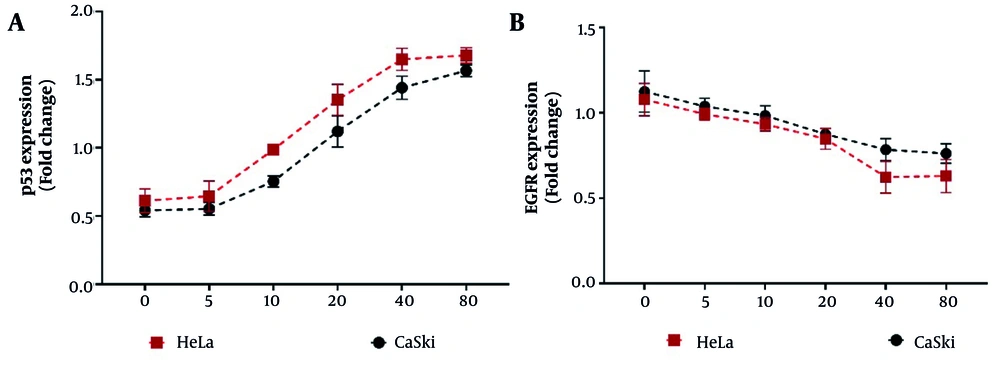
Figure 5.
The expression of p53 (A) and EGFR (B) genes in HeLa and CaSki cell lines after treatment with 0, 5, 10, 20, 40, and 80 µg/mL epigallocatechin-3-gallate (EGCG). Cells were treated with EGCG for 72 hours, and gene expression was measured by qRT-PCR (n = 3).
5. Discussion
Cervical cancer, as a common malignancy, is associated with substantial mortality and morbidity (16). Key therapeutic modalities include surgery, radiotherapy, chemotherapy, and immunotherapy; each is linked to notable adverse effects (17), which necessitates the development of new therapeutic approaches. In this research, we evaluated the impacts of varying concentrations of EGCG on two cervical cancer cell lines, HeLa and CaSki. Our findings show that EGCG exerts cytotoxic effects, particularly at higher concentrations (40 and 80 μg/mL), against cancer cells, and cancer cell death was accompanied by apoptosis. Gene expression analysis revealed that EGCG upregulated bax, CASP3, CASP9, and TP53 (p53) transcripts, while downregulating bcl-2 and EGFR transcripts in cancer cells. Collectively, these results suggest that the cytotoxic effects of EGCG are mediated, at least in part, by activation of the mitochondrial (intrinsic) apoptotic pathway and by inhibition of proliferative signaling via the EGFR pathway.
The EGCG is one of the most important catechin compounds in several plants, particularly green tea, and has shown a broad spectrum of biological effects, including antioxidant, anti-obesity, anti-inflammatory, anti-diabetic, and anticancer effects (18). The anticancer activities of this natural product are exerted through modulation of multiple signaling pathways (12). In this study, we observed that EGCG exerted anticancer effects against both HeLa and CaSki cervical cancer cell lines, accompanied by the induction of apoptosis. Our findings align with numerous studies reporting anticancer effects of EGCG across a variety of malignancies (19-21). Notably, in this study, 40 μg/mL EGCG had strong cytotoxic effects against both ovarian cancer cell lines. This contrasts with Zhang et al., who reported that 80 μg/mL EGCG induced maximal cell death in hepatocellular carcinoma HCCLM6 cells, suggesting cell-type–specific sensitivity to EGCG (22). Differences in cell type may account for this discrepancy, indicating that HeLa and CaSki cells may be more sensitive to EGCG. Another study reported that 40 μg/mL EGCG significantly inhibited proliferation of Hep3B cells (23), consistent with our observation that this concentration can induce substantial cytotoxic effects.
This study showed that EGCG overexpressed bax, CASP3, CASP9, and p53 genes, while downregulating bcl-2 and EGFR in cancer cells. These findings indicated that EGCG promotes a shift toward pro-apoptotic signaling in cancer cells, as evidenced by the upregulation of bax, CASP3, CASP9, and p53 transcripts alongside the downregulation of anti-apoptotic bcl-2 and the growth/survival receptor EGFR. Increased bax can disrupt mitochondrial membrane integrity, facilitating cytochrome c release and activation of the caspase cascade, highlighted by elevated CASP9 and CASP3 transcriptional signals (24). The concurrent rise in p53 suggests a p53-mediated transcriptional response to cellular stress, reinforcing apoptotic pathways and potentially enhancing DNA damage surveillance (25, 26). Suppression of bcl-2 removes a critical brake on mitochondrial outer membrane permeabilization, synergizing with Bax to promote apoptosis (27). Reduced EGFR transcripts may diminish proliferative and survival signaling, further tipping the balance toward cell death rather than growth (28, 29). Collectively, these gene expression changes support a mechanistic model where EGCG activates intrinsic apoptosis and suppresses pro-survival cues, offering a molecular rationale for its anticancer effects in this context.
It seems that EGCG elicits a dose-dependent alteration of key regulatory pathways in cervical cancer cells, upregulating the tumor suppressor p53 while concurrently suppressing the receptor tyrosine kinase EGFR. The concordant changes in p53 and EGFR expression may reflect a coordinated cellular response to EGCG that contributes to reduced proliferation and increased apoptotic signaling in these cell lines. However, this study was conducted in vitro, which is one of the limitations of this study, and generalization of the findings of this research to clinical conditions should be done with caution. Therefore, further mechanistic studies are warranted to dissect the upstream regulators mediating EGCG’s effects on p53 and EGFR expression. Finally, functional validation (protein levels) would strengthen the link between transcript changes and cell fate.
5.1. Conclusions
Our data indicate that EGCG exerts dose-dependent cytotoxic effects on cancer cells, with the most pronounced cell death observed at higher concentrations (40 and 80 μg/mL), predominantly via apoptosis. The observed transcriptional profile supports activation of the intrinsic (mitochondrial) apoptotic pathway, evidenced by upregulation of pro-apoptotic bax, caspases (CASP3 and CASP9), and p53, together with downregulation of anti-apoptotic bcl-2. Concurrent suppression of EGFR suggests reduced pro-survival signaling, which may further sensitize cells to apoptotic death. Collectively, these results propose a mechanistic model in which EGCG initiates mitochondrial-dependent apoptosis and attenuates growth/survival pathways in cancer cells. Future studies validating these findings at the protein level and assessing functional apoptosis will strengthen the translational potential of EGCG as an anticancer agent.