1. Background
Diabetes is the most common endocrine disease and a disorder of carbohydrate metabolism, characterized by high levels of glucose in the blood. Increased blood glucose, resulting from defects in insulin secretion or action, is associated with disturbances in the metabolism of carbohydrates, fats and proteins (1). Nowadays, diabetes is a major threat to global public health and its incidence is on a rise worldwide, being responsible for direct spending of 2.5 - 15% of the total health budget in most of countries and for the multiplication of indirect costs (2, 3). There are two main types of diabetes: type 1 and type 2. Type 1 diabetes occurs when insulin-producing cells, pancreatic beta cells, are destroyed, and the body is unable to produce insulin, which must be provided by daily multiple insulin injections for treatment (4). Type 2 Diabetes (T2D) means that the body is still able to produce insulin, although in most cases it is not enough to cover the body’s necessities, and becomes evident when the produced insulin, or its cellular receptor, do not work properly, finally leading to insulin therapy after a variable time interval of oral treatment (pills) (5). Patients with T2D that have an unsatisfactory glycemic control (6) may develop common complications of diabetes, namely retinopathy, nephropathy and neuropathy (7). Various studies have shown that social isolation, stress and obesity can be the triggers of Type 2 Diabetes and also, are major risk factors for mortality in humans (1, 8, 9). Oxytocin (OXT), a nine-amino acid neuropeptide hormone, synthesized in the hypothalamus (10) is implicated in a variety of social behaviors, like the control of stress responses (11), feeding behavior (12), metabolic syndrome (8) and obesity (13), as well as energy balance, such as weight gain or weight loss (14, 15). Studies have shown that OXT has anti-diabetic and obesity effects (16, 17). Limited evidence indicates an increased oxytocin production in patients with type 1 diabetes (18). Interestingly, OXT is involved in glucose homeostasis by glycogenolysis (19), gluconeogenesis (18) and glycogenesis (20) and also, plays a central role in the control of carbohydrate metabolism in human (21-24) and animal models (25). The OXT can regulate peripheral insulin sensitivity and insulin secretion (26, 27). The actions of OXT are mediated by OXT Receptor (OXTR) that is widely distributed within the brain, including the amygdala, Hypothalamus-Pituitary-Adrenal axis (HPA) (28, 29) and peripheral tissue (30). The OXTR gene, located on chromosome 3, is composed of four exons and three introns. The OXTR gene product is a transmembrane chain of seven domains, belonging to class 1 G proteins (31). Previous obtained data have shown that OXTR activity is necessary for a variety of processes; for example, in the Prader-Willi syndrome, there are deficits of OXT in neurons, while experimental OXTR-deficient animal models show hyperphagia and an increased meal size (32-34). The OXT-OXTR system is necessary for optimal human health. In the recent years, published data showed that genes have an important role in the pathogenesis of T2D (35). Knowledge of polymorphism can be helpful in identifying patients susceptible to T2D disease. However, the role of OXTR polymorphism in carbohydrate metabolism and its effects under various catabolic conditions, especially in T2D, are not clear. Consequently, an investigation on the relationship between OXTR polymorphism and T2D patients, as compared to healthy controls, would be interesting.
2. Objectives
In this study the possible correlation between OXTR gene polymorphism and the risk of T2D was evaluated in a sample of the Iranian population.
3. Patients and methods
3.1. Patients
The protocol of this study was approved by the Ethics Committee of Zahedan University of Medical Sciences, Zahedan, Iran. Subjects were diagnosed with T2D if they had fasting blood sugar of > 126 mg/dL, HbA1C > 6.7% and determined proteinuria and T2D confirmed by a physician. Healthy controls were selected from Ali Asghar Hospital, Zahedan, Iran. Fasting blood sugar of the controls was normal, and they had no family history of diabetes and specific systemic disease. A blood sample was taken from all subjects and collected in Ethylene diamine tetra acetic acid (EDTA)- tubes and stored at 20°C until DNA extraction.
Genomic DNA was extracted from peripheral blood of 120 subjects with T2D and 120 healthy controls, using the salting-out method. The DNA extracts were analyzed by electrophoresis. By NanoDrop, DNA concentrations of about 60 µg/ml were obtained and the ratio of 260/280 nm between 1.7 - 1.9 were considered appropriate.
In the OXTR (rs53576) T/C were detected by Allele-Specific Primer (ASP)–Polymerase Chain Reaction (PCR). For OXTR (rs2254298) A/G Restriction Fragment Length Polymorphism-Polymerase Chain Reaction (RFLP-PCR) was used for genotyping. Polymerase Chain Reaction amplifications were performed in a final volume of 20 μL. Briefly, 10 µL of master mix (ampliqon Taq 2x master mix, Denmark), 0.7 µL (10 pmol/mL) of each primer, 2 mL of template DNA and 6.6 µL of DNase-free water were used. For rs53576, the amplification was performed with an initial denaturation step at 95°C; followed by 30 cycles at 95°C for 60 seconds, 56°C for 35 seconds, and 72°C for 40 seconds with a final extension at 72°C for five minutes at 72°C. For Single Nucleotide Polymorphism (SNP) rs2254298, the cycling conditions were as follow: an initial denaturation step at 95°C for five minutes, followed by 30 cycles at 95°C for 30 seconds, 62°C for 25 seconds, and 72°C for 30 seconds with a final extension at 72°C for five minutes. For enzymatic digestion, 1.35 µL of buffer B 10x, 7 µL of PCR product, 0.5 µL Bsr1 enzyme, and 11.85 µL of DNase-free water were used.
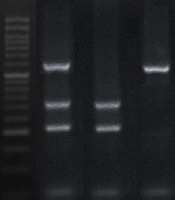
All primer sequences and fragment sizes are listed Table 1. The PCR for the rs2254298 A/G polymorphism was performed using a Forward primer (F) and sequence-Reverse primer (R) producing a 307 bp amplicon, and to digested amplification product, the enzyme Bsr1 produced parts G: 9/163/34/101bp and A: 9/163/135 bp (36) (Figure 1). For the rs53576 T/C, PCR was performed using a common Forward primer (F), and two sequence-specific Reverse primers (R1 and R2) creating a 224 bp band for both T and C alleles (Figure 2).
Table 1.
Allele-Specific Polymerase and Restriction Fragment Length Polymorphism Polymerase Chain Reaction Primer Sequences
| Primer 5’ - 3’ | Product | Method | Allele (bp) |
|---|---|---|---|
| rs2254298 | 307 bp | RFLP: BsrI | |
| F: TGAAAGCAGAGGTTGTGTGGACAGG | G 9/163/34/101 | ||
| R: AACGCCCACCCCAGTTTCTTC | A 9/163/135 | ||
| rs53576 | 224 bp | ARMS | |
| F: TGTGATTTGTACCCAGAAGG | |||
| R1: CCTGTTTCTGTGTGACTGAGGTT | |||
| R2: CCTGTTTCTGTGTGACTGAGGTC |
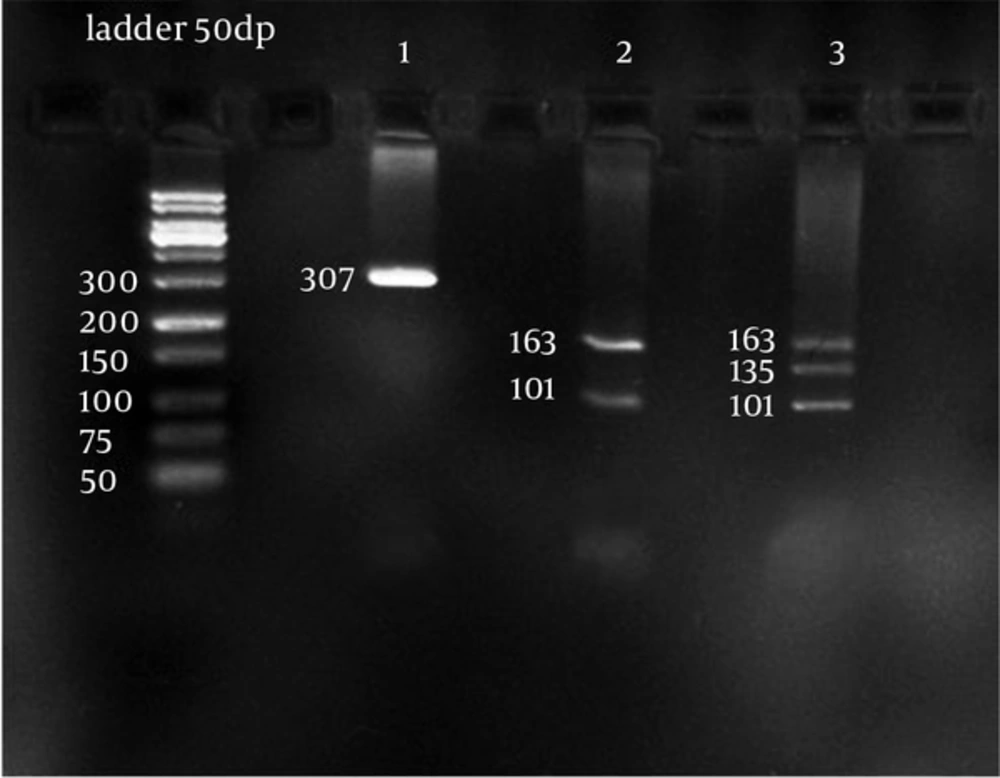
Figure 1.
Product size: 307 bp, restriction enzyme: BsrI, sample 2: G 9/163/34/101 bp, sample 3: AG 9/101/163/135 bp.
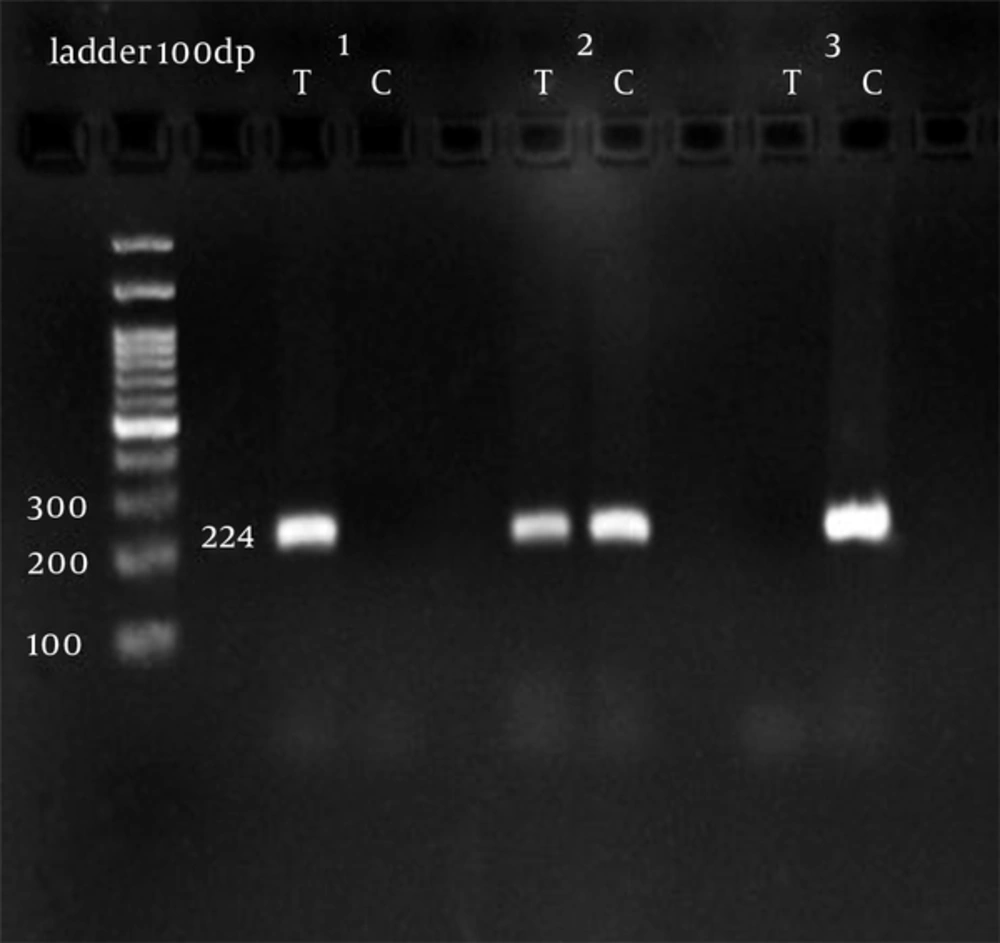
Figure 2.
Product size: 224 bp, sample 1: T, sample 2: TC, sample 3: C.
3.2. Statistical Analysis
The SPSS software version 16.0 (SPSS Inc., Chicago, IL, USA) was used for all the statistical analyses. The association between genotypes and T2D was estimated using the Odds Ratio (OR) and 95% Confidence Intervals (95% CI) from logistic regression analyses. The Hardy-Weinberg equilibrium was tested with the χ2 test for all of the Single Nucleotide Polymorphisms (SNPs) under consideration. The significance level was set at P ≤ 0.05 for all the tests.
4. Results
In this study, the allelic and genotypic distributions of OXTR polymorphism at position rs2254298 A/G were not significantly different between patients and controls (OR = 1.054, %95 CI: 0.557 - 1.995, P = 0.871), for the AG genotype; OR = 1.004, 95% CI: 0.547 - 1.845, P = 1 for the A allele). The AA genotype was not observed (Table 2).
Table 2.
Genotype and Allele Frequencies of Oxytocin Receptor rs2254298 Gene Polymorphism in Patients With Type 2 Diabetes and the Control Group
| Patients a,b | Control a,b | Odds Ratio (95% CI) | P Value | |
|---|---|---|---|---|
| Genotype | ||||
| GG | 96 (80) | 97 (80.8) | 1 (Ref) | - |
| AG | 24 (20) | 23 (19.2) | 1.054 (0.557 - 1.995) | 0.871 |
| AA | 0 (0.0) | 0 (0.0) | - | - |
| Allele | ||||
| G | 216 (90) | 217 (90.4) | Ref | - |
| A | 23 (10) | 23 (9.6) | 1.004 (0.547 - 1.845) | 1.000 |
a Values are presented as No (%).
b n = 120.
On the other hand, the allele and genotype frequencies of rs53576 OXTR variant, in patients with T2D and controls (listed in Table 3) showed significant differences of distribution. The frequency of TT genotype was lower in patients compared to controls (15.8% versus 25.8%), with the difference being statistically significant (OR = 0.466, 95% CI: 0.22 - 0.94, P = 0.035).
Table 3.
Genotype and Allele Frequencies of Oxytocin Receptor rs53576 Gene Polymorphism in Patients With Type 2 Diabetes and the Control Group
| Patients a,b | Control a,b | Odds Ratio (95% CI) | P Value | |
|---|---|---|---|---|
| Genotype | ||||
| CC | 50 (41.7) | 38 (31.7) | 1 (Ref) | - |
| TC | 51 (42.5) | 51 (42.5) | 0.76 (0.42 - 1.34) | 0.348 |
| TT | 19 (15.8) | 31 (25.8) | 0.466 (0.22 - 0.94) | 0.035 |
| Allele | ||||
| C | 151 (62.9) | 127 (52.9) | Ref | - |
| T | 89 (37.1) | 113 (47.1) | 0.66 (0.46 - 0.95) | 0.03 |
a Values are presented as No (%).
b n = 12.
The T allele, at position rs53576, had frequencies of 37.1% and 47.1% in patients and controls, respectively (OR = 0.66, 95% CI: 0.46 - 0.95, P = 0.003). Results of the Hardy-Weinberg equilibrium for all SNPs showed that the study population was in balance (data not shown).
5. Discussion
The aim of this study was to investigate the correlation between SNP candidate gene of OXTR and risk of T2D in a sample of the Iranian population. The results of this study showed a significant difference between the oxytocin receptor rs53576 (T/C) in genotype TT and T allele in the patient and control groups, emphasizing the protective role this receptor plays in T2D. However, the frequencies of the rs2254298 (A/G) OXTR gene, in the A genotype and allele, showed a negative association when analyzed against T2D risk factors.
Diabetes is the most common endocrine metabolic disorder that can reduce life expectancy by one-third (3). Diabetes affects over than 300 million people and this number will rise by 2030 (37). Poorly controlled diabetes leads to retinopathy, nephropathy and neuropathy. The T2D is a polygenic chronic disease and involves a multiple of factors, such as hormones (38). Oxytocin hormone has been implicated in socio-emotional behaviors (30), energy metabolism and also available data show that OXT in neurons can regulate the metabolic status of the body (38). Carbohydrate catabolism is modulated by oxytocin through its receptor in peripheral tissues. However, the role of OXTR polymorphism in T2D is unknown. A number of studies have shown that two of the SNP-OXTR are associated with some diseases. These SNPs are assumed to play a central role in the individual variability of stress reactivity, social behavior and autism (35, 39). For example, individuals with alleles A or AA in rs53576 of OXTR gene show reduced reactivity to high stress (40) and also present deficits in social behavior and in certain cases present autism (39). The heterozygous rs2254298 polymorphism show the highest levels of symptoms of depression (41), whereas the A allele of OXTR is associated with amygdala volume and autism (42, 43). Evidence on the associations between OXTR genotype rs2254298 and plasma concentration of OXT has been presented by previous reports (44). The data show that carriers of the A allele had increased OXT compared to the G allele. Limited studies have demonstrated the role of SNP of the OXTR gene in diabetes. Previous Whole-Genome Association (WGA) studies have shown an association between OXTR and perfect blood glucose homeostasis and thus an association with T2D in different ethnic groups. The WGA studies also indicated that SNP-OXTR could be regarded as a T2D susceptibility gene (38). In this study, we used only a sample of the Iranian population.
Previous study populations were from the four countries with a prevalence of diabetes in the family. In our study, we used only a sample of the Iranian population and the results showed a susceptibility to T2D with oxytocin receptor gene polymorphism. The rs1042778 OXTR has been considered as a risk factor among pregnant Malaysian women with gestational diabetes mellitus (45). The SNP used in their study is different from that used by our study. In this study, we aimed to evaluate the oxytocin receptor gene polymorphisms in patients with diabetes in South East of Iran. In this study, we provide evidence that oxytocin receptor gene polymorphism is a susceptibility gene for patients with type 2 diabetes. Nevertheless, our findings showed that the TT genotype and the T allele of rs53576 OXTR gene presented significant differences in the oxytocin gene polymorphisms in our population. Also, the rs2254298, in the A genotype and allele, showed a negative correlation with T2D. Therefore, it is suggested to study the OXTR in larger populations, with greater ethnic variability, so that the results could be confirmed.