
1. Background
Sleep quality is an important aspect of mental and physical health in today’s industrial world. Rapid population growth has brought about increasing demands for services, technology, and economic growth, which in turn turned industries into 24-hour or day-and-night working machines. Such 24-hour works need long shift working, which despite increased production and service delivery, leading to serious mental and physical problems for shift workers. Sleep disturbances are among the most problematic issues shift workers face. Shift work, especially night shifts, make individuals act against their biological clock, a condition giving rise to cumulative sleep need. Research has shown that there are two kinds of sleep disorders: first, a real decrease in sleep hours, and second, an instability and/or inconsistency in sleep hours. It seems that natural sleep includes different stages occurring at regular intervals throughout the night. The most important type of sleep for brain restoration, the slow-wave sleep, occurs during the first five-hour of the sleep cycle, while, among shift workers, sleep is shifted to an inappropriate time of the daily cycle when hormonal activities result in an increase in waking state (1). Therefore, it is especially difficult for night workers to keep a regular sleep habit, and their sleep might be disrupted just when they are at slow-wave sleep. The later hypothesis has been verified in survey studies performed on shift workers (1) as well as in electroencephalographic researches (2). Kolagari’s findings showed that more than a half of the nurses participated in his study faced difficulties falling asleep and experienced frequently wake ups during the night. The inadequate sleep amount led to feeling weakness and fatigue in these nurses (3).
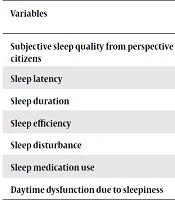
Pittsburgh Sleep Quality Index (PSQI) is a 19-item self-report questionnaire which assesses sleep quality. This questionnaire is one of the most frequently used and important instruments to study sleep quality (4). Using a clinical method, seven sleep quality components are calculated regarding the participants’ responses to PSQI, including subjective sleep quality, sleep latency, sleep duration, habitual sleep efficiency, sleep disturbances, use of sleeping medication, and daytime medication in the previous month. A total score is also calculated by summing the seven components (4-6). PSQI shows satisfactory reliability and validity when administered to patients with mental and sleep disorders (7) and physical illnesses (8). Knutson et al. (6) examined temporal stability of the PSQI in two year interval. Pearson correlation between total scores in two year interval was 0.68 for their total sample, 0.54 for black men, and 0.72 for black women (6). Shochat et al. (9) also examined the reliability and validity of the Hebrew version of PSQI and found a Chronbach's alpha of 0.72. Beck et al. (10) also examined psychometric properties of PSQI on patients with cancer and found a satisfactory internal consistency and construct validity. Cole et al. (11) examined factor structure of PSQI and concluded that a three-factor model achieves a higher goodness of fit compared to both single-factor and two-factor models. Burkhalter et al. (12); however, confirmed a three-factor model for PSQI through confirmatory factor analysis. No Iranian researches were found on psychometric properties of PSQI, but some articles used Persian versions of this questionnaire with their translations and just reported test-retest reliabilities based on very small samples (13). Since, sleep quality is a multi-dimensional concept and researches on the English versions of PSQI have approved its multi-dimensionality, it seems important to investigate the factor structure of the Persian version of PSQI as well.
2. Objectives
To evaluate the validity, reliability, and factor structure of the Persian version of PSQI in a sample of shift workers of hospitals of Kerman University of Medical Sciences.
3. Materials and Methods
3.1. Measures
Pittsburgh sleep quality index (PSQI) contains 19 self-report questions and subjects’ responses turned into seven components using clinical method for scoring. Total score of PSQI (global sleep quality) is also calculated by summing all the seven components. In the original PSQI scoring method (4), score five is considered as a cut-off, and the scores higher than five are suggestive of one’s sleep problems. As mentioned previously, several studies conducted outside Iran supported the internal consistency, temporal stability, and construct validity of PSQI. General health questionnaire-28 (GHQ-28) was developed by Goldberg and Hillier (1979), and its items were extracted based on factor analysis of the first 60-item questionnaire. This questionnaire includes four subscales of physical symptoms, sleep disturbances, social dysfunction, and severe depression (14, 15). Different studies on the validation of GHQ indicated its high reliability and validity (16-22). In Iran, a study on GHQ-28 validation was performed by Palahang et al. (23), Najafi et al. (24) and Noorbala et al. (25).
3.2. Procedure
We translated (forward translation) PSQI to Persian and then send it to occupational health and psychology experts to evaluate its content validity. The experts read our translation of PSQI and gave their comments. The purpose was to ensure that there is no ambiguity in the items, and different experts would come to a shared understanding of its items reading it. Then, backward translation was performed from Persian to English by an English language expert blinded to the content of primary questionnaire. Finally, the necessary changes were exerted on translated version of PSQI. Therefore, the Persian translation of PSQI was prepared and administered to 30 available participants to evaluate its internal consistency and item-total correlations. Results of this pilot study confirmed the internal consistency of the prepared version of PSQI. Then the questionnaires were filled by 415 participants among physicians and nurses working in hospitals of Kerman University of Medical Sciences. Finally, participants’ responses were analyzed using SPSS Statistics 17.0 (USA, SPSS Inc.) and internal consistency, concurrent validity and factor structure of PSQI was obtained. We assured confidentiality in our research by analyzing the data cumulatively and anonymously. There were no coercions for respondents to participate in our research and to respond our questionnaires. Those individuals with depression or any other severe mental disorders, derived from history taking and in-person interviews, were excluded from the study.
4. Results
Of all participants, 174 were females (41.9%) and 241 were males (58.1%). One hundred and eight participants (26%) were single, 296 (71.3%) were married and 11 (2.6%) were divorced, widows or widowers. Mean age of participants was 35.18 years. Average education and work years were 15.33 and 11.48, respectively. Table 1 shows the demographic variables of the study population. Table 2 shows inter-correlations of the three identified factors of PSQI. According to Table 2, correlations among all subscales are significant at 0.05 levels. These findings showed that all subscales of PSQI are correlated. To investigate the factor structure of PSQI, exploratory factor analysis (EFA) was performed with a principal components analysis (PCA), a three-factor solution and varimax rotation. KMO value was 0.58, and it was significant at 0.05. These three factors altogether explained 63.485% of the total variances in responses. Table 3 shows factor loadings of each of the seven PSQI components on the three recognized factors with varimax rotation. The correlation between PSQI and GHQ-28 scores was 0.479 which was significant at 0.01 (P ≤ 0.01).
Table 1.
Demographic Characteristics of Study Sample a
| Characteristics, n = 415 | Results |
|---|---|
| Gender | |
| Male | 174 (41.9) |
| Female | 241 (58.1) |
| Marital status | |
| Single | 119 (28.7) |
| Married | 296 (71.3) |
| Employment | |
| Official | 192 (46.3) |
| Contractual | 223 (53.7) |
| Working schedule | |
| Day work | 208 (50.1) |
| Shift work | 207 (49.9) |
| Second job | |
| Yes | 31 (7.5) |
| No | 382 (92.5) |
| Smoker | |
| Yes | 13 (3.3) |
| No | 385 (96.7) |
| Job title | |
| Physician | 25 (6.0) |
| Nurse | 390 (94) |
aData are presented in No. (%).
Table 2.
Inter-Correlations between the Three Identified Factors in Pittsburgh Sleep Quality Index
| Sleep Efficiency | Perceived Sleep Quality | Daily Malfunctioning | |
|---|---|---|---|
| Daily malfunctioning | 1 | 0.495 a | 0.133 b |
| Perceived sleep quality | - | 1 | 0.105 b |
| Sleep efficiency | - | - | 1 |
aCorrelation was significant at the 0.01 level.
bCorrelation was significant at the 0.05 level.
Table 3.
Seven-Factor Loadings of Pittsburgh Sleep Quality Index PSQI Obtained From Varimax Rotation
| Daily Malfunctioning | Perceived Sleep Quality | Sleep Efficiency | |||
|---|---|---|---|---|---|
| Components | Factor Loadings | Components | Factor Loadings | Components | Factor Loadings |
| C7 (daytime dysfunction) | 0.782 | C2 (sleep latency) | 0.844 | C4 (habitual sleep efficiency) | 0.852 |
| C5 (sleep disturbances) | 0.447 | C5 (sleep disturbances) | 0.602 | C3 (sleep duration) | 0.801 |
| C1 (sleep quality) | 0.69 | C6 (use of sleeping medication) | 0.583 | -- | -- |
5. Discussion
Current study focused on the translation and validation of the Persian version of PSQI. Results indicated an appropriate internal consistency (Chronbach’s alpha of 0.55) for its clinically calculated seven components. These findings were consistent with that of English version of PSQI (6-10). The Persian version of PSQI had also an appropriate internal consistency. Inter-correlations between the three dimensions of PSQI (Table 2) showed that different dimensions of PSQI are correlated, and each of the three dimensions assesses a relatively separate and unique concept. In the next step, exploratory factor analysis was conducted to find some evidence concerning goodness-of-fit of the three-factor model. Results showed that a clear factor structure of PSQI is obtained through principal components analysis using varimax rotation. This indicates that the three-factor model of PSQI is also applicable for the Persian version of PSQI. These findings are completely consistent with the findings obtained from factor analysis of PSQI in English speaking countries (11, 12), and that the three-factor model is applicable for the Persian PSQI too. Table 3 shows that component 5 of PSQI was loaded on both perceived sleep quality and daily malfunctioning simultaneously.
This indicates that there are some associations between the dimensions of sleep quality. The first component loaded on daily malfunctioning but did not load significantly on the perceived sleep quality. Factor analysis on the English versions of PSQI (11, 12) showed that the first component was expected to be loaded on perceived sleep quality. Two reasons can be assumed for this: first, this difference in findings is likely to be due to cultural differences in understanding the questionnaire items. For instance, Persian speakers might have found item 9 (which plays a significant role in calculating the first component) more related to sleep disturbances and have responded to it with such view. If it would be the case, the three-factor model would still be applicable to Persian culture with small modifications. Second fact is that respondents might have not clearly understood how to answer the item 9. This issue can be overcome by rewriting item nine in following studies. Finally, the relatively powerful and significant correlation between the Persian version of PSQI with GHQ-28 scores indicated that PSQI shows a proper concurrent validity. That is because sleep health is reasonably related to the total mental health of individuals, also confirmed by the findings of the present study. This study aimed at adaptation and validation of PSQI for the Persian language and Iranian society. According to the results of all tests and measurements, it seems reasonable to state and conclude that the Persian version of PSQI had a proper validity and reliability in our study sample. Therefore, it is recommended to investigate sleep quality by using this index in further investigations. Of course, it is evident that using every index for measuring factors and variables of workplace health requires investigation and evaluation of its reliability and validity in that context.