
1. Background
Nutritional concerns about cereal-based diets are important issues worldwide, especially vitamin and mineral deficiency in susceptible individuals such as children younger than five years and women at reproductive age (1). Mineral compounds are essential to daily food needs (2). Bread is an important food products that furnishes as much as 50% to 90% of total calorie and protein intakes (3). Because of high consumption of wheat in a variety of food products, it is considered an important source of mineral compounds (1). Heavy metals are the most noxious materials, due to no biodegradability and their potential to cause inappropriate effects (4, 5). The presence of heavy metals in food is determined by some factors such as environmental parameters, mode of production, and processing (6, 7). The effect of environmental pollution on contamination of foods and on their safety for human consumption is a serious global issue (8, 9). Many reports have investigated the heavy metals contents in foodstuff (10-12). Some heavy metals such as lead (Pb), cadmium (Cd), and nickel (Ni) are extendedly used in various industrial centers (13). These elements are non-essential materials for nearly all living creatures. Pb, Cd, and other heavy metals can enter wheat flour and then bread (10, 13). It has been reported that all types of grain contain trace metals such as iron (Fe), manganese (Mn), magnesium (Mg), copper (Cu), and zinc (Zn), which might be due to environmental condition such as weather during cultivation, rain, and levels of contamination (5, 14). Application of chemical fertilizer and using sewage sludge during the cultivation of cereals will substantially increase the levels of Pb, Zn, and Cd (9). Food processing equipment and containers have been long recognized as a source of trace metals such as Fe, Cu, Pb, and chromium (Cr) in the processed foods (14). Iranian breads like, Barbari, Lavash, Taftoon, and Sangak are mainly produced from wheat flours (10). The important subject in field of food sciences is daily intake of food materials (1, 2). The daily intake of bread in Iran is 420 gram per person (15). This quantity in the United States, the West Europe, Russia, and Turkey is 55, 274, 164, and 400 gram per person. Mean daily intake of bread in the world is 330 to 410 gram per person (12).
2. Objectives
The aim of this study was to determine the contents of heavy metals including Pb, Cd, Cr, Ni, Co, arsenic (As) in selected samples of breads that were baked in bakeries (124 bakery stores) of Rasht City in 2013. In addition, the daily intake of these heavy metals was determined based on bread per capita consumption.
3. Materials and Methods
In this study, 40 samples of several types of bread were collected from bakeries in different areas of Rasht city, center of Guilan province, Iran. This research was performed by two duplicates with a replicates. There are different types of bakery in north provinces of Iran. These bakeries produce several types of bread such as Barbari, Lavash, Sangak, and Baguette. Forty pieces of these breads were randomly collected from 124 bakeries at different areas of Rasht City in 2013. Bread samples were prepared according to Khaniki et al. (10). First, the bread samples were left to air dry before sub-sample were taken from each group and then were ground with Titanium knives and stored in high-density polyethylene bottles with 100 mL capacity. These bottles were washed with 1% hydrochloric acid and raised with deionized water. One gram of the prepared samples were precisely weighed and transferred into the 50-mL Erlene Mayer and 3 mL of 65% nitric acid was added. Total samples were located overnight at room temperature and then were heated up 130℃ for three hours using a hot plate. After cooling the samples, 2 mL of nitric acid, 0.7 mL of perchloric acid, and 43 mL of distilled water were added to each sample. Total samples were heated for three hours in temperature 230℃ and dissolved in 5 mL of distilled water. Total samples were analyzed by Inductive Couple Plasma spectrometry (ICP-Qes-Spectro arcos, Germany) to determine the heavy metal content. Working condition of the used ICP instrument is presented in Table 1.
Table 1.
Flame Conditions and Other Characteristics of Instrument for the Measurement of the Heavy Metals a
| Element | Wave Length, nm | Detection Limit, ppb |
|---|---|---|
| As | 189 | 1.19 |
| Pb | 283.3 | 2.1 |
| Cd | 228.8 | 0.05 |
| Cr | 267.7 | 0.1 |
| Co | 228.6 | 0.05 |
| Ni | 231.6 | 0.3 |
a Instrument conditions, ICP-QES (Spectro arcos); pump rate, 30 rpm; ICP torch injector, 2.5 mm; RF power, 1400 w; plasma gas flow rate, 14.5/min; auxiliary gas flow rate, 0.9/min; and nebulizer gas flow rate, 0.85/min.
3.1. The Daily Intake of Heavy Metals Through Bread Consumption
The daily intake of heavy metals through bread consumption was determine with the following equation (1, 2):
DIH.M = Daily Intake of Heavy Metal (μg/kgday).
C = Heavy Metal Concentration in Bread (mg/kg).
DIBread = Average Daily Intake of Bread (g/day).
BW = Body Weight (kg). In this study, body weight was determined as 65 kg.
According to Food and Drug Organization of Iran, average daily intake of bread in Iran is 420 gram per person (15).
4. Results
4.1. Heavy Metals Contents in the Different Breads
The results of this study showed that the concentration of Pb, Cd, Cr, Ni, and Co in the Barbari bread samples ranged respectively from 0 to 1.3, from 0.025 to 0.4, from 0.7 to 2.8, from 0.5 to 2.4, from 0.2 to 1.8, and from 0.016 to 0.1 mg/kg. The Pb, Cd, Cr, Ni, and Co contents in Sangak bread ranged respectively from 0 to 2.7, from 0 to 0.15, from 0.86 to 2.3, from 0.47 to 0.88, from 0 to 0.8, and from 0.01 to 0.15. The concentration of the studied heavy metals, ie, Pb, Cd, Cr, Ni, and Co in Lavash ranged respectively from 0 to 1.4, from 0 to 0.05, from 0.34 to 1.76, from 0.24 to 0.75, from 0 to 1, and from 0.02 to 0.16 mg/kg. According to these results, Pb, Cd, Cr, Ni and Co content of Baguette breads ranged respectively from 0 to 3.3, from 0 to 0.3, from 0.71 to 1.38, from 0.35 to 1.58, from 0 to 0.2, and from 0.01 to 0.14 mg/kg. In this study, the concentration of As was below detection limits in all of the samples (Table 2).
Table 2.
Daily Intake of the Studied Heavy Metals by the Bread Consumption a
| Type of Bread | Pb | Cd | Cr | Ni | Co | As | Total |
|---|---|---|---|---|---|---|---|
| Barbari | 4.7 | 0.4 | 8.4 | 7.8 | 3.9 | ND | 25.6 |
| Sangak | 4.1 | 0.8 | 5.2 | 3.9 | 1.2 | ND | 15.6 |
| Lavash | 2.1 | 0.1 | 4.5 | 2.6 | 0.9 | ND | 10.8 |
| Baguette | 5.8 | 0.6 | 5.8 | 4.5 | 0.5 | ND | 17.6 |
| Value b | 4.2 | 0.5 | 6 | 4.7 | 1.6 | ND | 17.5 |
| DI, μg/kg c | 3.6 | 1 | - | - | - | 2.5 | - |
| PTWI d | 25 | 7 | - | - | - | 15 | - |
a Abbreviations: ND, non-detectable; DI, daily intake; PTWI, provisional tolerable weekly intake.
b Data are presented as mean.
c FAO/WHO daily intake.
d FAO/WHO provisional tolerable weekly intake.
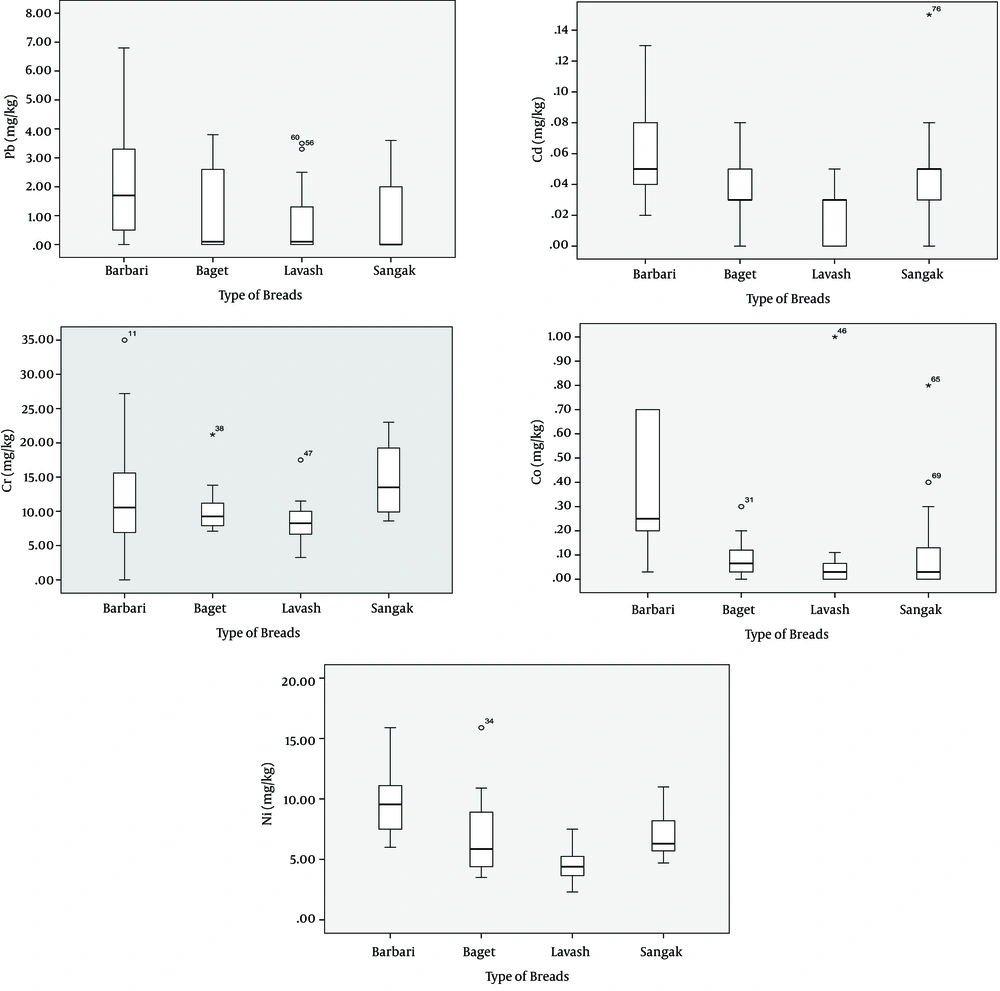
Figure 1.
Mean Contents of Heavy Metals in the Investigated Breads
4.2. The Daily Intake of Heavy Metals Through Bread Consumption
In Table 2, daily intake of the studied heavy metals was presented. The daily intake of Pb, Cd, Cr, Ni, and Co ranged respectively from2.1 to 5.8, from 0.1 to 0.8, from 4.5 to 8.4, from 2.6 to 7.8, and from 0.5 to 3.9 μg/kg.
5. Discussion
We investigated the levels of heavy metals for the 40 samples of different breads collected from bakeries of Rasht city. In this research, the average values of Cr for the different breads were more than other heavy metals. The levels of Cr in the bread samples ranged from 0.34 to 2.7 mg/kg and the mean contents of this element in Barbari, Sangak, Lavash, and Baguette were determined as 1.3, 0.8, 0.7, and 0.9 mg/kg, respectively. The levels of Cr had no significant difference between different breads. Cd concentrations ranged from 0 to 3.3 mg/kg, with mean level of 0.13 mg/kg in Barbari, 0.07 mg/kg in Sangak, 0.02 mg/kg in Lavash, and 0.09 mg/kg in Baguette. The mean levels of Pb in Barbari, Sangak, Lavash, and Baguette breads were 0.64, 0.73, 0.33, and 0.9 mg/kg, respectively. The levels of Pb in the bread samples showed a large variation among the different breads; the highest content of Pb in Baguette bread was approximately three-times higher than the lowest level in Lavash bread. The average contents of Ni in Barbari, Sangak, Lavash, and Baguette breads were found to be 1.2, 0.6, 0.4, and 0.7 mg/kg with no statistically significant differences among them. The levels of Ni in all breads ranged from 0.24 to 2.8 mg/kg. The Co levels in the studied breads ranged from 0 to 1.8 mg/kg and the mean contents of this metal were 0.6, 0.19, 0.14, and 0.07 mg/kg respectively in Barbari, Sangak, Lavash, and Baguette breads. Barbari had the highest average levels of Co among other breads. In this study, As could not be detected in samples. The results revealed the order of heavy metals concentrations in bread samples were as follows: Cr > Ni > Pb > Co > Cd > As. Khaniki et al. studied heavy metals contents in the different breads. In this study, variation of Pb, Cd, and Ni have been found to range respectively from 0.27 to 0.52, from 0.12 to 0.65, and from 0.45 to 2.67 mg/kg (10). Jawad et al. showed that contents of Pb and Cd in the breads of Baghdad were respectively 0.33 and 0.07 mg/kg (6). Harmankaya et al. reported Cr, Ni and Zn levels in the breads of Turkey to be 0.47, 0.72, and 20.9 mg/kg, respectively (13). In another research, mean levels of Cd, Cr, and Ni in the flour of breads in Kalabar City (Nigeria) were determined as 0.002, 0.012, and 0.06 mg/kg, respectively, while Hg and As were not detected in these breads (16). Magomia et al. found that Pb and Cd contents in the breads range from 0.34 to 3.13 and from 0.013 to 0.098 mg/kg, respectively (17). Tumir et al. showed that the levels of Pb, Cd, As, Hg, and Cr range from 0.25 to 3.86, from 0.05 to 0.28, from 0.1 to 0.19, from 0.02 to 0.12, and from 0.11 to 64.4 mg/kg, respectively, in dietary supplements on the Croatian market (18). In another research in Tenerif City of Spain, mean contents of Pb and Cd in the wheat of breads were determined as 0.037 and 0.027 mg/kg, respectively (19).
Estimated daily intake of Cd, Pb, Cr, Ni, and Co according to consumption of different breads was performed using market basket. The daily intake of Cd, based on Barbari, Sangak, Lavash, and Baguette breads consumption were 0.4, 0.8, 0.1, and 0.6 μg/kg, respectively, with the mean of 0.5 μg/kg. Estimated daily intake of Cd through diet, calculated for a standard individual, was 15.66 μg per day (2). The daily intake of Pb from the breads samples were 4.7, 4.1, 2.1, and 5.8 μg/kg, respectively, with the mean of 4.2 μg/kg. Estimated Pb intake for a standard individual was 28.37 μg per day and the largest proportion of this intake corresponds to cereals, with 4.94 μg/kg, followed by fish and meat with respectively 4.71 μg/day and 4.44 μg/day (20). Llobet et al. determined the most daily intake contents of As, Cd, Hg, and Pb from foodstuff in Catalonia to be respectively 223.6, 15.7, 21.2, and 28.4 μg/day (21). In this research, the mean daily estimated intake for Cr, Ni, and Co from different breads was respectively 6, 4.7, and 1.6 μg/kg.
Different factors affect the heavy metals contamination in foodstuff and breads. One of the most important contaminations source of breads is environmental pollution, especially agricultural soils pollution with heavy metals (13). In these areas, heavy metals are transferred to roots of agricultural plants such as wheat, rice, and other cereals. Another way of heavy metals contamination is preparation and processing operations in the consumed breads. During the processing and preparation of breads, some additive materials such as contaminated water, salt, yeast, and baking soda can contaminate the breads with heavy metals (10). in addition, bread baking in the metal trays (10), contaminated bakery ovens due to lack of surveillance, and fuels contaminated with heavy metals (7) are other contamination parameters. Secondary pollution with heavy metals in the breads includes packaging and urban and bakery air pollution are other ways of bread contamination.