
1. Background
Heat is considered a harmful agent in many workplaces. Heat stress is caused by internal and external factors that lead to a feeling of fatigue and sickness in humans. Internal factors include the internal temperature of the body, the ability of environmental adjustment and the metabolic rate. Moreover, some external factors such as ambient temperature, air velocity and humidity are important factors in heat stress value (1). In addition, obesity and overweight might be a risk factor affecting heat generation and excretion.
Obesity is a problem worldwide, including in Iran. Recent research has shown that the prevalence of overweight and obesity is increasing in both developing and developed countries (2, 3). Obesity causes other diseases, including cardiovascular disease, hypertension, hyperlipidemia, diabetes mellitus and different kinds of cancer (4). Moreover, the life expectancy has decreased seven years in obese subjects with the age of forty (5). Several studies have reported the prevalence of obesity in different parts of the world. In 2005, 937 million and 369 million were overweight and obese, respectively. These numbers have doubled compared to 25 years ago (6). It is predicted that the number of overweight and obese people worldwide will be 1.3 billion and 573 million in 2020, respectively (7). In urban areas of Iran, the overweight prevalence among the population aged 15 - 39 years and 40 - 69 years is estimated to be 22% and 40%, respectively (8). Obesity and overweight are characterized by a high body mass index (BMI) and fat percentage.
Overweight and obese people have a higher metabolic rate and a smaller ratio of body surface to body weight than people with normal weight (9). Therefore, they also have a higher heart rate than people with normal weight (10). Golbabaee et al. showed a strong correlation between the heart rate and wet bulb globe temperature (WBGT), as an index of heat stress (11). Another study on the effects of workplace heat on permanent workers found that heart rate increases by 1 bpm when the environmental temperature rises by 1°C (12). Therefore, it can be hypothesized that increasing heat stress would induce a higher heart rate among overweight individuals than individuals with normal weight.
2. Objectives
There is a high prevalence of overweight in adults, particularly workers, who can be exposed to high humidity and heat in workplaces. Heat-induced disorders may occur more among overweight individuals than individuals with normal weight. Therefore, this study examines the relationship between overweight and heart rate, which has been proposed as an indicator of heat stress (13), in hot and very hot weather under experimental conditions.
3. Patients and Methods
This experimental study was carried out with a sample of 70 healthy students of the medical university of Isfahan (35 participants who were normal weight (18 < BMI < 25) and 35 participants who were overweight and obese (BMI > 25 kg/m2)) in 2013, in hot and very hot climatic conditions in a climatic chamber located in the School of Health. Non-probabilistic sampling was used. Inclusion criteria included the absence of diseases such as cardiovascular disease, respiratory disease, musculoskeletal disease, and convulsions, and non-consumption of high blood pressure drugs and medications affecting the heart rate. All participants were asked to refrain from drinking coffee or alcohol for at least 12 hours before the day of testing. Exclusion criteria included an increased heart rate of over 180 bpm, an oral temperature over 38.5°C and fatigue (14). The participants were medically screened by a physician and were informed about the date of each trial after the physician’s confirmation. All participants gave informed consent, using the consent form developed by the medical ethics committee of the medical university of Isfahan. Prior to beginning the study, the test stages were clearly explained to the participants.
To assimilate the conditions, all participants were asked to use similar types of work clothes (30% polyester, 70% cotton). The participants’ weight was measured using a digital scale (Hamilton Model with an accuracy of 0.1 kg) and the height of the participants was measured using a wall-mounted stadiometer. Each participant was tested twice. During the first phase, each participant was asked to rest in a lying position on a bed for 30 min and the participants’ basic heart rate was recorded. Each participant then performed light exercise on a treadmill for 60 min (Kettler model) at a speed of 2.8 kmph (15), with a 10-min resting period from the 25th to 35th minute in a climatic chamber, while exposed to very hot and moderate humid climatic conditions (WBGT = 30°C, temperature (Ta) = 37°C, relative humidity (RH) = 50%) (16). While the participant was exercising, heart rate was measured every 2 min (using a sports polar tester). During the second phase, the participants were asked to rest in a lying position on a bed for 30 min. Each participant then performed moderate exercise on a treadmill for 60 minutes at a speed of 4.8 kmph (15), with a 10-min resting period between the 25th and 35th minute in a climatic chamber, while exposed to hot and moderate humid climatic conditions (WBGT = 27.5°C, Ta = 32°C, RH = 50%) (16). While the participant was exercising, heart rate was measured every 2 minutes (using a sports polar tester). During the test, oral temperature was measured every 4 mine. After ending the measuring process, BMI was calculated based on the following equation (17, 18).
To measure the amount of sweating, the participants’ weight was measured before and after each stage of exercise (using a digital scale (Hamilton Model) with an accuracy of 0.1 kg). The participants did not drink anything while exercising (19).
Data were analyzed using descriptive statistics and a one-way analysis of variance (ANOVA), with statistical package for the social sciences (SPSS) 16. The significance level was 0.05 for all tests.
4. Results
The demographic characteristics and other physical parameters of the normal weight and overweight participants are presented in Tables 1 and 2, respectively. WBGT did not significantly differ between normal weight and overweight participants in the two climatic conditions (P > 0.05).
Table 1.
Physiological and Demographic Characteristics of Subjects With a 18< BMI< 25 kg/m2
| Parameters | Range | Values a |
|---|---|---|
| Age, y | 21 - 27 | 22.72 ± 1.73 |
| Height, m | 1.65 - 1.89 | 1.76 ± 0.59 |
| Weight, kg | 57 - 80.10 | 68.72 ± 7.21 |
| Physical activity, h | 0 - 16 | 5.40 ± 3.90 |
| Body mass index, kg/m2 | 18.20 - 24.72 | 21.94 ± 1.69 |
| Hot and moderate humid condition | ||
| Sweating rate, kg | 0.10 - 1.30 | 0.61 ± 0.27 |
| Rest heart rate (RHR) | 70.33 - 91.67 | 84.14 ± 4.84 |
| Working heart rate (WHR) | 99.40 - 117.20 | 103.84 ± 3.34 |
| Very hot and moderate humid condition | ||
| Sweating rate, kg | 0.10 - 0.70 | 0.40 ± 0.14 |
| Rest heart rate (RHR) | 67.00 - 89.00 | 81.64 ± 4.00 |
| Working heart rate (WHR) | 96.13 - 104.33 | 99.56 ± 2.33 |
a Data are presented as mean ± standard deviation.
Table 2.
Physiological and Demographic Characteristics of Subjects With a BMI > 25 kg/m2
| Parameters | Range | Values a |
|---|---|---|
| Age, y | 21 - 35 | 23.71 ± 2.95 |
| Height, m | 1.65 - 1.98 | 1.76 ± 0.59 |
| Weight, kg | 73 - 111 | 85.79 ± 8.33 |
| Physical activity, h | 0 - 9 | 2.14 ± 1.55 |
| Body mass index, kg/m2 | 25.18 - 31.22 | 27.60 ± 1.71 |
| Hot and moderate humid condition | ||
| Sweating rate, kg | 0.40 - 2.20 | 0.71 ± 0.34 |
| Rest heart rate (RHR) | 64.00 - 93.33 | 88.75 ± 7.1 |
| Working heart rate (WHR) | 102.07 - 119.30 | 108.67 ± 3.27 |
| Very hot and moderate humid condition | ||
| Sweating rate, kg | 0.10 - 2.30 | 0.50 ± 0.38 |
| Rest heart rate (RHR) | 71.00 - 101.00 | 88.97 ± 6.46 |
| Working heart rate (WHR) | 99.40 - 113.07 | 105.84 ± 3.71 |
a Data are presented as mean ± standard deviation.
Mean weight, physical activity, and the ratio of the waist circumstance to hip circumstance were significantly different between the normal weight group and the overweight group in two physical activity levels in hot and very hot weather (P < 0.05). However, the mean difference of age, height and sweat rate were not statistically significant between the normal weight and overweight groups in two physical activity levels in two climatic conditions (P > 0.05).
Rest heart rate (RHR) did not significantly differ between the normal weight group and the overweight group in performing light and moderate exercise in two climatic conditions (P < 0.05). Working heart rate (WHR) significantly differed between the normal weight group and overweight group in performing light and moderate exercise in two climatic conditions (P < 0.001).
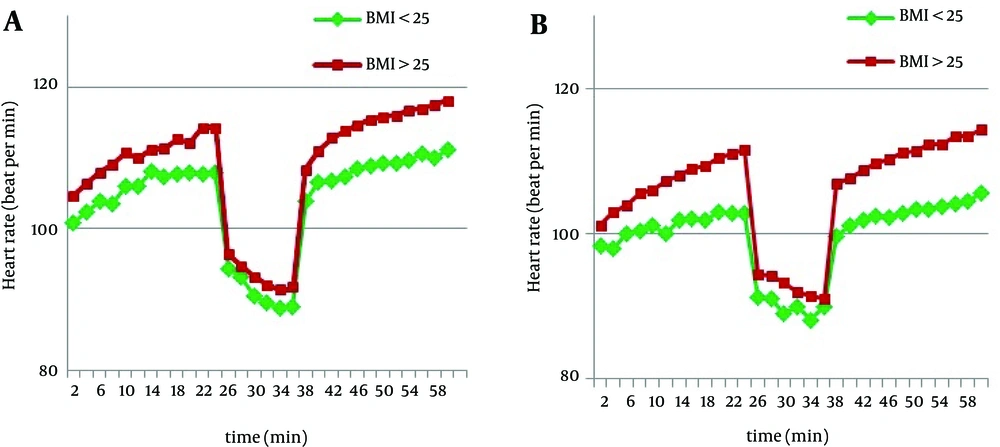
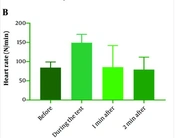
Figure 1.
A, with moderate physical activity in hot and moderate humid condition, B, with light physical activity in very hot and moderate humid condition.
The mean values of the heart rate measured every 2 min
for subjects with normal weight and subjects who were
overweight in two physical activity levels in two climatic
conditions are shown in Figure 1. Heart rate declined
beThe mean and standard deviation of the heart rate were 106.64 and 1.99 for subjects with BMI 25 - 26.9 kg/m2 and 110.02 and 3.28 for subjects with BMI > 27 kg/m2 in the hot condition and moderate exercise, respectively. The mean and standard deviation of heart rate were 102.95 and 2.94 for subjects with a BMI 25 - 26.9 kg/m2 and 107.77 and 2.83 for subjects with BMI > 27 kg/m2 in the very hot condition and light exercise, respectively.
The mean values of the heart rate measured every 2 min from the 2nd minute to the 60th minute for subjects with normal weight and subjects who were overweight (BMI 25 - 26.9 kg/m2 and BMI > 27 kg/m2) in two physical activity levels in two climatic conditions have been presented in Figure 2. The decline of the heart rate between the 25th and 35th minute in Figure 2 is due to resting in climatic chamber.
The results showed that the difference between heart rates of the three groups (18< BMI< 25 kg/m2, BMI 25 - 26.9 kg/m2 and BMI > 27 kg/m2) was statistically significant in performing light and moderate physical activity in two climatic conditions (P < 0.001). Between the 25th and 35th minute, in Figure 1 because the participants rested in a climatic chamber.
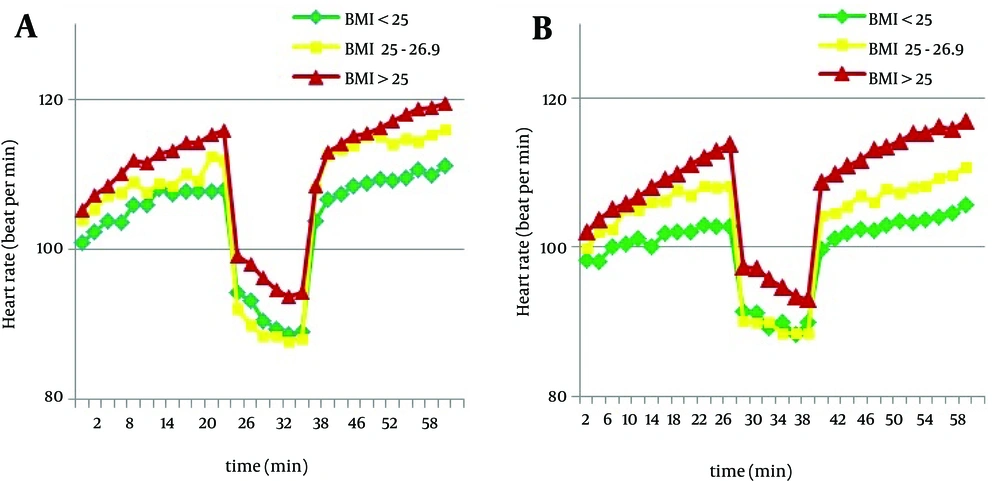
Figure 2.
A, with moderate physical activity in hot and moderate humid condition, B, with light physical activity in very hot and moderate humid condition.
5. Discussion
In this experimental study, the mean heart rate of the participants in the two conditions of hot and moderate physical activity and very hot and light physical activity was greater for participants who were overweight than participants with normal weight. All climatic parameters in the trial environment had no significant difference for all physical activity levels of both groups. Therefore, with the comparison of similar groups (in terms of type of activity type and intensity) it can be concluded that the difference between mean heart rate of the participants is not related to the climatic conditions, type of activity, and intensity of activity; however, it might have been affected by BMI.
Overweight and obesity is defined as the growth of white adipose tissue (20). This increased adipose tissue requires a higher metabolism. Therefore, the number or size of blood vessels has to increase (20). For this reason, being overweight has adverse effects on blood circulation as well as on the structure and function of cardiac vessels, because of increases in both the total blood volume and the cardiac output (21). Cardiac output also has a linear relationship with cardiac stroke volume and heart rate (22). Thus, the workload of the heart is likely to be higher in people who are overweight and obese than in people with normal weight (21). However, skin cardiovascular circulation during exercise is lower in people who are overweight than people with normal weight (23), and this may cause an increase in heat in central parts of the body in overweight or obese people. This contributes to increasing heart rate to accelerate skin blood circulation. Figures 1 and 2 show that with increasing BMI, heart rate also increases. Therefore, these mechanisms that increased BMI may be considered as a risk factor for the occurrence of heat-induced diseases (14). In experimental conditions, a strong correlation has also been reported between body fat percentage and heart rate (24). We found a significant difference in mean physical activity between the normal weight group and the overweight group in performing light and moderate activity in two climatic conditions, which may be an important factor on the results. More studies need to be carried out in order to confirm this result. Other studies illustrate the relationship between overweight and obesity and heat-induced disorders and heart rate; their findings accord with our results. For example, one study indicated that obese soldiers (as determined by BMI) in warm and humid conditions are more likely to be at risk of heat-induced disorders (odds ratio was 3.53 for obese subjects). In other words, obesity contributes to decreasing heat tolerance capacity (25). In another study of mining workers, odds ratio of heat exhaustion for the individuals with a high BMI (32 - 36.99 kg/m2) was 3.63 compared to the individuals with a BMI less than 27 kg/m2. This indicates that the individuals with a higher BMI are more at risk of exposure to heat stroke (26). Heat stroke occurs when an individual is exposed to a high temperature for a long time, resulting in dehydration, which contributes to an imbalance in the body thermoregulation system. Hence, the body would generate more heat than it is transferring to the surrounding environment. Heat exhaustion mostly occurs when the core temperature is between 38°C and 40°C and heart rate increases (27). In another study, the measured radial blood flow in individuals who were obese was considerably less than that of people with normal weight; this finding shows that heat conductivity in the body is slower among people with obesity (23). Furthermore, in another study on workers in the south of Iran (a sultry region), cardiac strain intensity was higher in workers who were overweight than those with normal weight (28).
Based on our finding, the mean heart rate was higher in participants who were overweight than those with normal weight. Thus, the risk of heat strain is more in overweight subjects than normal weight subjects. Given the fact that heart rate is considered as one of the physiological parameters for evaluating heat strain, the following suggestions could be helpful in order to control cardiac and heat strain of workers: pre-employment assessments to ensure that individuals with BMI higher than 25 kg/m2 are not employed in jobs with a high risk of heat strain and implementation of appropriate measures to counteract heat strain, such as a rest-work schedule, for overweight and obese workers.