
1. Background
Refractory materials are usually non-metallic materials that are stable at high temperature. These materials are used in different shapes, the most common of which are refractory bricks and insulating materials or refractory fibers. Mineral fibers are naturally created and among them asbestos is the most prominent type of mineral fiber and is widely used in industrial applications (1). With the advent of science and technology, in addition to synthetic fibers, synthetic vitreous fiber (SVFs) or man-made mineral fibers were introduced to the industry. The main types of SVFs are glass fibers, minerals (slag wool and rock wool), and ceramic fibers (including refractory ceramic fibers) (2).
Refractory ceramic fibers (RCFs) are synthetic amorphous fibers made from kaolin or the combination of alumina (AL2O3) and silicon dioxide (SiO2) (2). RCFs have a good thermal resistance, tensile strength, high durability, and lightweight. Although RCFs are less durable (i.e., more soluble) than the least durable asbestos fiber (chrysotile), they are more durable than most fibrous glass and other types of SVFs (1). RCF has been produced in the United States since the early 1950s. In 2006, the total RCF production in the United States was estimated to be 80 million pounds a year, representing 1% - 2% of total SVFs production worldwide (1, 3). Approximately 32,000 - 32,500 workers in the United States might be exposed to RCFs, of which 800 are directly exposed during RCF production, and the remainder is exposed to RCF products when using them (4). RCF is mainly in the form of fiber flasks or as a special RCF product in the form of mattresses, fabrics, felts, boards, and firebricks in industries such as industrial furnaces, boilers, pipes, and ships manufacturers, thermal stress reduction systems, fire extinguishing systems and temperature protection enhancers for melting piles (3, 4). Clinical radiographic examination of workers with RCF showed that exposure to RCF is associated with elevated pleural effusions (5). The International Agency for Research on Cancer (IARC) puts RCF in group 2B carcinogens (6). National Institute for Occupational Safety and Health (NIOSH) recommends a working exposure limit of 0.5 fiber per cubic centimeters (F/cm3) for RCF while American Conference of Governmental Industrial Hygienists (ACGIH) recommends TLV-TWA = 0.2 (F/cm3) for the RCFs.
As mentioned above, there are refractory materials in the form of bricks that are used in metal furnaces or metal pellets. Refractory bricks are usually made of firebrick that predisposes the workers to occupational injuries through the inhalation of dust from the destruction of these bricks in the melting furnaces. It has been evidenced that people exposed to these materials are actually exposed to free silica (7, 8). The accumulation of silica in the lung tissue causes silicosis (9). In 1997, the IARC classified inhaled crystalline silica as a human carcinogen (group 1) (10). The main function of the occupational health profession is to provide health care in all its aspects, and the tools of this function are known as controlling the harmful factors of the work environment. Controlling the harmful conditions of workplace can be addressed in the field of engineering controls and management controls. Moreover, if these methods cannot reach exposure levels below the threshold limit value, personal protective equipment, as the only practical means, will be used. Air purifier masks are commonly used to protect people from exposure to aerosols. According to a survey conducted in the United States, 95% of the workers use the air purifying equipment. NIOSH estimates that 20 million US workers use respiratory masks daily for reducing exposure to airborne hazards (11). Unfortunately, limited studies have been conducted on the efficacy of respiratory masks against fibrous contaminants (12-16) and currently there is no evidence of the effectiveness of respiratory masks against RCF fibers. Therefore, the efficiency of respiratory masks used in a refractory group in one steel industry was surveyed in the present study.
2. Methods
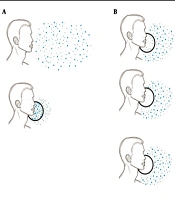
The purpose of this study is to evaluate the efficiency of protective masks used against fiber and particulate pollutants in refractory department of a steel industry. In this study, three types of masks, namely FFP3, FFP2 and 3M elastomeric facemasks with P100 filter (represented by letters A, B, and C, respectively) were studied. Regarding the masks used in the industry, all three types of masks were evaluated against particulate pollutants and only the masks type A were evaluated against the fiber contaminants caused by destruction of RCF insulators. To evaluate effectiveness of the mask, concentration of airborne contaminant outside (Cout) and inside the mask (Cin) was measured simultaneously during the work (17, 18). Sampling of air outside the mask was done from a person’s respiratory tract and a hole with a diameter of 8.1 mm in the area between the nose and the mouth, was taken on the pink part of the mask for sampling of air inside the mask (19). As shown in Figure 1, for sampling the air inside the mask, the input portion of the sampling chamber was connected to the hole created on the attached mask and the holder outlet portion was attached to the individual sampler pump. The number of samples taken from each mask was 20.
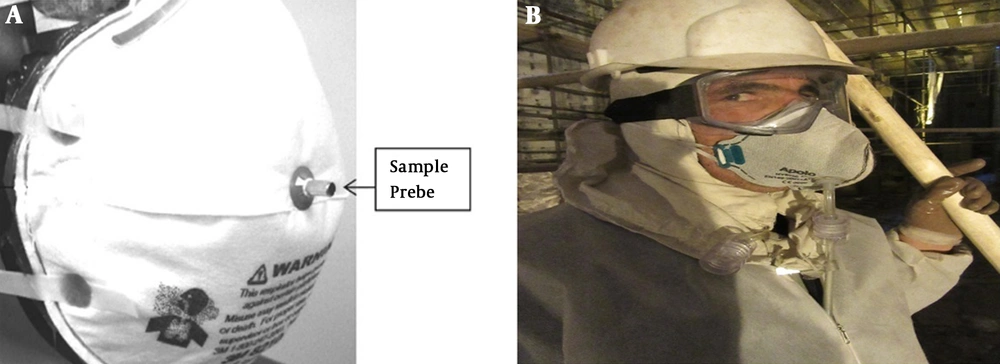
Figure 1.
Sampling from the mask after creation of a sewage for internal sampling (A) and sampling from inside and outside of the mask during the work (B).
2.1. Measuring the Effectiveness of the Mask Against Particle Pollutants
Sampling was carried out based on the 0500 method of the NIOSH (20). Sampling was performed using a PVC filter with 37 mm diameter and 5 μm pore size and an individual sampling pump. Flow rate and sampling time was 2 liter per minute (L/min) and 30 minutes, respectively. The samples were analyzed by gravimetric method. Sampling of respirable particles was carried out according to the 0600 method of the NIOSH. Sampling was performed using cyclone, PVC filter with 5 μm pore size, and an individual sampling pump. The sampling flow and sampling times according to 0600 method for HD cyclones were selected to be 2.2 (L/min) and 90 minutes, respectively. The samples were analyzed by gravimetric method.
2.2. Measuring the Efficiency of the Mask Against Fibers
NIOSH recommends the same method for sampling asbestos fibers and other fiber contaminants. Therefore, in this step, the 7400 method of NIOSH was used for sampling and analysis of fibers (21). Sampling was done using a three-piece cassette filter holder, a 25 mm cellulosic filter with a pore size of 0.8 μm, and a sampling pump. Flow rate and sampling time were 4 lit/min and 100 minutes, respectively. In order to sample the inside and outside the mask, a holder inlet was connected to created hole on the mask and a cassette filter holder was placed in the respiratory tract, respectively. The number of fibers collected on the sampling filters was counted by the phase-contrast microscopy. Moreover, vector images of the surface of the filter were used to show the fiber density on the filters taken from inside and outside of the mask using an electron microscopy device.
2.3. Calculation of the Penetration Rate
Penetration percentage (P%) was calculated as the ratio of particle concentration inside the mask (Cin) to the concentration outside the mask (Cout) multiplied by 100% (22).
2.4. Calculation of the Efficiency
The following formula was used to evaluate the effectiveness of respiratory masks against particulate and fiber contaminants.
3. Results
The present study was conducted to evaluate the efficiency of the respiratory masks used in refractory work during the degradation of refractories in a steel plant. Results are presented in the following sections.
3.1. Penetration of Particle Pollutants and Masks Efficiency
The range, mean, and standard deviation of the penetration percentage of total and respirable particles for the masks A, B, and C are shown in Table 1. As shown in this table, mask type A with an average of 10.91% and 40.76%, respectively, has the highest penetration rate against total and respirable particles while masks B and C are in the next rank, in the order of their appearance. The efficiency of masks A, B, and C against total and respirable particles is shown in Figure 2.
Table 1.
Penetration Percent of Total and Respirable Particles in Three Masks of A, B and Ca
| Mask | Range (%) | Mean (± SD) (%) |
|---|---|---|
| Penetration percentage of total particles | ||
| A | 2.22 - 27.69 | 10.92 (8.43) |
| B | 2.02 - 51.87 | 9.4 (14.86) |
| C | 0 - 25.21 | 4.37 (8.66) |
| Penetration percentage of respirable particles | ||
| A | 10.96 - 55.52 | 40.76 (17.37) |
| B | 0 - 50.37 | 14.29 (15.64) |
| C | 0 - 9.71 | 2.07 (3.36) |
a Mask A: FFP3 (APOLO), Mask B: FFP2 (3MAX), Mask C: 3M elastomeric face masks with P100 filter.
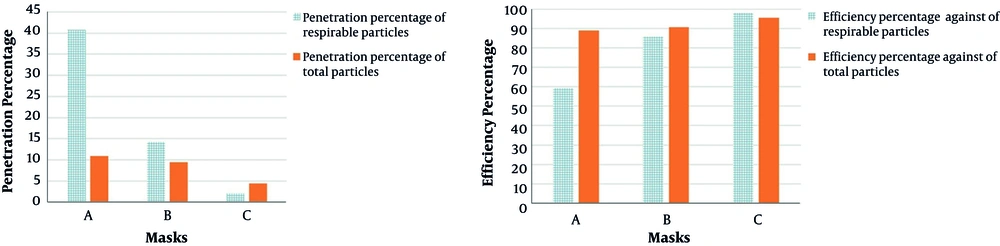
Figure 2.
The efficiency of masks A, B, and C against total and respirable particles
3.2. Penetration and Efficiency During the Use
Since the efficiency of the mask may change during the use, the penetration and efficiency of masks A and B were evaluated with respect to the time of consumption were evaluateduse (Figure 3).
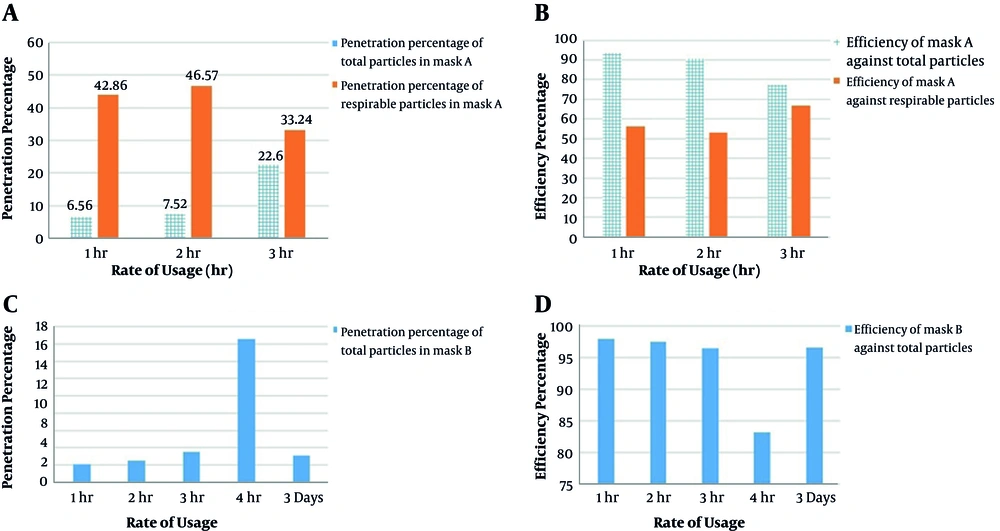
Figure 3.
Penetration and efficiency of mask A against total and respirable particles (A and B) and penetration and efficiency of mask B against total particles with respect to the time of use (C and D)
3.3. Penetration and Efficiency Levels Against Fibrous Contaminants
Given the fact that mask type A was used when exposed to fiber pollutants, this type of mask was selected for testing against fiber contaminants. Percentage of penetration refractory ceramic fiber in mask A was 15.1 ± 11.9 and percentage efficiency was 84.99 ± 11.9. Figure 4 shows the density of the fiber at the surface of the sampled filter outside and inside the mask A.
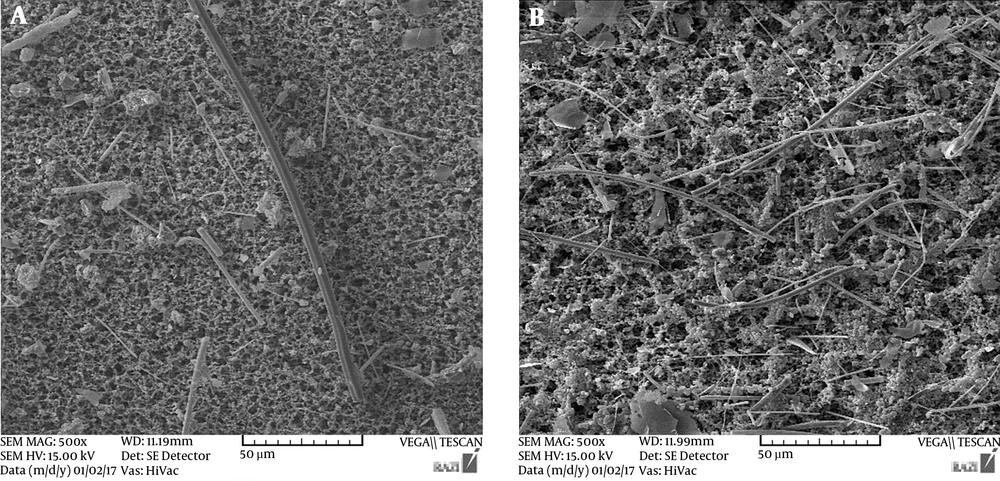
Figure 4.
The surface of the sampled filter from inside of the mask (A) and outside the mask (B)
4. Discussion
In this study, two masks of FFP3 (A) FFP2 (B) and an elastomeric half mask with P100 (C) filter were used. As shown in Table 1, the mean penetration percentage total particle in masks A and B was 10.91% and 4.34%, respectively. Therefore, mask type A has a higher penetration compared to mask type B against total particles. In addition, the penetration rate of respirable particles in mask A and was 40.76% and 2.7% respectively, suggesting that the total particle penetration respirable particles in mask A is higher than that of mask B. In this regard, although mask type A is of the type FFP3 and should actually have a higher efficiency than FFP2-type mask B, the penetration of total and respirable particles in mask A is more than that of mask B. This result can be explained, in part, by surface resistance of the mask against airflow. The results of a study by Rengasamy et al. showed that the surface of FFP3 masks has a higher resistance compared to that of FFP2 masks (23). The airs flowing from the body of these two types is expected to be different because of the difference in their resistance. The relationship between filter resistance and airflow velocity is as follows:
where,
Given the above two equations, the resistance is equal to:
Since both masks have almost the same area, the resistance is equal to:
The inverse relationship between the resistance and the flow of air shows that the percentage of total airflow passing through a filter with lower resistance (mask B) is more than the airflow of the larger resistance filter (mask A). The filter’s resistance to the airflow leads to a higher percentage of air for passing through the open space between the face and the surrounding mask. Therefore, the surface of the filter with a lower resistance can filter more particles pass as compared to the filter surface with more resistance. Because the air passing through around the mask has a high concentration of contaminants (the concentration is equal to the concentration of air outside the mask), a greater the percentage of air passing through the sides of the mask would result in an increase in the concentration of the contaminant in the internal air of mask and the percentage of penetration. The results are consistent with the results of Rengasamy et al. (23, 24) and Nelson et al. (25). According to Table 1, the penetration rate of the total particles and respirable particles in mask type C, which is an elastomeric half-mask, are respectively 4.37% and 2.7%. NIOSH expresses the penetration percentage for P100 filters to be less than 0.03% under constant airflow at 85 L/min (26). He et al. showed that when the space between the mask and the face is fully sealed, the penetration rate is less than 0.03%, which is consistent with the values proposed by NIOSH for the P100 filter. However, the penetration rate in conditions that the space between the mask and the face of the manikin without being sealed equals to 10.3% for a cyclic airflow of 30 L/min (breathing airflow at moderate workloads) (18). Since evaluation of penetration rate in this study was performed under not fully sealed conditions, results of a study by He et al. supports the results obtained in this study. According to Figure 2, mask A has the lowest efficiency and mask type C has the highest efficiency against respirable and total particles. The remarkable point here is the low efficiency of mask type A as compared to mask type B and the very low efficiency of mask type A against respirable particles, which is equivalent to 59.22%.
The efficiency of the masks is expected to change with the duration of use, so the penetration and efficiency of masks A and B were evaluated with duration of use. As shown in Figure 3A, the amount of particle penetration increased with the duration of use, so that penetration rate from 6.56% in the first hour of use increased to 22.66% at the third hour of consumption. As a result, as shown in Figure 3B, the efficiency decreases during the use. As shown in Figure 3A, the penetration rate of respirable particles increased in the first hour (43.86%) and the second hour (46.75%) but slightly decreased at the third hour (33.24%). The author supposes that reduction for penetration at the third hour of using the mask is due to saturation of the filter surface or better adjustment of the mask with the individual’s face due to the loss of mask dryness. As shown in Figure 3B, the efficiency against respirable particles decreases by up to 2 hours and increases thereafter during the mask use.
As shown in Figure 3C, the total particle penetration in mask B was increased during consumption from 2.05% at the first hour to 16.59% at the fourth hour. The workers of the unit wash the mask every day after work and re-used it the next day, which leads to the penetration rate of 3.13% three days after use. An explanation for this surprising result is that after washing the mask, the structure of the fibers inside the mask was changed or possibility the mask lost its dryness and caused a better adjustment on the individual’s face, resulting in a decrease in particle penetration around the mask.
According to the results, the percentage of refractory ceramic fiber penetration during the use of Type A mask is 15.1%, which indicates the poor efficiency of this type of mask in the filtration of fiber pollutants. Figure 4 presents the density of fiber on the filters sampled from the air inside and outside the mask using an electron microscope, which illustrates the poor efficiency of mask type A in the airflow filtration. Brosseau et al. in a studied collection of silica and asbestos aerosols by respirators at steady and cyclic flows and reported 0.01 to 0.1% mean penetration of an amosite aerosol at 32 L/min constant flow and mean penetration of 0.1 to 0.6% at 76 L/min cyclic flow (12). Ortiz et al. compared the penetration of chrysotile asbestos and oil test aerosol of di-2-ethylhexyl sebacate (DEHS) through filter cartridges approved by NIOSH. They found that the lowest penetration rates for asbestos and DEHS aerosols are 0% - 3% and 0% - 30%, respectively (14). The researcher believes that the factors leading to the high level of penetration rate in this study compared to those in other studies are: conducting the experiments under actual conditions (not in the laboratory), improper fitting of the mask to the face of individuals, and the creation of open spaces between the mask and the face. However, according to study Ortiz et al. (14), storage time may also affect filtration performance, which unfortunately does not provide data on storage time and conditions maintenance of masks for the researcher.
4.1. Conclusions
Comparison of particle penetration rate in masks A and B shows that the rate of penetration in mask A with a high efficiency is higher than that of mask B with a low efficiency. The evaluation of the elastomeric mask with the P100 filter showed that the penetration rate was greater than recommended by NIOSH (0.03%). Comparing the penetration rate during consumption showed that with increasing the use of mask, the efficiency of the mask decreases. However, results showed that washing the mask has a positive effect on the efficiency of the mask B, which requires further studies. Evaluating the efficiency of the FFP3 (APOLO) mask for particles against fibrous contaminants showed that this mask does not have a good efficiency under the test conditions, probably due to not performing a fitting test before the sampling. Therefore, as a general result, it can be argued that the air leakage from around the mask due to the inappropriate fitting with the face can be a major cause of inefficiency of the masks. For this reason, it is necessary to design a mask that is suitable for the anthropometry of Iranian workers’ face.