1. Background
Non-alcoholic fatty liver disease (NAFLD) refers to a situation in which triglycerides are accumulated in the liver cells of individuals with no history of alcohol abuse or those who use little alcohol (1). This disease is the most prevalent liver disorder in western industrial countries, and about 20‒40% of the members of these societies suffer from NAFLD, with a prevalence estimate of 5‒30% in Asia (2, 3). The prevalence of NAFLD in the general population of Iran has been reported to of about 2.1% (4). The NAFLD has a wide range of clinical presentations: several patients may only suffer from the accumulation of lipid in their liver tissue, while the disease may progress to non-alcoholic steatohepatitis (NASH) in several others (5, 6). Moreover, this disorder may lead to liver fibrosis, cirrhosis, and failure, in 20% of these patients (5, 7, 8). Up to now, the pathogenesis of NAFLD has not been identified however. It has been shown to have a close relationship with obesity, dyslipidemia, hypertension, and type II diabetes (2, 6, 8). Recently, this disorder has been considered as a major cause of liver cirrhosis and failure and is the most prevalent cause of increases in the values of liver function tests (7, 9, 10).
Up to present, due to the fact that the accurate pathogenesis of NAFLD has not been identified, no medication is available for its treatment (11). Only a limited number of studies have been conducted on the issue (12). Nevertheless, decreasing the obesity and treating hyperlipidemia as well as diabetes mellitus are the measures which can be taken toward decreasing the probability of NAFLD (11).
Nowadays, the use of herbal medicines has considerably increased in Europe and the US, leading to about 65% use of herbal medicines in these countries (13).
Berberis vulgaris belongs to the Berberidaceae family and is one of the native plants of Iran, which is widely used in traditional medicine. Almost, 22 alkaloids have been identified in the root, leaf, and fruits of this plant (13); the most important of which is berberine, which can reduce weight, improve dyslipidemia, and increase insulin sensitivity (14). Similarly, it is expected to reduce the transaminases in NAFLD.
2. Objectives
The present study was conducted to investigate the effect of berberis vulgaris on NAFLD patients in Iran.
3. Patients and Methods
In this study, a randomized controlled trial (IRCT: 201202068505N2) design was employed. After obtaining approval of the Ethics Committee (Registration Number: Ct-91-6081) of Shiraz University of Medical Sciences, Shiraz, Iran, the present clinical trial was conducted between October 2011 and May 2012 on 99 patients (42.42% male and 57.57% female), who had referred to the Motahari Clinic affiliated to Shiraz University of Medical Sciences, Shiraz, Iran, for treatment of their liver diseases. The patients were selected by purposive sampling, based on the inclusion criteria. The necessary criteria for the diagnosing NASH included having ultrasound evidence of fatty liver (grade II) and increased liver enzymes (one to three times more than the normal level). On the other hand, the exclusion criteria of the study regarded the patients suffering from liver diseases resulting from causes other than NAFLD, such as hepatitis B or C, autoimmune hepatitis and drug abuse, type I diabetes, type II diabetes with 1 year duration using glucose-lowering drugs, pregnancy, breast feeding, alcohol consumption, use of medications known to affect liver tests during the previous 2 months, and having the history of psychotic diseases or severe depression.
The study subjects were randomly assigned to the case and control groups. Simple randomization was used in this study. For the randomization, we numbered the groups (case 1, control 2) then the sequence of groups was drawn up by coin tossing. The case group received 750 mg aqueous extract of berberis vulgaris for 3 months, while the control group received placebo. Both groups received their medications in the form of capsules (with identical appearance).
After berberis vulgaris was purchased, it was confirmed by a botanist and cleaned. Then, it was extracted by a specialist in the Medicinal Plants Laboratory of Shiraz School of Pharmacy, Shiraz, Iran, then concentrated in a rotary evaporator, and dried using the freeze dryer. In addition, microbial control experiments were performed in order to ensure that pathogens, such as Salmonella, Escherichia coli, Staphylococcus, and Bacillus cereus, did not exist in the berberis vulgaris extract. The two groups' weight, total cholesterol, triglyceride, high-density lipoprotein cholesterol (HDL-C), low-density lipoprotein cholesterol (LDL-C), and fasting blood glucose (FBG) were measured before and 90 days after the intervention. Besides, the alanine transaminase (ALT) and aspartate transaminase (AST) enzymes' levels were measured before and 45 and 90 days after the intervention. It should be noted that these experiments were carried out using Biosystem kits (Biosystem S.A., Barcelona, Spain) and through the spectrophotometry method.
Both groups received two capsules every day, one before breakfast and one before dinner, and the probable complications were followed up through telephone contacts. During the first week, four cases of mild disorders were reported in the case group, three of which were diarrhea and the other one was mild constipation.
Of the total 99 patients, 19 were excluded from the study due to lack of cooperation and completion of treatment period, and finally, 40 patients were enrolled into each study group for analysis.
The collected data were analyzed in the SPSS statistical software (v. 16) (SPSS Inc., Chicago, ILL, USA) using independent sample t-test before the intervention and repeated measurement test after the intervention.
4. Results
A number of 19 patients were excluded from the study resulting in a final number of 40 subjects enrolled in each group. In the case group, 19 patients (47.5%) were male, while 21 (52.5%) were female. On the other hand, the control group included 13 males (33%) and 27 females (67%). The mean age of the patients in the case and control groups was 43.65 and 42.97 years, respectively. The mean weights of the case and control subjects were 80.24 and 83.62 kg, respectively.
Table 1.
Demographic Characteristics of the Two Study Groups
| Group | No. | Age, y | Female, No. (%) | Male, No. (%) | Weight, kg |
|---|---|---|---|---|---|
| Case | 40 | 43.65 | 21 (52.5) | 19 (47.5) | 80.24 |
| Control | 40 | 42.97 | 27 (67) | 13 (33) | 83.62 |
Table 2.
Changes in Each Variable From the Beginning to the end of the Study a
| Variable | Placebo (n = 40) | Berberis Vulgaris (n=40) | P Value | |||||
|---|---|---|---|---|---|---|---|---|
| Before Treatment | Forty-fifth day | After Treatment | Before Treatment | Forty-fifth day | After Treatment | Berberis Vulgaris vs. Placebo | ||
| Baseline | After Treatment | |||||||
| Weight, kg | 83.62 ± 9.33 | 83.52 ± 9.10 | 83.53 ± 9.31 | 80.24 ± 11.68 | 79.13 ± 11.48 | 78.71 ± 11.31 | 0.1 | < 0.001 |
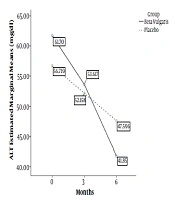
| ALT, U/l | 50.40 ± 9.38 | 49.90 ± 12.17 | 46.80 ± 9.87 | 49.0 ± 11.44 | 36.42 ± 12.10 | 29.08 ± 12.99 | 0.5 | < 0.001 |
| AST, U/l | 45.70 ± 8.19 | 46.32 ± 10.08 | 44.98 ± 9.69 | 48.22 ± 9.82 | 37.02 ± 12.18 | 2748 ± 12.50 | 0.2 | < 0.001 |
| FBG, mg/dL | 91.60 ± 16.24 | 93.45 ± 13.39 | 93.62 ± 16.20 | 87.95 ± 13.65 | 86.47 ± 14.5 | 85.70 ± 15.28 | 0.2 | 0.18 |
| TG, mg/dL | 214.7 ± 55.29 | 201.47 ± 60.60 | 219.22 ± 72.14 | 167.20 ± 69.32 | 0.7 | < 0.001 | ||
| CHOL, mg/dL | 225.38 ± 43.17 | 220.80 ± 39.49 | 211.40 ± 30.93 | 186.05 ± 36.51 | 0.1 | < 0.001 | ||
| LDL, mg/dL | 139.86 ± 34.14 | 134.33 ± 30.69 | 130.68 ± 27.79 | 116.13 ± 32.47 | 0.1 | 0.054 | ||
| HDL, mg/dL | 41.05 ± 8.66 | 41.22 ± 8.34 | 36.87 ± 7.43 | 37.0 ± 7.17 | 0.1 | 0.96 | ||
According to the results, the case group's mean weight decreased from 80.24 kg at the beginning of the study to 78.71 kg at the end, which was statistically significant compared to the control group (P < 0.001). The case group's mean serum level of ALT was 49 and 27.48 u/L before and after the intervention, respectively (P < 0.001), while it was measured as 50.4 and 46.8 u/L, respectively, in the control group (P > 0.05). Also, the mean AST level of the case group was 48.22 and 29.8 u/L before and after the intervention, respectively (P < 0.001), while it was measured as 45.7 and 44.9 u/L, respectively, in the control group (P > 0.05). The mean FBG in the case group was 87.95 and 85.70 mg/dL before and after the intervention, respectively (P > 0.05), while it was 91.60 and 93.62 mg/dL, respectively in the control group (P > 0.05). Moreover, the mean level of triglycerides in the case group was 219.22 and 167.20 mg/dl before and after the intervention, respectively (P < 0.001), while it was measured to be 214.7 and 201.47 mg/dL, respectively, in the control group (P > 0.05). In addition, the mean serum level of total cholesterol in the case group was 211.40 and 186.05 mg/dL before and after the intervention, respectively (< 0.001), while it was 225.38 and 220.80 mg/dL, respectively, in the control group (P > 0.05). Furthermore, the mean serum level of LDL was 130.68 and 116.13 mg/dL in the case group (P > 0.05) and 139.86 and 134.33 mg/dL in the control group (P > 0.05), before and after the intervention, respectively. Finally, the case group's mean HDL serum level was 37.0 and 36.87 mg/dL before and after the intervention, respectively (P > 0.05), while it counted 41.05 and 41.22 mg/dL, respectively in the control group (P > 0.05). As shown, no significant difference was found between the two groups regarding the study variables before the intervention.
5. Discussion
The decreases in liver transaminases (ALT and AST), cholesterol, triglyceride, and weight in the case group showed the effectiveness of berberis vulgaris. In fact, the antioxidants, as well as anti-inflammatory effects of the phenolic compounds present in berberis vulgaris demonstrate its hepatoprotective role (15-19). Shulman states that the decrease in liver triglycerides leads to the progression of insulin sensitivity and protection against type II diabetes (14). A large number of studies have also shown that NAFLD can predict type II diabetes, as well as metabolic syndrome, and therefore, treating this disorder can be an effective way of preventing type II diabetes (14).
The theory of insulin resistance, which is considered as the main mechanism in liver steatosis states that insulin resistance leads to lipid accumulation in hepatocytes through two mechanisms:
- Increase in lipolysis, which results in an increase in free fatty acids;
In general, NAFLD has a close relationship with metabolic syndrome, diabetes, hypertension, and dyslipidemia. Therefore, all the medications used for treating the metabolic disorders can improve liver disorders and it seems that insulin sensitizing agents are efficient. However, this method might not be appropriate for non-diabetic or thin patients (22).
Motalleb believes that alkaloid protoberin, which is one of the major components of berberis, has attracted much attention in the recent years and is one of the best reactive oxygen species (23).
Wei et al. investigated the effect of berberine on type II diabetes accompanied by fatty liver. That study was conducted on 30 diabetic patients who were also suffering from fatty liver. The study subjects received 500 mg berberine pills three times a week, for 8 weeks, and the results revealed that the ALT, AST, glycated hemoglobin (HbA1C), FBG, body-mass index (BMI), LDL, triglycerides, total cholesterol, and gamma glutamyl transferase (GGT) markers had significantly decreased in comparison to the levels before the treatment (24).
In the in vitro study of Yang et al. treatment by berberine hydrochloride reduced triglycerides, LDL-C, liver transaminases and improved liver steatosis in the case group (25). In the same line, Zhang et al. revealed that berberine considerably helped to improve dyslipidemia, as well as diabetes, and significantly corrected lipid and diabetes parameters. In comparison to the placebo group, ALT, AST, and GGT significantly decreased in the berberine group. Also, ALT, AST, and GGT had decreased from 30 ± 21 to 22 ± 14 IU/L (P < 0.001), 26 ± 12 to 22 ± 7 IU/L (P = 0.006) and 34 ± 20 to 30 ± 24 IU/L (P = 0.53), respectively (26).
In another study, Taheri et al. investigated the effect of hydroalcoholic extract of berberis on liver enzymes activity in mice. The results showed that the hydroalcoholic extract of berberis had significantly decreased the serum ALT level, while no significant decrease was observed regarding AST (27).
Furthermore, Murugesh et al. studied the antioxidant and hepatoprotective role of berberis. In that animal study, hepatotoxicity was created in one group of mice by administration of paracetamol, and one week after starting the administration of methanolic berberis extract, the increased levels of enzymes had dropped significantly. Besides, the serum levels of AST and ALT reached the normal level, which was interpreted as hepatocyte cytoplasmic membrane repair (15). These findings are consistent with those of the present study
Motalleb et al. also came to the conclusion that berberis vulgaris extract reduced the activity of liver enzymes, while at the same time preventing the expression of alpha-fetoprotein in liver cancer (28).
Moreover, Eidi et al. investigated the hepatoprotective effect of berberis extract on the toxicity resulting from carbon tetrachloride in mice. After intraperitoneal use of three different doses of berberis for 28 days, the rate of aminotransferases had significantly decreased almost down to the normal level (29).
Ebrahimi et al. conducted a study on 57 patients with hyperlipidemia in Iran. After 8 weeks of intervention with berberis vulgaris processed in vinegar, no significant changes were observed in BMI, total cholesterol concentration and triglycerides. However, a significant decrease was found in HDL-C and LDL-C concentrations, and also in the total cholesterol to HDL-C ratio (30). Similarly, in the study by Farhadi et al. which employed 200 mg capsules of aqeous extract of berberis three times a day for 2 weeks, significantly decreased blood cholesterol and triglycerides? of 5.13% and 17.2%, respectively (31).
Another study was conducted by Yin et al. on the effectiveness and safety of berberine in the treatment of the patients with type II diabetes in China in 2008. The results revealed no significant changes regarding HDL-C and LDL-C in the berberine group during the 1st and 13th weeks. Nevertheless, a significant decrease was found in HbA1c, as well as FBG levels (32).
The findings of the present study are in agreement with those of the previous investigation. However, despite the fact that most of the study patients were nondiabetic, no significant decrease was observed in FBG. Nonetheless, it should be noted that the diabetic patients with more than 1 year duration of the disease, or who were using antidiabetic medication, were excluded from the current study. Therefore, the changes in FBG in this study cannot be generalized, and this may be considered as one of the limitations of the present research. Finally, using aminotransferase level in the follow up of NAFLD represented the other limitation of the study, as histologic findings are presently the gold standard method.
The study findings revealed the effectiveness of berberis vulgaris extract in reducing liver transaminases (ALT and AST), cholesterol, triglyceride, LDL-C, and weight. In addition, these factors have a close relationship with NAFLD. Therefore, due to its low cost and low incidence and severity of complications, berberis extract can be used as a supplementary medication in treating NAFLD.