1. Background
Hepatitis B is an important cause of morbidity and mortality, worldwide, especially in developing countries, since it accounts for a wide spectrum of liver problems ranging from acute hepatitis to chronic hepatitis, cirrhosis, and hepatocellular carcinoma (HCC) (1, 2). According to the report released by the world health organization (WHO) in 2001 and centers for disease control and prevention (CDC) in 2005, the prevalence of chronic hepatitis B infection in Iran was 2% to 7% (3, 4); however, more recent studies have estimated the prevalence of chronic HBV infection as 1.2% and 9.7% in different provinces (5). The prevalence of HBV infection has also been reported among different population groups, including patients with hemophilia (6).
T cell-mediated chronic inflammation leads to necro-inflammatory responses during chronic HBV infection. Therefore, T cell-mediated adaptive immunity imposes a “double-edged sword” by decreasing the levels of HBV at the expense of organ injury (7).
During viral infection, various cytokines are involved in both viral clearance and tissue damage mechanisms. While Th1 cytokine profile leads to a cell-mediated immunity and is accompanied by remission, Th2 cytokine response causes the development of persistent lifelong infection. Thus, it can be proposed that the imbalance of pro-inflammatory Th1 and anti-inflammatory Th2 cytokine synthesis may contribute to the pathogenesis of viral hepatic infections (8, 9).
Recently, in chronic HBV infection, strong long-term viral suppression was achieved through various nucleoside or nucleotide analogs. However, one of the problems with treatment with these analogs is the low rate of HBe seroconversion, even after long-term administration in HBeAg+ subjects (10). Achieving long-term viral eradication could be possible even after cessation of nucleoside or nucleotide analogs, if viral suppression with the analogs were combined with efficient immunotherapies (11). The differences in cytokine pattern of patients from different parts of the world has been reported as well (12-14) and the importance of some cytokines, as indirect markers of T cell activation, has been shown (15). Interleukin-4 and IL-10 as Th2 cytokines and IFN-γ as Th1 cytokine have been measured to determine Th2 and Th1 cell activation in HBV and HCV diseases (16-18). It is important to determine the pattern of patient’s cytokine in each area as it can lead to different immunotherapeutic strategies to optimize available antiviral therapies of HBV patients.
According to previous studies, in which the levels of IL-4, IL-10, and IFN- γ were considered as important indirect markers of Th2 and Th1 cell activation (19), this study investigated these three important cytokines to evaluate Th2 and Th1 cell activation in Iranian patients, who are chronically infected with HBV. The relationship between the levels of cytokines and ALT (Alanine transaminase) were also investigated.
2. Objectives
The aim of the current study was to determine the serum level of three important cytokines (IL-4, IL-10, and IFN-γ) in patients with HBV infection in comparison with the levels of these cytokines in healthy controls and to determine the correlation between the levels of cytokines and ALT level.
3. Methods
The study protocol was approved by the local ethics committee of the department of Medical ethics, Shiraz University of Medical Sciences, Shiraz, Iran, and an informed consent form was signed by all participants prior to enrollment in this study. Sixty HBV-infected patients, who were untreated and had no other infections referring to two centers in Shiraz from April 2016 to April 2017, and 60 matched (age and gender) healthy subjects were enrolled in the study. The patients were selected randomly. The HBV infection in the patients had been confirmed by HBV genome detection using polymerase chain reaction following viral quantification by commercial real-time polymerase chain reaction (PCR). The treated patients and those, who had systemic or other diseases, were excluded from the study.
3.1. Blood Sampling and Serum Extraction
Each patient’s blood (5 mL) was drawn into a vacutainer tube containing no anticoagulant. After clotting, the samples were centrifuged and the supernatants (serum) were aspirated, aliquoted and stored at 80°C.
3.2. Enzyme-Linked Immunosorbent Assay (ELISA)
The ELISA kit (U-Cytech, bioscience, Netherlands) was used to determine the concentration of cytokines, IL-4, IL-10, and IFN-γ in the patients’ sera. Coating antibody (against each of cytokines) was diluted and added to each well of 96-well ELISA plate and incubated at 4°C overnight. After washing the plates with PBST, blocking buffer was added and incubated at 37°C for 1 hour. A mixture of cytokine stabilizing buffer (CSB) and serum, biotinylated detector antibody, Streptavidin-HRP Polymer (SPP conjugate) were added respectively and incubation was done after each step at 37°C for one to two hours. The substrate (TMB solution) was then added and the reaction was stopped after 30 minutes by adding 2M H2SO4. The ODs were determined using an ELISA reader. The cytokine standards were also prepared and the concentration of each cytokine (pg/mL) was determined using the standard curve.
3.3. Colorimetry Procedure
The colorimetry procedure was done according to the Colorimetry Kit (Pars Azmoon, Iran) instructions to determine the ALT serum levels. Patient’s serum (100 µL) was added to the first working solution (1000 µL) (TRIS 100 mmol/L, L-alanine 500 mmol/L and lactate dehydrogenase (LDH) ≥ 1200 U/L) and incubated for 5 minutes at 37°C. The second working solution (250 µL) (2- oxoglutarate 15 mmol/L and NADH 0.18 mmol/L) was then added and mixed. The ODs were read after one, two, and three minutes. The difference between absorbance was determined and the mean of the results was used to determine the average change in absorbance per minute.
3.4. Statistical Analysis
Statistical analysis was performed by the SPSS statistical package version 20 (SPSS Ltd, Woking, Surrey, UK) and ‘Mann-Whitney U’ test was administered to compare the median level of serum cytokines in patients and controls; Kendall’s tau-b correlation coefficient was used to determine the correlations between cytokine levels and ALT levels with cytokine levels.
4. Results
4.1. Serum Level of Cytokines (IL-4, IL-10, IFN-γ) in Patients and Healthy Subjects
Serum levels of IL-4, IL-10, and IFN-γ (pg/mL) in patients with chronic HBV infection and healthy controls are presented in Table 1. The results indicated that the median level of IL-4 was significantly lower in patients compared to healthy controls (6.11 versus 17.76, P = 0.001). The median level of IL-10 in patients and controls showed no significant difference (0.71 versus 0.51, P = 0.057). However, the median level of IFN-γ in the patients was significantly higher than that of the healthy subjects (1.22 versus 0.84, P = 0.001).
Table 1.
Descriptive Statistics of Interleukin-4, Interleukin-10 and Interferon-γ Concentration in Chronic Hepatitis B Virus Infected Patients and Healthy Subjects
| Variables | Concentration, pg/mL, Median (Min - Max) | P Value |
|---|---|---|
| IL-4 | 0.001 | |
| Patients | 6.11 (1.07 - 40.27) | |
| Healthy controls | 17.76 (11.27 - 67.36) | |
| IL-10 | 0.057 | |
| Patients | 0.71 (-7.32 - 85.47) | |
| Healthy controls | 0.51 (0.0 - 13.75) | |
| IFN-γ | 0.001 | |
| Patients | 1.22 (0.47 - 6.8) | |
| Healthy controls | 0.84 (0.0 - 12.05) |
4.2. Correlation Between Serum Levels of Cytokines, Interleukin-4, Interleukin-10, and Interferon-γ, in Chronic Hepatitis B Virus Infected Patients
No significant correlation was detected between circulating levels of IL-4 and IL-10, IL-4 and IFN-γ, and neither between IL-10 and IFN-γ (P > 0.05) (Figure 1).
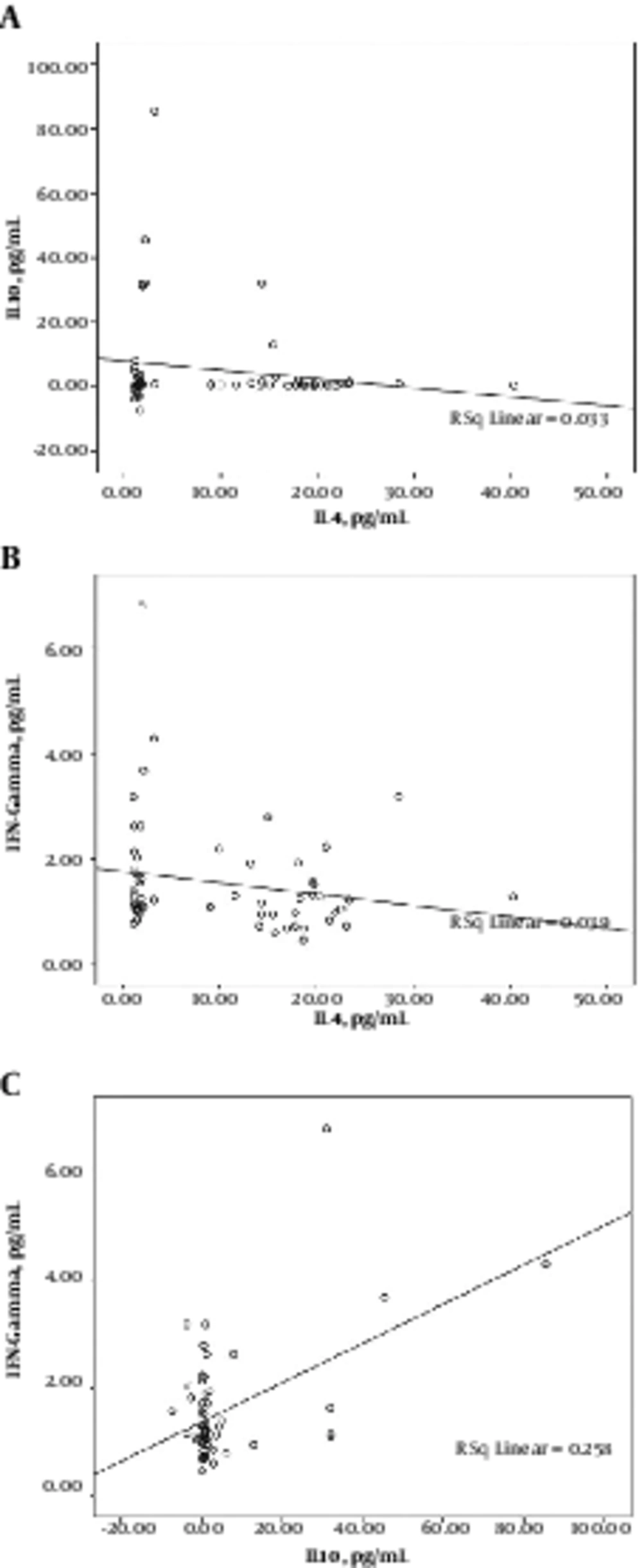
Figure 1.
Correlation between serum levels of cytokines; interleukin (IL)-4 and IL-10 (A), IL-4 and interferon (IFN)-γ (B), IL-10 and IFN-γ (C)
4.3. Correlation Between Circulating Cytokines (IL-4, IL-10, and IFN-γ) Levels and ALT in Patients
No significant correlation was detected between circulating levels of IL-4, IL-10, and IFN-γ and ALT level (P > 0.05) (Figure 2).
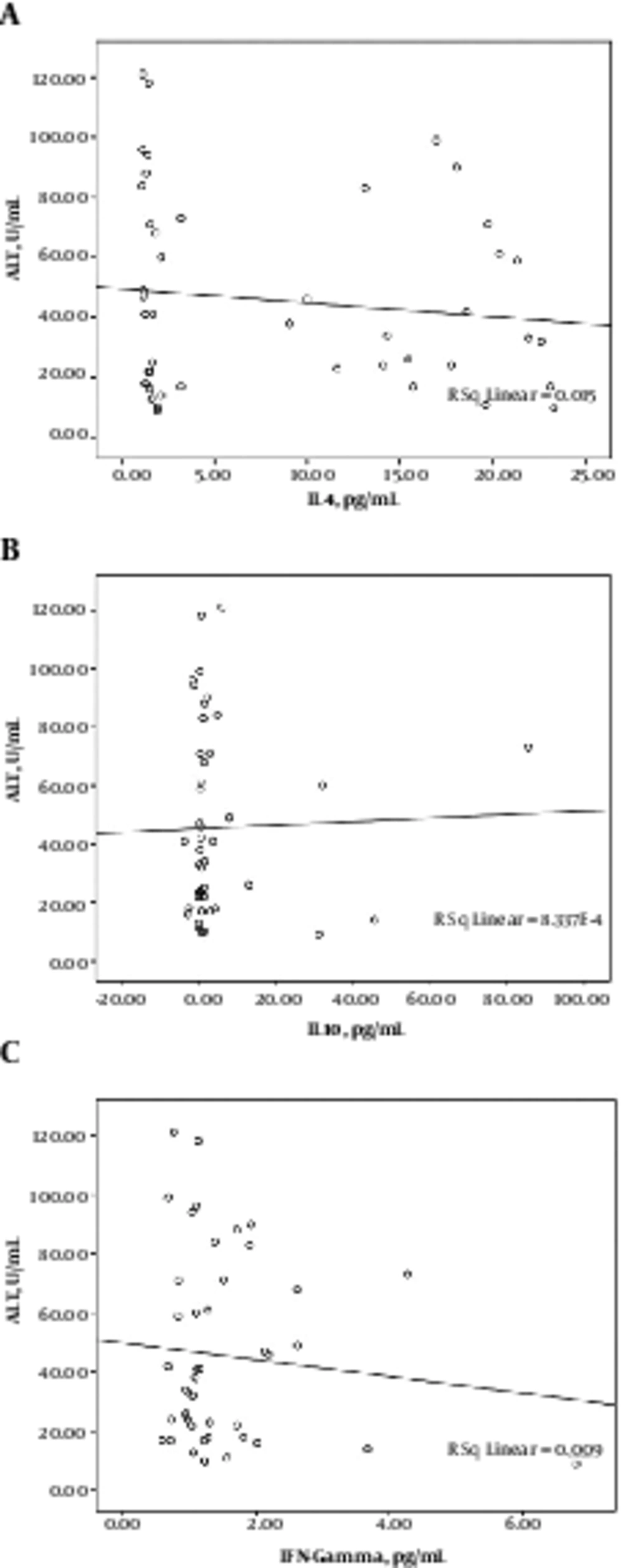
Figure 2.
Correlation between serum levels of cytokines and ALT; IL-4 and ALT (D), IL-10 and ALT (E), IFN-γ, and ALT (F)
5. Discussion
Several studies have been performed on the importance of pro-inflammatory Th1 and anti-inflammatory Th2 cytokine profiles in chronic hepatitis B infection. There are contrasting data from these studies regarding the levels of Th1/ Th2 cytokines in HBV infection (20). In this study, the researchers assessed the circulating levels of Th1 and Th2 cytokines, IL-4, IL-10, and IFN-γ in chronic HBV-infected patients compared to healthy controls. The results revealed a significant decrease of IL-4 cytokine in chronic HBV patients compared with the healthy individuals. Similar results were obtained by Monsalve-De Castillo et al. (21), who reported a significant decrease in IL-4 levels in both acute and convalescent phases of HBV infection. It has also been reported that the decrease in IL-4 levels could be a consequence of the auto-regulatory mechanism of IL-10. According to Penna et al. (22), levels of IL-4 and IL-5 were increased in acute self-limited hepatitis B infection. A positive correlation was reported between viral load and levels of circulating IL-4 and IL-6 in chronic HBV patients (23). Therefore, decrease of I L-4 evidently indicates a lower viral load in chronic HBV patients.
The current investigation on IL-10 levels showed no significant difference between the median level of IL-10 in patients and controls, which represents a non-active disease. As the patients are in the chronic stage of the disease, this results are in accordance with the disease condition. In some studies, elevated IL-10 levels have been reported in chronic HBV patients. Increase in IL-10 level was shown to be associated with the increase in HBV DNA level (24, 25). Therefore, the increased IL-10 level would represent disease progression. Conde et al. (26) reported that in HBV active disease, the level of IL-10 decreases. Interleukin-10, produced mainly by macrophages, generally acts as an immunosuppressant in chronic viral infection. Significant elevation of serum IL-10 level has been shown in Turkish chronic HBV-infected patients (24) in contrast with the results obtained from the patients in the current study. Interleukin-10 may have an anti-inflammatory role leading towards end-stage liver disease or a pro-inflammatory role leading to self-limiting HBV infection. Some factors, such as viral strain, patients’ genetic, and disease phase have important roles in this regard.
Significant increase of IFN-γ in patients compared to controls indicated the activation of Th1 cells. An inverse correlation between the increase of IFN-γ and the decline of HBV load in chronic active hepatitis B patients has been reported (27), which demonstrates the important role of this cytokine against the virus. Some studies have shown that in chronic HBV-infected patients, decrease in Th1 cell activation will lead to the reduction of IFN-γ level. Akpolat et al. (28) reported a lower IFN-γ yet higher IL-4 serum levels in chronic HBV infected patients with decreased Th1 activation compared to controls. The study of Vietnamese HBV infected patients also reported lower levels of IFN-γ than that of the controls, which represents the patients’ susceptibility to develop chronic HBV infection (29).
No significant correlation was found between the levels of IL-4 and IL-10, IL-4 and IFN-γ, and IL-10 and IFN-γ. This means that increase or decrease in one of these cytokines has no significant effect on the increase or decrease of the other cytokine. Similar results were reported by Jegaskanda et al. (30), who measured these correlations in patients with HBV in Australia. Priimagi et al. (31), however, reported a significant positive correlation between IL-10 and IFN-γ in chronic viral hepatitis patients in Estonia.
No significant correlation was found between these three cytokines serum levels with serum ALT level. Similar results were also shown (17, 32) whereas Priimagi et al. (31) reported a significant correlation between IL-10 serum levels and ALT activity in chronic HBV patients. Monitoring ALT is of important value in evaluating hepatocellular damage in patients with chronic hepatitis B virus infection (33). In the present study, although no significant correlation was detected between serum levels of cytokines and ALT level, a decrease in ALT was shown to be due to increasing IFN-γ (Figure 2F). This decrease is not statistically significant; more cases are required to accurately evaluate this correlation. It seems that hepatocellular damage is modulated in patients with higher IFN-γ level.
The importance of viral clearance has led to the development of strategies, including passive immunization and cytokine therapy (34-37). In persistent viral infections, such as HBV infection, cytokine therapy is suggested as a useful immunotherapy (38). Although enhanced Th1 response was found in the current study, in order to improve viral clearance, interferon therapy with a low dose can be regarded as a helpful strategy. The difference in IL-4, IL-10, and IFN-γ levels in patients with chronic HBV infection in different populations could be due to different genetics, viral strains, and disease phases. The primary examination in the current population revealed a high level of IFN-γ and low level of IL-4 in most patients. These changes are indicative of more pronounced activity of Th1 lymphocytes and suppression of Th2 mediator synthesis, which is favored for the formation of immune response and viral elimination.