
1. Background
Occurrence of pediatric cancers is affected by maternal, environmental, and hereditary-genetic factors (1, 2). Maternal factors include smoking and pregnancy age. Environmental factors include background radiation, medical radiation, direct or indirect exposure to toxic or unusual substances, etc. Hereditary and genetic factors include a family history of solid tumors, family history of blood malignancies, etc. (3-5). Cancers are generally divided into hematologic malignancies including acute lymphocytic leukemia (ALL), acute myeloid leukemia (AML), chronic myeloid leukemia (CML), and chronic lymphocytic leukemia (CLL) and solid tumors, such as brain tumors, sarcomas, Wilms' tumor, germ cell tumors, and malignant liver tumors. ALL, AML, and CML are more common in children (6, 7). Cell sensitivity to radiation depends on the rate of cell metabolism and cell proliferation (8).
Background radiation originates from cosmic rays and the earth's surface radioactive materials (terrestrial radiation). Cosmic rays are found almost all over the surface of the earth, but they are further in high-altitude areas (9). Terrestrial radiation originates from natural decay series such as uranium, plutonium, and actinium. The amount of radiation from these sources depends on the amount of their accumulation in each location (10). Background radiation is different in various regions (11). Radon gas is one of the terrestrial elements of the uranium series that can diffuse out of the ground, and its radiation could be greatly increased in basements of buildings (12).
The cumulative annual dose rate is total radiation from terrestrial elements gamma rays, radon gas, food radionuclides, and cosmic radiation. Fifteen percent of pediatric leukemia (except for CLL) could be induced by background radiation (13). There is an association between background radiation and the risk of various types of leukemia and nervous system tumors (14).
X-ray ionizing radiation is used in medical imaging such as radiography, CT scans, radioisotope imaging, etc. Medical radiation is considered a carcinogen for fetuses and children (15).
Ultrasound waves are high-frequency mechanical waves between 2 MHZ and 18MHZ that are used in diagnostic imaging (ultrasonography). These mechanical waves are non-ionizing and are usually considered to be safe for fetuses, but they have thermal and non-thermal acoustic radiation forces and cavitation effects on cells and tissues (16).
2. Objectives
The current research aimed at evaluating the Repeat ultrasound before sex diagnose (RUBSD), Repeat ultrasound during pregnancy (RUDP), Medical ionizing radiation (MIR), pediatric medical ionizing radiation (PMIR), maternal smoking during pregnancy (MSDP), Family history of leukemia (FHL), family history of solid tumors (FHST), children residence place (CRP), background radiation (BR), maternal age of pregnancy (MAP), abortion history (AH), toxic substances (TS), and in vitro fertilization (IVF) baby as possible risk factors for pediatric cancers in order to reduce or eliminate their effects.
3. Methods
3.1. Participants and Procedures
This cross-sectional descriptive-analytic study was performed in Kurdistan Province in the west of Iran. We studied 103 patients with cancer younger than 14 years old. They were admitted to the oncology ward of Sanandaj Be’sat Hospital.
We conducted the study in 3 sections. The first section was an interview with children’s parents using a researcher-made questionnaire whose validity was evaluated by experts, and its reliability was assessed by the test-retest method. The second interview was repeated approximately 2 weeks after the first one with the same questionnaire, which included questions about repeated ultrasound before gender determination diagnosis (RUBGD), Repeated ultrasound during pregnancy (RUDP), Maternal ionizing radiation exposure (MIRE), Pediatric medical ionizing radiation (PMIR), Maternal smoking during pregnancy (MSDP), Family history of leukemia (FHL), Children’s residence (CRP), Maternal pregnancy age (MPA), Abortion history (AH), IVF baby, and exposure to toxic substances (TS).
3.2. Data Sources/Measurement
In the second section of this research, the children's place background radiation dose rate was measured by a survey meter (RDS-110; made in Finland). We measured outdoor and indoor background radiation in cities of Kurdistan province by an RDS-110 serveymeter and calculated the mean background radiation for the cities. Altitude from the sea level in each city was measured by a GPS grid. Annual dose rates (ADR) were calculated for each region according to the following formula (1):
In the third part of the research, statistical data were provided from the Kurdistan Registrar's Office (birth information) and the cancer registry of Kurdistan University of Medical Sciences (cancer frequency information).
3.3. Statistical Analysis
The statistical analysis was performed with SPSS version 26. The Kolmogorov-Smirnov test was used to evaluate normal and abnormal results. Data analysis used the Chi-square and independent t-test. P-value less than 0.05 was considered statistically significant for any test.
Cancer incidence rate in this studied sample size was defined for cities and areas separately. We defined the city and area for data analysis. The cities consisted of urban parts, towns, and villages. Areas consisted of one or more cities placed at the same range in terms of area background radiation (ABR).
Incidence in the studied sample size (ISSS) index rate was calculated per 1000 people. We determined various areas according to the amount of annual dose rates (ADR).
Province regions had a wide distribution of background radiation. We divided the regions into 3 areas in terms of annual background radiation (ABR): less than 1000, 1000 - 1100, and more than 1100 µSv/year.
We got birth statistics from Sanandaj District Registry. The incidence in the studied sample size at city (ISSSC) and the incidence in the studied sample size at area (ISSSA) indices were calculated per 1000 population.
4. Results
The analysis of patient demographic profiles, clinical characteristics, and variables were measured by the questionnaire designed based on the validated surveys with the patient’s parents and medical records (Table 1).
Table 1.
Results of Frequency Assessment of Demographic Characteristics of Patients and study variables
| Variables | Frequency | Percent |
|---|---|---|
| Sex | ||
| Male | 54 | 52.4 |
| Female | 49 | 47.6 |
| Age group | ||
| 1 - 60 | 49 | 47.6 |
| 61 - 119 | 34 | 33.0 |
| > 120 | 20 | 19.4 |
| Blood groups | ||
| A | 48 | 46.6 |
| B | 18 | 17.5 |
| Ab | 5 | 4.9 |
| O | 32 | 31.1 |
| Rh | ||
| + | 96 | 93.2 |
| - | 7 | 6.8 |
| Cancer types | ||
| All | 59 | 57.3 |
| Aml | 10 | 9.7 |
| Sarcoma | 6 | 5.8 |
| Lymphoma | 7 | 6.8 |
| Neuroblastoma | 3 | 2.9 |
| Brain tumor | 12 | 11.7 |
| Medulloblastoma | 1 | 0.97 |
| Cml | 1 | 0.97 |
| Wilms tumor | 4 | 3.9 |
| Cancer groups | ||
| Hematologic malignancies | 70 | 68.0 |
| Solid tumors | 33 | 32.0 |
Abbreviations: all, acute lymphocytic leukemia; aml, acute myeloid leukemia, chronic myeloid leukemia
The variables were analyzed with SPSS software version v26 and the Student's t-test (T) and chi-square (χ2) tests were used for data analysis. The Student's t-test was used to compare the means, solid tumor, and hematologic malignancies groups for 4 risk factors. The chi-square test was used to evaluate the associations of 6 risk factors and cancer types. The results of the statistical analysis are shown in Table 2.
Table 2.
Results of t-Test and Chi-square Tests for Study Risk Factors
| Variables | Statistical Analysis | ||
|---|---|---|---|
| Statistic | P Value | ||
| t-test (T) | Chi–square (χ2) | ||
| Repeat ultrasound before sex diagnose (RUBSD) | - 2.34 | - | 0.023 |
| Repeat ultrasound during pregnancy (RUDP) | -2.21 | - | 0.038 |
| Medical ionizing radiation (MIR) | 2.65 | - | 0.01 |
| Toxic/unusual substances (TS) | 2.20 | - | 0.03 |
| Family history of leukemia (FHL) | - | 36.5 | 0.04 |
| Family history of solid tumors (FHST) | - | 41.3 | 0.01 |
| Children residence place (CRP) | - | 65.38 | < 0.01 |
| Abortion history (AH) | - | 38.46 | 0.01 |
| Maternal smoking during pregnancy (MSDP) | - | 36.13 | 0.03 |
| Maternal age of pregnancy (MAP) | - | 7.83 | 0.95 |
In our study, none of the cancerous children were IVF babies. Medical radiation exposure of mother during pregnancy had happened to only one of the mothers who was excluded from the study because she was skeptical.
The cancer incidence rate in larger population sample sizes was higher. The cancer frequency in different cities in the sample size is illustrated in Figure 1.
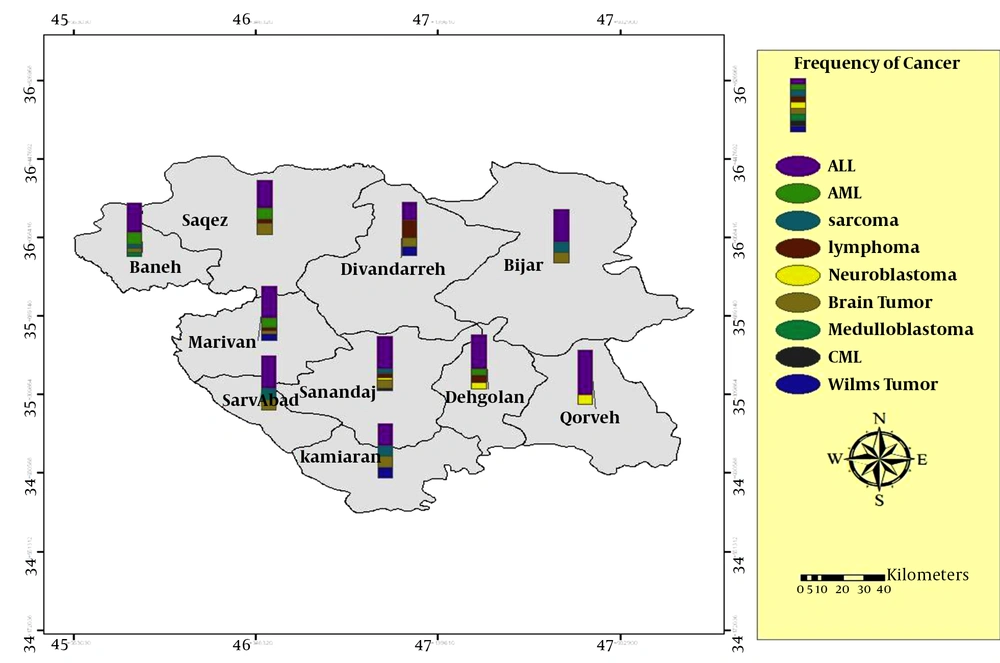
Figure 1.
Frequency of cancer types in different cities
The measured outdoor and indoor radiations, average background radiation, altitude(m) of cities, and ABR(μsv/y) are presented in Table 3.
Table 3.
The Dose Rate in the City and ADR
| Item | Outdoor Radiation nsv/h | Indoor Radiation nsv/h | Average Background nsv/h | Altitude (m) | ADR (μsv/y) |
|---|---|---|---|---|---|
| Baneh | 130 | 150 | 140 | 1523 | 1227 |
| Gorvh | 114 | 160 | 137 | 1910 | 1200 |
| Saghez | 105 | 134 | 129 | 1833 | 1130 |
| Bijar | 114 | 140 | 127 | 1929 | 1112 |
| Divandareh | 102 | 128 | 115 | 1516 | 1008 |
| Sanandaj | 105 | 140 | 122 | 1500 | 1068 |
| Marivan | 110 | 122 | 116 | 1310 | 1016 |
| Kamyaran | 90 | 120 | 105 | 1192 | 920 |
| Dehgolan | 130 | 165 | 148 | 1820 | 1296 |
| Sarvabad | 110 | 120 | 115 | 1188 | 1005 |
Abbreviation: adr, annual dose rates.
The province was divided into areas with < 1000, 1000 - 1100, and > 1100 µSv/year area annual background radiation (ABR). We got birth statistics from Sanandaj District Registry.
The incidence in the studied sample size at city (ISSSC) and that in the studied sample size at area (ISSSA) indices were calculated per 1000 population. The results of measurement and calculations are summarized in Table 4.
Table 4.
Radiation Indices for Comparing Annual Background Radiation (ABR) and Incidence Indices in Cites and Areas
| ABR (μsv/y) | City | ADR (μsv/y) | Incidence in the Sample Size | Births in Cities | ISSSC Index | ISSSA Index | |
|---|---|---|---|---|---|---|---|
| Area 1 | Less than 1000 | Kamyaran | 920 | 5 | 11068 | 0.45 | 0.45 |
| Area 2 | 1000 - 1100 | Sanandaj | 1064 | 25 | 22979 | 1.08 | 0.97 |
| Divandareh | 1068 | 6 | 10668 | 0.56 | |||
| Sarvabad | 1005 | 4 | 7962 | 0.50 | |||
| Marivan | 1016 | 17 | 11921 | 1.42 | |||
| Area 3 | Up to 1100 | Qorveh | 1191 | 6 | 11127 | 0.54 | 1.02 |
| Bijar | 1112 | 5 | 5834 | 0.85 | |||
| Dehgolan | 1296 | 8 | 8215 | 0.98 | |||
| Baneh | 1227 | 12 | 6637 | 1.8 | |||
| Saghez | 1120 | 15 | 13067 | 1.14 |
Abbreviations: ISSSC, incidence in the studied sample size at city; ISSSA, incidence in the studied sample size at area.
According to Table 4, a comparison between the second column (ABR) and the eighth column (ISSSA) shows that incidence in the studied sample size at area (ISSSA) index roughly increased with increasing annual background radiation (ABR). Cities such as Sanandaj due to migration and border cities such as Marivan, Baneh, and Saqez increased in ISSSC index may due to chemical wars.
The increase in background radiation rate was correlated with the ISSSA index in different areas. Therefore, background radiation has a direct association with cancer incidence.
5. Discussion
The results showed that cancers were slightly more prevalent in boys (52.4%) than in girls (47.6%) with male to female ratios of 1.1. Given that the population of boys is slightly higher than that of girls in our province, it seems to be logical. The results are consistent with Eghbalian et al.’s study (17).
The incidences of pediatric malignancies in different age groups (1 - 60, 61 - 120, and > 120 months) were 47.6%, 33%, and 19.4%, respectively. There was a decreasing trend with increasing age. It seems that the declining trend in cancer incidence with increasing age is due to the fading of the role of maternal risk factors. This pattern is consistent with the results of the study by Wiangnon et al. (18).
Ultrasound is a mechanical wave that can be absorbed and transmit energy to tissues. It may have mechanical, thermal, and cavitation effects. The RUBGD and RUDP variables were different for solid tumors and hematologic malignancies, and they were statistically higher in the solid tumors group. This result is consistent with the study conducted by Shu et al. (19), but it contradicts the results of another study by Oppenheim et al. that showed the lack of adverse effects of ultrasound waves (20).
The history of pediatric medical ionizing radiation (PMIR) is an environmental risk factor. The results in our study showed that the mean PMIR in hematologic malignancies is higher than in solid tumors. The results were consistent with the results of the study by Miglioretti et al. (21).
Maternal smoking during pregnancy (MSDP) is a maternal risk factor. The results showed that there is a significant association between MSDP and AML, which is contradicting with the findings of Chunxia et al.’s study (22).
Family history of leukemia (FHL) is a hereditary genetic risk factor. The results showed that there is a significant association between FHL and ALL, which is consistent with the other study conducted by Perrillat et al. (23).
Children’s residence place (CRP) is an environmental risk factor. There was a significant association between CRP and ALL. The malignancies were more common in children who lived in basements or on ground floors. Radon gas is a radioactive element that comes from inside the Earth produced by terrestrial materials, rocks, etc. Radon gas could be accumulated in basements, therefore, exposure to radon gas radiation could be directly proportional to residency in lower levels of a building. The results were consistent with a prior study by Raaschou-Nielsen et al. that highlighted the effects of radon gas in ALL (24).
Exposure to toxic substances (TS) could be an environmental risk factor. TS variables were different for solid tumors and hematologic malignancies, and it was statistically higher in the hematologic malignancies group. In line with this result, Poynter et al. emphasized the effects of chemical materials in AML type of leukemia (25).
Background radiation (BR) is an environmental risk factor for pediatric cancers. It was directly associated with ALL incidence. Nikkila et al. also showed the effects of BR on malignancy (26).
In this study, in addition to quantitative measurement of radiation, we found promising results by defining incidence in the studied sample size at city (ISSSC) and that in the studied sample size at area (ISSSA) indices in association with BR. The ISSSA roughly increased with increasing background radiation.
5.1. Conclusions
The RUBSD and RUDP were statistically higher in the solid tumors group. The TS and PMIR were higher in the hematologic malignancies group. There was a statistically significant relationship between cancer types and FHL, FHST, AH, MSDP, CRP, and BR variables. No statistically significant association was found between different cancer types and MPA, MIRE and IVF baby variables. Pediatric cancers are multifactorial diseases. background radiation is correlated with an increased incidence of pediatric cancers. It seems that increasing ultrasound scans increase the risk of solid tumors in children.