
1. Background
Diagnosis and treatment of cancer in children caused some unique challenges for children and their families. Children with cancer’s family members and their caregivers experience immense psychological distress, financial and relationship problems, and low quality of life so they need support, information, and advice (1, 2).
Social workers play an important role in supporting children with cancer and their families (3). They provide psycho-social services for patients, across the treatment process from diagnosis to survivorship or end-of-life care (4, 5). In the trajectory of providing these services, pediatric oncology social workers experience high levels of exposure to suffering and death and they are involved in complex therapy issues, professional and organizational challenges (6, 7). The prolonged severity of these experiences can cause compassion fatigue (CF) and provoke burnout (BO) in social workers (5, 8).
CF is a clinician’s feeling about decreased empathy or capacity to bear the suffering of dying patients and BO is most commonly results from the stresses of the individual’s exhaustion related to the demanding nature of the workplace (9, 10).
Previous studies confirmed that pediatric oncology social workers are particularly vulnerable to CF and BO (9, 11-13). Ostadhashemi et al. indicated that the involvement of Iranian pediatric oncology social workers in stressful and emotionally demanding situations and facing professional and organizational challenges caused CF and BO (14).
It is well established that among health providers and social workers CF and BO affect their clinical practices and quality of patient care (15, 16). There might be an avoidance of situations which patient suffering is involved and distressing symptoms. A professional with burnout might make experience sense of professional competence, emotional exhaustion, and job dissatisfaction so their clients are less satisfied with the quality of their care (5, 17). Social workers require to have the skills and support to deal with their CF and BO to continue their work efficaciously. In this regard, it’s necessary to explore which strategies can be used by social workers not only to alleviate their CF and BO but also to promote their personal and professional skills.
2. Objectives
This qualitative study aimed to understand the Iranian pediatric oncology social worker experiences to explore how they alleviate CF and BO.
3. Methods
In the present study, as qualitative research, used the 5-stage content analysis method which recommended by Graneheim and Lundman (23), since it could provide deep and rich understanding about the experience of social workers dealing with CF and BO.
3.1. Setting and Participants
The participants were 19 hospital social workers, who were working in public and specialized children’s cancer hospitals in Iran. The subjects had at least 5-year experience regarding pediatric oncology care and were able to articulate one’s own experiences. They were from a range of age groups and they had different education levels, job experience, and organizational positions. Eligible social workers were recruited through the lists of the Ministry of Health and Medical Education’s social workers. The first author contacted the social workers and after declaring their willingness, she set the time of the interviews. All interviews were conducted with social workers who were working in hospitals in Tehran city (Mahak Hospital, Bahrami Children Hospital, Mofid Children’s Hospital, Shariati Hospital, Taleqani Hospital and etc.) at their workplace and 4 interviews were performed with social workers from other provinces who attended the annual Mahak conference which was held in Tehran on November 2015. Two eligible social workers declined interviews because they were unwilling to be interviewed and also because of their high work volume. The selection of participants was determined using a purposeful sampling method and it was continued until no new concepts emerged.
3.2. Data Collection and Analysis
In the present study, the research team spent about 15 months for collecting and analyzing data from October 2015 until January 2017. Data collected through semi-structured interviews and field observation without any pre-assumption. The interview questions evolved during the process of the study. The following general questions were asked to identify participants’ experiences:
1. Please talk about your experience of working in pediatric oncology.
2. Please talk about your experiences of compassion fatigue and burnout.
3. Please explain factors that help prevent or alleviate compassion fatigue.
4. Please describe how you manage the challenging and demanding work (burnout).
All interviews were conducted by the first author and they lasted between 40 to 60 minutes. The interviewer was a social worker and she was expert in qualitative research, with related experience in health social work.
Before all interviews, subjects were informed that their interviews would be confidential, all data would be de-identified, and audio recordings would be erased after analysis. The aims of study were explained to the participants.
They were also informed that participation in the study is voluntary, so they could refuse to participate or withdraw from the study at any time. Lastly, the participants who agreed to participate in the study were asked to sign a written informed consent.
Research team coded and analyzed the data from the start of the data collection process. Coding stages were performed with an emphasis on constant data comparison, asking more detailed questions, and writing memos during the interviews. First, each recorded interview was transcribed in a text file and a line-by-line review was done to extract data meaning units and codes. Then, through team discussions, the codes were verified and developed into themes and subthemes. Finally, team members selected quotes that illustrated the themes.
In the present research, the study criteria were included credibility, transferability, dependability, and conformability (24). The strategy for gaining trust was to provide enough time to collect and analyze the data and to use multiple methods including interviews and field observations (triangulation) to collect information. Some participants (member checking) checked data and results of analyses. Reviews were done by second, third and last authors and two doctoral students of social work with sufficient experience of conducting qualitative research.
The Ethics Committee of University of Welfare and Rehabilitation Sciences verified this study (code: USWR.REC.1393.185).
4. Results
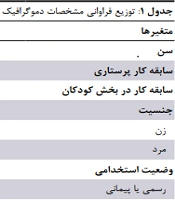
In total, 15 women and 4 men participated in this study. Participants’ ages ranged from 25 to 55 years old and their work experience was between 5 and 30 years (Table 1).
Table 1.
Participant Characteristics
| Participant | Position | Age | Gender | Job Experience, y |
|---|---|---|---|---|
| 1 | Supervisor | 42 | Female | 20 |
| 2 | Supervisor | 38 | Female | 10 |
| 3 | Supervisor | 36 | Female | 9 |
| 4 | Supervisor | 33 | Female | 7 |
| 5 | Social worker | 31 | Female | 7 |
| 6 | Social worker | 31 | Male | 5 |
| 7 | Social worker | 30 | Female | 6 |
| 8 | Social worker | 29 | Female | 6 |
| 9 | Social worker | 34 | Female | 9 |
| 10 | Social worker | 36 | Male | 8 |
| 11 | Supervisor | 34 | Male | 8 |
| 12 | Social worker | 29 | Female | 5 |
| 13 | Supervisor | 45 | Female | 25 |
| 14 | Social worker | 32 | Female | 8 |
| 15 | Supervisor | 53 | Female | 30 |
| 16 | Supervisor | 39 | Female | 9 |
| 17 | Supervisor | 42 | Female | 14 |
| 18 | Social worker | 38 | Female | 9 |
| 19 | Social worker | 35 | Male | 12 |
This study was part of a larger research. By analyzing 458 primary codes, 4 main categories including sense of being worthy, self-care, professional growth, and establishing boundaries were extracted from the experiences of social workers which was identified with the theme of resilience of social workers (Table 2).
Table 2.
Concepts and Their Subcategories of Resilience Theme
| Category, Subcategory | Codes |
|---|---|
| Sense of being worthy | |
| Self-satisfaction | Families positive feedback; the result of serving in the patient’s life |
| spirituality | God's satisfaction; upturns in life |
| Self-care | |
| Social support | Support of supervisor/coworkers; support of family/friends |
| Psychological preparation | Self-control; relaxing/interesting activities |
| Professional growth | |
| Promoting specialized knowledge | Self- learning; in-service training |
| Acquisition of related experience | Learn from experienced workers; improving skills in the fields |
| Establishing boundaries | |
| Strengthening professional boundaries | Empathy versus sympathy; separate work from home |
| Strengthening boundaries with other team members | Redefine role/task; inclusive presence in the field; develop status in care team |
4.1. Sense of Being Worthy
Participants identified that the factors which sustained them in the oncology field and made them accept its pressures and hardships were the satisfaction of the service outcome and the spiritual effect of the service. Two participants (p5 and p8) stated the following sentences about families’ positive feedback and the result of their serving in the patient’s life:
“It makes me happy when I call to follow the condition of the children who stopped treatment, and I understand that they are now a student, employed, married, and have a normal life”.
“One time, a 60 years old man told me that your behavior is so respectful that I have forgotten all my pain or once a child’s mother gave me a bunch of flowers and thanked me. These make me hopeful to continue working here”.
Social workers consider serving children with cancer and their families as worship and God’s consent. Participants believed in the spiritual effects of serving in their lives and considered many of the blessings and opportunities of their lives as a result of the patients’ prayers. A social worker (p14) said:
“When children’s families in different accents pray for me, I think that my services give me God’s consent and some kind of worship”.
Another participant (p13) said:
“Sometimes there were problems in my life that I could not solve them, but I was provided with some prerequisites for solving the problems that I did not understand how they were solved”.
4.2. Self-Care
Social workers acknowledge that plan for their own care is one way to reduce tension and control negative emotions and the efforts to receive social support and psychological preparation are two of these. Participants (p4 and p10) told about receiving support from family and coworkers:
“After one of child’s death, I was very emotionally devastated; I felt bad sense because I did not have the ability to console his mother. I was looking for someone who listened to me, understood, and guided me so I talked with the supervisor”.
“We have case reporting sessions every week, and we discuss each case and its problems. We talk about our concerns and feelings. That’s where I understood my feelings are so much as others, and I just do not experience it”.
By performing activities such as traveling, exercises, climbing, meditation and the like, social workers can have taken care of themselves. They also learned life skills and self-control techniques, stress management, and anger management to help themselves.
4.3. Professional Growth
In regard to the severe, complex and special nature of the child’s oncology work, and lack of their expertise and skills, social workers have tried to promote their specialized knowledge and acquisition of related experience. Participants reported that due to the existing academic limitations, they used 2 strategies including self-learning and participating in in-service training to increase their special capacity. Two social workers (p17 and p12) stated about these:
“I would like to read Persian related books and English resources. I also raised my knowledge about cancer when I informed the families about their child disease. I also follow the websites about international associations and the results of conferences on cancer”.
“Here is a series of training courses for us. Of course, the courses were more about psychology, not social work, and the focus was entirely on the child, not the family, but our knowledge in this field was updated”.
From the perspective of social workers, the field of pediatric oncology, with all its complexities and unique difficulties, is considered as a learning opportunity. They reported that the growth of capacities and the development of individual and professional skills resulted from work in this challenging environment. Participants also benefited from the direct and indirect training of experienced workers.
4.4. Establishing Boundaries
Social workers considered strengthening professional boundaries and strengthening boundaries with other team members as one of their fundamental strategies in facing professional challenges and fatigue. Social workers set personal and professional boundaries. Participants reported that by engaging with the client’s pain and sorrow, they felt compassion fatigue and couldn’t help the client. In this regard, social workers tried to use empathy versus sympathy to avoid the mentioned effects. Likewise, in order to reduce the negative effects of professional life on personal life, social worker tried to separate their work from their home. Some participants stated that they kept their distance from the clients and tried to cut off contact with them at non-office hours.
The social workers also felt that establishing professional boundaries with other care team members can clarify their role served. Due to the lack of specific job descriptions in the children cancer centers in Iran, social workers made internal redefinition of their roles and responsibilities in each center. They were present throughout the treatment process and provided services for the child and their family.
5. Discussion
The present study conducted to understand how pediatric oncology social workers deal with CF and BO. From the analysis of social worker’s experiences, 4 key concepts including a sense of being worthy, self-care, professional growth, and establishing boundaries emerged and “resiliency of social workers” as a key concept was identified. According to this study, social workers were able to alleviate CF and BO and promote personal and professional skills by using the mentioned strategies.
Based on the findings of this study, social workers had a positive self-concept of their performance that led to their self-satisfaction. Getting positive feedback from clients and the results of serving in the patient’s life strengthened their usefulness feeling so they had more motivation and hope to continue their work.
Social workers also believed that serving human brings God’s satisfaction and even regarded their work as worship. Participants perceived the spiritual effects of their work in their lives, and they considered religious beliefs to be patient and persevering in stressful circumstances. Spirituality and religious beliefs lead to increased self-control and psychological adjustment through the belief in divine power. Yi et al. (3) considered spirituality as one of the protective factors of oncology social workers from fatigue. In other studies, Froutan et al. (25) and Lyckholm et al. (26) suggested that spiritual wealth increase the resilience of health provider.
The findings also indicated that applying strategies to provide self-care through receiving social support and psychological or mental preparation, helped workers feel better and capable of coping with CF. Some social workers talked about their work and unpleasant events with family members or friends. Spending time with family and getting empathic support from closed relatives could be effective to negative excitement and alleviation. Contrary to the findings of this study, Korean oncology social workers reported that they would rather not talk about their work with their families and friends because they thought it would be too difficult to make themselves understood (8). The differences in results may be related to cultural diversities. The social workers in this study manage their difficult situations and complex cases by receiving informational and emotional support from their colleagues and supervisors. Yi et al., also confirm these findings.
Engaging in relaxing and interesting activities makes social workers calm down and help them to protect themselves from the negative consequences of their work. Applying life skills such as stress and anger management helped participants manage their stress, find alternate solutions, and see the situation more objectively. Whitebird et al. (27), and Kapoulitsas and Corcoran (28) found that physical activities and social support decrease hospice social worker’s burnout.
The other strategies employed by social workers to manage lack of their professional competence included adopting measures to develop the level of expertise and experiences by studying related books and attending specialized conferences, and training courses at the workplace. Participants also acquired related experience by learning from experienced workers and improving skills in the fields. This is similar to the findings of a study by Yi et al. (8). In this regard, Khalvati et al. in their study of the process of professionalism of Iranian hospital social workers referred to self-learning and learning in the field and from colleagues (29). Social workers also mentioned establishing and strengthening professional boundaries as another effective strategy, which is consistent with previous studies on pediatric oncology providers (30, 31). Participants due to lack of integrated job description for oncology work and to provide a better view of their professional duties, began to redefine new tasks.
According to the findings, social workers tried not to get too involved with the clients’ situations, and they employed empathy versus sympathy to protect themselves from the emotional intensity of oncology work. They separated their work from their home by keeping their distance from the clients and work events after official hours and conscious and purposefully attempt to separate personal life from professional life. The results of some other studies support these finding (8, 29).
5.1. Conclusions
This qualitative study showed that major themes contributing to the resilience of the social workers in caring for children with cancer and their families that indicated how social workers deal with CF and ways in which their interactions serve to protect them from burnout. The results implicated the importance of developing programs, policies, and research on the prevention of CF and BO. The findings also suggested the need for strong support systems for social workers to allow them to share their unpleasant experiences. Supervisors can play a crucial role in this field. Promotion of resilience in professional training may further enhance social workers’ skills to continue to work in this field.
This study had some limitations that need to be considered. The first limitation of this study, like other qualitative studies, was about the generalization of the results. Second, we did not consider how participants’ demographic characteristics were related to their experiences. Although considering the qualitative approach of this study, the results cannot be generalized to other cultures and countries, some findings may be subscribed to other similar cultures. It is suggested that future research address the question of whether the results of this study can be generalized to pediatric oncology social workers with different cultural backgrounds, job experience, and education/training levels.