
1. Background
Family-centered care (FCC) refers to the care philosophy accepting the family’s crucial role in the life of the child and delivery of care (1-5). Family-centered care is a frequently used care philosophy in pediatric nursing to provide care to families and their children in hospitals and the community (3, 6, 7). This also establishes trusting relationships within the patient-family relationship structure (8).
The FCC philosophy identified in the 1950s has evolved over the years from parental participation to partnership and eventually to the care provided for the entire family (9). Accordingly, FCC is rooted in the belief that families are the primary source of nurturing and care for their children during childhood (10-12). This helps to ensure that the care provided is organized around the entire family, rather than just the child, and that all members of the family are viewed as care recipients (13, 14).
Foster et al. (15) and Power and Franck (16) proposed that the delivery of FCC by healthcare providers is impeded by a lack of awareness, skills, knowledge, time, and resources. Paliadelis et al. (17) point out that nurse practitioners struggle with FCC because they are concerned about the families’ ability to provide proper assistance. Others have suggested that inappropriate negotiating processes and healthcare provider perceptions affect the delivery of FCC (15, 17). Furthermore, Mirlashari et al. (18) proposed that units are insufficiently equipped for the implementation of FCC, family difficulties, and families reluctant to remain engaged with the relevant departments for an extended time.
Implementing FCC among nurses necessitates shifting from the role of care prescriber to a participatory role in which they collaboratively work with families (19). Hence, nurses must consider sharing health information with both the families and children, and each treatment plan must consider the families’ preferences and needs (20). To date, studies on suggested that the FCC is an important component in the health system and plays a key role in pediatric nursing to provide holistic care to patients and their families (3, 6, 7, 13, 14).
In light of this, there is an increasing amount of literature that recognizes the importance of the FCC approach. Despite this, very few survey studies conducted have investigated both perceptions and practices of pediatric nurses in Arab and Middle East countries. In addition, the data about the association between the socio-demographic factors and pediatric nurses’ perceptions and practice toward FCC is still limited. In Jordan, less attention paid to address the FCC approach among pediatric nurses, as well as they are a few researchers have been attempted to examine this area. Up-to-date, there is no published study has investigated both perceptions and practices among pediatric nursing regarding FCC in governmental hospitals in the southern part of Jordan. Therefore, the survey method undertaken in this study is intended to fill in these gaps in the research.
2. Objectives
With the nature of the study problem raised in the background, the study aims:
(1) To investigate the pediatric nurses’ perceptions and practices toward FCC in selected governmental hospitals in the southern part of Jordan;
(2) To examine the relationship between the demographic variables (age and academic level) and pediatric nurses’ perceptions and practices.
3. Methods
3.1. Study Design, Duration, Setting
A cross-sectional study was conducted from January to March 2022 in pediatric settings in three governmental hospitals, namely, Al-Karak Governmental Hospital, Ma'an Governmental Hospital, and Queen Rania Governmental Hospital
3.2. Population
The target population consists of all the nurses working in pediatric settings in the three governmental hospitals located in the southern part of Jordan. The sample units are selected based on the inclusion and exclusion criteria. Only nurses fulfilling the study criteria received the respondent’s information sheet to participate in the study questionnaire.
3.3. Sample Size
Total population sampling was used for this study. We collect the data as our sample convenience. A convenience sampling approach is used to invite pediatric nurses from three governmental hospitals to complete the study questionnaires.
3.4. Inclusion and Exclusion Criteria
The inclusion criteria for the respondents include full-time, qualified with a degree of nursing or higher, and at least six months of experience in pediatric wards. Nurses working part-time or on a contract are excluded from this study.
3.5. Study Instruments
The questionnaire adopted as an instrument study consists of two parts: the demographic profile of the respondents, such as their age, gender, religion, academic level, and years of clinical experience, and the Family-Centered Care Questionnaire (FCCQ). It’s a self-reporting instrument applied to investigate pediatric nurses’ perceptions and practices regarding FCC. According to Bruce and Ritchie (21), FCCQ contains nine dimensions: “Family is the constant” (3 items); “Parent/professional collaboration” (6 items); “Recognition family individuality” (5 items); “Sharing information” (5 items); “Developmental needs” (4 items); “Parent-to-parent support” (5 items); “Emotional/financial support” (4 items); “Design of healthcare system” (7 items); and “Emotional support for staff” (6 items). Each item of FCCQ is rated on a 5-point Likert scale ranging from 1 = “strongly disagree” to 5 = “strongly agree.” The content validity of the instrument was stated previously by Bruce and Ritchie (21). They reported an acceptable content validity and vetted that the FCCQ items denote FCC concepts, and all items were found to be relevant to the FCC approach (21). The reliability of FCCQ is approved across different studies (1, 2, 21). The instrument has good reliability, with a Cronbach’s alpha between 0.5 and 0.9 for FCC domains as well as a total alpha of 0.90 (1, 2, 21).
3.6. Data Collection Procedures
Prior to the data collection, the first author conducted preliminary visits and contacted the directors of the three selected governmental hospitals. The first author, who has previous work experience as a researcher in pediatric clinical settings, met the hospital director to explain the nature and purpose of the study and arrange to survey the hospital. The provision of a suitable place in each workplace to conduct the study was requested. Then, the first author requested permission from the pediatric ward director to hand out the study questionnaires to the nurses. The first and second authors coordinated with the director of the target sample to arrange a timetable for data collection. All respondents fulfilling the study inclusion criteria are invited to participate by an invitation letter, text message, and phone call.
Before distributing the two parts of the questionnaire, the informed consent sheet is carefully read and signed by each respondent. The informed consent is reviewed with the respondent to ensure their understanding of the form. The respondents agreeing to participate in this study are offered a detailed study description, the benefits, and the rights. Every respondent has the right to ask questions to obtain adequate information about the study. Additionally, every respondent has the right to withdraw or withhold information at any time but not after transferring the data into the statistical program. Completing the two-part study questionnaires requires giving each respondent approximately 20 to 30 minutes for completion. In the case of incomplete responses, the respondents are requested to go back and complete them.
3.7. Ethical Considerations
The study approval is granted by the Ethics and Research Committee at the Faculty of Nursing at Mutah University and the Ministry of Health (reference number; SREC-10-2021). The respondents are assured that their participation is voluntary and anonymous and there are no negative effects regarding their medical care. The respondents are assured that their answers are kept confidential as only the research team can access the information, and questionnaires include no personal identifying information.
3.8. Data Analysis
The collected data is analyzed using the Statistical Package for Social Sciences (SPSS), v. 25 (SPSS@IBM). The descriptive and inferential statistics are computed as the selected study variables. Descriptive statistics are utilized to describe the demographics and the frequency distribution of each variable in the study. Demographic variables are analyzed to describe the sample using frequency, percentage, mean, and standard deviation. All variables demonstrate a correlation at a significance level of P < 0.05. Multiple linear regressions are performed to examine the relationship between the socio-demographic variables and the perceptions and practices of the nurses regarding FCC.
4. Results
Table 1 illustrates the participants’ demographic characteristics. The total number of participants completing the survey is 102. The mean ± standard deviation (SD) of the age of participants is 31 ± 5.1 years old, ranging from 22 to 45 years old. Among all the participants, 95.1% (n = 97) are female nurses, and 4.9% (n = 5) are male. The majority of the participants (82.4%, n = 84) are Muslim. In terms of academic level, 82.4% (n = 84) of the participants have a bachelor’s degree or higher. Eighty-two point four percent (n = 84) of the participants had a bachelor’s degree or higher.
Table 1.
Demographic Variables of the Participants (n = 102) a
| Demographic Variables | Values |
|---|---|
| Age | 31 ± 5.3 (22 - 45) |
| Gender | |
| Male | 5 (4.9) |
| Female | 97 (95.1) |
| Religion | |
| Islam | 84 (82.4) |
| Christian | 18 (17.6) |
| Educational level | |
| Diploma | 18 (17.6) |
| Bachelor or higher | 84 (82.4) |
a Values are expressed as mean ± standard deviation (range) or No. (%).
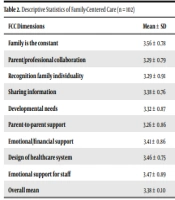
As presented in Table 2, the overall mean score of the participants toward FCC is 3.38 ± 0.10, showing the modest perceptions and practices toward FCC. “Family is the constant” receives the highest score (3.56 ± 0.78), followed by “Emotional support for staff” (3.47 ± 0.89), “Design of healthcare system” (3.46 ± 0.75), “Emotional/financial support” (3.41 ± 0.86), “Sharing information” (3.38 ± 0.76), “Developmental needs” (3.32 ± 0.87), “Recognition family individuality” (3.29 ± 0.91), and “Parent/professional collaboration” (3.29 ± 0.79). “Parent-to-parent support” is the dimension with the lowest score (3.26 ± 0.86).
Table 2.
Descriptive Statistics of Family-Centered Care (n = 102)
| FCC Dimensions | Mean ± SD |
|---|---|
| Family is the constant | 3.56 ± 0.78 |
| Parent/professional collaboration | 3.29 ± 0.79 |
| Recognition family individuality | 3.29 ± 0.91 |
| Sharing information | 3.38 ± 0.76 |
| Developmental needs | 3.32 ± 0.87 |
| Parent-to-parent support | 3.26 ± 0.86 |
| Emotional/financial support | 3.41 ± 0.86 |
| Design of healthcare system | 3.46 ± 0.75 |
| Emotional support for staff | 3.47 ± 0.89 |
| Overall mean | 3.38 ± 0.10 |
Abbreviations: FCC, family-centered care; SD, standard deviation.
As demonstrated in Table 3, there are no correlations between participants’ age, academic level, and overall FCC. As can be seen in Table 3, age (P = 0.02) is the only predictor significantly associated with the dimension “Emotional support for staff.”
Table 3.
Relationship Between the Demographic Variables (Age and Education Level) and Family-Centered Care (n = 102)
| FCC Dimensions | Age | Education Level | ||
|---|---|---|---|---|
| β | P | β | P | |
| Family is the constant | 0.03 | 0.80 | -0.09 | 0.37 |
| Parent/professional collaboration | 0.02 | 0.88 | 0.09 | 0.40 |
| Recognition family individuality | 0.05 | 0.61 | 0.19 | 0.06 |
| Sharing information | 0.11 | 0.26 | 0.02 | 0.82 |
| Developmental needs | 0.14 | 0.17 | -0.13 | 0.18 |
| Parent-to-parent support | 0.15 | 0.14 | 0.04 | 0.71 |
| Emotional/financial support | 0.04 | 0.70 | 0.13 | 0.20 |
| Design of healthcare system | 0.17 | 0.08 | 0.01 | 0.95 |
| Emotional support for staff | 0.24 | 0.02 a | 0.03 | 0.75 |
| Overall | 0.15 | 0.14 | 0.06 | 0.58 |
Abbreviations: FCC, family-centered care; β, standardized coefficients.
a P < 0.05
5. Discussion
This section gives insights into the discussion related to the results of the study.
First: The Jordanian pediatric nurses’ perceptions and practices of FCC: The pediatric nurses’ perceptions and practices toward FCC are examined in selected governmental hospitals in the southern part of Jordan. The study demonstrated that pediatric nurses’ perceptions and practices toward FCC were rated as modest. Concerning FCC domains, the “Family is the constant” factor is ranked first with the highest score. This finding is in line with various studies showing that families are a rich source of support for their children, as children are not comfortable in hospitals. Their discomfort can be mitigated by having the parents stay with their children (5). Additionally, Done et al. (5) show that the child’s family makes important decisions regarding their child’s care. However, this result is inconsistent with the majority of the previous studies demonstrating that the pediatric nurses’ perception of the “Family is the constant” domain is ranked second with a low score (2, 22-25). A possible explanation for this result is that Jordanian pediatric nurses positively support the cooperation of family members while delivering care for their children when admitted to the hospitals. This explanation is supported by the previous studies by Khalaf and Callister (26), reporting that Jordanian people live in an extended family structure where family kinship is both deeply rooted and highly valued. Therefore, visiting patients in a hospital represents a favorable social act culturally and socially encouraged by the Holy Qur’an and Sunnah, i.e., sayings, deeds, and sanctions of the Prophet Mohammed regardless of the type of disease (27).
Moreover, Jordanian families are required to stand with and be close to the patient to obtain certain information about their progress and condition. A similar explanation is found in a Saudi Arabian study conducted by Alabdulaziz and Cruz (25), observing a deep emotional connection between parents and children in the country. It is argued that this deep emotional bond may be due to the cultural and religious aspects of Saudi society (28). Other countries have a similar value placed on the engagement of the family as part of delivering holistic care for their children during hospitalization. In developed countries such as Australia and the United Kingdom, for example, family members are heavily involved in healthcare and decisions related to the hospitalization of their children (29). On the other hand, nurses from Thailand perceive that the parents are not involved in the healthcare delivery to their children while they are hospitalized (30).
In the current study, the Jordanian pediatric nurses have rated the “Emotional support for staff” factor as the second most important factor of FCC. This result agrees with a previous study conducted in the United States by Petersen et al. (24), indicating that emotional support for staff is ranked among the top three domains of FCC. On the other hand, other studies have reported that a lack of organizational guidance and direction, support for the professional autonomy of nurses, and recognition for their professional contribution when delivering care may lead to a lower rating of the emotional support for staff domain as perceived by the nurses (2, 22, 23). The possible explanation why the Jordanian pediatric nurses have rated the emotional support for staff domain among the top three domains is explained by the fact that the Jordanian nurses feel that they have access to many sources of support during their daily practice. Those sources include the nursing educators, colleagues, and head nurses. This type of support will enhance the nurses’ positive feelings about their work, ultimately leading to improved job performance, less staff burnout, and less staff turnover. This interpretation is supported by the findings from research undertaken with a focus on children (23, 31). This research indicates that various training programs to educate nurses about the principles of FCC are essential for establishing an optimal level of cooperation between parents and nurses. This model of care will result in substantial improvements in the care quality provided to hospitalized children.
The third domain of FCC ranked among the top three domains by Jordanian pediatric nurses is the design of the healthcare system. This domain is related to the immediate patient environment, including the physical environment, human resources, furnishings, equipment, and educational materials. This result is in line with a previous study showing that individual rooms reduce the rate of patient infection, decrease stressful stimuli, and provide privacy and space for the patients and their families (32). On the contrary, this result is inconsistent with the Sri Lankan study conducted by Done et al. (5), indicating that poor facilities for families, overcrowding, staff shortages, and unlimited hospital admissions are the major factors affecting the Sri Lankan pediatric nurses’ perception of FCC. The results of the current study regarding the rating of the design of the healthcare system domain of FCC is explained by the fact that everything in the pediatrics wards in the Jordanian hospitals, such as the walls, corridors, treatment rooms, and reception, is child-friendly, creating a therapeutic environment. This possible explanation is supported by a previous study conducted by Long et al. (32) demonstrating that the physical environment of the wards plays a major role in creating and conveying a therapeutic ward atmosphere (33). These factors consist of the location of the ward concerning other facilities, the size of the ward, the occurrence of overcrowding, and the physical layout, including bedrooms, bathrooms, and recreational areas that are adequate facilities for families, along with the required security measures (33).
The domain “Parent-to-parent support” is ranked last, with the lowest rating from the Jordanian pediatric nurses participating in the current study. This result is in agreement with the previous studies showing that parent-to-parent support is rated the lowest domain of the FCC as perceived by the participants (2, 22-25, 34). One possible explanation for this finding may be due to the lack of time and facilities or designated areas allowing parents to comfortably gather and express their experiences in a private and confidential atmosphere. Jordanian pediatric nurses participating in the current study have no adequate time to encourage the parents to discuss their concerns with other parents having similar experiences, which is essential in FCC. This possible explanation is supported by the findings of a previous study done by Dall’Oglio et al. (33) in Italy.
Second: Relationship between the demographic variables: age and academic level and the pediatric nurses’ perceptions and practices: The findings of this study indicate no correlations between the participants’ age and academic level and their overall FCC domains. These findings are consistent with the previous studies that show no correlations between the demographic variables and their overall FCC perceptions and practices (35, 36). These results were inconsistent with the Greek study done by Matziou et al. (35), demonstrating that nurses under the age of 30 years old have recognized the importance of FCC more than older nurses. However, these results are inconsistent with the study by Alemdar et al. (36), indicating that the higher the academic level of the nurses, the more positive the perception and practices of FCC. The findings also show that only the participants’ age, as one of the demographic variables measured in this study, has significantly influenced the perception and practices of emotional support for the staff domain. This finding is consistent with the study by Bruce et al. (22), reporting that the nurses’ age has significantly impacted the overall FCC domains. The possible explanation for this result could be related to the fact that older nurses have more specialized knowledge and information about the principles of FCC and can understand the needs of families with hospitalized children. This finding, along with having skills in communication, conflict management, and negotiation, enables them to adopt the principles of FCC in their daily practice more than the younger nurses. This possible explanation is supported by the previous studies reporting those younger nurses at the beginning of their professional careers are required to be aware of the principles of FCC. Thus, they can cooperate with this care model in their practices to improve the care quality and increase patient satisfaction (2, 23, 37, 38).
5.1. Limitations of the Study
Like other pieces of research, this study has several limitations. First, using a cross-sectional design has limited the establishment of any causal relationships. Second, this study has exclusively relied on a self-administered questionnaire, increasing the possible reporting bias such as social desirability. Third, the study sample is restricted to pediatric nurses from governmental hospitals in the southern part of Jordan. Therefore, the results may not be generalized to other settings in different locations in Jordan. Using the convenience sampling strategy and a sample consisting of 102 pediatric nurses from three governmental hospitals compared with the total number of nurses employed in these hospitals also affects the results. Consequently, the results of the current study should be interpreted with caution.
5.2. Implications
5.2.1. Implications for the Nursing Administration
The nursing administration should take the initiative to develop policies supporting the practice of FCC. This step requires changes to the Jordanian health policy to accelerate the FCC model integration into the daily practice of different clinical settings.
5.2.2. Implications for Nursing Education
Improving the Jordanian pediatric nurses’ knowledge and understanding of the theoretical underpinning of FCC necessitates arranging family educational programs by nursing educators to increase the FCC-based awareness of families. Sufficient educational opportunities and activities related to the concepts of FCC and how the model works are also needed. It means that the educational materials in pediatric wards may need updating. The positive aspects of FCC can be included in orientation programs for new nurses in pediatric wards to develop and use the necessary knowledge and skills in the clinical experience. Moreover, an educational policy requiring the integration of FCC model content into the nursing curriculum must be created and implemented in Jordanian nursing colleges and universities.
5.2.3. Implications for Nursing Practice
Integrating FCC into the daily practice of Jordanian pediatric nurses necessitates using a series of orientation sessions to assist the nursing staff in improving their FCC perception and practice in a clinical setting.
5.2.4. Implications for Further Research
A replication of this study with a sample representing the various healthcare providers would be a valuable addition to the knowledge in this area. Also, another copy of the study using a mixed method would enable a broader measure rather than solely the quantitative approach.
5.3. Conclusions
This study set out to investigate pediatric nurses’ perceptions and practices of FCC in selected governmental hospitals in the southern part of Jordan and exam the relationship between age and academic level and pediatric nurses’ perceptions and practices. The present study’s findings indicated that Jordanian pediatric nurses have modest perceptions and practices of FCC. In addition, only nurses’ age is found to be correlated with the domain of “Emotional support for staff.” The findings make an important contribution to the field of the FCC approach, which might be applied in crafting policies and interventions in various pediatric units and nursing education in Jordan. Ongoing education programs focused on FCC are also needed for nurses in pediatric settings.