


1. Background
Cigarette smoking is a major global health crisis, resulting in millions of deaths annually and posing a substantial public health threat (1, 2). Despite worldwide anti-smoking efforts, nearly 1 billion individuals continue to smoke, with a concerning increase in prevalence among youth and women (3, 4). In Iran, approximately 15% of the population smokes, reflecting this trend (4). Early smoking initiation and persistence are associated with psychological factors such as anxiety sensitivity (AS) and low distress tolerance (DT) and are linked to common psychological comorbidities, such as anxiety and mood disorders, which severely impair overall quality of life (5, 6).
Anxiety sensitivity is not equivalent to trait or state anxiety, which refer to the frequency or intensity of anxious feelings. Rather, AS is a specific fear of anxiety sensations because of perceived catastrophic consequences, such as social ridicule or cardiac arrest (7, 8). This fear of anxiety-related sensations is a critical factor in the development of anxiety and depressive disorders, which are highly comorbid with maladaptive coping behaviors such as smoking (9). The relationship between AS and smoking is theorized to be bidirectional. High AS may predispose individuals to use smoking for negative reinforcement. Conversely, persistent and long-term smoking may pharmacologically increase interoceptive awareness and sensitivity, thereby exacerbating AS over time (10, 11). This reciprocal cycle is a key mechanism in the maintenance of dependence and warrants focused investigation. Anxiety sensitivity is hypothesized to influence smoking through key theoretical mechanisms. It may motivate initiation through experiential avoidance of aversive internal states (12). Subsequently, smoking provides immediate negative reinforcement by alleviating these feared sensations, thereby strongly reinforcing the behavior (13). This reliance on smoking for emotion regulation establishes a maladaptive cycle, creating a substantial barrier to cessation for individuals with high AS. High AS predisposes individuals to initiate smoking as a maladaptive coping strategy and impedes cessation (14). These smokers exhibit greater nicotine dependence, more severe withdrawal, and higher relapse rates (14, 15).
Distress tolerance is conceptualized according to established theoretical models. It is defined as a multidimensional construct encompassing an individual’s perceived ability to tolerate emotional distress, cognitive appraisal of distress, degree of absorption by negative affect, and capacity for behavioral regulation in the presence of distress (16, 17). This framework of DT as the capacity to withstand negative emotional states is essential for analyzing its specific relationship with smoking behaviors (18). Lower DT correlates with increased neuroticism, greater susceptibility to smoking, and greater difficulty quitting, leading to more severe withdrawal and higher relapse rates (17, 19). Low DT is theoretically linked to substance use through key psychological mechanisms. Individuals with low DT may initiate smoking as a maladaptive strategy for experiential avoidance and for the immediate negative reinforcement of distress (20). This reliance can create a bidirectional cycle: smoking temporarily alleviates distress and reinforces use, whereas chronic avoidance may further erode DT, creating a substantial barrier to cessation by undermining coping with withdrawal-related discomfort (21, 22). In light of this bidirectional interaction, the critical role of DT in both smoking initiation and relapse underscores the need to integrate its assessment into clinical interventions and public health strategies (23).
Although the physiological underpinnings of nicotine dependence are well documented, the psychological mechanisms that sustain it, particularly among cigarette-dependent men, require further exploration. This study is grounded in Erikson's Psychosocial Developmental Theory (24), the Cognitive-Behavioral Model of addiction (25), and Socioemotional Selectivity Theory (26), which provide robust theoretical frameworks for anxiety, distress, and problematic behaviors such as smoking. This model posits that smoking often functions as a maladaptive coping strategy learned to manage aversive affective states. Central to this model, AS, the fear of anxiety-related sensations, and DT, the perceived ability to withstand negative emotional states, are 2 critical vulnerability factors for addictive behaviors (27). Individuals with high AS appraise internal arousal as catastrophic, generating significant distress; when this is coupled with low DT, which diminishes the perceived capacity to endure distress, the propensity to seek immediate negative reinforcement through substances such as nicotine is substantially amplified (28, 29). Consequently, high AS and low DT are theorized to form a synergistic vulnerability, intensifying the tendency to smoke for affect regulation and impeding cessation efforts (30), thereby justifying a focused investigation of these constructs within a dependent male population.
Despite established empirical links between these vulnerabilities and smoking intensity, dependence, and relapse, a significant gap remains. Research on how AS and DT manifest across the adult lifespan among cigarette-dependent men is strikingly sparse. Although general population studies suggest potential age-related variations, such as older adults exhibiting higher DT and lower AS (5, 28), these patterns remain unexplored in a clinical smoking cohort. This omission is critical because the interaction between core psychological vulnerabilities and aging may profoundly influence the maintenance of smoking dependence and the efficacy of interventions. A uniform psychological approach to cessation may therefore be suboptimal. To address this gap, the present study aimed to conduct a comparative analysis of AS and DT across distinct age groups among cigarette-dependent men. By examining whether and how these foundational psychological risk profiles differ with age, this investigation sought to provide essential insights for developing more targeted, age-sensitive, and psychologically informed cessation strategies that move beyond generic interventions to address the specific needs of different demographic subsets within the smoking population.
2. Objectives
This study compared anxiety sensitivity and distress tolerance among male smokers across four age groups: adolescents, young adults, middle-aged adults, and older adults.
3. Materials and Methods
3.1. Study Design and Participants
This comparative cross-sectional study recruited 300 male smokers in Tehran through convenience sampling during spring and summer 2024. After application of the eligibility criteria, 278 participants were included in the final analysis. A post hoc sensitivity analysis using G*Power 3.1 indicated that with this sample size (N = 278) and an alpha of 0.05, the study achieved more than 80% power to detect medium effect sizes (f ≥ 0.175) for the primary MANOVA, confirming adequate statistical power. Participants were categorized into 4 age groups based on established developmental frameworks and epidemiological classifications commonly used in substance use research (31, 32): adolescents (13 - 19 years; n = 69, 24.8%), young adults (20 - 39 years; n = 68, 24.5%), middle-aged adults (40 - 59 years; n = 71, 25.5%), and elderly adults (60 years or older; n = 70, 25.2%). This stratification clarifies distinct psychosocial contexts relevant to anxiety sensitivity, distress tolerance, and smoking patterns across the lifespan.
Convenience sampling was pragmatically necessitated by feasibility constraints in recruiting a clinical, treatment-seeking population of nicotine-dependent men across multiple age cohorts within the study’s limited timeframe and resources. A total of 22 questionnaires were excluded because of noncompliance with the eligibility criteria, such as incomplete responses. For data management, 22 incomplete questionnaires with nonrandom, critical omissions were excluded. The final dataset had minimal item-level missing data (< 1%), which were handled through pairwise or listwise deletion, as appropriate. A missing values analysis confirmed that the data were missing completely at random, mitigating concerns about systematic bias. Inclusion criteria required participants to be at least 13 years old, have basic literacy, and smoke at least 1 cigarette daily. However, definitive classification relied on the Fagerström Test for Nicotine Dependence to ensure diagnostic validity. Exclusion criteria included a history of psychiatric hospitalization and active major psychiatric or chronic medical conditions, verified through self-report and medical records, because these represent significant confounding variables for the core psychological constructs under investigation. The psychiatric hospitalization criterion, while broad, was selected as an objective indicator of severe impairment and was prioritized over targeting specific anxiety-related disorders.
3.2. Instruments
3.2.1. Distress Tolerance Scale
The Distress Tolerance Scale (DTS) was developed by Simons and Gaher in 2005 (16) and consists of 15 items designed to assess various dimensions of emotional distress. These dimensions include the perceived ability to tolerate distress, subjective appraisal of distress, attention absorption by negative emotions, and efforts to regulate distress. The scale uses a 5-point Likert scale, ranging from “strongly agree” (1) to “strongly disagree” (5), with higher scores reflecting lower distress tolerance. The total score is obtained by summing responses across the 4 emotional distress subtypes (16). Factor analysis demonstrated that 88% of the variance in distress tolerance was accounted for by the model. The reliability of the scale was satisfactory, with Cronbach's alpha coefficients reported as follows: Tolerance, α = 0.72; subjective appraisal, α = 0.82; attention absorption, α = 0.78; regulation, α = 0.74; and total scale, α = 0.82 (16).
3.2.2. Anxiety Sensitivity Index-Revised
The Anxiety Sensitivity Index-Revised (ASI-R), developed by Taylor and Cox in 1998 (33), is a 36-item scale used to assess the fear of anxiety-related symptoms and their perceived consequences. Respondents rate each item on a 5-point Likert scale from 0 (very low) to 4 (very high), with higher scores indicating greater anxiety sensitivity. The ASI-R has demonstrated strong psychometric properties, including reported internal consistency, with Cronbach's alpha ranging from 0.83 to 0.94 (33). Arnau et al. (34) demonstrated significant correlations between this questionnaire and the Body Sensations Questionnaire (r = 0.704) and the Agoraphobic Cognitions Questionnaire (r = 0.640). Furthermore, the reliability of the instrument was strong. The reliability of this index was assessed using 3 methods, including internal consistency, test-retest reliability, and split-half reliability, yielding coefficients of 0.93, 0.95, and 0.97, respectively, for the overall scale.
3.3. Procedure
Data collection was conducted in public locations across Tehran. Participants completed the questionnaires individually in sessions lasting approximately 30 minutes. The order of questionnaire administration was randomized for each participant to control for potential order effects or fatigue-related bias in responses. Ethical approval was granted by the Institutional Review Board, specifically the Research Ethics Committee of Semnan University of Medical Sciences (IR.SEMUMS.REC.1403.047, dated 08.07.2024). All ethical protocols were followed, including obtaining written informed consent, ensuring confidentiality, and guaranteeing the right to withdraw. For adolescent participants aged 13 - 19 years, written parental consent and adolescent assent were obtained. Statistical analyses were conducted using SPSS version 26 and included descriptive statistics and MANCOVA. Post hoc comparisons were performed using Bonferroni post hoc comparison tests, with the significance level set at P < 0.05 for all analyses.
4. Results
4.1. Sample Characteristics
Participants ranged in age from 14 to 76 years, with an overall mean ± SD age of 41 ± 19 years. The mean ± SD age within each group was 17.50 ± 1.35 years for adolescents, 29.87 ± 4.84 years for young adults, 49.81 ± 5.84 years for middle-aged adults, and 65.90 ± 3.77 years for elderly adults. For the entire sample, the mean ± SD scores were as follows: anxiety sensitivity, 61.49 ± 25.50; distress tolerance, 37.40 ± 13.49; smoking intensity, 5.10 ± 2.92; and smoking duration, 15.02 ± 11.76 years. The demographic characteristics of the study sample are presented in Table 1.
Table 1.Demographic Characteristics of Participants in the 4 Age Groups a
| Demographic Characteristics | Adolescents | Young Adults | Middle-aged Adults | Elderly Adults | χ2 | P-Value |
|---|---|---|---|---|---|---|
| Literacy | 16.351 | 0.012 | ||||
| Illiterate | 8 (11.6) | 9 (13.2) | 15 (21.1) | 21 (30.0) | ||
| Non-university education | 35 (50.7) | 21 (30.9) | 26 (36.6) | 26 (37.1) | ||
| University education | 26 (37.7) | 38 (55.9) | 30 (42.3) | 23 (32.9) | ||
| Employment status | 177.507 | 0.001 | ||||
| Unemployed | 37 (53.6) | 6 (8.8) | 6 (8.5) | 5 (7.1) | ||
| Part-time | 24 (34.8) | 17 (25.0) | 12 (16.9) | 8 (11.4) | ||
| Employed | 8 (11.6) | 45 (66.2) | 39 (54.9) | 17 (24.3) | ||
| Retired | - | - | 14 (19.7) | 40 (57.1) | ||
| Marriage | 140.352 | 0.001 | ||||
| Single | 55 (79.7) | 12 (17.6) | 6 (8.5) | 4 (5.7) | ||
| Married | 11 (15.9) | 45 (66.2) | 51 (71.8) | 46 (65.7) | ||
| Divorced | 3 (4.3) | 9 (13.2) | 7 (9.9) | 6 (8.6) | ||
| Widowed | - | 2 (2.9) | 7 (9.9) | 14 (20.0) | ||
| Socioeconomic status | 5.566 | 0.474 | ||||
| Low | 17 (24.6) | 16 (23.5) | 18 (25.4) | 17 (24.3) | ||
| Moderate | 39 (56.5) | 31 (45.6) | 37 (52.1) | 42 (60.0) | ||
| High | 13 (18.8) | 21 (30.9) | 16 (22.5) | 11 (15.7) | ||
| Number of cigarettes smoked per day | 17.243 | 0.008 | ||||
| Less than 10 | 32 (46.4) | 34 (50.0) | 28 (39.4) | 19 (27.1) | ||
| Between 10 and 20 | 24 (34.8) | 30 (44.1) | 38 (53.5) | 38 (54.3) | ||
| More than 20 | 13 (18.8) | 4 (5.9) | 5 (7.0) | 13 (18.6) | ||
| Total | 69 | 68 | 71 | 70 |
a Values are expressed as No. (%).
Chi-square tests revealed significant differences in literacy, employment status, marital status, and smoking across age groups (P < 0.05). Although these differences could influence the results, controlling for these variables was not feasible because literacy increases with age, employment follows life-stage patterns, marriage peaks and then declines in adulthood, and smoking varies across age groups. These patterns reflect developmental, socioeconomic, and generational transitions across the lifespan.
4.2. Descriptive Statistics and Assumption Testing
Descriptive statistics, including means and standard deviations, for the continuous variables anxiety sensitivity, distress tolerance, smoking intensity, and smoking duration are presented by age group in Table 2 and Figure 1. Before the parametric analyses, normality was evaluated using skewness and kurtosis indices. For all variables, the absolute skewness and kurtosis values fell within the accepted range of -2 to +2 (Table 2), supporting the assumption of normality.
Table 2.Adjusted Means of Anxiety Sensitivity, Distress Tolerance, Smoking Intensity, and Smoking Duration by Age Group
| Variables and Groups | Adjusted Means | SD | Skewness | Kurtosis | 95% Confidence Interval | |
|---|---|---|---|---|---|---|
| Lower Limit | Upper Limit | |||||
| Anxiety sensitivity | ||||||
| Adolescents | 69.85 | 3.75 | -0.431 | -0.922 | 62.46 | 77.24 |
| Young adults | 50.68 | 2.96 | 1.246 | 1.198 | 44.83 | 56.52 |
| Middle-aged Adults | 54.03 | 2.33 | 0.180 | -0.822 | 49.43 | 58.64 |
| Elderly | 71.28 | 3.84 | -1.495 | 2.087 | 61.97 | 80.59 |
| Distress tolerance | ||||||
| Adolescents | 26.92 | 2.14 | 1.068 | 1.316 | 22.69 | 31.15 |
| Young Adults | 36.24 | 1.69 | 0.188 | -1.266 | 32.89 | 39.58 |
| Middle-aged Adults | 47.35 | 1.33 | -0.053 | -1.020 | 44.32 | 49.59 |
| The elderly | 39.16 | 2.70 | 1.348 | -0.722 | 33.83 | 44.49 |
| Smoking intensity | ||||||
| Adolescents | 4.95 | 0.344 | 0.290 | -1.244 | 4.279 | 5.634 |
| Young Adults | 4.19 | 0.347 | 0.731 | -0.687 | 3.509 | 4.873 |
| Middle-aged Adults | 5.07 | 0.339 | 0.389 | -1.203 | 4.403 | 5.738 |
| The elderly | 6.17 | 0.342 | -0.166 | -1.662 | 5.499 | 6.844 |
| Smoking duration | ||||||
| Adolescents | 3.333 | 0.556 | -0.577 | 0.085 | 2.239 | 4.428 |
| Young Adults | 7.632 | 0.560 | 0.526 | 0.538 | 6.530 | 8.735 |
| Middle-aged Adults | 17.197 | 0.548 | 0.368 | -0.150 | 16.118 | 18.276 |
| The elderly | 31.514 | 0.552 | -0.927 | 0.081 | 30.428 | 32.601 |
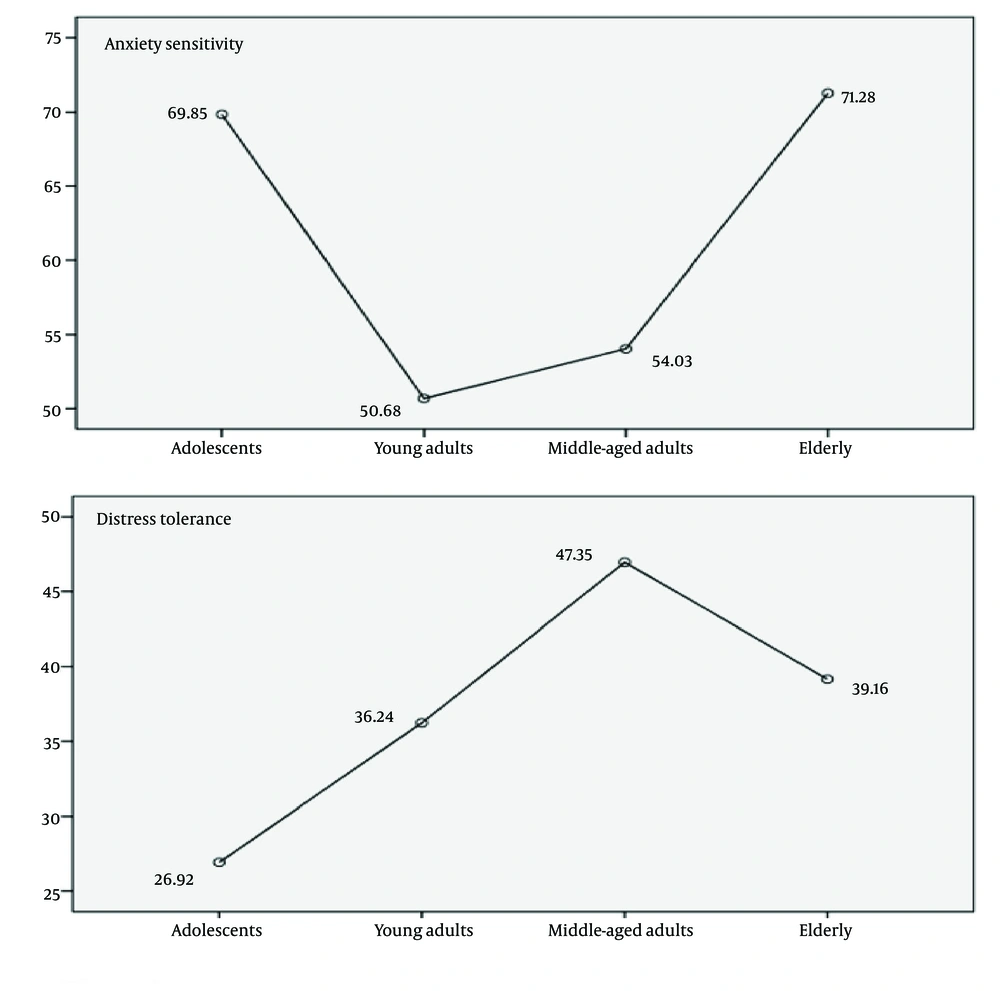
Figure 1.
Adjusted mean of anxiety sensitivity and distress tolerance in the groups
Preliminary assumption testing was conducted before the main analysis. Box's M test indicated no significant violation of the homogeneity of covariance matrices assumption (Box's M = 23.102, F = 1.34, P = 0.061). Furthermore, Levene's test supported the assumption of homogeneity of variances for the dependent variables, yielding nonsignificant results for anxiety sensitivity (F (3, 276) = 1.115, P = 0.187) and distress tolerance (F (3, 276) = 0.236, P = 0.101). With these key assumptions for parametric testing satisfied, MANCOVA was performed to examine differences in anxiety sensitivity and distress tolerance across the 4 age groups.
4.3. MANCOVA and Pairwise Comparisons
The multivariate MANCOVA tests yielded significant results. Wilks' Λ indicated a significant main effect of group (Λ = 0.688, F (6, 542) = 18.577, P < 0.001, partial η2 = 0.171). In addition, the multivariate tests for the covariates were significant. Significant effects were found for smoking intensity (Λ = 0.847, F (2, 271) = 24.458, P < 0.001, partial η2 = 0.153) and smoking duration (Λ = 0.966, F (2, 271) = 4.837, P = 0.009, partial η2 = 0.034). Tests of between-subjects effects for group and covariates on the dependent variables are presented in Table 3.
Table 3.Tests of Between-Subjects Effects of Group and Covariates on the Dependent Variables
| Source and Variables | SS | df | MS | F | Sig. | Eta. | Statistical Power |
|---|---|---|---|---|---|---|---|
| Intercept | |||||||
| Anxiety sensitivity | 32726.146 | 1 | 32726.146 | 89.373 | 0.001 | 0.247 | 1.000 |
| Distress tolerance | 54982.362 | 1 | 54982.362 | 458.518 | 0.001 | 0.628 | 1.000 |
| Group | |||||||
| Anxiety sensitivity | 21129.012 | 3 | 7043.004 | 19.234 | 0.001 | 0.175 | 1.000 |
| Distress tolerance | 10140.746 | 3 | 3380.249 | 28.189 | 0.001 | 0.237 | 1.000 |
| Smoking intensity | |||||||
| Anxiety sensitivity | 11743.439 | 1 | 11743.439 | 32.070 | 0.001 | 0.105 | 1.000 |
| Distress tolerance | 4903.741 | 1 | 4903.741 | 40.894 | 0.001 | 0.131 | 1.000 |
| Smoking duration | |||||||
| Anxiety sensitivity | 2661.322 | 1 | 2661.322 | 7.268 | 0.007 | 0.026 | 0.766 |
| Distress tolerance | 871.343 | 1 | 871.343 | 7.266 | 0.007 | 0.026 | 0.766 |
| Error | |||||||
| Anxiety sensitivity | 99599.995 | 272 | 366.176 | ||||
| Distress tolerance | 32616.411 | 272 | 119.913 |
The MANCOVA results presented in Table 3 revealed statistically significant main effects across groups for both dependent variables: anxiety sensitivity (F (3, 272) = 19.234, P < 0.001) and distress tolerance (F (3, 272) = 28.189, P < 0.001). The covariates also significantly influenced the outcomes. Smoking intensity was a significant covariate for anxiety sensitivity (F (1, 272) = 32.070, P < 0.001) and distress tolerance (F (1, 272) = 40.894, P < 0.001). Similarly, smoking duration was a significant covariate for anxiety sensitivity (F (1, 272) = 7.268, P = 0.007) and distress tolerance (F (1, 272) = 7.266, P = 0.007). A Bonferroni correction was applied after MANCOVA to control the family-wise error rate for pairwise comparisons (Table 4).
Table 4.Bonferroni Results for Pairwise Comparisons
| Dependent Variable, Group (I) and Group (J) | Mean Difference (I-J) | Std. Error | Cohen’s d | Sig. |
|---|---|---|---|---|
| Anxiety sensitivity | ||||
| Adolescents | ||||
| Young adults | 19.175 | 3.480 | 0.88 | 0.001 |
| Middle-aged Adults | 15.819 | 4.781 | 0.67 | 0.006 |
| Elderly | 1.429 | 7.806 | - | 1.000 |
| Young adults | ||||
| Middle-aged Adults | 3.355 | 4.035 | - | 1.000 |
| Elderly | 20.603 | 6.814 | 0.46 | 0.016 |
| Middle-aged Adults | ||||
| Elderly | 17.248 | 4.824 | 0.73 | 0.002 |
| Distress tolerance | ||||
| Adolescents | ||||
| Young adults | 9.311 | 1.992 | 0.81 | 0.001 |
| Middle-aged Adults | 20.030 | 2.736 | 0.96 | 0.001 |
| Elderly | 12.238 | 4.467 | 0.34 | 0.039 |
| Young adults | ||||
| Middle-aged Adults | 10.718 | 2.309 | 0.83 | 0.001 |
| Elderly | 2.927 | 3.899 | - | 1.000 |
| Middle-aged Adults | ||||
| Elderly | 7.792 | 2.761 | 0.25 | 0.031 |
Post hoc Bonferroni-corrected analyses revealed significant pairwise differences between age groups (Table 4). Adolescents exhibited higher anxiety sensitivity than young adults (d = 0.88, P < 0.001) and middle-aged adults (d = 0.67, P < 0.05). Both young adults (d = 0.46) and middle-aged adults (d = 0.73) differed significantly from the elderly group (P < 0.05). For distress tolerance, adolescents showed lower tolerance than young adults (d = 0.81, P < 0.001), middle-aged adults (d = 0.96, P < 0.001), and elderly adults (d = 0.34, P < 0.05). Significant differences were also observed between young adults and middle-aged adults (d = 0.83, P < 0.001) and between middle-aged adults and elderly adults (d = 0.25, P < 0.05). According to Cohen's convention (35), these effect sizes indicate practical significance. All other comparisons were nonsignificant (P > 0.05).
5. Discussion
The results revealed statistically significant main effects across the adolescent, young adult, middle-aged adult, and elderly groups for anxiety sensitivity and distress tolerance. Empirical evidence from Garey et al. (28), Redmond et al. (29), Bello et al. (20), Schlam et al. (5), and Farris et al. (27) largely supports this pattern, documenting decreasing neuroticism and improved emotional stability into later adulthood. In addition, these findings are theoretically consistent with lifespan developmental models (24, 26). Erikson's psychosocial theory (24) posits that successfully navigating stage-specific crises fosters greater ego resilience, which may manifest as lower AS and higher DT with age. Similarly, Carstensen's Socioemotional Selectivity Theory (26) suggests an age-related shift toward emotion regulation goals, promoting decreased anxiety sensitivity and the cultivation of distress tolerance. The significant main effects across four distinct age cohorts for anxiety sensitivity and distress tolerance underscore a clear developmental trajectory in core emotion regulation capacities. However, some research, such as that by Langdon et al. (13) and Powers et al. (9), reports incongruent findings, particularly elevated anxiety symptoms in older adults because of health declines. This discrepancy across studies may reflect differences in the focus on fundamental psychological capacities as opposed to the frequency or content of worries, genetic vulnerability, or personality traits, all of which can be influenced by late-life stressors. The robust, parallel effects for AS and DT strengthen the conclusion that development across adolescence and adulthood involves a normative recalibration of one’s relationship with aversive internal states, characterized by decreasing fear of anxiety sensations and an increasing perceived ability to withstand distress. This highlights the need to incorporate a developmental lens into transdiagnostic models of psychopathology.
Smoking intensity and duration were significant covariates for both anxiety sensitivity and distress tolerance. The significant influence of smoking intensity and duration as covariates for anxiety sensitivity and distress tolerance refines our understanding of the interplay between health behaviors and emotion regulation. Empirical evidence, including studies by Redmond et al. (29), Schlam et al. (5), and Farris et al. (27), supports this bidirectional link, demonstrating associations between smoking, elevated anxiety sensitivity, and impaired distress tolerance. These findings align with theoretical frameworks that position substance use as both a coping mechanism for and a contributor to affective dysregulation (25, 26). According to Marlatt (25), negative reinforcement models of addiction posit that smoking may be maintained to alleviate aversive states such as distress or anxiety. Over time, this reliance can paradoxically heighten sensitivity to anxiety cues and erode the perceived capacity to tolerate distress without the substance, a process consistent with the observed covariance. The strength and consistency of the covariate effects observed here, after controlling for developmental stage, suggest a more direct and potentially compounding relationship. Notably, both the extent (intensity) and chronicity (duration) of use independently contributed, indicating that the impact on these transdiagnostic mechanisms is both dose-dependent and cumulative. This underscores the critical need to address smoking behavior concurrently in interventions targeting anxiety and emotional dysregulation, because untreated substance use may fundamentally undermine therapeutic gains by perpetuating the very cognitive-affective vulnerabilities that treatment seeks to ameliorate.
Post hoc analyses elucidate the precise developmental trajectory of anxiety sensitivity and distress tolerance. Adolescents exhibited significantly higher AS than young and middle-aged adults and lower DT than all other groups. These results align with research by Garey et al. (28) and Bello et al. (20) and with theories of adolescent neurodevelopment (31), in which heightened emotional reactivity coupled with immature prefrontal regulatory systems may amplify fear of somatic sensations and impair tolerance. The pattern supports models (24) that posit adolescence as a peak vulnerability period for anxiety-related constructs. Furthermore, the progression into middle adulthood appears critical. Young adults still demonstrated significantly higher AS than elderly adults, but a large increase in DT occurred between young and middle adulthood. This supports Carstensen's Socioemotional Selectivity Theory (26), suggesting the cumulative acquisition of coping skills and emotional wisdom across early adulthood. The subsequent small but significant decrease in DT from middle-aged to elderly groups, alongside the lower AS of elderly adults compared with younger adults, presents a nuanced picture. According to Langdon et al. (13) and Powers et al. (9), although fundamental capacities may remain superior to those in adolescence, health declines or late-life stressors may modestly erode tolerance, potentially explaining incongruent literature that focuses on symptom frequency rather than capacity. The obtained medium-to-large effect sizes confirm that these differences have not only statistical but also practical significance. This detailed mapping underscores that emotion regulation development is nonlinear and highlights middle adulthood as a potential inflection point for consolidating distress tolerance.
5.1. Conclusions
This study demonstrates that core emotion regulation capacities, namely AS and DT, follow a clear, nonlinear developmental trajectory, with AS decreasing and DT generally increasing from adolescence through middle age. Crucially, this normative progression is moderated by health behaviors. Smoking intensity and duration independently and negatively covary with these transdiagnostic mechanisms, supporting a bidirectional model in which smoking both temporarily alleviates and chronically exacerbates affective vulnerability. Consequently, our findings argue for a dual focus in clinical models. First, interventions must be developmentally informed, recognizing that adolescence is a period of heightened vulnerability and that middle adulthood is a critical window for consolidating DT. Second, interventions must be behaviorally integrated, actively addressing maladaptive coping behaviors such as smoking. Isolating treatment for anxious states from comorbid substance use risks perpetuating the targeted vulnerabilities. Therefore, integrating psychological strategies that decrease AS and enhance DT into cessation programs is essential to disrupt the core affective processes that sustain dependence. Future research must employ longitudinal designs to confirm causality, elucidate shared neurobiological substrates, and test the efficacy of hybrid interventions through randomized controlled trials. Ultimately, disrupting the core affective cycle sustaining smoking dependence requires moving beyond disorder-specific models to target these transdiagnostic mechanisms across the lifespan.
5.2. Limitations and Suggestions
This study has limitations. The cross-sectional design, exclusive focus on cigarette-dependent men, and use of convenience sampling preclude causal inferences, introduce selection bias given the socioeconomic heterogeneity across Tehran's districts, and limit generalizability. The criterion for current smoking, defined as at least 1 cigarette per day, exclusively captures daily smokers and does not include other smoking patterns, such as occasional or non-daily smoking. A key limitation is the presence of significant intergroup differences in demographic variables, such as literacy, employment status, and marital status, which could confound age-related findings. Future studies should employ longitudinal designs or matched sampling to better disentangle age effects from these intrinsically age-correlated life-course patterns. Future research should also trace reciprocal transactions among age, AS, DT, and diverse smoking patterns over time, using more representative samples that include women, non-daily smokers, and individuals with other dependencies. Methodological rigor would be enhanced by supplementing self-reports with behavioral measures of DT and clinical interviews. Investigations should also examine the moderating roles of smoking history, nicotine withdrawal, and psychiatric comorbidities. Finally, qualitative inquiry could elucidate the subjective experience of these vulnerabilities across the lifespan, informing more person-centered interventions.
