1. Background
For a long time, the study of the addictive behavior has been based on a biological model, which highlighted the role of brain chemistry and neurological considerations. In this approach, nicotine dependence has been explained as a consequence of limbic and cortical structures malfunctioning, that was produced by a dopaminergic up-regulation. Actually, nicotine alters the reinforcement signal processing in ventral regions of the basal ganglia thus determining a brain neuro-adaptation to the substance. However, starting by the 1990s a new cognitive model introduced further perspective on smoking. These models are essentially based on the study of risk, since risk dis-perception was considered a major factor in favoring initiation and maintaining an unsafe behavior over the time (1, 2).
While previous psychological research had stressed the role of the motivational factors and impulsiveness (3), the new paradigm suggested that smokers’ mental models and their belief system might also be considered to understand individual behaviors and decision making, in particular when risks should be weighted on benefits to follow the best option (e.g. smoking versus nonsmoking) (4).
According to Slovic (5, 6) an individual may take disadvantageous decisions not only when affective components are purposely manipulated (e.g. in marketing actions), but also when cognitive distortions and biased beliefs are present. Actually, research on smokers’ behaviors has shown that they tend to underestimate both the long-term and short-term risks of the tobacco consumption. Consequently, smokers’ judgment tends to be driven by anticipatory feelings elicited by previous experiences and consolidated beliefs (7).
Generally speaking, we may state that risk perception is the result of an intrasubjective cognitive assessment. The information processing involves both cognitive and emotional processes. For this reason the risk perception cannot be considered a pure logic and objective evaluation. In particular, three different elements should be taken into consideration to understand health-related risk assessment including the perceived vulnerability, the preventive efficacy and unwarranted optimism. The perceived vulnerability is the degree to which an individual feels to be personally exposed to health consequences due to their own behavior. A high level of vulnerability in smokers is generally associated with a:
- high level of motivation to give up smoking (8);
- high probability to be involved in smoking cessation programs;
- high likelihood to do a real attempt to give up (9)
It has also been observed that cancer patients with high level of perceived vulnerability generally show a higher motivation to quit (10), and a better success rate (11). The preventive efficacy is related to the belief of an individual to be able to carry out preventive actions (e.g. physical activity) to obtain health benefits. Individuals with high levels of preventive efficacy believe that their decisions (e.g. to stop smoking) will actually preserve their future health. Smokers motivated to give up generally show high level of preventive efficacy and perceive higher benefits associated with smoking discontinuation; However, the former smokers who report to perceive high level of health benefits often fail to sustain their abstinence over time (9, 12).
Finally, the unwarranted optimism, also called optimistic bias (13) is a cognitive bias that push people to believe to be invulnerable to a potential risk’s source (14, 15), allowing them to feel a sense of control over the effects of their choices. This bias leads people to underestimate risks when considering themselves, while being more realistic (or pessimistic) when considering other people’s behaviors. The optimist bias entails a "first-person evaluation" as opposed to a “third-person evaluation”; for instance, smokers are usually more optimistic about themselves rather than others. Thus, when they use a first-person evaluation of smoking-related risks, they are much more optimistic than when they evaluate others’ risks (e.g. “I can stop when I want” or “Since my grandfather died 80 years old smoking 20 cigarettes a day, I’ve got good genes”). This optimistic illusion seems to be the result of two distinct mental processes (16-19):
-The illusion of control, due to the overestimation of preventive behavior efficacy (e.g. increased physical activity that decreases the perceived need to stop). The illusion of control leads smokers to the false belief that they will able to stop when they want. In this way, they categorize smoking as a controllable and removable behavior. Only later, after repeated failed quit attempts, they come to understand to be nicotine-dependent. For instance, among occasional smokers, namely who smoke less than a cigarette a day, only 15% think that within 5 years could become a heavy smoker, thus developing a chronic dependence to nicotine. Moreover, among heavy smokers, 32% consider that within 5 years they will still be a smoker, while 68% believe that will interrupt. In reality, the official statistics show that after 5 years 70% of people keep on smoking (20).
- The need to preserve a good self-esteem level. Indeed, one’s self-esteem is generally threatened when a risk is not avoided. At the opposite, one’s self-esteem increases when self-efficacy is high (21, 22).
In this way, smokers develop illusory beliefs to justify their behaviors and reduce the negative feelings associated to the adoption of a risk choice that could be avoided. Being able to find arguments in favor of others’ risks (e.g. a high genetic vulnerability), smokers succeed in managing the cognitive dissonance due to the mismatch between risk perception (“smoking may be hazardous”) and the actual behavior (14). This optimistic thinking is linked to the memory functioning, since a recurrent behavior is more easily accessible, and due to a habitation effect, they are considered acceptable though being risky. This implies that, when a person assesses specific levels of risk (e.g. the likelihood to develop a lung cancer due to heavy smoking) available memories will guide judgment instead of an objective assessment (23, 24). Finally, the optimistic bias may be linked to so-called wishful thinking including cognitive distortions produced by desirable situation, events, subject and/or object evaluation. This distortion leads people to consider the occurrence of an event more likely than another only because it is more desirable. For instance, smokers may conclude that smoking is not riskier than other behaviors, just because this is a wishful consideration.
It is important to note that both adolescent and adult smokers are generally able to recognize the hazardous smoking in a long-run perspective and the existence of smoking-related diseases (e.g. lung cancer, cardiovascular problem and other cancer syndrome) (4, 25).They show to have an adequate information about these issues; nevertheless, they show ambiguous attitudes towards risk, since they don’t relate their choices to health and wellbeing.
2. Objectives
The present study aimed to analyze the influence of the optimism bias and illusionary beliefs that support smoking initiation, consolidation and maintenance over time. Moreover, this study aimed to evaluate four main hypotheses as follows:
1- Since smoking-related issues are common in the whole society, in smokers and nonsmokers , we hypothesized that smokers with respect to nonsmokers show an optimistic bias, being more benevolent when evaluating first-person risks than third-person ones. At the opposite nonsmokers and former smokers should be more realistic, showing balanced judgments.
2- We hypothesized that former smokers develop a specific belief system to support their abstinence. In particular, we supposed former smokers having higher smoking-related risk perception than smokers. At the same time, we argued that former smokers feel to modulate the effects of previous smoking on their health by their actual behavior.
3- Finally, since risk perception and health-related beliefs are modulate by behavioral, psychological and demographic variables, we hypothesized that age, gender, smoking habits (nicotine dependence) and motivation to quit should affect the smokers’ cognitive distortions.
3. Patients and Methods
3.1. Subjects
The sample was recruited in collaboration with the Interdisciplinary Research Center on Decision (IRIDe) of the University of Milan. The research was conducted from January 2013 until June 2013. The sample is made by 633 volunteer participants (Female = 54.5%; Male = 45.5%), recruited through internet sites. During a telephone contact, all the needed information was delivered and if the subject agreed to participate in the study, an e-mail with the study description, the informant consent and a link to an online questionnaire was sent to him/her. The time to complete the protocol was about 20 minutes for all conditions. Subjects had the possibility to contact a researcher by an e-mail or telephone on demand. After the completion of the procedure, each subject was contacted for a fast debrief. An opportunistic sampling method was used. The mean age of the samples was 48.01 years (standard deviation = 15.203), with an age range of 19-74 years. The samples were classified into three clusters: smokers (35.7%), ex-smokers (32.2%), and nonsmokers (32.1%).
3.2. Instruments
Two standardized questionnaires were used:
-The Fagerstrom test for nicotine dependence (FTND) (26) to assess the dependence level both physiological and psychologically;
- A motivational questionnaire to evaluate the intention to give up smoking (27);
To evaluate smoking-related beliefs, we used a set of Likert scale questions. The Fagerström test for nicotine dependence is a 6-item self-administered questionnaire. The scale evaluates three main dimensions including the average daily amount of cigarette smoked, the nicotine compulsion, and the general level of dependence. The total score ranges from a minimum of the 0 points to a maximum of the 10 points, with the following meanings: 0-2 mild dependence, 3-4 not severe dependence, 5-6 strong dependence, 7-10 very strong dependence.
The motivation to give up smoking (27) consists of four multiple-choice questions; to each is assigned a score ranging from 1 to 4. The total score allow to classify smokers into one of four motivational clusters: 4-6 low (not yet seriously considered to give up smoking); 7-10 middle (the person evaluated both the benefits of quitting and the risks of smoking); 11-14 high (there are moments in which the person is determined to quit smoking); 15-19 very high (the person is ready to give up smoking).
To assess the system of subjects’ beliefs, we collected a set of 11 assertions (Appendix 1) adapted by previous works (12, 14). The translation and the cultural adaptation of items were performed by a panel of expert, including two psychologists, one counselor expert in tobacco cessation and one professional English to Italian translator. To study the face validity of items, we asked 20 subjects (all smokers) to indicate whether the questions were clear, understandable, and in a logical order. To further validate our version of the instrument, we collected data from 20 students of the University of Milan (20 smokers, 20 former smokers, and 20 nonsmokers) in a pilot phase of the study. We performed a test-retest study, asking participants to answer to the same items three months after the first trial, finding a mean test-retest correlation (Spearman’s Rho) of 0.88 (range, 0.82-0.96).
Subjects were asked to rate themselves according to each assertion on a 4-point Likert scale. Each item has been built specifically to describe beliefs and opinions with respect to smoking-related risks and dependence issues. Consequently, items do not assess the individual’s knowledge levels, since we wanted to assess biased cognitive processes rather than notions. The first 7 items contain assertions on risk perception. These items are semantically constructed to assess the self-oriented (first-person perspective) risk perception in contrast to a general risk perception (third-person perspective). Items 8 to 11 consider smoking-related myths and cognitive strategies used to cope with tobacco-related risks.
4. Results
Data were processed using the (SPSS, IBM, USA) version 20.0. Descriptive statistics were used to analyze sample characteristics. Most smokers (63%) had a moderate to high nicotine-dependence level as measured by the Fagerström test. At the same time, the 41.7% of smokers reported a high motivation score, and most fall between high and middle level. Although our sample is quite heterogeneous, most participants had a strong addiction (mean of daily cigarettes = 20.181, standard deviation = 12.246) and good motivation to quit. A series of cross tables were created to find associations between the answers and smoking clusters (smokers, ex-smokers and nonsmokers). The chi-square test was used to evaluate statistical differences.
Statistically significant effects were found in items 2, 3, 4, 8, and 11 showing different distributions for the three clusters. In particular, answering to item 2 many smokers reported to doubt that the cigarette smoking could be a possible cause of death, while former and nonsmokers reported more realistic judgments (X2 = 25.469, df = 6, P = 0.000) with respect to well-known statistics. This result is particularly important because when the subjective perspective (first-person risk evaluation) is substituted by a general perspective (risk for others), the optimistic bias disappeared (Figure 1).
Also, answers to item 3 (X2 = 28.240, df = 6 P = 0.000) and 4 (X2 = 23.436, df = 6, P = 0.001) showed different distributions. These items refer to the smokers’ confidence in controlling their behavior. Consequently, we can say that smokers tend to underestimate the power and the salience of the nicotine addiction. In the third area, we analyzed the preventive strategies enacted by respondents to contrast the side-effects of tobacco consumption. Different distributions were observed in item 8 (X2 = 23.545, df = 6, P = 0.001) and item 11 (X2 = 13.724, df = 6, P = 0.033). Smokers compared to nonsmokers trust more on the power of the physical activity to contrasts the cigarette smoking negative effects. Furthermore, smokers and ex-smokers seem to underestimate the association between tobacco consumption and lung cancer (Figure 1). Smokers probably tend to develop this illusory belief to contrast the mismatch between the pleasure for the smoking (hedonistic dimension) and the health consequences. Coherently with our second hypothesis, former smokers probably need to believe that their previous behavior won’t have severe consequences on their future health; otherwise, remaining abstinence could be perceived as useless.
To address our third hypothesis, a similar analysis was carried out on smokers considering motivational to give up groups (low, middle, high) as measured by the motivational questionnaire. However, no significant difference was found in judgments and beliefs among these groups. The role of gender and age was also evaluated. A statistical difference was found at the item 7: the male ex-smokers reported more pessimistic evaluations on the association between cigarette smoking and lung cancer than female smokers (X2 = 13.553, df = 3, P = 0.004).
Four categories were considered to examine the effect of age: 19-40 years; 41-50 years; 51-60 years and 61-75 years. Answers to the item 2, 4, 6 and 10 showed different distributions for age categories. More in details, at the item 2 (X2 = 20.380, df = 9, P = 0.016) smokers under 40 and smokers over 50 tend to underestimate the smoking-related risks. At the opposite, nonsmokers between 19 and 40 years showed higher awareness (X2 = 17.402 df = 9, P = 0.043) about smoking-related risks.
At item 4, younger smokers (aged between 19 and 40) reported to underestimate the strength physical dependence more than older smokers (X2 = 20.833, df = 9, P = 0.013). Indeed, they believed that cigarette smoking was an easily controllable behavior. In the clusters of 51-60 and 61-75 years, an inversion of this trend was observed. The younger ex-smokers (19-40 years) tended to underline their chances of contrasting disease development due to protective behaviors (X2 = 30.771, df = 9, P = 0.000). This trend was in accordance to answers to item 10, since smokers over 60 underestimated the risk to develop the lung cancer, if they had smoke just for few years (X2 = 29.352, df = 9, P = 0.001). Otherwise, smokers under 60 admitted this risk. It is interesting to note that the nicotine-dependence level increased during time (X2 = 39.628, df = 9, P = 0.000), since smokers in clusters 51-60 and 61-75 years reported higher level of dependence as measure by the Fageström test. This datum suggests that smokers with high levels of nicotine-dependence (and then the number of cigarettes consumed) also reported a heavily biased smoking-related risk perception.
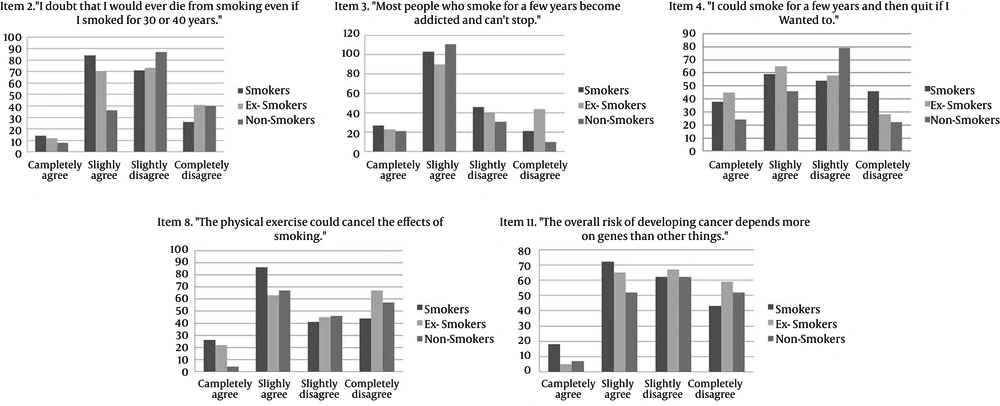
Figure 1.
Distribution of Answers at Items 2, 3, 4, 8 and 11
5. Discussion
In the 2011, the World Health Organization report on the global tobacco epidemic as stressed that the cigarette smoking is a first cause of death in the world. Each year, tobacco consumption kills six millions of people. Many of these people develop a respiratory or cardiovascular disease due to smoking; however, few of these individuals seem to be aware of this great problem. In 2010, it was conducted a study in several American hospitals, and it was discovered that the 47.6% of smokers admitted at the emergency department for acute respiratory care did not believe that the real cause was cigarettes smoking (28). In smokers is strong the tendency to underestimate all smoking-related risks. The need to defend the self-esteem induces the addicted subject to develop a series of illusion and false beliefs to support the choice to keep on smoking.
The aim of this study was to investigate the belief system in smokers and former smokers with respect to nonsmokers. The theoretical framework we used is based on the concept that the optimistic bias is structured on a set of mental models (cognitive architecture) used to appraise health-related risk in different contexts. Confirming our hypotheses, it emerged that the activation of a cognitive distortion is produced by an error in evaluating smoking-related risk. In particular, it was observed that smokers underestimate the strength of their dependence and related problems. Indeed, smokers generally consider having the control over their smoking behavior. In this way, smokers do not identify themselves as being abusers; however, at the opposite they believe that their behavior is the result of a hedonistic (the pleasure of tobacco) and aware evaluation (5, 14).
Our data have also confirmed a higher attitude of younger smokers to neglect the risk to develop a strong dependence due to nicotine absorption. Indeed, smokers between 19-40 years old consider the cigarette smoking as a consciously driven behavior. Only later, after repeated failed quit attempts, they come to understand their dependence to nicotine. Indeed, at the item 4 the answers of over 60 smokers showed that the awareness of their dependence is greater than in younger smokers. The obtained results from this study are in agreement with those of the previous studies (28-31), which have stressed both the experiential dimension of addiction and the limited capacity of people to rationally assess future consequences of their behavior (7) understanding the real complexity of a psychological and physical dependence to nicotine (5).
Another important result is the attitude of female smokers to underestimate smoking-related risks compared to males. This could explain the problem of the female smokers to give up smoking and the great risk of a new female smoking epidemic in some country, such as Italy (32). Previous research addressed this issue (33), finding associations between the fear to increase the body weight (aesthetics issues) and the perceived stress reported during the abstinence. This association might lead female smokers to underestimate risks to sustain smoking also in the presence of long-term negative consequences, preferring short-term benefits.
Actually, female smokers comparing with male smokers reported to believe that cigarette smoking has a preventive action against anxiety and depression and this belief is a serious obstacle to smoking discontinuation. Moreover, some researchers (34) have observed that females are more inclined to strain the disadvantages provoked by the smoking cessation, instead of the benefits. This is a salient factor, because the assessment of benefits and the identification of potential risks are related both to the give-up motivation and at the success rate of smoking cessation programs. Indeed, smokers with high level of motivation to give up are generally able to interrupt and to maintain the abstinence over a long time period (35).
Finally, the tendency to overestimate the efficacy of preventive strategies to contrast the negative effects of cigarettes (e.g. to carry out regular physical exercise, to adopt a healthy diet, to increase vitamins intakes and so on) was confirmed. Smokers tend to adopt a series of preventive behaviors with the belief to decrease risks for their health. Regarding this issue, it is interesting to compare the beliefs system of smokers and former smokers. We hypothesized that also former smokers need such beliefs in order to sustain their abstinence.
A high level of awareness about smoking-related risks might be considered the first motivational factor to contrast the pleasure associated with the cigarette consumption. Actually, they reported strong convictions about the hazardous effects of smoking. Furthermore, ex-smokers seem to have developed a considerable trust in the power of a healthy lifestyle to contrast all the risks associated with the previous smoking behaviors. In this way, former smokers may sustain their abstinence by believing that now they elude smoking-related risks thanks to healthier choices. Otherwise, thinking that the tobacco consumption had already impacted their health irremediably could weaken the decision to remain abstinence.
In conclusion, smokers and former smokers showed a different beliefs system. In particular, ex-smokers tend to assume the responsibility of their health, overestimate the impact of their decision, while smokers are more optimistic on their future and on their capacity to monitor health consequences. This optimistic perspective seems to put on the subject a "veil of Maya”, which changes how the reality is seen, leading to harmful behaviors by overshadowing rational judgments. The unrealistic optimism is an important obstacle to interrupt the smokers' attempts, because it prevents the transition to the full awareness of tobacco consumption. This lack of awareness hinders the passage through the spiral of change (36) by developing the necessary motivation to quit.
Unfortunately, contrasting this optimistic distortion is not an easy task (1): however, developing of a strong individual awareness is fundamental to improve the likelihood of the adaptation of a healthy behavior. We argue that the comprehension of the cognitive processes of smokers is an important starting point, since it allows the understanding of the complex nature of smoking to promote tobacco cessation interventions able to fit with smoker needs. Since many antismoking interventions are only based on drugs, behavioral change and nicotine substitution strategies without considering the cognitive issues, investigate how smokers thinks about their behaviors and their risks is particular important. In particular, the use of the electronic cigarettes that promises to be the next frontier to contrast tobacco consumption in the near future should be analyzed within this framework to avoid the substitution of bad behavior with another one.
In conclusion, our data showed interesting suggestions to better understand the smoker’s mind. However, this study has several limitations, in particular, the quantity and the quality of the sample and the data collection methodology, which do not allow drawing easy generalizations, since this is a survey study that do not permit variable manipulations. For this reason, we have limited the complexity of the data analysis to allow a simple and direct reading. However, we argue that our data suggest future lines of research able to verify the size effect and generalizability of our results other than to promote cognitive-based intervention to improve the adoption of healthy lifestyle and increase the efficacy of antismoking cessation programs.