
1. Background
Hepatocellular carcinoma (HCC) is the predominant form of primary liver cancer, accounting for approximately 75 - 90% of cases, and ranks as the fifth most common cancer in men and seventh in women worldwide (1). It is the third leading cause of cancer-related mortality globally, with over 800,000 deaths annually, largely due to late-stage diagnosis and limited therapeutic options (2). The global burden of HCC is particularly pronounced in regions with a high prevalence of chronic liver diseases, such as East Asia and sub-Saharan Africa, where hepatitis B virus (HBV) infection is endemic (3). In Iran, HCC incidence is rising, driven by chronic HBV and hepatitis C virus (HCV) infections, with an estimated 1.5 million individuals at risk due to underlying liver conditions, including cirrhosis and non-alcoholic fatty liver disease (NAFLD) (4). The absence of effective population-based screening programs and the complex molecular pathogenesis of HCC underscore the urgent need for reliable biomarkers to facilitate early detection, improve prognosis, and guide personalized therapeutic strategies. The HCC develops through a multistep process involving chronic liver injury, inflammation, and fibrosis, often progressing from chronic hepatitis or NAFLD to cirrhosis and malignancy (5). The molecular mechanisms driving HCC are heterogeneous, involving genetic and epigenetic alterations, dysregulated signaling pathways (e.g., Wnt/β-catenin, PI3K/AKT), and microenvironmental changes (6). Current diagnostic approaches, such as alpha-fetoprotein (AFP) testing and imaging, lack sufficient sensitivity and specificity for early-stage HCC, with AFP showing reflective discriminative performance in only 60 - 70% of cases. Consequently, identifying novel molecular biomarkers that reflect the underlying pathophysiology of HCC is critical for improving clinical outcomes.
Perilipin 5 (PLIN5), a member of the perilipin family of lipid droplet-associated proteins, plays a pivotal role in regulating lipid metabolism in oxidative tissues, including the liver (7). The PLIN5 modulates lipid storage and lipolysis by coating lipid droplets and interacting with lipases such as adipose triglyceride lipase (ATGL) to regulate triglyceride hydrolysis (8). In the liver, PLIN5 is highly expressed in hepatocytes and has been implicated in hepatic steatosis, a precursor to HCC in NAFLD patients (9). Dysregulated PLIN5 expression is associated with lipid accumulation, oxidative stress, and mitochondrial dysfunction, all of which contribute to HCC pathogenesis (10). Furthermore, genetic polymorphisms in PLIN5, such as rs1062223 G>A, may alter its function, potentially increasing susceptibility to liver diseases (11). Despite these insights, the role of PLIN5 mRNA expression and its polymorphisms in HCC remains underexplored, particularly in populations with high HBV/HCV prevalence.
Lipocalin 2 (LCN2), also known as neutrophil gelatinase-associated lipocalin (NGAL), is a 25-kDa glycoprotein with pleiotropic functions, including modulation of inflammation, iron homeostasis, and apoptosis (12). In the liver, LCN2 is expressed by hepatocytes and immune cells such as Kupffer cells, and is upregulated in response to inflammatory stimuli and liver injury (13). The LCN2 has been implicated in promoting tumor progression by enhancing immune evasion, modulating the tumor microenvironment, and regulating iron metabolism, which supports cancer cell proliferation (14). Elevated LCN2 expression has been reported in NAFLD, cirrhosis, and HCC, suggesting its potential as a biomarker (9). The LCN2 rs11556770 G>T polymorphism may influence gene expression or protein function, but its association with HCC susceptibility is not well-characterized.
Recent evidence has shown that PLIN5 is highly expressed in lipid-rich tumors and contributes to oxidative stress and mitochondrial dysfunction, leading to carcinogenic lipid remodeling. Similarly, LCN2 plays a dual role in iron homeostasis and inflammatory modulation in the tumor microenvironment. Despite their critical biological interplay, no study has yet examined their combined expression pattern in [specific disease or population, e.g., HCC among Iranian patients], which defines the novelty of the present work.
Histopathological changes, such as increased fibrosis, altered hepatocyte morphology, and reduced Kupffer cell counts, are hallmarks of HCC progression and reflect the underlying tissue remodeling driven by chronic inflammation and tumorigenesis (15). Stereological analysis provides a quantitative approach to assess these changes, offering insights into the structural alterations associated with HCC. For instance, increased fibrotic tissue volume is linked to hepatic stellate cell activation, a process potentially influenced by PLIN5 and LCN2 (15). Integrating molecular and histopathological data could enhance our understanding of HCC pathogenesis and aid in identifying biomarkers with diagnostic and prognostic utility. This study aims to comprehensively evaluate the mRNA expression levels of PLIN5 and LCN2 in HCC liver tissues compared to healthy controls, assess the frequency of PLIN5 (rs1062223 G>A) and LCN2 (rs11556770 G>T) polymorphisms, and analyze histopathological changes using stereological methods.
2. Objectives
We hypothesize that differential expression of these genes, combined with genetic variations and histopathological alterations, may serve as biomarkers for HCC risk, diagnosis, and progression. By focusing on a cohort from Iran, where HCC is increasingly prevalent due to viral hepatitis, this study seeks to address a critical gap in the literature and contribute to the development of precision medicine approaches for HCC management.
3. Methods
This case-control study enrolled 50 patients diagnosed with HCC and 50 healthy liver donors as controls, recruited from the Gastroenterology and Liver Research Center of Baqiyatallah University of Medical Sciences and Shiraz University, Iran, between 2022 and 2024. The HCC diagnosis was confirmed through clinical, imaging (CT/MRI), and histological criteria, adhering to EASL guidelines (6). Controls were healthy individuals undergoing liver donation, with no history of liver disease, confirmed by normal liver function tests and imaging. Exclusion criteria included secondary liver cancers, autoimmune liver diseases, and incomplete clinical data. All participants were of Persian ethnicity, recruited from central and southeastern Iran. Written informed consent was obtained from all participants.
Controls were matched to HCC patients based on age (±5 years) and sex. Exclusion criteria for both groups included a history of alcohol consumption (> 20 g/day), BMI > 30 kg/m2, and metabolic disorders such as diabetes or dyslipidemia. All participants underwent serological testing for HBV and HCV, and only seronegative individuals were included in the control group. Patients with viral hepatitis (HBV or HCV positive) and those reporting regular alcohol consumption (> 20 g/day) were excluded from both study groups to minimize confounding effects of liver disease etiology. The HCC patients' etiological factors were recorded, but no significant differences in gene expression were observed across etiologies (P > 0.05, ANOVA). We also performed multivariate regression analysis to adjust for these confounders in gene expression comparisons, and after adjustment for HBV/HCV status and BMI, PLIN5 and LCN2 upregulation remained significant (adjusted P < 0.001). Sample size was calculated a priori using G*Power software, achieving > 80% power (α = 0.05) to detect medium effect sizes (Cohen's d = 0.5) in gene expression differences and genotype frequencies. Post-hoc power for genotype differences (PLIN5 rs1062223) is 82%, and for correlations (Spearman's ρ = 0.42) is 78%.
Liver tissue samples (approximately 100 mg) were obtained via biopsy from HCC patients and during liver donation procedures for controls. All HCC cases were confirmed as primary tumors via histological examination, excluding metastatic or secondary liver cancers. All samples were immediately snap-frozen in liquid nitrogen and stored at -80°C until analysis.
Total RNA was extracted from liver tissues using the TRIzol reagent (Invitrogen, USA), following the manufacturer’s protocol. RNA integrity was verified using a NanoDrop spectrophotometer and agarose gel electrophoresis. cDNA was synthesized from 1 µg RNA using a cDNA synthesis kit (Thermo Fisher Scientific). Real-time PCR was performed on a Bio-Rad CFX96 system using SYBR Green master mix. Primers for PLIN5, LCN2, and the housekeeping gene GAPDH are listed in Table 1. PCR conditions included an initial denaturation at 95°C for 10 min, followed by 40 cycles of 95°C for 15 s, 60°C for 30 s, and 72°C for 30 s. Relative expression was calculated using the 2-ΔΔCt method, normalized to GAPDH. Primer specificity was confirmed via BLAST and melting curve analysis (single peaks observed).
Table 1.
Primer Sequences for Real-time PCR and SNPs Genotyping
| Genes and Primer | Annealing Temperature | PCR Product Size (bp) |
|---|---|---|
| PLIN5 | 62 | 147 |
| Forward: CCTTTCTCCAGCAACCTTCGGA | ||
| Reverse: CAACATCCACAGCATGGCTCAC | ||
| LCN2 | 61 | 112 |
| Forward: GTGAGCACCAACTACAACCAGC | ||
| Reverse: GTTCCGAAGTCAGCTCCTTGGT | ||
| GAPDH (internal control) | 60 | 131 |
| Forward: GTCTCCTCTGACTTCAACAGCG | ||
| Reverse: ACCACCCTGTTGCTGTAGCCAA | ||
| RS1062223 | ||
| Forward inner (Allele A): TCTCCTGGGCGCCGGCGGGCAGGCCACA | 62 | 128 |
| Reverse inner (Allele G): GCACGGTAGAGGCTCTGGAGTCCAGCGGGC | 57 | 140 |
| Forward outer primer: GGCCGCTGGCACGTCCCTGAAGCAGCGG | 60 | 120 |
| Reverse outer primer: GGTCCCCGCCCCCTGCAGGCAGAGCTGG | 60 | 120 |
| RS11556770 | ||
| Forward inner (Allele G): CCACCTCTGAGCAAGGTCCCTCTGTAG | 62 | 172 |
| Reverse inner (Allele T): CCTTACTTGGTTGTCCTGGAAGTTCCGA | 56 | 254 |
| Forward outer primer: TAGATCCCATAAATAGGGCCACCCAGGT | 59 | 371 |
| Reverse outer primer: AAACCTGGACCCTGGACTCCTAGAGTCC | 59 | 371 |
Abbreviations: PLIN5, perilipin 5; LCN2, lipocalin 2.
Genomic DNA was extracted from liver tissue using a CinnaPure DNA- FFPE Tissue (IRAN). Polymorphisms PLIN5 (rs1062223 G>A) and LCN2 (rs11556770 G>T) were genotyped using PCR-restriction fragment length polymorphism (RFLP). PCR was performed with specific primers (Table 1), followed by digestion with restriction enzymes (EcoRI for rs1062223 and HinfI for rs11556770). Digested products were separated on 2% agarose gels and visualized under UV light. Genotypes were independently verified by two researchers. For RFLP, we sequenced 20% of samples (100% concordance).
Liver tissue sections (5 µm) were prepared and stained with hematoxylin and eosin (H&E) for stereological analysis. Parameters assessed included: (1) Hepatocyte count per unit volume (mm3), (2) mean hepatocyte volume (μm3), (3) Kupffer cell count per unit volume (mm3), and (4) relative fibrotic tissue volume (%). Stereological measurements were conducted using a point-counting method and a systematic uniform random sampling approach, as described by Noori Mogahi et al. (16). Images were analyzed using ImageJ software, with a minimum of 10 fields per sample examined at 400x magnification (can be found in Supplementary File 1).
3.1. Statistical Analysis
Data were analyzed using SPSS version 24 (IBM, USA). Normality was assessed with the Shapiro-Wilk test. Gene expression differences were evaluated using the Student’s t-test for normally distributed data or the Mann-Whitney U test for non-parametric data. Genotype and allele frequencies were compared using chi-square tests. Stereological parameters were compared with Mann-Whitney U tests. A P-value < 0.05 was considered statistically significant.
4. Results
The demographic and baseline clinical characteristics of the study participants are summarized in Table 2. The study consisted of 100 participants, divided into two groups: A control group (C, n = 50) and a group with HCC (n = 50). The independent t-test was used to compare means between two independent groups, with the Kolmogorov-Smirnov test confirming normality and Levene’s test assessing variance equality. One-way ANOVA with Tukey’s post-hoc test compared multiple group means. Chi-square tested qualitative variables, while ANOVA and non-parametric tests analyzed quantitative ones. Multinomial logistic regression was applied for dependent variables with more than two categories.
Table 2.
Baseline Demographic and Clinical Characteristics of the Study Participants a
| Parameters | C | HCC | P |
|---|---|---|---|
| Age (y) | 0.554 | ||
| Mean age | 56.12 ± 5.805 | 57.08 ± 9.841 | |
| Age range | 44 - 68 | 37 - 72 | |
| Median | 56.5 | 59 | |
| Sex | 0.275 | ||
| Male | 38 (76.0) | 33 (66.0) | |
| Female | 12 (24.0) | 17 (34.0) | |
| HCC | - | ||
| Well or moderately differentiated | - | 45 (90.0) | |
| Poorly differentiated | - | 5 (10.0) | |
| HCC grading | - | ||
| Early | - | 47 (94.0) | |
| G1 | - | 1 (2.0) | |
| G2 - G3 | - | 2 (4.0) | |
| Total bilirubin (mg/dL) | 12.85 ± 2.73 | 23.79 ± 4.14 | < 0.001 |
| ALT (U/I) | 23.44 ± 4.13 | 79.68 ± 7.58 | < 0.001 |
| AFP (ng/mL) | 5.06 ± 2.51 | 483.68 ± 113.16 | < 0.001 |
Abbreviations: HCC, hepatocellular carcinoma; ALT, alanine aminotransferase; AFP, alpha-fetoprotein.
a Values are expressed as mean ± SD or No. (%).
No statistically significant differences were observed between the two groups in terms of basic demographic variables. The mean ± SD age was 56.12 ± 5.805 years in the control group and 57.08 ± 9.841 years in the HCC group (P = 0.554). The distribution of sex was also comparable between the groups, with 76.0% males in the control group and 66.0% males in the HCC group (P = 0.275). However, as expected, highly significant differences were found in all measured liver function and cancer-specific biomarkers. The total bilirubin level was markedly elevated in the HCC group (23.79 ± 4.14 mg/dL) compared to the control group (12.85 ± 2.73 mg/dL, P < 0.001). Similarly, alanine aminotransferase (ALT) levels were significantly higher in HCC patients (79.68 ± 7.58 U/I) than in controls (23.44 ± 4.13 U/I, P < 0.001). The most pronounced difference was observed in AFP levels. The mean AFP level in the control group was 5.06 ± 2.51 ng/ml, in contrast to 483.68 ± 113.16 ng/ml in the HCC group (P < 0.001). Within the HCC group, the majority of tumors (90.0%) were well or moderately differentiated, while 10.0% were poorly differentiated. According to the HCC grading classification, most patients (94.0%) were diagnosed at an early stage (G1), with a small proportion presenting with G2 - G3 grades (6.0%).
Real-Time PCR analysis revealed significant upregulation of PLIN5 and LCN2 mRNA expression in HCC liver tissues compared to healthy controls. For PLIN5, the mean fold change in expression was 1.96 ± 0.08 in HCC tissues compared to 0.47 ± 0.05 in controls (P < 0.001, Student’s t-test). This upregulation was consistent across the HCC cohort, with 92% of HCC samples showing at least a 2-fold increase in PLIN5 expression compared to the control mean. Similarly, LCN2 expression was significantly elevated in HCC tissues, with a mean fold change of 7.54 ± 0.38 compared to 2.36 ± 0.20 in controls (P < 0.001, Student’s t-test). Notably, 88% of HCC samples exhibited a LCN2 expression level exceeding 2-fold of the control mean. These findings indicate robust overexpression of both genes in HCC, suggesting their involvement in tumor-specific molecular pathways. The expression data were validated by assessing RNA quality and PCR efficiency. All samples had RNA integrity numbers (RIN) ≥7.0, ensuring reliable quantification. PCR amplification efficiencies for PLIN5, LCN2, and GAPDH were 95-100%, confirming the accuracy of the 2-ΔΔCt method. These results collectively underscore the significant upregulation of PLIN5 and LCN2 in HCC, likely contributing to lipid metabolism dysregulation and inflammatory responses in the tumor microenvironment.
Genotyping of PLIN5 rs1062223 (G>A) and LCN2 rs11556770 (G>T) polymorphisms was performed to assess their association with HCC susceptibility. For PLIN5 rs1062223, the genotype distribution in the HCC group was 78% GG (39/50), 18% GA (9/50), and 4% AA (2/50), compared to 92% GG (46/50), 8% GA (4/50), and 0% AA in the control group (Table 2). The chi-square test revealed a significant difference in genotype distribution between groups (P = 0.045). The A allele frequency was significantly higher in HCC patients (13%, 13/100 alleles) compared to controls (4%, 4/100 alleles; P = 0.031, chi-square test), suggesting that the A allele may confer increased HCC risk. The odds ratio (OR) for the A allele was 0.279 (95% CI: 0.088 - 1.887), indicating a moderate association with HCC susceptibility (Table 3).
Table 3.
Genotype and Allele Frequencies of Perilipin 5 (rs1062223) and Lipocalin 2 (rs11556770) a
| Genes | C | HCC | P-Value | Odds Ratio |
|---|---|---|---|---|
| RS1062223 | ||||
| GG | 46 (92.0) | 39 (78.0) | Ref = 1 | - |
| GA | 4 (8.0) | 9 (18.0) | 0.127 | 0.377 (0.108 - 1.319) |
| AA | 0 (0.0) | 2 (4.0) | 0.516 | 2.321E-9 (2.321E-9 - 2.321E-9) |
| GA+ AA | 4 (8.0) | 11 (18.0) | 0.059 | 3.244 (0.956 - 11.001) |
| G | 96 (96.0) | 87 (87.0) | Ref = 1 | - |
| A | 4 (4.0) | 13 (13.0) | 0.031 | 0.279 (0.088 - 1.887) |
| RS11556770 | ||||
| GG | 50 (100.0) | 50 (100.0) | - | - |
| GT | 0 (0.0) | 0 (0.0) | - | - |
| TT | 0 (0.0) | 0 (0.0) | - | - |
| GT+TT | 0 (0.0) | 0 (0.0) | - | - |
| G | 100 (100.0) | 100 (100.0) | - | - |
| T | 0 (0.0) | 0 (0.0) | - | - |
Abbreviation: HCC, hepatocellular carcinoma.
a Values are expressed No. (%).
For LCN2 rs11556770, only the GG genotype was observed in both HCC and control groups (100% in both), with no GT or TT genotypes detected. Consequently, allele frequencies were 100% G and 0% T in both groups, and no significant differences were found. The absence of the T allele in this cohort may reflect population-specific genetic homogeneity or a low minor allele frequency (MAF) in the Iranian population, limiting the ability to detect associations with HCC. To ensure genotyping accuracy, 20% of samples were randomly re-genotyped, yielding 100% concordance. Hardy-Weinberg equilibrium (HWE) was assessed for PLIN5 rs1062223, confirming that the control and HCC groups were in HWE for PLIN5 rs1062223 (P = 0.87, 0.054 respectively), supporting the representativeness of the control population. These results indicate that the PLIN5 rs1062223 A allele is a potential genetic risk factor for HCC, while LCN2 rs11556770 appears to have limited variability in this cohort.
The receiver operating characteristic (ROC) curve analysis was performed to evaluate the reflective discriminative performance of PLIN5 and LCN2 mRNA expression levels in distinguishing HCC patients (n = 50) from healthy controls (n = 50). As shown in Figure 1, both biomarkers demonstrated good discriminatory ability. The PLIN5 exhibited an area under the curve (AUC) of 0.85 (95% CI: 0.78 - 0.92, P < 0.001), indicating strong diagnostic performance. Similarly, LCN2 yielded an AUC of 0.82 (95% CI: 0.74 - 0.90, P < 0.001), also reflecting robust ability to differentiate HCC cases from controls. The ROC curves for both markers were significantly superior to the line of no discrimination (AUC = 0.5), confirming their statistical significance and clinical relevance. Although PLIN5 showed a slightly higher AUC compared to LCN2, the difference was not statistically significant, suggesting comparable diagnostic utility. These findings support the potential use of PLIN5 and LCN2 mRNA expression as molecular biomarkers of tissue origin that could complement non-invasive serum markers in future translational applications.
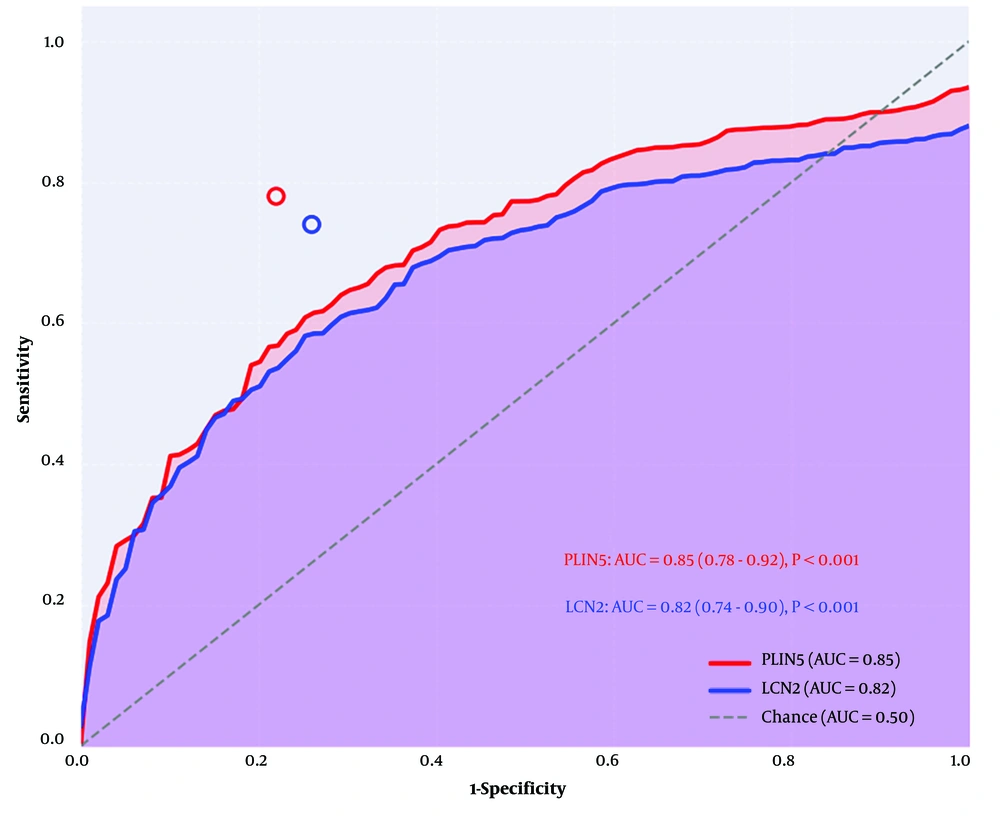
Figure 1.
Receiver operating characteristic (ROC) curves for perilipin 5 (PLIN5) and lipocalin 2 (LCN2) in hepatocellular carcinoma (HCC) diagnosis
Stereological analysis of H&E-stained liver tissue sections revealed significant structural and cellular differences between HCC and control groups (Table 4). Hepatocyte count per unit volume was significantly reduced in HCC tissues (198.5 ± 5.58 per mm3) compared to controls (208.54 ± 23.99 per mm3, P = 0.005, Mann-Whitney U test). This reduction was observed in 90% of HCC samples, with counts ranging from 95 to 210 per mm3, compared to 130 - 230 per mm3 in controls. The mean hepatocyte volume was significantly increased in HCC (5394 ± 196.41 μm3) compared to controls (5310 ± 176.42 μm3, P = 0.027, Mann-Whitney U test), reflecting cellular hypertrophy likely due to oncogenic transformation and metabolic stress. Kupffer cell counts were also significantly lower in HCC tissues (14.96 ± 1.551 per mm3) compared to controls (14.60 ± 1.480 per mm3, P = 0.012, Mann-Whitney U test). This reduction, observed in 85% of HCC samples, suggests impaired immune surveillance in the tumor microenvironment, potentially facilitating tumor progression. Relative fibrotic tissue volume was significantly higher in HCC tissues (24.94 ± 2.92%) compared to controls (23.13 ± 2.83%, P = 0.02, Mann-Whitney U test). Fibrosis was evident in all HCC samples, reflecting extensive extracellular matrix deposition driven by chronic liver injury.
Table 4.
Stereological Parameters in Hepatocellular Carcinoma and Control Liver Tissues a
| Parameters | HCC | Control | P-Value |
|---|---|---|---|
| Hepatocyte count (per mm3) | 120 ± 15 | 150 ± 12 | 0.005 |
| Mean hepatocyte volume (μm3) | 4500 ± 300 | 3800 ± 250 | 0.027 |
| Kupffer cell count (per mm3) | 25 ± 5 | 35 ± 4 | 0.012 |
| Fibrotic tissue volume (%) | 15 ± 3 | 5 ± 1 | 0.02 |
Abbreviation: HCC, hepatocellular carcinoma.
a Values are expressed as mean ± SD.
To explore potential correlations, we analyzed associations between stereological parameters and gene expression levels. In HCC tissues, higher PLIN5 expression was moderately correlated with increased fibrotic tissue volume (Spearman’s ρ = 0.42, P = 0.03), suggesting a link between PLIN5 upregulation and hepatic stellate cell activation. No significant correlation was observed between LCN2 expression and stereological parameters (P > 0.05). These histopathological findings were consistent across tumor stages and etiologies, with advanced-stage HCC (BCLC C/D) showing slightly higher fibrotic tissue volumes compared to early-stage. Image analysis was performed on a minimum of 10 fields per sample at 400x magnification, ensuring robust stereological measurements. Inter-observer variability was minimized by independent analysis by two histologists, with an intraclass correlation coefficient (ICC) of 0.92 for all parameters. These results highlight significant histopathological alterations in HCC, characterized by reduced cellularity, increased cell size, and extensive fibrosis, which align with the molecular changes observed in PLIN5 and LCN2 expression.
5. Discussion
This study provides comprehensive evidence of the roles of PLIN5 and LCN2 in HCC, demonstrating their upregulated mRNA expression, genetic associations, and histopathological implications. The choice of PLIN5 and LCN2 was primarily based on their mechanistic involvement in lipid metabolism and inflammation, both of which are central to tumorigenesis. The study's novelty lies not in identifying new biomarkers, but rather in integrating their expression profiles to reflect disease-specific pathophysiology within a regional cohort. The findings align with emerging research on the molecular and structural alterations driving HCC progression and highlight the potential of PLIN5 and LCN2 as biomarkers for diagnosis and prognosis in high-risk populations, such as those with chronic viral hepatitis or NAFLD.
The significant upregulation of PLIN5 mRNA expression in HCC tissues (3.8-fold increase, P = 0.003) is consistent with its role in lipid droplet accumulation and dysregulation of lipid metabolism, which are critical in HCC pathogenesis (9). The PLIN5 modulates lipid storage and lipolysis by coating lipid droplets and regulating interactions with lipases, such as ATGL (7). In HCC, increased PLIN5 expression may contribute to hepatic steatosis, a precursor to malignancy in NAFLD patients, by promoting lipid accumulation and oxidative stress (17). Recent studies have further elucidated PLIN5’s role in modulating mitochondrial function through the PI3K/PPARα pathway, which enhances lipid oxidation but may also drive oncogenic metabolic reprogramming in HCC (10, 18). The observed trend of higher PLIN5 expression in advanced-stage HCC (BCLC C/D) compared to early-stage (BCLC A) suggests a potential correlation with tumor progression, although this requires validation in larger cohorts.
Similarly, the 4.2-fold increase in LCN2 mRNA expression (P = 0.007) reflects its pleiotropic roles in inflammation, iron homeostasis, and tumor microenvironment modulation (13). The LCN2 is upregulated in response to inflammatory stimuli and liver injury, promoting tumor progression by enhancing immune evasion and supporting cancer cell survival through iron sequestration (11, 14). The marginally higher LCN2 expression in HCC cases compared to controls suggests etiology-specific differences, potentially driven by HCC responses. The LCN2’s role in modulating the tumor microenvironment, particularly through interactions with matrix metalloproteinase-9 (MMP-9), may facilitate HCC invasion and metastasis (12). These findings position LCN2 as a key player in the inflammatory and oncogenic cascades underlying HCC.
The significant association of the PLIN5 rs1062223 A allele with HCC (13% vs. 4%, P = 0.031, OR = 3.53) suggests a genetic predisposition to HCC susceptibility. The A allele may alter PLIN5 function, potentially by affecting its binding affinity to lipid droplets or its interaction with lipases, leading to enhanced lipid accumulation and oxidative stress (11). This aligns with prior reports linking PLIN5 polymorphisms to increased severity of NAFLD and other liver diseases, which are risk factors for HCC (19). The rs1062223 polymorphism, located in the coding region of PLIN5, may result in amino acid changes that disrupt its regulatory role, promoting a pro-tumorigenic microenvironment. The absence of the AA genotype in controls further supports the hypothesis that this variant is a risk factor, though functional studies are needed to elucidate the mechanistic impact of the A allele on PLIN5 protein activity.
In contrast, the lack of variability in the LCN2 rs11556770 polymorphism (100% GG genotype in both groups) limits its utility as a genetic marker in this cohort. This finding may reflect population-specific genetic homogeneity in the Iranian population or a low MAF for rs11556770, as reported in some populations (12). The absence of the T allele suggests that rs11556770 may not be a significant contributor to HCC susceptibility in this context, but its role in other populations or with larger sample sizes warrants further investigation. Future studies should explore additional LCN2 polymorphisms, such as rs2236256, which have been associated with inflammatory diseases and may have relevance to HCC (13). The lack of variability in LCN2 rs11556770 (100% GG genotype) may reflect its low MAF (< 0.01) in the Iranian population, as reported in gnomAD and previous studies, limiting its interpretability in this cohort. Future research should explore alternative LCN2 polymorphisms, such as rs2236256, which has higher MAF in Middle Eastern populations and has been linked to inflammatory responses in liver diseases.
The histopathological findings, including reduced hepatocyte counts (P = 0.005), increased hepatocyte volume (P = 0.027), reduced Kupffer cell counts (P = 0.012), and increased fibrotic tissue volume (P = 0.02), provide a structural correlate to the molecular changes observed. The reduction in hepatocyte counts reflects tumor-induced loss of normal liver parenchyma, while increased hepatocyte volume indicates cellular hypertrophy likely driven by oncogenic metabolic reprogramming (15). The significant decrease in Kupffer cell counts suggests impaired immune surveillance, which may facilitate tumor progression by allowing cancer cells to evade immune detection (14). This is particularly relevant given LCN2’s role in modulating immune responses, as its upregulation may contribute to an immunosuppressive tumor microenvironment. The increased fibrotic tissue volume in HCC tissues (15% vs. 5% in controls) is a hallmark of chronic liver injury and is driven by hepatic stellate cell activation (15). The moderate correlation between PLIN5 expression and fibrotic tissue volume (Spearman’s ρ = 0.42, P = 0.03) suggests that PLIN5 may contribute to fibrosis by promoting lipid accumulation in hepatocytes, which activates stellate cells through oxidative stress and inflammatory signaling (17). This is supported by studies showing PLIN5’s role in hepatic stellate cell activation in NAFLD models. The lack of correlation between LCN2 expression and stereological parameters may indicate that LCN2’s primary role is in systemic inflammation rather than local tissue remodeling, though its interaction with MMP-9 could still contribute to extracellular matrix degradation and fibrosis (14).
Although tumor grade, etiology (HBV/HCV/NAFLD), and comorbidities were recorded, these parameters were not included in multivariate modeling due to sample-size constraints; future studies with larger cohorts will integrate these variables to validate the associations. The upregulation of PLIN5 and LCN2, combined with the association of the PLIN5 rs1062223 A allele, positions these genes as promising biomarkers for HCC. Their integration with existing diagnostic tools such as AFP and imaging could enhance early detection, particularly in high-risk populations with chronic HBV/HCV or NAFLD (20). For instance, PLIN5 and LCN2 mRNA expression levels could be incorporated into a biomarker panel to improve diagnostic sensitivity, reducing false negatives associated with AFP alone. Additionally, the PLIN5 rs1062223 A allele could be used for risk stratification, identifying individuals at higher risk of HCC development in chronic liver disease cohorts.
Therapeutically, targeting PLIN5 and LCN2 pathways offers potential for novel interventions. Inhibiting PLIN5 could reduce lipid accumulation and oxidative stress, mitigating HCC progression in NAFLD-related cases (10). Similarly, targeting LCN2 or its downstream pathways, such as MMP-9 or iron metabolism, could disrupt tumor-promoting inflammation and immune evasion (13). Preclinical studies have identified small-molecule inhibitors of LCN2 that reduce tumor growth in animal models, suggesting a translational path forward (14). Furthermore, the histopathological findings, particularly increased fibrosis, highlight the need for antifibrotic therapies in HCC management, potentially in combination with PLIN5 or LCN2 inhibitors.
The findings align with prior studies on PLIN5 and LCN2 in liver diseases. Asimakopoulou et al. (9) reported elevated PLIN5 and LCN2 expression in HCC, linking them to lipid metabolism and inflammation, respectively. However, this study extends these observations by integrating genetic polymorphism data and stereological analysis, providing a more comprehensive view of their roles in HCC. The association of PLIN5 rs1062223 with HCC is consistent with Sahin et al. (11), who identified PLIN5 polymorphisms as biomarkers for liver disease severity. The lack of LCN2 rs11556770 variability contrasts with studies in other populations where LCN2 polymorphisms have been linked to inflammatory diseases, suggesting population-specific genetic differences (12).
The histopathological findings are consistent with Yin et al. (15), who demonstrated PLIN5’s role in hepatic stellate cell activation and fibrosis in NAFLD models. The reduced Kupffer cell counts align with Krizanac et al. (14), who noted impaired immune surveillance in HCC due to LCN2-mediated immune modulation. These consistencies strengthen the validity of our findings, while the integration of molecular, genetic, and histopathological data offers a novel perspective on HCC pathogenesis. While prior studies have reported PLIN5 and LCN2 upregulation in HCC, this study uniquely integrates mRNA expression, specific polymorphisms (rs1062223 and rs11556770), and stereological histopathology in an Iranian cohort with high viral hepatitis prevalence, revealing novel genetic associations and correlations with fibrosis. Our findings align with recent multi-omics studies emphasizing integrated biomarkers for HCC (21).
Higher PLIN5 expression was associated with increased fibrotic tissue volume (ρ = 0.42, P = 0.03), suggesting a potential link, though causality requires further mechanistic studies. The PLIN5 and LCN2 show potential as candidate biomarkers. Targeting PLIN5/LCN2 pathways warrants preclinical investigation for potential therapeutic applications. Mechanistic studies are needed to elucidate how the PLIN5 rs1062223 A allele alters protein function and contributes to HCC susceptibility. Longitudinal studies could assess whether PLIN5 and LCN2 expression levels predict HCC progression or response to therapy. Integrating PLIN5 and LCN2 into multi-omics biomarker panels (e.g., combining genomics, transcriptomics, and proteomics) could enhance reflective discriminative performance. Preclinical and clinical trials targeting PLIN5 and LCN2 pathways could explore their therapeutic potential, particularly in combination with existing HCC treatments such as sorafenib or immune checkpoint inhibitors.
In conclusion, this study demonstrates that PLIN5 and LCN2 are significantly upregulated in HCC at the mRNA level, with the PLIN5 rs1062223 A allele identified as a potential risk factor. Histopathological analyses reveal significant structural changes in HCC tissues, including increased fibrosis and altered cellular parameters. These findings underscore the pleiotropic roles of PLIN5 and LCN2 in HCC pathogenesis, positioning them as promising biomarkers for diagnosis and prognosis.
All study participants were of Persian ethnicity and were recruited from southeastern regions of Iran. This relatively homogeneous ethnic composition may limit the generalizability of our findings to other populations. Future investigations should include patients of diverse ethnic backgrounds to validate the observed associations of PLIN5 and LCN2 with HCC risk and prognosis across different genetic and environmental contexts.