
1. Background
Autoimmune thyroid diseases (AITD), primarily Hashimoto’s thyroiditis (HT) and Graves’ disease (GD), are the most common organ-specific autoimmune disorders in children and adolescents (1-3). HT is characterized by chronic lymphocytic infiltration of the thyroid gland, leading to hypothyroidism and the presence of anti-thyroid peroxidase (TPO-Ab) and anti-thyroglobulin (TG-Ab) antibodies (2, 4). In contrast, GD results from stimulating autoantibodies against the thyroid-stimulating hormone receptor (TRAb), which cause hyperthyroidism and thyroid hyperplasia (1). The pathogenesis of AITDs involves a complex interplay of genetic susceptibility, environmental triggers (such as infections, iodine intake, and stress), and immune dysregulation, including both humoral and cellular immune responses (1-3). While the thyroid gland is the primary target in these disorders, emerging evidence suggests that the autoimmune process in AITDs may extend beyond the thyroid, potentially affecting multiple organ systems.
Beyond thyroid dysfunction, AITD is frequently associated with other autoimmune diseases, such as childhood-onset systemic lupus erythematosus (5), type 1 diabetes (6), celiac disease (6), and juvenile idiopathic arthritis (7). Emerging evidence suggests that renal involvement may also occur in patients with AITD, although the underlying mechanisms remain poorly understood (8). Case reports and small series have described various glomerular pathologies in adults and children with GD (9-13) and HT (14-16), including membranous nephropathy, membranoproliferative glomerulonephritis, IgA nephropathy, and focal segmental glomerulosclerosis. The accumulation of circulating immune complexes and cross-reactivity between thyroid antigens (e.g., TPO, TG) and renal structures have been proposed as potential mechanisms for kidney involvement in these patients (17, 18).
2. Objectives
This study aimed to investigate the prevalence of microalbuminuria in children and adolescents with AITD and to explore potential associations with thyroid function and autoantibody status.
3. Methods
3.1. Study Population and Definitions
This section describes the study population, inclusion and exclusion criteria, and key clinical definitions used in the study.
This single-center, cross-sectional study was conducted using retrospectively collected data. It included children and adolescents aged 6 to 18 years diagnosed with HT or GD, as well as age- and sex-matched healthy controls. All participants were recruited from the Pediatric Endocrinology Outpatient Clinic of Istanbul University-Cerrahpaşa between November 2022 and October 2023. Demographic, anthropometric, laboratory, and ultrasonographic data were retrieved from medical records for analysis.
Inclusion criteria for the AITD group were defined separately for HT and GD. HT was diagnosed based on positivity for TPO-Ab and/or TG-Ab antibodies together with compatible clinical and ultrasonographic findings. GD was diagnosed based on the presence of TRAb and biochemical hyperthyroidism.
Exclusion criteria included pre-existing renal disease, hypertension, urinary tract infection or other acute infection. Patients with a history of thyroidectomy or radioiodine therapy were also excluded. In addition, patients using corticosteroids or nephrotoxic drugs within the previous three months were not included.
The healthy control group consisted of children undergoing routine medical evaluations prior to participation in sports activities, with no history of thyroid, renal, or systemic diseases.
Pubertal status was determined using Tanner staging, which evaluates the development of secondary sexual characteristics, and assessments were performed by a trained pediatric endocrinologist during clinical examinations.
3.2. Sample Size Calculation
This section outlines the sample size estimation and statistical power of the study. The minimum sample size was calculated using GPower software (version 3.1.9.7, Düsseldorf University, Germany) (23). Power analysis was performed with the following parameters: α = 0.05, power (1-β) = 0.80, effect size = 0.35, and three groups (healthy controls, HT, and GD). Based on these inputs, the required sample size was determined to be 84 participants, providing an actual power of 81.1%. The final study sample included 98 participants, exceeding the minimum required sample size.
3.3. Ethical Approval
This section summarizes the ethical considerations and approvals for the study. This study involving human participants was in accordance with the ethical standards of the institutional and national research committee and with the 1964 Helsinki Declaration and its later amendments or comparable ethical standards. The Clinical Research Ethical Committee of Istanbul University-Cerrahpaşa approved this study (Approval Number: E-83045809-604.01.01-513330, date: 19.10.2022). Participants and parents provided written informed consent.
3.4. Laboratory and Clinical Assessments
This section describes the procedures for biochemical measurements and clinical evaluations. Blood and urine samples were collected after an overnight fast, between 08:00 and 10:00 AM. First-morning spot urine specimens were used to minimize diurnal variations in urinary albumin excretion. This standardized timing was maintained across participants to reduce variability.
Thyroid function tests (TSH, FT3, FT4) and thyroid autoantibodies (TPO-Ab, TG-Ab, TRAb) were measured using the chemiluminescence method (Cobas, Roche GmbH, Germany). Reference ranges for TSH, FT4, and FT3 were 0.51 - 4.3 µIU/mL, 0.98 - 1.63 ng/dL, and 2.56 - 5.01 pg/mL, respectively. TPO-Ab > 34 IU/mL and TG-Ab > 115 IU/mL were defined as “positive”. The reference range for TRAb was < 1.5 IU/L, according to the manufacturer.
Estimated glomerular filtration rate (eGFR) was calculated using the bedside Schwartz formula appropriate for pediatric populations: eGFR (mL/min/1.73 m²) = 0.413 × height (cm)/serum creatinine (mg/dL).
Urinary albumin and creatinine levels were measured, and the urinary albumin-to-creatinine ratio (UACR) was calculated (expressed in mg/g). Microalbuminuria was defined as UACR of 30 - 300 mg/g according to pediatric nephrology guidelines, and categorized using a threshold of ≥ 30 mg/g (24). Urinary microalbumin concentrations were measured immunoturbidimetrically. Urinary creatinine levels were measured by enzymatic colorimetry using the Roche Modular System (Cobas, Roche GmbH, Germany).
To minimize confounding factors, participants were evaluated for recent febrile illness, menstruation, or intense physical activity prior to sample collection. Participants with these conditions were excluded from the analysis. Age, sex, pubertal status, BMI-SDS, thyroid functional status, and disease duration were considered clinically relevant variables when interpreting UACR levels. However, additional tests such as urinalysis (for microscopic hematuria) and repeat UACR measurements were not performed, which is acknowledged as a study limitation.
3.5. Ultrasonographic Evaluation of Thyroid Gland
This section describes the thyroid imaging protocol and volume assessment. Detailed thyroid ultrasonography was performed by the same radiologist using a 14 MHz linear array Aplio 500 ultrasound system (Toshiba Medical Systems, Tokyo, Japan). The volume of the thyroid lobes was calculated using the formula 0.52 x length (cm) x width (cm) x thickness (cm). Total thyroid volume was the sum of the volumes of the two lobes and was compared with reference values in the literature (25).
3.6. Statistical Analysis
This section describes the statistical methods used for data analysis. We performed statistical analyses using the Statistical Package for the Social Sciences (SPSS) version 21.0 and Jamovi version 2.3.21. The normality of the data distribution was assessed using either the Kolmogorov-Smirnov test or the Shapiro-Wilk test. The continuous variables were presented as either the mean plus or minus the standard deviation, or as the median with the 25th to 75th percentile range, depending on their distribution. The categorical variables were expressed as frequencies and proportions. UACR was evaluated both as a continuous variable and as a categorical variable based on the clinical threshold of ≥ 30 mg/g, which indicates microalbuminuria. Because UACR values were not normally distributed, they were summarized as median (25th - 75th percentile) and analyzed using non-parametric tests where appropriate. We conducted statistical analyses on non-normally distributed continuous variables using either the Mann-Whitney U test (for two groups) or the Kruskal-Wallis test and Dwass-Steel-Critchlow-Fligner post hoc tests (for three groups). One-way analysis of variance (ANOVA) was employed to compare normally distributed continuous variables among three groups. The categorical variables were assessed using both the chi-square test and the Fisher exact test. Spearman correlation analysis was used to examine the associations between UACR and other parameters. A P-value less than 0.05 was considered statistically significant.
4. Results
A total of 98 participants (72 females, 88 pubertal) with a median age of 15.0 years (12.4 - 16.2) were included in the study. Of the 64 patients with AITD (29 HT and 35 GD), 75% were female. Only four patients (6.3%) were prepubertal, while the majority (93.7%) were pubertal. There were no significant differences among the three groups regarding age, sex, pubertal status, and BMI-SDS. The median disease duration was significantly longer in the HT group [48.0 months (27.8 - 66.3)] compared to the GD group [12.0 months (6.0 - 36.0)].
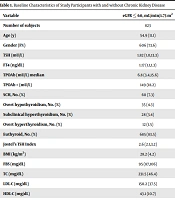
As expected, TSH levels were significantly lower in the GD group than in both the HT and control groups (P < 0.001 for both comparisons), while FT4 levels were significantly higher in GD compared to controls (P = 0.001). Thyroid autoantibodies (TPO-Ab and TG-Ab) were elevated in both AITD groups compared to controls (P < 0.001 for both). Demographic, clinical, and laboratory data were presented in Table 1.
Table 1.
Demographic, Clinical, and Laboratory Characteristics of Children and Adolescents with Hashimoto’s Thyroiditis, Graves’ Disease, and Healthy Controls, Including Continuous and Categorical Analyses of Urinary Albumin-to-Creatinine Ratio a
| Variables | Total (n = 98) | Cases with GD (n = 35) | Cases with HT (n = 29) | Healthy controls (n = 34) | P-Value |
|---|---|---|---|---|---|
| Age (y) | 15.00 (12.40 - 16.20) | 15.50 (13.80 - 16.10) | 15.00 (12.60 - 16.80) | 14.10 (11.80 - 15.80) | 0.176b |
| Male/Female | 26/72 (26.5/73.5) | 11/24 (31.4/68.6) | 5/24 (17.2/82.8) | 10/24 (29.4/70.6) | 0.395c |
| Prepuberty/Puberty | 10/88 (10.2/89.8) | 3/32 (9.4/90.6) | 1/28 (3.6/96.4) | 6/28 (21.4/78.6) | 0.195d |
| Weight SDS | 0.17 ± 1.24 | 0.05 ± 1.21 | 0.27 ± 1.40 | 0.24 ± 1.16 | 0.740e |
| Height SDS | -0.08 ± 1.12 | -0.13 ± 1.04 | -0.19 ± 1.24 | 0.05 ± 1.12 | 0.693e |
| BMI SDS | 0.31 ± 1.30 | 0.09 ± 1.33 | 0.46 ± 1.22 | 0.42 ± 1.35 | 0.473e |
| Age at the time of diagnosis (y) | 13.9 (10.4 - 15.4) | 10.4 (8.0 - 12.0) | 0.003f | ||
| Duration of GD or HT (mo) | 12.0 (6.0 - 36.0) | 48.0 (27.8 - 66.3) | < 0.001f | ||
| Methimazole dose per kg (mg/kg/day) | 0.18 (0.10 - 0.3) | ||||
| Duration of methimazole treatment (mo) | 12.0 (6.0 - 36.0) | ||||
| Levothyroxine dose per kg (µg/kg/day) | 1.05 (0.74 - 2.00) | ||||
| Thyroid volume SDSb | 3.50 (2.36 - 8.34) | 1.26 (0.34 - 3.35) | 0.016f | ||
| TSH (μIU/mL; reference range: 0.27 - 4.2) | 1.79 (0.70 - 2.92) | 0.050 (0.01 - 1.74) | 2.60 (1.67 - 3.89) | 2.04 (1.39 - 2.49) | < 0.001b < 0.001 GD vs. HTg < 0.001 GD vs. HCg |
| FT4 (ng/dL; reference range: 0.93 - 1.70) | 1.28 (1.14 - 1.49) | 1.49 (1.21 - 2.13) | 1.29 (1.17 - 1.47) | 1.20 (1.10 - 1.30) | < 0.001b 0.001 GD vs. HCg |
| FT3 (pg/mL; reference range: 2.56 - 5.01) | 4.61 (3.68 - 6.54) | ||||
| TPO-Ab (IU/mL; reference range: 0 - 34) | 57.00 (9.00 - 217.00) | 171.00 (102.50 - 285.30) | 207.50 (114.00 - 377.00) | 9.00 (9.00 - 11.10) | < 0.001b < 0.001 GD vs. HCg < 0.001 HT vs. HCg |
| TG-Ab (IU/mL; reference range: 0 - 115) | 45.00 (14.80 - 291.00) | 145.00 (34.40 - 346.50) | 289.00 (142.50 - 483.00) | 14.75 (13.80 - 17.30) | < 0.001b < 0.001 GD vs. HCg < 0.001 HT vs. HCg |
| TRab (U/mL; reference range: 0 - 1.5) | 3.99 (1.39 - 9.70) | ||||
| Urea (mg/dL) | 16.00 (11.00 - 21.00) | 19.00 (15.00 - 23.00) | 19.00 (18.00 - 23.00) | 10.00 (8.30 - 12.80) | < 0.001b < 0.001 GD vs. HCg < 0.001 HT vs.HCg |
| Creatinine (mg/dL) | 0.59 ± 0.13 | 0.56 ± 0.13 | 0.58 ± 0.13 | 0.62 ± 0.13 | 0.238e |
| eGFR (mL/min/1.73 m2) | 148.00 (134.00 - 164.00) | 151.00 (139.00 - 166.00) | 151.00 (144.00 - 178.00) | 146.00 (129.00 - 160.00) | 0.160e |
| Spot urine microalbumin (mg/dL) | 0.95 (0.43 - 2.34) | 0.92 (0.45 - 1.50) | 0.71 (0.39 - 2.52) | 1.70 (0.63 - 3.00) | 0.179b |
| Spot urine creatinine (mg/dL) | 148.80 (90.30 - 201.40) | 117.50 (71.00 - 192.00) | 123.90 (82.10 - 183.30) | 176.10 (142.20 - 237.90) | 0.010b 0.022 GD vs. HCg 0.032 HT vs. HCg |
| UACR (mg/g; microalbuminuria range: 30 - 300) | 7.06 (4.39 - 12.66) | 7.36 (5.45 - 12.54) | 6.66 (3.96 - 22.59) | 7.79 (4.50 - 11.77) | 0.779b |
| Number of microalbuminuric cases | 7 (7.1) | 1 (2.9) | 5 (17.2) | 1 (2.9) | 0.042c |
Abbreviations: GD, Graves’ disease; HT, Hashimoto’s thyroiditis; SDS, standard deviation score; BMI, Body Mass Index; TSH, thyroid-stimulating hormone; FT4, free thyroxine; FT3, free triiodothyronine; TPO-Ab, thyroid peroxidase antibody; TG-Ab, thyroglobulin antibody; TRAb, thyroid-stimulating hormone receptor antibody; eGFR, estimated glomerular filtration rate; UACR, urinary albumin-to-creatinine ratio.
a Values are expressed as No. (%), mean ± SD or median (25th - 75th percentile).
b Kruskal-Wallis test.
c Chi-square test.
d Fisher exact test.
e One-way ANOVA test.
f Mann-Whitney U test.
g Dwass-Steel-Critchlow-Fligner test.
While no significant differences were observed between the groups when UACR was analyzed as a continuous variable (P = 0.779), the prevalence of microalbuminuria based on the clinical cut-off (UACR ≥30 mg/g) was higher in the HT group. Microalbuminuria was detected in 5 of 29 patients with HT (17.2%; 95% CI: 7.6 - 34.5), compared with 1 of 35 patients with GD (2.9%; 95% CI, 0.5 - 14.5) and 1 of 34 healthy controls (2.9%; 95% CI, 0.5 - 14.9) (P = 0.042) (Figure 1).
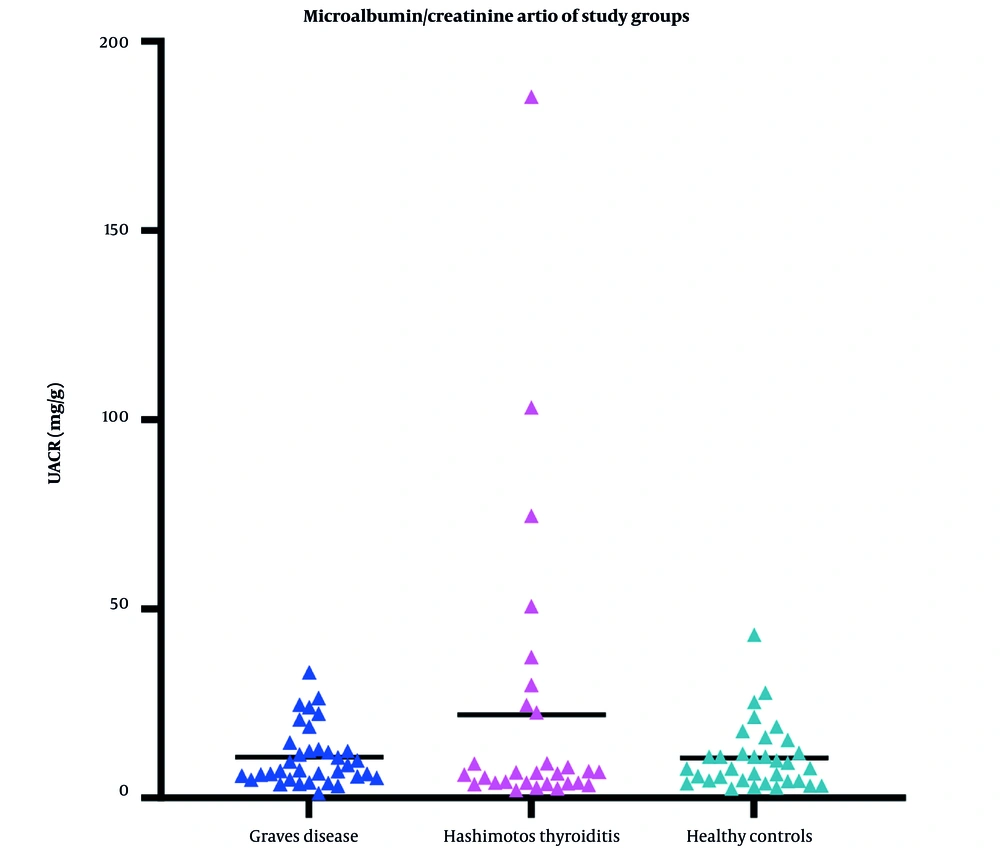
Figure 1.
Comparison of urinary albumin-to-creatinine ratio (UACR) levels among children and adolescents with Hashimoto’s thyroiditis (HT), Graves’ disease (GD), and healthy controls. UACR: urinary albumin-to-creatinine ratio (mg/g). Microalbuminuria was defined as UACR ≥ 30 mg/g (corresponding to 30 - 300 mg/g).
Overall, the prevalence of microalbuminuria was 9.4% (6/64; 95% CI, 4.4 - 19.0) in the overall AITD cohort (HT and GD combined) and 2.9% (1/34; 95% CI, 0.5 - 14.9) in healthy controls (P = 0.416). Additionally, UACR values did not differ significantly based on thyroid functional status (hyperthyroid vs euthyroid; P = 0.383) or antibody positivity (P = 0.748) within the AITD cohort. Similarly, in patients with GD, no significant difference in UACR was observed between hyperthyroid and euthyroid subgroups (P = 0.317).
No significant correlations were identified between UACR and age, disease duration, thyroid function tests, autoantibody titers, urea, creatinine, or eGFR (P > 0.05 for all; Table 2).
Table 2.
Correlation Analysis of Urinary Albumin-to-Creatinine Ratio with Clinical and Laboratory Parameters in the Overall Autoimmune Thyroid Disease Cohort a
| Variables | UACR (mg/g) | |
|---|---|---|
| P-Value | r (Spearman’s rho) | |
| Age (years) | 0.903 | 0.012 |
| Duration of GD or HT | 0.378 | -0.116 |
| TSH (μIU/mL) | 0.157 | -0.144 |
| FT4 (ng/dL) | 0.084 | 0.175 |
| FT3 (pg/mL) | 0.725 | 0.063 |
| TPO-Ab (IU/mL) | 0.336 | 0.104 |
| TG-Ab (IU/mL) | 0.664 | 0.047 |
| TRab (U/mL) | 0.336 | -0.182 |
| Urea (mg/dL) | 0.904 | 0.013 |
| Creatinine (mg/dL) | 0.400 | -0.089 |
| eGFR (mL/min/1.73 m2) | 0.585 | 0.059 |
Abbreviations: GD, Graves’ disease; HT, Hashimoto’s thyroiditis; TSH, thyroid-stimulating hormone; FT4, free thyroxine; FT3, free triiodothyronine; TPO-Ab, thyroid peroxidase antibody; TG-Ab, thyroglobulin antibody; TRAb, thyroid-stimulating hormone receptor antibody; eGFR, estimated glomerular filtration rate; UACR, urinary albumin-to-creatinine ratio.
a Correlation coefficients are presented as Spearman’s rho (r).
5. Discussion
This study is one of the first to investigate the prevalence of microalbuminuria in children and adolescents with AITD, including HT and GD. Although continuous UACR values did not differ significantly among groups, the prevalence of microalbuminuria—defined using a clinical threshold of ≥30 mg/g—was significantly higher in the HT group compared to GD and healthy controls. This discrepancy between categorical and continuous analyses suggests a potential threshold effect rather than a uniform shift in UACR distribution. To our knowledge, data on microalbuminuria in pediatric AITD are limited, and these findings provide novel insights but should be interpreted cautiously. Larger, longitudinal studies are needed to determine whether the observed difference reflects a transient phenomenon or a clinically relevant risk.
According to the NHANES III study, the prevalence of microalbuminuria in 5921 children aged 6 to 19 years is reported as 8.9 - 10.1% (26). In our study, this prevalence was higher in children and adolescents with HT (17.2%) compared to healthy controls (2.9%). Adult studies have reported proteinuria or albuminuria in AITD patients ranging from 12.4% to 45.5% (19-22). Similarly, Zhao et al. (8) documented a 7.9% prevalence of AITD in adults diagnosed with nephropathy.
Microalbuminuria in healthy children may result from transient factors such as fever, stress, intense physical activity, or orthostatic proteinuria. Therefore, repeat UACR measurements and exclusion of orthostatic proteinuria are essential to distinguish persistent renal involvement from functional variations (24, 27). The low prevalence observed in our control group suggests a possible underestimation, while the elevated rate in HT patients may partly reflect such transient influences.
The pathophysiology of microalbuminuria in AITD remains uncertain, with conflicting evidence regarding the role of immune mechanisms. Gao et al. (21) suggested that lesions responsible for microproteinuria in untreated HT and GD may involve both glomerular and tubular structures. While immune complex deposition has been proposed as a potential contributor to renal involvement in this population, Weetman et al. (19) argued that this is less likely due to the low prevalence of circulating immune complexes and the lack of correlation between proteinuria and immune complex-mediated damage. Conversely, Süher et al. (20) reported a higher prevalence of microalbuminuria in patients positive for thyroid autoantibodies, although most were also hypothyroid, suggesting that reduced thyroid hormone levels rather than autoimmunity itself may account for the findings. Several reports in adults with AITD have described glomerular pathologies, including membranous nephropathy, membranoproliferative glomerulonephritis, and IgA nephropathy (18, 28). Proposed immunological mechanisms involve the deposition of circulating immune complexes, molecular mimicry between thyroid antigens (e.g., TG and TPO) and renal structures, and shared susceptibility genes that predispose to both thyroid and renal autoimmunity (18). Immunohistochemical studies have demonstrated TPO-Ab and TG-Ab expression in glomerular tissues of patients with AITD, suggesting that thyroid autoantibodies may cross-react with renal antigens and contribute to glomerular injury. In a subgroup analysis of membranous nephropathy cases, TPO-Ab expression in renal tissue was more frequent in patients with GD and HT, whereas no significant difference was observed in TG-Ab expression among GD cases (8). Huang et al. (29) also demonstrated phospholipase A2 receptor (PLA2R) expression, the target antigen in idiopathic membranous nephropathy, in patients with HT, raising the possibility of novel pathways linking AITD and renal disease. However, other studies have questioned this association due to the low prevalence of circulating immune complexes and the lack of correlation between autoantibody titers and proteinuria (19, 30). On the other hand, Demir et al. (22) suggested that autoimmunity could play a role, as TRAb remained an independent risk factor for microalbuminuria in their cohort of patients with GD. In our cohort, however, no correlation was observed between UACR and thyroid autoantibody levels or thyroid functional status, suggesting that a direct immunological mechanism is unlikely but cannot be completely excluded in pediatric AITD. Given the autoimmune nature of HT and the high prevalence of microalbuminuria observed in our euthyroid HT patients, it is plausible that immune-mediated processes may contribute to renal alterations. When considered alongside previous studies, it is reasonable to speculate that, in addition to autoimmunity, other factors may also play a role in the development of microalbuminuria.
Moreover, the transient nature of proteinuria reported in AITD supports the hypothesis that thyroid autoimmunity alone may not fully account for the observed renal findings (31). Another potential explanation for the higher prevalence of microalbuminuria in HT patients could be the significantly longer disease duration compared to patients with GD. Prolonged exposure to chronic low-grade inflammation over time might lead to subtle renal involvement, although this hypothesis warrants further investigation.
Functional and transient factors may also contribute to the higher prevalence of microalbuminuria observed in HT patients. Hypothyroidism has been linked to hemodynamic changes such as decreased renal perfusion, increased systemic vascular resistance, and alterations in glomerular basement membrane permeability, which may result in mild proteinuria (17). Süher et al. (20) proposed that thyroid hormone deficiency, rather than autoimmunity itself, could explain microalbuminuria in patients with positive thyroid autoantibodies. In contrast, hyperthyroidism has been associated with increased renal blood flow and glomerular hyperfiltration, potentially leading to transient elevations in urinary albumin excretion that normalize after euthyroidism is restored (32). In our study, most HT patients were euthyroid at the time of assessment, making it less likely that overt thyroid dysfunction was the primary driver of microalbuminuria. However, the longer disease duration in HT compared to GD raises the possibility that chronic low-grade inflammation or subtle hemodynamic changes could contribute to subclinical renal involvement.
Although our study does not establish a causal link between AITD and microalbuminuria, the findings highlight the potential value of monitoring renal function in pediatric patients with HT, especially those with longer disease duration. Routine UACR testing may help identify children at risk for transient or early renal changes, but its utility in detecting clinically significant renal involvement remains unclear. Our findings should be interpreted with caution, as this preliminary investigation requires confirmation through larger, longitudinal studies including serial measurements to determine whether microalbuminuria represents a transient phenomenon or an early marker of renal involvement in this population.This study has several limitations. First, the cross-sectional design precludes causal inferences. Second, microalbuminuria was assessed at a single time point without confirmatory testing, limiting the ability to distinguish transient from persistent findings. Third, the relatively small sample size restricted subgroup analyses and reduced statistical power to detect subtle differences. Finally, detailed renal evaluations (e.g., urinalysis, renal Doppler ultrasound) were not performed to exclude other causes of proteinuria.
5.1. Conclusion
This study demonstrated an increased prevalence of microalbuminuria in children and adolescents with HT compared to age- and sex-matched healthy controls, despite no significant difference in continuous UACR values. Although based on a single spot urine measurement, this preliminary study suggests a possible renal involvement in children with autoimmune thyroid disease. These findings highlight the potential relevance of monitoring urinary albumin excretion in pediatric AITD, particularly in patients with longer disease duration. However, further large-scale, longitudinal studies are needed to determine whether microalbuminuria represents a transient phenomenon or an early indicator of renal involvement in this population.