1. Background
Importantly, neonatal necrotizing enterocolitis (NEC) is a serious clinical emergency with high morbidity and mortality rates. The incidence of NEC is reported to be 7%, and the morbidity and mortality rates are as high as 20 - 30% in foreign countries (1). The incidence of NEC in China is as high as 27.63% (2), and NEC requires surgical treatment. At present, among the surgical means of treatment, necrotic bowel resection with a small bowel stoma is the most commonly used and relatively safe surgical method. Owing to the special physiological function of neonates, severe intestinal leakage and absorption can easily occur in children after surgery, which may lead to the emergence of malnutrition, water–electrolyte–acid–base imbalance, and many other diseases, which in turn affect intestinal dysfunction and induce a variety of complications. Complications after neonatal enterostomy are more prevalent than in adults, with 2% to 7% reported abroad (3) and 16.3% to 53.8% reported in China (4). Importantly, in contrast to adult stomas, neonatal stomas may be associated with a range of potential complications, including peristomal dermatitis, mucosal bleeding, stoma prolapse, stoma stenosis, and other issues (5). These effects may be further compounded by hydroelectrolyte imbalances, high-flow diarrhea, and intestinal failure. The optimal timing for stoma closure is a complex decision that must be made with careful consideration of the child's postoperative nutritional status, bowel function, and severity of complications. There is great academic debate about the closure time of necrotizing small bowel colitis stoma, and some scholars have proposed that the stoma should be closed early to reduce complications related to water, electrolytes, and nutrition (6, 7), whereas others have proposed that if the stoma is closed too early, it will result in intraintestinal adhesion and inflammatory bowel stenosis, which will make the operation more difficult and increase the number of complications (8, 9). It is my understanding that neonatal ostomy is usually a matter of urgency and that randomization and small sample sizes are part of the process.
2. Methods
2.1. General Information
A retrospective analysis was conducted on infants who underwent ileostomy for necrotizing enterocolitis (NEC) at the Children’s Hospital of Zhejiang University School of Medicine from January to December 2020. Of the 95 eligible infants, 3 preterm infants died due to pneumoperitoneum with multiple organ failure, 1 was withdrawn because of multiple malformations and social factors, and 3 were lost to follow-up, resulting in 88 infants included in the final analysis [44 males, 44 females; 65 preterm (< 37 weeks), 23 full-term (≥ 37 weeks)]. During the study period, our center admitted approximately 1,200 neonates annually, among whom NEC was diagnosed in about 15% (approximately 180 cases). Of these, 95 infants (representing 52.8% of surgically managed NEC cases) underwent ileostomy as the primary surgical intervention.
2.2. Data Collection Method
Data extracted from the medical records included: (1) Basic patient information (sex, gestational age, birth weight, and weight on the day of surgery); (2) clinical details, such as the initiation time and duration of parenteral nutrition, along with liver function profiles; (3) documentation of postoperative complications; and (4) follow-up records, encompassing the timing of stoma closure, stoma duration, weight at closure, and nutritional status.
2.3. Relevant Concepts
2.3.1. Peristomal Dermatitis
It has been suggested that peristomal dermatitis is an inflammatory skin lesion that can develop on the patient's skin around the stoma after an enterostomy. This skin lesion is thought to be caused by friction, irritation, and contact of secretions between the stoma bag and the surrounding skin. Peristomal dermatitis may present with symptoms such as redness, swelling, pain, burning sensation, itching, skin ulceration, blisters, or skin desquamation (10).
2.3.2. Ostomy High-flow Diarrhea
Stoma high-flow diarrhea is characterized by the passage of large quantities of thin, watery stools in a short period of time, or over a prolonged period, in quantities exceeding 40 mL per kg of body weight per day, accompanied by more than moderate dehydration. This condition can result in severe loss of water and electrolytes in the child, necessitating prompt diagnosis and treatment (11).
2.3.3. Neonatal Intestinal Failure
Neonatal intestinal failure is characterized by the intestine's inability to fulfill the body's nutritional and fluid-electrolyte needs via the enteral pathway due to significant structural or functional defects, mandating the use of total parenteral nutrition (TPN) for survival and growth (12, 13).
2.4. Statistical Methods
The data were analyzed using SPSS 26.0 statistical software. Data that were normally distributed are expressed as x ± S values. A t test was employed for measurement data, whereas the chi-square test was used for counting data. The influencing factors were subjected to single-factor analysis, and the statistically significant single factors were subjected to logistic multiple regression analysis. The difference was considered statistically significant at P < 0.05.
3. Result
3.1. Postoperative Complication Results
A total of 67 (76.14%) of the 88 children who were followed up experienced complications, of which 35 (39.77%) had three or more complications, 49 (55.7%) had peristomal dermatitis, 5 (5.7%) had prolapse of the stoma, and 10 (11.4%) of the subjects exhibited retraction of the stoma, whereas 18.2% demonstrated parastomal hernias. Electrolyte imbalances were observed in 59.1% of the patients, malnutrition in 39.8%, intestinal failure in 18.2%, and liver function abnormalities in 40.9% (Table 1).
Table 1.
Percentage of Complications a
| Variables | Values |
|---|---|
| Peristomal dermatitis | 49 (55.7) |
| Stoma prolapse | 5 (5.7) |
| Stoma retraction | 10 (11.4) |
| Parastomal hernia | 16 (18.2) |
| Electrolyte disturbance | 52 (59.1) |
| Intestinal failure | 16 (18.2) |
| Malnutrition | 35 (39.8) |
| Liver dysfunction | 36 (40.9) |
a Values are as expressed as No. (%).
3.2. Univariate Analysis
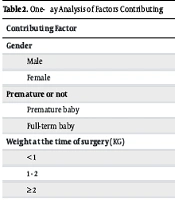
A total of 88 children underwent second-stage surgery to close the stoma, with 100% survival rates. Univariate analysis indicated that the occurrence of postoperative complications was associated with the duration of the stoma, the duration of parenteral nutrition, and the magnitude of weight gain (P < 0.05). However, no significant associations were observed with sex, prematurity, or weight at the time of surgery (P > 0.05) (Table 2).
Table 2.
One-way Analysis of Factors Contributing
| Contributing Factor | Numbe | Complications a | χ2 | P-Value |
|---|---|---|---|---|
| Gender | 3.065 | 0.080 | ||
| Male | 44 | 30 (44.8) | ||
| Female | 44 | 37 (55.2) | ||
| Premature or not | 0.085 | 0.771 | ||
| Premature baby | 65 | 50 (74.6) | ||
| Full-term baby | 23 | 17 (25.4) | ||
| Weight at the time of surgery (KG) | 4.830 | 0.089 | ||
| < 1 | 10 | 10 (14.9) | ||
| 1 - 2 | 45 | 35 (55.2) | ||
| ≥ 2 | 33 | 22 (32.8) | ||
| Duration of stoma maintenance (d) | 6.687 | 0.035 | ||
| < 60 | 15 | 8 (11.9) | ||
| 60 - 120 | 52 | 40 (59.7) | ||
| ≥ 120 | 21 | 19 (28.4) | ||
| Intravenous hypernourishment maintenance time (d) | 8.840 | 0.012 | ||
| < 30 | 36 | 23 (34.3) | ||
| 30 - 60 | 26 | 19 (28.4) | ||
| ≥ 60 | 26 | 25 (37.3) | ||
| Weight growth rate (%) | 1.234 | 0.540 | ||
| < 90 | 24 | 20 (29.9) | ||
| 90 - 199 | 38 | 27 (40.3) | ||
| ≥ 200 | 26 | 20 (29.9) |
a Values are as expressed as No. (%).
3.3. Multifactor Analyses
The findings of the logistic regression analysis indicated that the duration of the stoma, the duration of parenteral nutrition, and the magnitude of weight gain in the child constituted independent risk factors for postoperative complications in neonatal enterostomies (P < 0.05) (Table 3).
Table 3.
Multiple Linear Regression Analysis of Stoma Duration and Parenteral Nutrition
| Variables | B | S.E. | Wals | P | OR | 95%CI |
|---|---|---|---|---|---|---|
| Duration of stoma maintenance (d) | 6.959 | 0.031 | ||||
| 60 - 120 | 1.360 | 0.723 | 3.535 | 0.06 | 3.896 | 0.944-16.077 |
| ≥ 120 | 2.515 | 0.976 | 6.642 | 0.01 | 12.372 | 1.827-83.804 |
| Intravenous hypernourishment maintenance time (d) | 7.138 | 0.028 | ||||
| 30 - 60 | 0.684 | 0.639 | 1.143 | 0.285 | 1.981 | 0.566-6.938 |
| ≥ 60 | 2.943 | 1.117 | 6.948 | 0.008 | 18.974 | 2.127-169.265 |
4. Discussion
4.1. High Complication Burden and Nutritional Management
This retrospective study found that 67 of 88 infants (76.14%) developed complications following ileostomy, with 35 (39.77%) experiencing three or more concurrent issues. The most frequent complications were electrolyte disorders (59.1%), peristomal dermatitis (55.7%), and liver function abnormalities (40.9%). This high complication rate is consistent with a reported rate of 40.4% in similar neonatal populations (14). Notably, malnutrition was prevalent (39.8%), a distinctive feature compared to adult stoma patients. In NEC, a pre-existing catabolic state characterized by negative nitrogen balance and impaired immunity (15), compounded by intestinal loss from the stoma, significantly increases malnutrition risk. Consequently, proactive and individualized nutritional support is not merely adjunctive but fundamental to improving nutritional status, immune function, and overall prognosis (16). A comprehensive strategy — encompassing detailed assessment, tailored planning, and close monitoring — is essential for optimizing outcomes in these infants.
4.2. Peristomal Dermatitis: Prevention and Care
Peristomal dermatitis was the most common complication in our cohort, aligning with other studies. Neonates are particularly susceptible due to their immature skin barrier, characterized by a thinner stratum corneum and higher permeability (17). Inflammation primarily results from prolonged exposure to stoma effluent. Effective management hinges on proper stoma appliance application and diligent peristomal skin care. However, caregiver awareness is often lacking, with many not seeking timely professional help. Therefore, enhancing health education for caregivers, especially focusing on post-discharge home care, is a critical nursing intervention for preventing and managing this condition.
4.3. Electrolyte Disorders and Intestinal Failure-Associated Liver Disease
Electrolyte disorders constituted the second most prevalent complication, accounting for 59.11% of cases. The probability of electrolyte disorders is high due to excessive intestinal fluid loss through the stoma, with severe cases often requiring long-term intravenous nutritional support, which may itself compromise liver function. There is a clear correlation between long-term intravenous nutrition and liver injury and cholestasis in children with intestinal failure. Liver disease caused by the application of intravenous nutrition is collectively termed intestinal failure-associated liver disease (IFALD) (18), which is a common problem after high small bowel stoma, and the following difficulties in its management exist: (1) Enteral nutrition cannot be used to prevent the liver from healing. First, enteral nutrition is incapable of meeting the demands for growth and development, necessitating prolonged intravenous nutritional support, which can result in liver damage and cholestasis; (2) some children require active nutritional support and hepatoprotective, cholestatic, and yellowing treatment, but liver damage and cholestasis still tend to progressively aggravate, cannot provide adequate nutrition, are difficult to achieve weight gain, grow and develop, and are forced to close the stoma earlier; (3) stoma associated with liver failure (IFALD) is a common problem after high small bowel stoma. Surgical intervention for stoma formation is associated with a number of risks and potential complications. These include but are not limited to surgical site infections, anastomotic fistulas, anastomotic stenosis, and postoperative intestinal adhesion. The risks are further compounded in cases of small body weight and early stoma closure owing to the short interval between surgery and the commencement of the stoma. The treatment of water and electrolyte disorders can be achieved by collecting the intestinal fluid discharged from the proximal stoma and infusing it back through the stoma.
4.4. Towards Optimal Stoma Closure and Comprehensive Care
All 88 infants underwent second-stage surgery to close the stoma, and all survived. Univariate analysis demonstrated that the occurrence of postoperative complications in children was related to the duration of the enterostomy, the duration of parenteral nutrition, and the magnitude of weight gain (P < 0.05). Given the short proximal intestinal tube and weak compensatory ability, the treatment goal is to actively restore enteral nutrition and to withdraw from intravenous nutrition as soon as possible. This promotes the growth and development of the child and reduces malnutrition and its complications. Therefore, the nursing team needs to develop a comprehensive and professional care plan, including holistic skin care, vital sign monitoring, 24-hour access statistics, and nutritional assessment. The caloric allocation of parenteral and enteral nutrition should be adjusted in a timely manner according to the daily assessment of the child, feeding status, and stool characteristics. The risk of hepatic impairment and cholestatic disease due to prolonged parenteral nutrition also needs to be monitored, and an appropriate intravenous access protocol needs to be developed. Infection protection measures need to be emphasized throughout the treatment process (19). A comprehensive care plan is instrumental in mitigating the risk of impaired intestinal barrier function and enterogenous infections, thereby creating optimal conditions for stoma closure surgery at a later date. This is paramount in accelerating the resolution of the disease in children.
4.5. Conclusions
This retrospective study also verified that neonatal enterostomies have a greater incidence of stoma complications than adult enterostomies do because of their special characteristics, and the types of complications also differ; electrolyte disorders, intestinal failure, and malnutrition are special types of stoma complications that differ from intestinal failure in neonates and cannot be avoided by administering intravenous nutrition for a prolonged period; therefore, it is important to determine the indications for the timing of stoma closure surgery and to perform stoma closure ahead of schedule. Ostomy can be used as a therapeutic option, so choosing the right time to close the stoma is important. This is related to the child's weight and nutrition, such as the ability to carry out nursing interventions in advance before the onset of these complications through the full range of nursing interventions during the period of the stoma and surgery and nutrition. This approach encompasses the collaborative efforts of various departments, including gastroenterology, to ensure optimal nutritional support for the child. The efficacy of this strategy is evidenced by its ability to facilitate weight gain, ensure reasonable feeding patterns, and employ active and effective nursing interventions. Notably, this strategy facilitates the closure of the stoma prior to the onset of complications, thereby enhancing the child's well-being and reducing the need for subsequent surgical interventions. In home care, effective weight gain, reasonable feeding, active and effective nursing interventions, recovery of the child’s intestinal function and nutritional status, and determination of the suitability of the timing of the operation are crucial for accelerating the recovery of the patient, shortening the number of days of hospitalization, and achieving the objective of reducing various types of postoperative complications and mortality.