1. Background
Adolescents are among the most important assets any country has, and any psychosocial vulnerability among this age group will have detrimental consequences. Adolescents’ and young people’s health is strongly correlated with their health-related behaviors (1). Adolescence is a period of great and rapid emotional, physical, and social change, and a period in which the individual learns and develops self-esteem, self-control, independent decision-making, autonomy, and a sense of responsibility, as well as a period of making important decisions about health, family, work, and choice of friends, and the acquisition of social skills to assume future roles and responsibilities (2). Being prone to risk-taking, adolescents are likely to engage in high-risk behaviors in an attempt to consider and try different behaviors, experiment with various roles, sometimes even with flagrant disregard for rules and regulations, unless a precise model of social norms is defined and set for them (3). With more than 15 million adolescents accounting for a quarter of its population, Iran is among the youngest countries in the world (4). In young societies, high-risk behaviors occur in many forms (5). Various studies have also shown an increase in the incidence of high-risk behaviors among adolescents (6). In the 2016 census, the population of Iran was estimated to be 79,926,270 individuals, approximately 25.1% (20,053,009) of which belonged to the 15 - 24 age group (7).
Risky behaviors are a set of behaviors that can cause not only serious harm to an individual and his/her loved ones, but also unintentional harm to innocent people (8). Familial factors (parental substance abuse), intrinsic characteristics (an individual’s temperament) (9), increased conflicts and breakdown of parent-child relationships due to increased adolescent relationships with different peer groups, and increased risk-taking in comparison with other developmental stages are considered to be among factors contributing to the inclination of adolescents towards high-risk behaviors (5). Behaviors such as drug use, alcohol consumption, smoking, physical confrontations and violence, illicit sexual intercourse, reckless driving, and carrying firearms or melee weapons are considered high-risk behaviors (10, 11), with psychological and physical consequences, such as depression (12), premature death (13), AIDS and sexual diseases (14), academic failure, and low academic motivation (15). Many high-risk behaviors, such as unprotected sexual intercourse and 90% of the first instances of smoking and drug use, occur in adolescence before the age of 18 (16). According to a worldwide study on tobacco use in 43 countries, the average prevalence of smoking among adolescents was reported as 33%, and nearly 25% of students who smoked had first smoked before the age of 10 (17). On the other hand, the earlier individuals start smoking and using drugs, the less likely they are to fully quit them in adulthood (18).
Aggression is a complex phenomenon influenced by contextual and psychological factors, as well as genetic factors (19). Social psychologists define aggression as physical or verbal acts or expressions of suffering, hatred, and criticism to inflict physical or psychological harm, pain, and suffering (20). In a 1995 study, in a response to a question about the causes of violent behavior, students mentioned membership in criminal gangs (35%), lack of parental supervision (35%), peer influence (35%), and poverty as factors contributing to the occurrence of violence (21). According to health theories, preventive programs in adolescence are more effective and beneficial than measures that are subsequently taken to correct the unintended consequences of high-risk behaviors for the individual and society (22). Therefore, it is necessary to develop strategies to educate and reduce adolescents’ risky behaviors.
One of the strategies to reduce risky behaviors in adolescents is to educate them on these issues. Effective education will improve the level of awareness and performance, as well as mental and physical health, reduce the likelihood of progressive complications, and increase the sense of responsibility to eliminate or change inappropriate behaviors (23). An effective training method is life skills training, which includes the set of abilities that facilitate adjustment and positive and beneficial behaviors, as a result enabling the individual to take on responsibilities and roles without harming him/herself and others and to deal with the challenges and requirements of daily life effectively. The objective of life skills training is to promote the individual’s adjustment with oneself, others, and the environment (24). So far, no studies have been conducted on the effects of life skills training on high-risk behaviors of students in Iran. Therefore, we decided to conduct this study due to cultural and social differences in different countries.
2. Objectives
Adolescents are one of the most important assets of any society and a large part of the population of any country. Their developmental period is characterized by risk-taking, and physical, mental, and social changes that may unknowingly expose them to many dangers and threats. Therefore, they should be taught skills that can help them easily control their emotional behaviors and induce them to play a positive role in society by making the right decisions. The present study was designed to determine the effects of life skills training on the inclination of adolescents to engage in high-risk behaviors.
3. Methods
3.1. Participants
The present study is a randomized controlled clinical trial. The study population included public high school students aged 13 - 17 years residing in Boroujerd in 2018 - 2019. To determine the sample size, the following formula was used:
With s = 25, d = 15, α = 0.05, and β = 0.2, the sample size was determined as 22 for each group. Considering a possible dropout rate of 25, a sample size of 50 was set for the intervention and control groups. In other words, it was determined to enroll 50 individuals in the study from each sex.
3.2. Procedure
For sampling purposes, the girls and boys high schools in Boroujerd were considered as the strata, and high schools within these strata were assigned to clusters. Then, based on the map of the city and the systematic random sampling method, and the multistage cluster sampling method, the target high schools were selected. In the next step, a pretest was administered to the students to screen and select eligible individuals in accordance with the determined sample size. The inclusion criteria were the acquisition of the highest marks on the Iranian Adolescents’ Risk-Taking scale (IARS), willingness to cooperate with the researchers, being a resident of Boroujerd, participation in all counseling sessions, lack of scheduling conflicts among the routine high school classes of the students with the counseling sessions, and being a high school student. From among individuals with the highest scores on IARS, 50 male students and 50 female students were enrolled in the study. Next, eligible participants were assigned to the control and intervention groups based on their genders in random blocks of four.
After the acquisition of the requirements of research, obtaining the necessary permissions from the Vice Chancellorship for Research of the Lorestan University of Medical Sciences, and getting authorization letters from the Protection Bureau of the Education Office of Boroujerd, the researchers visited the target schools, explained the educational content of the study and the research method to school principals and parents, obtained written consent from them, and assured them that participation in the study was voluntary and the participants could leave the study whenever they wished. They were also assured that all the information obtained would remain confidential, the questionnaires would be processed using numbers and codes rather than names, and only one of the researchers would know the name of the individual to whom the code has been assigned. The exclusion criteria consisted of absence from training sessions, migration and leaving the place of residence, a history of receiving psychological or psychiatric counseling, and unwillingness to continue participation in the study.
The instructor had a bachelor’s degree in nursing, and the supervisor of the sessions had a master’s degree in nursing. Before the training sessions began, a briefing session was held to gain the trust of the participants and instruct them about how to complete the questionnaires. Then, for each of the intervention subgroups, eight 45-minute workshop and group discussion sessions were held to instruct them on life skills for a duration of two months. In each session, first, the participants expressed their views by brainstorming, which were fully directed and recorded by the researcher. Next, the counselor taught the content planned for each session. At the end of each session, educational feedback was taken. After two months, during a follow-up session and in a free discussion mode, the participants shared their experiences of applying what they had learned in the presence of others. Their experiences were reviewed, and they were advised by a consultant. The concepts that were taught in the sessions included self-awareness skills (two sessions), communication skills (two sessions), emotion management skills (one session), problem-solving skills (one session), decision-making skills (one session), and critical thinking skills (one session).
Follow-up Session: The ninth session was a one-hour follow-up session held 20 days after the first eight sessions had ended. During this session, first, feedback was taken from the participants through brainstorming, and the participants shared their positive experiences regarding the constraining of high-risk behaviors with their peers. Next, the issues presented in the educational sessions were summarily recapped. In the control group, the training was not conducted as a group discussion. At the end of the session, after the participants had filled out the research questionnaire again, and in order to observe ethical considerations, brochures containing the key points of the taught skills were handed out to the families and the control group participants.
3.3. Measures
The demographic information questionnaire included 18 questions about the grade point average of the previous academic year, the grade of the participant, education, divorce status, and whether the parents have deceased or not, history of violence, history of car accidents, history of running away from school, history of smoking, and family income level.
3.4. Iranian Adolescents’ Risk-Taking Scale (IARS)
This questionnaire was designed by Zadeh Mohammadi et al. (25) to assess risk-taking among teenagers, containing 38 items evaluating the susceptibility of adolescents to high-risk behaviors, including reckless driving, violence, smoking, narcotic drugs, and substance abuse, alcohol consumption, sexual behaviors, and relationships, and relationships with the opposite sex. The subjects indicated their agreement or disagreement with the items on the questionnaire on a five-point Likert scale from “completely agree” (= 5) to “completely disagree” (= 1). The total score was obtained by adding the scores of all the subscales (25). Ultimately, the obtained scores were converted to a standard scale of 0 to 100. In the present study, the Cronbach’s alpha internal consistency of the subscales of violence, smoking, the use of narcotics, and alcohol consumption was 0.67, 0.76, 0.74, and 0.70, respectively.
3.5. Statistical Analysis
After collecting and entering the data into SPSS version 18, the standard deviations of quantitative variables and the percentages of qualitative variables were calculated. The statistical tests, including the chi-squared test, the independent t-test, and repeated-measures analysis of variance, were also used, and the results were reported at a significance level of 0.05.
4. Results
The studied participants included 50 male and 50 female students, whose demographic characteristics are summarized in Table 1. As can be observed, the two groups were homogenous in terms of all demographic variables, such as educational stage, parents’ education, etc., and the difference between the mean ages of the parents of the two groups was not significant (P > 0.05).
Table 1.Demographic Characteristics of Study Participants
| Demographic Characteristics | Group | χ2 | P | |
|---|---|---|---|---|
| Intervention Group, No. (%) | Control Group, No. (%) | |||
| High school grade | 0.541 | |||
| Freshman | 18 (36) | 22 (44) | 0.667 | |
| Sophomore | 32 (64) | 28 (56) | ||
| Decline of academic performance | 0.408 | |||
| Yes | 34 (68) | 29 (58) | 1.073 | |
| No | 16 (32) | 21 (42) | ||
| Dropping out of school | 0.422 | |||
| Yes | 25 (50.0) | 20 (40.0) | 1.010 | |
| No | 25 (50.0) | 30 (60.0) | ||
| History of verbal or physical violence | 0.176 | |||
| Yes | 40 (80.0) | 33 (66.0) | 2.486 | |
| No | 10 (20.0) | 17 (34.0) | ||
| Grade retention | 0.362 | |||
| Yes | 4 (8.0) | 1 (2.0) | 1.895 | |
| No | 46 (92.0) | 49 (94.0) | ||
| A history of addiction among the parents | 0.408 | |||
| Father | 21 (42.0) | 16 (32.0) | 1.073 | |
| Both parents | 1 (2.0) | 0 (0.0) | ||
| None of the parents | 30 (60.0) | 34 (68.0) | ||
| No | 22 (44.0) | 29 (58.0) | ||
| Are the parents divorced | 0.99 | |||
| Yes | 9 (18.0) | 8 (16.0) | 0.071 | |
| No | 41 (82.0) | 42 (84.0) | ||
| History of smoking | 0.435 | |||
| The student himself/herself | 10 (20.0) | 12 (24.0) | 0.792 | |
| Father | 24 (48.0) | 18 (36.0) | ||
| None | 16 (32.0) | 20 (40.0) | ||
In order to compare the subscales of the risk-taking questionnaire between female and male students in the intervention and control groups over time, a repeated-measures analysis of variance test was run. The results of this test for the narcotic drug use subscale showed the lack of statistical significance in the interactions of sex * group * time, indicating that variations in the mean score of the control and intervention groups in both sexes over time were not statistically significant (P = 0.537). Furthermore, the lack of statistical significance in the interactions of sex * time showed that regardless of group, variations in the narcotic abuse subscale mean scores among male and female students were not significant over time (P = 0.142). However, the presence of a statistical significance in the effect of time * group suggested that variations in the mean scores of the groups over time were statistically significant (P < 0.001). The mean variation trend in both groups in this subscale is presented in Figure 1A. As can be seen, the decreasing trend in the variations of the mean scores of the intervention group at different times was significantly higher than that in the control group (P < 0.001).
Concerning alcohol consumption, smoking, and violence, the results were similar to those obtained on the narcotic drug use subscale, such that the presence of a statistical significance in the group * time effect indicated that variations in the mean scores of the intervention group at different times were significantly higher than those in the intervention group (P < 0.001). The variations trends of the mean scores of students are presented in Figure 1B-C, as well as Table 2.
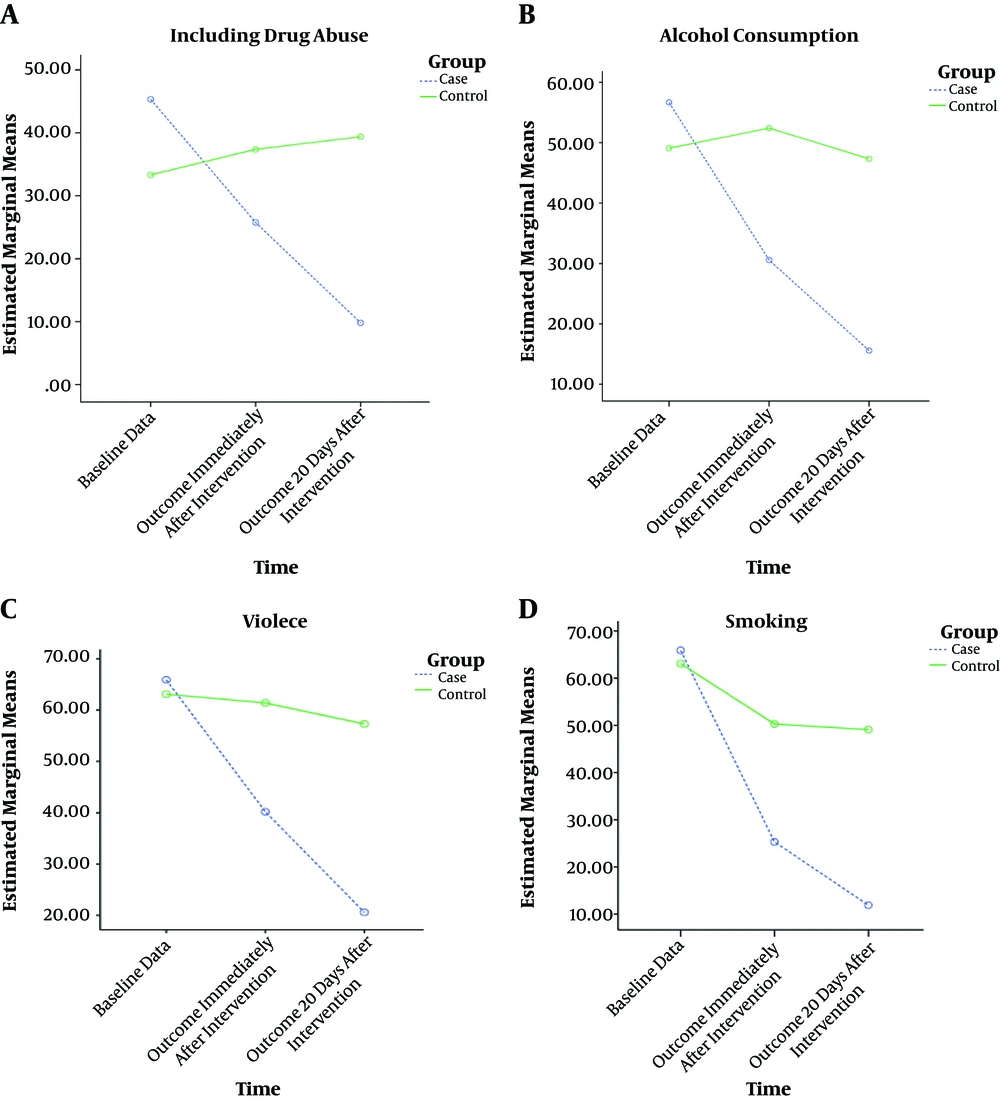
Figure 1.
Comparison of mean scores of risk-taking subscales between intervention and control groups over time. A and B, Alcohol consumption; B and C, Violence.
Table 2.Comparison of Risk-Taking Mean Scores of Male and Female Students in Intervention and Control Groups Over Time
| Dimension (Subscale) | Before Intervention | After Intervention | 20 Days After Intervention (After the Follow-up Session) | Effect of Time | Effect of Time * Group | Effect of Time * Sex | Effect of time * Sex * Group |
|---|---|---|---|---|---|---|---|
| Narcotic abuse | < 0.001 | < 0.001 | 0.142 | 0.537 | |||
| Intervention | |||||||
| Male | 46.75 ± 23.67 | 24.87 ± 15.71 | 8.25 ± 9.66 | ||||
| Female | 43.87 ± 13.08 | 26.62 ± 11.27 | 11.37 ± 7.80 | ||||
| Sum | 45.31 ± 18.98 | 25.75 ± 13.56 | 9.81 ± 8.83 | ||||
| Control | |||||||
| Male | 36.87 ± 19.76 | 38.75 ± 22.40 | 40.75 ± 22.47 | ||||
| Female | 29.75 ± 16.41 | 36.00 ± 13.65 | 38.00 ± 10.85 | ||||
| Sum | 33.31 ± 18.33 | 37.37 ± 18.41 | 39.31 ± 17.51 | ||||
| Alcohol consumption | < 0.001 | < 0.001 | 0.674 | 0.400 | |||
| Intervention | |||||||
| Male | 58.66 ± 48.47 | 32.33 ± 15.51 | 14.66 ± 12.21 | ||||
| Female | 54.66 ± 18.13 | 28.83 ± 14.27 | 16.50 ± 8.11 | ||||
| Sum | 56.66 ± 18.23 | 30.58 ± 14.85 | 15.58 ± 10.30 | ||||
| Control | |||||||
| Male | 56.00 ± 23.23 | 58.33 ± 21.81 | 54.50 ± 22.33 | ||||
| Female | 42.16 ± 17.97 | 46.50 ± 16.25 | 40.16 ± 17.42 | ||||
| Sum | 49.08 ± 21.71 | 52.41 ± 19.95 | 47.33 ± 21.10 | ||||
| Smoking | < 0.001 | < 0.001 | 0.149 | 0.837 | |||
| Intervention | |||||||
| Male | 66.20 ± 27.12 | 21.20 ± 15.36 | 8.40 ± 7.86 | ||||
| Female | 65.60 ± 20.01 | 29.40 ± 16.22 | 15.40 ± 14.71 | ||||
| Sum | 69.90 ± 23.59 | 25.30 ± 16.17 | 11.90 ± 12.20 | ||||
| Control | |||||||
| Male | 66.60 ± 20.65 | 48.00 ± 21.88 | 49.80 ± 24.97 | ||||
| Female | 59.60 ± 17.90 | 52.60 ± 26.06 | 48.40 ± 22.99 | ||||
| Sum | 63.10 ± 19.45 | 50.30 ± 23.93 | 49.10 ± 23.76 | ||||
| Violence | < 0.001 | < 0.001 | 0.634 | 0.743 | |||
| Intervention | |||||||
| Male | 66.20 ± 27.12 | 38.60 ± 16.86 | 19.60 ± 10.29 | ||||
| Female | 65.60 ± 20.01 | 41.80 ± 21.45 | 21.60 ± 12.30 | ||||
| Sum | 65.90 ± 23.59 | 40.20 ± 19.16 | 20.60 ± 11.27 | ||||
| Control | |||||||
| Male | 66.60 ± 20.65 | 64.00 ± 21.74 | 62.00 ± 22.63 | ||||
| Female | 59.60 ± 17.90 | 58.80 ± 17.33 | 52.60 ± 17.50 | ||||
| Sum | 63.10 ± 19.45 | 61.40 ± 19.64 | 57.30 ± 20.58 |
5. Discussion
The findings of this study suggest that life skills training reduced high-risk behaviors, including drug abuse, alcohol consumption, smoking, and violence, in the intervention group as compared to the control group. These findings indicate the positive impact of life skills training on the mental health and attitude modification and the reduction of negative behaviors of adolescents that are consistent with the findings of many previous studies, including Botvin et al. (26), Botvin et al. (27), Botvin et al. (28), and Botvin et al. (29), all of which emphasized the effectiveness of life skills training on mental health and the reduction of negative high-risk behaviors in adolescents. Additionally, Vranda et al. (30) investigated the impact of life skills training on children and adolescents’ experiences and concluded that such training is an effective tool for promoting psychological well-being and can help students gain attitudes and values that lead to positive behaviors, and, in turn, facilitate the prevention of high-risk behaviors.
The results of the present study can be explained by the fact that some studies have shown that deficits in life skills can make adolescents susceptible to high-risk behaviors. Reza’ea et al. (31) reported that inadequate life skills lead to low self-efficacy in adolescents, making them unable to resist peer pressure to get involved in high-risk behaviors and unable to deal with problems of daily life. In other words, low self-control and self-efficacy can reduce adolescents’ ability to delay gratification, resulting in high-risk behaviors.
It can be said that one of the skills that can make individuals evaluate their own self-efficacy and capabilities is self-awareness. Therefore, one of the life skills taught in the present study was self-awareness that enables individuals to better understand and weigh up their personal characteristics, needs, desires, goals, weaknesses, feelings, values, and identities (32). As a result, by recognizing and relying on their strengths, they can reduce the impact of their weaknesses. That is to say, by acquiring self-awareness skills through self-knowledge and by making better use of their capabilities, they can increase their self-efficacy and better accept their social responsibilities and roles, and act effectively (33). Ahmed and Elmasri (34) also found out that self-awareness training is effective in promoting good self-efficacy.
As a result of increased self-efficacy, the individual can better recognize and manage his/her weaknesses. Therefore, a teenager who knows himself/herself well can better constrain and reduce high-risk behaviors and even improve his/her academic performance. As Wing et al. (35) showed, students with higher self-efficacy were less likely to engage in high-risk behaviors. Other studies have also shown that improved self-awareness positively affects the motivation for academic achievement (36) and decreases aggression among students (37).
Other skills that can enhance a person’s self-control and self-efficacy in coping with life stresses, frustrations, and decision-making situations include emotion management, problem-solving, and critical thinking skills that were taught to students in the present study and reduced the incidence of high-risk behaviors among teenagers. This finding is in line with the findings of other studies, such as Sukhodolsky et al. (38), which demonstrated that problem-solving skills and the use of a combination of different types of skills could be more effective in reducing high-risk behaviors in adolescents.
What can be observed here is that improvements in life skills reinforce each other’s effects. Therefore, the promotion of the four skills mentioned earlier can improve adolescents’ ability to communicate properly with the world around them. As a result, adolescents can correctly identify harmful situations and social demands and manage their negative impacts with proper communication skills such as saying no. Most importantly, these skills can reduce the emotional and stress-related problems of teenagers in these situations, leading to making better decisions. Studies by Roy et al. (39) in India and Mutiso et al. (40) have demonstrated that life skills training programs are effective in reducing the stress levels and emotional and behavioral problems of adolescents.
5.1. Conclusions
In the present study, one of the important effects of life skills training was to increase adolescents’ self-efficacy, which plays a significant role in reducing high-risk behaviors. It should be noted, however, that training just one life skill alone cannot increase individuals’ self-efficacy. The present study confirmed that training a set of life skills can enhance individuals’ self-efficacy, and help them identify their behavioral weaknesses and strengths, and facilitate managing and constraining high-risk behaviors. Therefore, by constraining some high-risk behaviors, teenagers unconsciously help themselves control other high-risk behaviors, as well.
5.2. Limitations
The fact that the consent of school principals had to be obtained for the researchers to be able to attend classes and hold sessions and the fact that the participants studied in different grades and the schools were in different geographical locations may have limited the researchers’ access to the students and may have limited the number of participating students.
5.3. Recommendations
Life skills training and the application of life skills in adolescents’ lives to control emotional behaviors are issues that have not received adequate attention. Therefore, based on the findings of this study and other studies, it is recommended that authorities design, implement, and evaluate a long-term program from childhood to adulthood to teach these skills and apply them from the family to the community.