


1. Background
Anxiety disorders are the most common of mental disorders, with a generalized anxiety disorder (GAD) being the most prevalent. However, factors that contribute to GAD symptoms and worrying over time are well identified. To address this problem, a large amount of research and several theories on GAD have focused on uncovering the underlying mechanisms that cause and maintain this disorder (1, 2). Theoretical models of GAD differ based on their assumptions about the main fear of GAD. According to the Intolerance of Uncertainty Model, the uncertainty in vague events is the basis of fear in GAD (3, 4).
In contrast, the Cognitive Avoidance Theory of Worry (5, 6) shows that the main fear of GAD is the negative emotional image and related arousal, which people try to avoid by the persistent use of worrying, a verbal-linguistic mode of theoretical thinking to avoid further emotional arousal for imagery. Similarly, the Emotion Dysregulation Theory emphasized on fear of those suffering from GAD and their inability to comprehend and manage emotional arousal (7). The Acceptance-Based Model of GAD (8, 9) anticipates the main fear and reluctance to accept negative thoughts and emotional positions. Lastly, the Contrast Avoidance Model (10, 11) supposes that the main fear in the GAD is a negative emotional change, a severe change from a neutral or positive emotion to a negative emotional position. The Contrast Avoidance Model CAM offers a completely new approach to understanding the nature of GAD because it focuses on the role of emotional changes and worrying as a method to create and maintain a negative emotional state to avoid aversive negative emotional changes (10). The purpose of CAM is to further understand the mechanisms of worrying and emotion in GAD, as well as explaining why those who seem to perceive emotion and anxiety as negative would endorse their worrying as a positive coping strategy (10). In addition, CAM may describe the processes by which individuals are exposed to GAD, how GAD symptoms are preserved, and why current treatments aren't effective enough (12). The CAM assumes that a person with GAD maintains a state of consistent worrying as a protective measure against potential negative shifts in emotions that occurred due to negative events (10, 13, 14). Further, the CAM proposes that individuals with GAD would prefer to experience a consistent state of negativity because they feel it protects them from being surprised by a negative event and experiencing a sharp change in their emotional state (i.e., a negative emotional contrast). This allows them to feel more emotionally prepared for possible negative events rather than being emotionally surprised and/or disappointed.
CAM is based on three principles. Firstly, the main fear in people with GAD is a severe and rapid contrast of negative emotions; i.e., the core of fear in these people is a rapid and sudden shift in their emotional state from a positive or neutral to negative emotional state, named negative emotion contrast (10). Secondly, worrying creates and maintains negative emotions. Thirdly, those suffering from GAD pleasure from the temporary positive emotional condition. Worrying is a common element in all the explanatory models of GAD. In CAM, consistent negative emotion acts as a protective shield against negative emotional changes; however, positive emotional changes (change in emotional state from neutral/negative to positive) cause continuation of anxiety in GAD. This claim is based on numerous studies that stated worrying, compared to the initial worrying or the healthy period, creates and maintains negative emotions and physiological arousal (13).
This feature of the model is unparalleled among other GAD and worry models. People with GAD are uniquely sensitive to such emotional changes; hence, they use worrying not to avoid negative emotions or arousal but to develop and maintain a state of negative emotional arousal, which translates into avoiding or reducing additional unexpected change to a negative position (10).
These findings indicated that avoidance of change can be used as a meta-diagnostic structure in a wide range of emotional disorders, and there may be common mechanisms among these disorders. Although, it should be noted that the use of one or two principles to another disorder, such as major depressive disorder, does not mean the ability of the CAM to explain that disorder. Therefore, it should be used to develop principles, based on the CAM, that essentially show contrast avoidance in other disorders or meta-diagnostic mechanisms capable of eliminating anxiety and mood disorders (15). Llera and Newman (16) set out to develop two separate measures according to the CAM’s principles. The CAQ-Worry contains 30 items and intends to assess the level of worrying to prevent negative emotional changes, to maintain negative emotion, or to create a positive emotional contrast (17). CAQ-W investigates worrying as the exact mechanism for avoiding the negative change that characterizes GAD in general. The CAQ-General Emotion is a 25-item questionnaire that studies the extent to which people participate in negative emotions to prevent negative conflicts in emotions and the degree to which people are upset about emotional changes. CAQ-GE stimulates a wider range of negative emotion generators that may perform similar functions in other disorders (15). It is important to note that researchers interested in studying CA may have tendencies towards using CAQ-GE. In this way, future studies can use two criteria, either together or separately, to detect a wide range of mental disorders for this emotional pattern (16).
Until today, two studies investigated the psychiatric properties of CAQ measures. Newman and Llera (16) showed construct validity of CAQ-W (98%) and CAQ-GEQ (96%). According to their findings, CAQ-GEQ and CAQ-W demonstrated satisfactory consistency reliability (i.e., 90 and 93%, respectively). The other study is performed by White et al (17). They presented separate validation of the psychometric properties, reliability, and validity of the contrast avoidance questionnaires. Test-retest reliability of the measure was high and detected subscales showed the ability to predict next worrying and depression. Their results showed that subscales relevant to the experience of negative do not affect avoidance, and showed the ability to predict future symptoms. Despite notable characteristics of GEQ, so far, no study has been performed to validate GEQ in non-American cultures or to use this criterion to examine CAM. Therefore, studying the psychometric properties of GEQ in various normal and abnormal populations and in non-American cultures can present evidence of model validation.
In this study, we attempted to fill the research gap to make the model stronger. Finally, the aim of this work is to assess psychometric properties of GEQ in normal students and patients with GAD in Iran because of the requirements of diagnostic and research studies in individual and group levels and any reference, assessment of therapeutic effects, screening are affected by the entrance of the test into a certain culture (i.e., its translation, adaptation, and standardization) (18).
2. Objectives
The present study aimed to assess the psychometric properties of the GEQ in Iran.
3. Methods
3.1. Participant
A total of 576 participants (520 students and 50 cases with GAD) were recruited, 59.2% (341) were female, and 40.8% (235) were male. Also, 68.9% (397) of them were single, and 31.1% were married (179). Concerning education level, 21.2 (122) had an associate degree, 31.8% (183) were undergraduate students, 26% (150) were M.Sc. students, and 21% (121) had Ph.D. Participants were selected using multistage cluster sampling. Five universities from Tehran (i.e., Iran University of Medical Sciences (IUMS), Tehran, Allameh Tabatabai, Tarbiat Modares, and SBMU) were randomly selected, then from each of them, three different colleges were selected for the academic year of 2020. Also, 50 patients with GAD were selected by convenience sampling among those admitted to Iran Psychiatric Hospital and Tehran Psychiatric Institute. The diagnosis of participants was confirmed by a psychiatrist according to the DSM. For the student sample, inclusion criteria were being 18 to 50 years old, ability to read and write. And the exclusion criterion was non-Iranian nationality. For the clinical sample, inclusion criteria were being 18 to 50 years old and meeting diagnostic criteria for GAD. The clinical sample was used to assess the discriminative validity.
3.2. Procedure
Initially, the questionnaire was translated by two English translators. The following stages were performed according to the intercultural adaptation of self-report measurements (19). Afterward, two translations formed a team, and a single version was set up and translated into English by another translator. Then, the questionnaire was reviewed by experts and compared with the original text of the questionnaire. After agreeing on the final English version and the Persian content of the questionnaire, the final Persian version of the questionnaire was prepared. Next, the final questionnaire was piloted on 15 students, through interviewing, to ensure its appropriateness for the Iranian culture. Finally, the final version was confirmed for psychometric evaluations.
Data were collected using GEQ, PSWQ, and GAD-7 after a comprehensive introduction to the study protocol for all participants. Demographic characteristics such as age, sex, education, and marital status were also collected. Data were collected using paper-based or online (via Porsline website) tools. For the online tools, a link was sent to participants through Telegram or WhatsApp. Data analysis was administered using SPSS version 23 and AMOS.
3.3. Ethical Considerations
All participants were told that participation is voluntary, and their informed consent was obtained. In addition, all participants were ensured about the confidentiality of their information (Ethical approval code: IR.IUMS.REC.1398.1322).
3.4. Measures
3.4.1. General Emotion Questionnaire (GEQ)
It is a 25-item questionnaire intended to investigate the extent to which people participate in negative emotions to prevent negative conflicts in emotions and the degree to which people are upset about emotional changes. GEQ has 2 factors (16): (1) create and maintain negative emotions to avoid negative contradictions (18 items); and (2) upset with emotional changes (7 items). The first factor contains items number 1, 2, 4, 5, 7, 8, 9, 10, 12, 13, 16, 17, 18, 20, 21, 22, 24, and 25 and the second one contains 3, 6, 11, 14, 15, 19, and 23. These items are rated on a 5-point Likert scale, ranging from one (“not at all true”) to 5 (“absolutely true”). The total score is the sum of scores obtained for each item. GEQ has high Internal consistency (α = 0.98-0.99) and test-retest reliability (r = 0.90-0.93) (16).
3.4.2. Penn State Worry Questionnaire
Developed by Meyer et al 1990, this questionnaire contains 16 items (20). It has high internal consistency (α = 0.86 to 0.96) and good test-retest reliability (r = 0.74-0.93) (21). Shirinzadeh (22) showed that PSWQ has good internal consistency (α = 0.86) and good test-retest reliability (r = 0.77 to 0.99). Bakhshipour (23) showed that PSWQ has good internal consistency (α = 0.94) and good test-retest reliability (r = 0.90).
3.4.3. Generalized Anxiety Disorder-7
This 7-item scale intends to measure the severity of the GAD. GAD-7 evaluates changes in symptoms. Items are rated on a scale ranging from zero (“not at all”), one (“few days”), two (“more than 1 week”), and three (“almost every day”). The total score ranges from zero to 21, in which 0 - 5 is mild anxiety, 6 - 10 is moderate anxiety, 11 - 15 is relatively severe, and severe anxiety (24, 25).
4. Results
Data are analyzed using both descriptive and inferential statistical methods. Nearly 6% of returned questionnaires were incomplete; therefore, data of 526 students and 50 patients with GAD were analyzed. Table 1 shows the demographic characteristics of the participants.
Table 1.Demographic Characteristics of Participants
| Variable | No. (%) | Mean ± SD |
|---|---|---|
| Sex | ||
| Male | 235 (40/8) | 54.13 ± 23.03 |
| Female | 341 (59/2) | 57.46 ± 25.15 |
| Marital Status | ||
| Single | 397 (68/9) | 55.38 ± 23.77 |
| Married | 179 (31/1) | 57.70 ± 25.56 |
| Education | ||
| Associate degree | 122 (21/2) | 53.80 ± 22.88 |
| Bachelor | 183 (31/8) | 59.32 ± 27.14 |
| M.A | 150 (26) | 54.34 ± 22.46 |
| Ph.D. | 121 (21) | 55.75 ± 23.30 |
Statistical analysis was considered when p-value < 0.05. Structural equation, the first order confirmatory factor analysis, and second-order confirmatory factor analysis were used to assess the construct validity. The results of the construct validity in the first-order confirmatory factor analysis are presented in Figure 1.
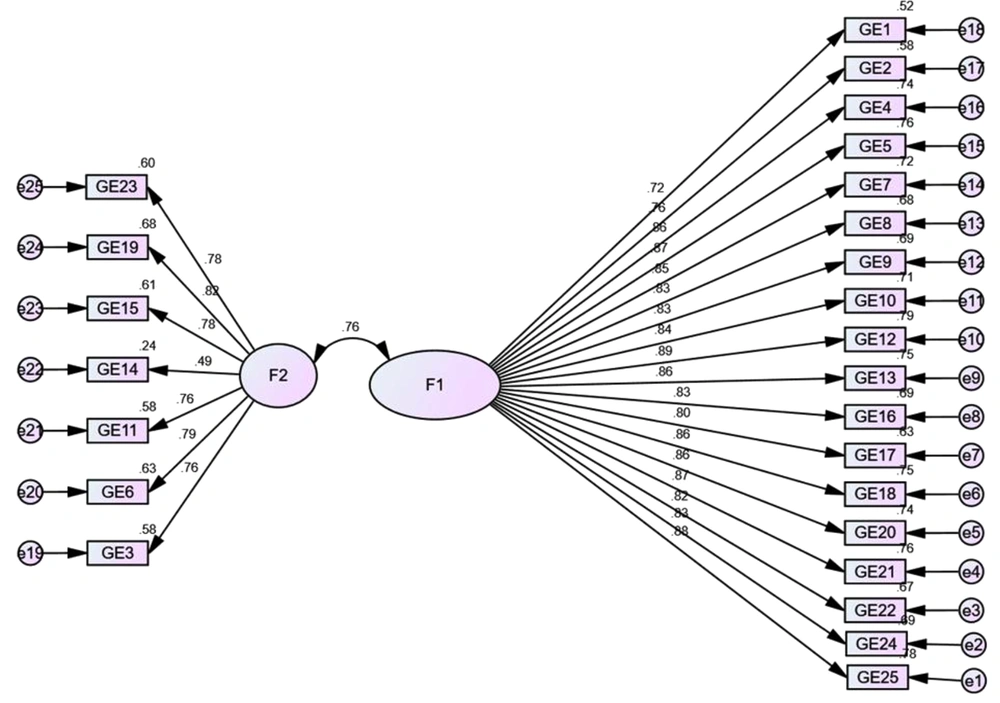
Figure 1.
The results of construct validity in first-order confirmatory factor analysis (Calculation method; maximum likelihood).
The factor load of all questions is above 5%. Also, there is a significant positive association between factors 1 and 2. The chi-square, P-value, χ2/df, NFI, CFI, IFI, TLI, RFI, GFI, and RMSEA were used to assess the pattern fit of the first-order structural equation. The results of the goodness of fit are presented in Table 2.
Table 2.The Results of Goodness of Fit for the First Order Structural Equation
| Index | Values |
|---|---|
| χ2 | 1505.825 |
| P | 0.000 |
| χ2/df | 4/591 |
| NFI | 0.912 |
| CFI | 0.930 |
| IFI | 0.930 |
| RFI | 0.904 |
| TLI | 0.923 |
| GFI | 0.820 |
| AGFI | 0.787 |
| RMR | 0.249 |
| RMSEA | 0.079 |
| PRATIO | 0.917 |
These results showed that the questionnaire has an adequate model fit, and the total structure of the relationship was confirmed.
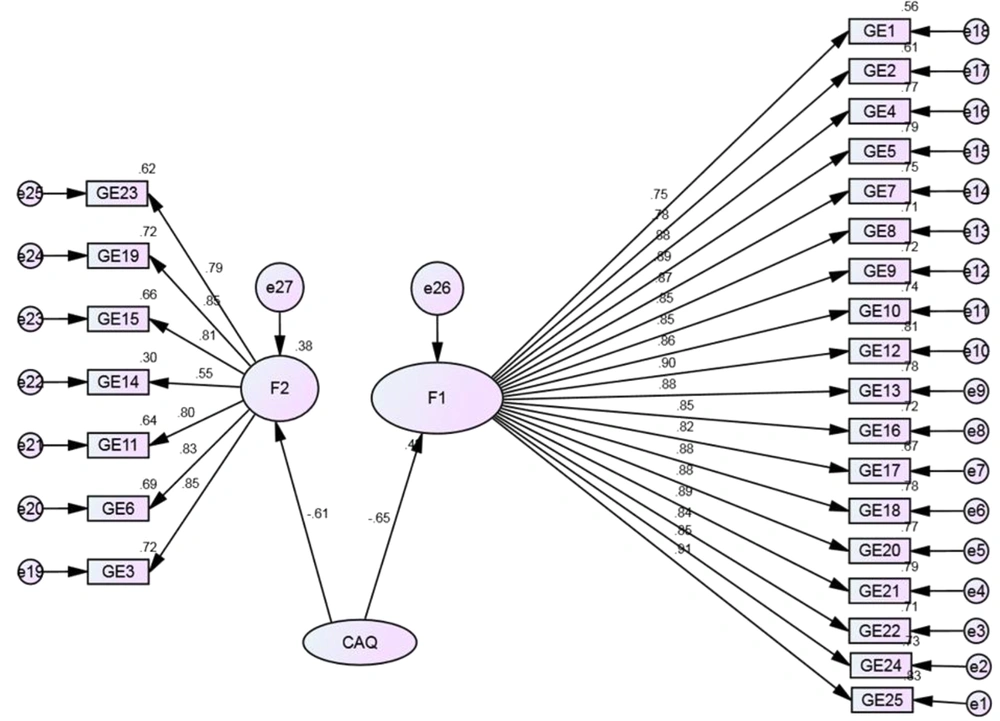
Figure 2.
The results of construct validity in second-order confirmatory factor analysis (Calculation method; maximum likelihood).
The results of construct validity in second-order confirmatory factor analysis are presented in Figure 2. Second-order factor analysis showed that both factors have a significant and strong relationship with total score of the questionnaire. Factor 1 (factor loading = 0.65) and factor 2 (factor loading = 0.61) have a high and acceptable correlation with total score that shows high construct validity of the questionnaire. The results of goodness of fit for the second order structural equation are showed in Table 3.
Table 3.The Results of Goodness of Fit for the Second Order Structural Equation
| Index | Values |
|---|---|
| χ2 | 1505.825 |
| P | 0.000 |
| χ2/df | 5/476 |
| NFI | 0.895 |
| CFI | 0.912 |
| IFI | 0.912 |
| RFI | 0.885 |
| TLI | 0.904 |
| GFI | 0.820 |
| AGFI | 0.787 |
| RMR | 0.249 |
| RMSEA | 0.088 |
| PRATIO | 0.917 |
The results showed that the questionnaire has an adequate model fit. Confirmatory factor analysis showed that factor 1 (r = 0.98) and factor 2 (r = 0.83) have a significant association with the total score. Also, there was a positive significant association between factors 1 and 2. There was a significant correlation among coefficients of the items and total score in all items. Hence, no item was deleted.
Second-order factor analysis showed that both factors have a significant and strong association with the total score of the questionnaire. Factor 1 (factor loading = 0.65) and factor 2 (factor loading = 0.61) have a high and acceptable correlation with the total score, which indicates high construct validity of the questionnaire. Factor 1 has a significant and strong association with items number 1, 2, 4, 5, 7, 8, 9, 10, 12, 13, 16, 17, 18, 20, 21, 22, 24, and 25. Factor 2 has a significant and strong association with items number 3, 6, 11, 14, 15, 19, and 23 (Table 4).
Table 4.Factor Loading of 25 Items of GEQ
| Item Number | Item | Factor 1 | Factor 2 |
|---|---|---|---|
| 1 | I focus on the negative issues because I want to be emotionally prepared if something terrible happens | 0.75 | |
| 2 | I tend to expect the worst results so as not to be emotionally surprised | 0.78 | |
| 3 | I become upset with emotional changes | 0.85 | |
| 4 | I prefer to feel bad now because I will not experience severe affective and emotional fluctuations when a terrible thing happens | 0.88 | |
| 5 | Because bad things happen at any time it is easier to already have depressed mood | 0.89 | |
| 6 | I become so upset with intense changes in negative emotions | 0.83 | |
| 7 | I prefer to have a pessimistic view, so I would be pleasantly surprised if something good happens | 0.87 | |
| 8 | I except failure because I do not want to expect something that may not happen | 0.85 | |
| 9 | If I find out that I am happy, I immediately remind myself of all the bad things that can happen | 0.85 | |
| 10 | I am never very hopeful, so I am not hopeless | 0.86 | |
| 11 | When I suddenly feel bad, I get confused | 0.80 | |
| 12 | I prefer to feel bad now so that I do not have to lose my happiness later | 0.90 | |
| 13 | When I already have a bad mood, it will be easier to bear unpleasant news | 0.88 | |
| 14 | I do not want that external events control the ups and downs of my life | 0.55 | |
| 15 | When my emotions fluctuate, I feel that I cannot control myself | 0.81 | |
| 16 | When I feel calm, I focus on negative issues as a method to avoid sudden changes in my mood if something bad happens | 0.85 | |
| 17 | I do not expect anything good to happen, so everything will be as pleasant as unexpected situation | 0.82 | |
| 18 | I maintain a negative mood because it makes coping easier when something bad happens | 0.88 | |
| 19 | Emotional fluctuations upset me | 0.85 | |
| 20 | I focus on negative issues because at least I know there are not many things that make me worse | 0.88 | |
| 21 | I prefer to be sad rather than I experience emotional ups and downs throughout my life | 0.89 | |
| 22 | Allowing myself to be happy, finally makes me feel terrified | 0.84 | |
| 23 | Intense emotional fluctuations are especially unpleasant for me | 0.79 | |
| 24 | I try to focus on negative issues that could have happened because it prevents me from being emotionally vulnerable | 0.85 | |
| 25 | Sometimes I prefer to feel bad rather than waiting for what happens | 0.91 |
Cronbach’s alpha coefficient in total scale, factor 1, and factor 2 is 0.973, 0.975, and 0.983, respectively; therefore, the internal consistency of GEQ is desirable. The test-retest method was used to assess the reliability of GEQ. Test-retest scores in total scale, factor 1, and factor 2 are 0.986, 0.981, and 0.963, respectively; therefore, the GEQ has the desirable reliability. Fifty students were re-evaluated 2 weeks later to investigate the reliability of the test.
The PSWQ and GAD-7 were used to assess convergent validity. There is a positive and significant correlation between the total scores of GEQ and the scores of PSWQ (r = 0.804) and GAD-7 (r = 0.727), which indicates the good convergent validity of the GEQ. Also, GEQ showed good discriminative validity. There was a significant difference between the scores of students and patients with GAD in total score, factor 1, and factor 2. Patients with GAD had higher scores than students (P < 0.05). The difference between the scores of students and patients with GAD is represented in Table 5.
Table 5.The Results of Difference Between the Scores of Students and Patients with GAD
| Variables | Number | Mean | SD | Sig |
|---|---|---|---|---|
| Total score | 0.000 | |||
| Students | 50 | 35.50 | 20.73 | |
| GAD | 50 | 89.30 | 23.83 | |
| Factor 1 | 0.000 | |||
| Students | 50 | 35.04 | 15.75 | |
| GAD | 50 | 64.06 | 19.54 | |
| Factor 2 | 0.000 | |||
| Students | 50 | 18.46 | 7.63 | |
| GAD | 50 | 25.24 | 5.14 |
5. Discussion
The aim of this study was to determine the psychometric properties of GEQ in students and patients with GAD in Iran. The Persian version of GEQ showed good validity and reliability. Twenty-five items of GEQ remained The GEQ in which the best model includes two conceptually basic factorswith two original factors. The first factor (i.e., create and maintain negative emotions to avoid negative contradictions) compounded the second and third principles of CAM, i.e., negative emotions to eschew negative contradictions and preference to activate positive contrasts. The second factor (i.e., upset with emotional changes) covered the first principle of CAM, which was focused on the perceived threat of emotional changes (16). Furthermore, Factor 1 and factor 2 showed a high and acceptable correlation with the total score, which shows the high construct validity of the questionnaire. Factor 1 has a significant and strong association with items number 1, 2, 4, 5, 7, 8, 9, 10, 12, 13, 16, 17, 18, 20, 21, 22, 24, and 25. Factor 2 has a significant and strong association with items number 3, 6, 11, 14, 15, 19, and 23, which are consistent with previous studies (16, 17). Hence, GEQ is confirmed in the Iranian population.
Also, GEQ showed good construct validity and test-retest reliability, which is consistent with previous research (16) and expand the literature by indicating the subscales taken from factor analytic inquiry also showing reliability over time and construct validity for the subscales. Together, this line of evidence strongly supports the two-factor basic structure of the GEQ (17). The GAD group had a significantly higher score on each scale and GEQ subscale than the group without anxiety, which supports the construct validity of GEQ. This indicates that a person with GAD is likely to score higher than individuals without anxiety in the GEQ. These results are consistent with the study by Llera and Newman (16) who reported that people with clinical levels of GAD symptoms are more likely, than those without anxiety, to confirm the following points: (1) they have considerable upset with negative emotional shifts; (2) prefer to feel unpleasant; and (3) they prefer to anticipate the worst and be happy surprisingly rather than hope for the best (preference for a positive shift). Also, the GEQ scale and all subscale scores had a more positive and stronger correlation with convergent instruments such as GAD-7 (r = 0.727) and PSWQ (r = 0.804) (16), which is in line with the study by Llera and Newman (11), who reported an association between GEQ and GAD. They also reported that GEQ could differentiate people with GAD from those without anxiety and had good validity and reliability.
This supports the CAM’s motion that avoidance of change is an emotion regulation style characterized by clinical levels of GAD, both in terms of total emotional functioning and the use of worrying. The GEQ and its subscales also demonstrated sufficient test-retest reliability. Generally, this study demonstrated that GEQ and its related subscales showed reproducibility in one sample over time (17). In sum, to expand our understanding of maladaptive efforts with respect to overall emotional coping, CAM examination in diagnostic categories will be beneficial. The study of CAM in terms of similarities and differences in various disorders will be useful. Also, it will be useful to survey CAM with comorbid GAD group and those with other primary diagnoses to explore if these results are exclusive to GAD or may be present transdiagnostically. The use of GEQ is useful for researchers and clinicians to better comprehend the emotional factors that create GAD symptoms. In addition, longitudinal studies on various age groups suggest us the path of development of change avoidance tendencies. Also, studying the avoidance of change in early life considering temperament, parenting, and environmental influences is another important issue in this area. This can provide a more integrated framework for comprehending the incidence and maintenance of GAD.
Such studies can be promising to regulate a wide theory of psychopathology underlying emotional disorder. Another research deficiency in this field is to validate the model by creating treatment protocols regarding improving the elements of CAM. Studying the modulators, mediators, predictors, and mechanisms of the shift in the CAM should be focused in future works. Ultimately, the studying of psychometric properties of CAQ-Worry should be performed in the next works.
This study suffers from some limitations, including the majority of samples were composed of students of the Tehran universities; therefore, it will be difficult to generalize the results to other cities and populations. Next, such research should consider various demographic characteristics in other cities and universities as well as abnormal groups. In addition, the validity of the GEQ should be assessed using both structured and unstructured interviews. Furthermore, the study sample was restricted to those aged 18 to 50 years old. Thus, replication in samples representing a wider range of age groups and other groups in Iran is warranted. Further, this study did not intend to evaluate the divergent validity. Despite limitations, our results are novel, theory-consistent, and provide a basis for further investigation of the CAM of GAD symptoms in the Iranian population.
5.1. Conclusion
This study demonstrated the desirable validity and reliability of the GEQ and provided primary evidence about the use of the Persian version of the GEQ in the Iranian population. Although, more studies are warranted to investigate the psychometric properties of the Persian of GEQ in clinical positions.
In summary, the Persian version of GEQ has adequate reliability and validity to assess behaviors and emotions related to anxiety. These findings are complementary to the results of research on GEQ across the world. This questionnaire can improve our ability to better understand the CAM in different areas: (1) in terms of general emotional tendencies; and (2) in GAD and in other clinical populations. So GEQ can be used in research, assessment, and diagnosis.


