
1. Background
Autism spectrum disorder (ASD) is a neurodevelopmental condition characterized by challenges in social communication and interaction, along with repetitive behaviors and restricted interests. The prevalence of ASD is concerning, with estimates indicating 1 in 36 births in the United States (1) and 26.6 per 10,000 individuals in Iran (2). A prominent feature of children with ASD is difficulty in emotion regulation, which negatively impacts their behavioral, social, and emotional functioning (3).
The theoretical framework of emotion regulation, proposed by Gross (4), categorizes strategies into antecedent-focused and response-focused approaches, highlighting their synergistic interaction in managing emotional responses to maintain emotional homeostasis. Emotion regulation is influenced by various cognitive processes, which are closely linked with neural networks, primarily within the prefrontal cortex and amygdala (5). This intricate interplay emphasizes the need to investigate the neurobiological mechanisms underlying emotion regulation, especially in children, as emotional responses significantly affect social competence and peer relationships (6).
While much of the existing literature has focused on early childhood development — when foundational emotion regulation skills are formed — there is a noticeable lack of research addressing later stages of childhood (7). Studies examining the relationship between cognitive functions and emotion regulation remain limited (8), and critiques have pointed to the absence of comprehensive frameworks for understanding these complex interactions (9). Although various emotion regulation strategies have been explored in adult populations, late childhood — when such skills continue to develop — has been largely overlooked.
The use of emerging technologies such as robots, virtual reality, digital tools, and gaming platforms has garnered increasing attention in the study and intervention of childhood disorders (7, 10). Several computer-based programs have been developed in recent years to teach emotion regulation strategies, including those focused on anger management (11). Combining educational methods for anger control with therapeutic interventions has been shown to more effectively reduce physiological responses to anger in children, compared to conventional approaches (12).
Advancements in technology have sparked growing interest in using computer-based cognitive training to enhance emotional regulation in children with ASD. Preliminary evidence suggests that such interventions may leverage the principles of neuroplasticity to support cognitive development and emotional well-being (13). For example, engagement in targeted cognitive exercises can promote synaptic changes that enhance functional outcomes. However, the evidence regarding the efficacy of these interventions remains mixed. A study by Tajik et al. (14) found no significant improvement in advanced theory of mind among children aged 6 to 11 years, highlighting a gap in understanding the age-specific effectiveness of such programs.
This study seeks to address this gap by focusing on children aged 7 to 10 years, examining the effects of computer-based cognitive training on emotion regulation and related cognitive functions. Using a modified training program that incorporates new variables and personalized feedback, the research aims to clarify the relationship between emotion regulation strategies and cognitive development in this age group. The novelty of the study lies in its targeted demographic and the use of comprehensive cognitive assessment tools to monitor both emotional and social development holistically.
Ultimately, this research aims to enhance understanding of how cognitive training can be effectively tailored to meet the emotional regulation needs of children with ASD, thereby supporting improved social functioning and overall well-being. Filling this gap is essential for developing optimized educational and therapeutic strategies for children with ASD, promoting a more supportive framework for their emotional and cognitive growth.
2. Objectives
Given that the underlying neurocognitive factors associated with ASD present significant challenges for emotional regulation — and considering the high prevalence of ASD among children — cognitive deficits appear to play a key role in these difficulties. The present study aims to investigate the effectiveness of a computer-based cognitive training program in enhancing emotional regulation among children with high-functioning ASD.
3. Methods
In this quasi-experimental study, a pretest-posttest design with a control group and a two-month follow-up was employed. The target population included all children aged 7 to 10 years diagnosed with ASD in Tehran during the academic year 2023–2024, who were referred to the Autism Center. From this population, 50 children were selected using convenience sampling after being evaluated using the Autism Spectrum Screening Questionnaire (ASSQ). To determine the minimum sample size required for the study, previous research (15) was consulted, considering financial and time constraints. A power analysis indicated that a sample size of 50 participants (25 in each experimental and control group) was necessary to achieve 80% power and a significance level of 0.05, while accounting for a 10% dropout rate.
After scoring the questionnaire, 50 boys with high-functioning autism were selected based on inclusion criteria (child’s eagerness to engage in computer games, a score of 19 or higher on the parent version of the ASSQ, age range of 7 to 10 years, and no physical disabilities or sensory impairments), and exclusion criteria (no participation in cognitive rehabilitation programs in the recent six months). Participants were matched according to age and subsequently assigned to either the experimental group or the control group (25 participants in each group).
Data collection involved the ASSQ and the Shields and Cicchetti Emotion Regulation Checklist. The experimental group participated in 20 individual sessions of a computer-based cognitive training program, while the control group only received mainstream services at the center, such as occupational therapy and speech therapy, in addition to playing an active game called “Brain Boost.” The Brain Boost included tasks such as shape matching, puzzles, and memory exercises. These activities were selected to provide cognitive engagement without explicitly targeting emotion regulation or social skills, ensuring an active control condition. However, the specific cognitive demands and difficulty levels of these tasks were not formally matched to those of the intervention, which may represent a limitation. Both groups were assessed before and after the intervention sessions and again two months following the last session using the Shields and Cicchetti Emotion Regulation Checklist.
Data analysis was conducted using the non-parametric regression modeling method [generalized estimating equations (GEE)] through SPSS version 27. This analytical approach facilitated the evaluation of the effectiveness of the computer-based cognitive training program on the emotional regulation of children with high-functioning autism while controlling for various covariates and ensuring the robustness of the findings.
3.1. Measurement Tools
3.1.1. Autism Spectrum Screening Questionnaire
The questionnaire developed by Ehlers and Gilberg in 1999 consists of 27 items that parents or teachers complete to assess multiple domains related to communication disorders, social interactions, restricted and stereotypical interests, motor clumsiness, and the presence of vocal and motor tics. The estimated time for completion is approximately 10 minutes. Responses are scored using a three-point Likert scale (0, 1, 2), reflecting "no," "somewhat," and "yes," with a maximum possible score of 54. A score of 19 or higher on the parent form indicates a diagnosis of high-functioning autism (16).
The questionnaire has been translated and validated in Persian (17). Reliability analyses revealed Cronbach's alpha coefficients of 0.77 (parents of typically developing children), 0.68 (parents of children with autism), 0.81 (teachers of typically developing children), and 0.70 (teachers of children with autism). Test-retest reliability scores were 0.467 for parents and 0.614 for teachers. Furthermore, convergent validity was supported through significant correlations with the Rutter Child Behavior Questionnaire (parent form: r = 0.715; teacher form: r = 0.495) and the Child Symptom Inventory (CSI-4) (parent form: r = 0.486; teacher form: r = 0.411), underscoring the questionnaire's efficacy in screening for high-functioning autism (18). For this study, we utilized the parent form of the questionnaire.
3.1.2. Emotion Regulation Checklist (ERC)
The checklist created by Shields and Cicchetti in 1997 aims to assess emotional regulation in children aged 5 to 12 years. Comprising 24 items, it evaluates emotional processes and regulation in children aged 7 to 11 years using a four-point Likert scale (1 = "never" to 4 = "always"). The checklist is divided into two components: Adaptive emotional regulation and emotional lability/negativity. The adaptive emotional regulation component consists of eight items measuring contextually appropriate emotional expressions, empathy, and emotional self-awareness, with higher scores indicating better emotional modulation and management. Conversely, the emotional lability/negativity component includes 16 items assessing flexibility, dysregulation, negative affect, and mood variability, with lower scores reflecting improved emotional lability.
A study evaluating the psychometric properties of the checklist reported a Cronbach’s alpha of 0.79 for adaptive emotional regulation and 0.90 for emotional lability/negativity (19). The Persian version's validity and reliability have also been affirmed (20), revealing a Cronbach’s alpha of 0.46 for children with learning disorders and 0.74 for typically developing children, indicating moderate to good internal consistency. Additionally, reliability coefficients were calculated as 0.75 for adaptive emotional regulation and 0.82 for emotional lability/negativity in the Persian version (20).
3.1.3. Computer-Based Cognitive Training Program (CBCTP)
This cognitive training program, developed by the Shepherd Company, is grounded in the Vienna Testing System and has its content validity endorsed by the Austrian Neurological Society. Its aim is to enhance cognitive functions through adaptive gaming exercises tailored to individual abilities (5). As participants' performance improves, the game's speed increases, facilitating a gradual transition from simpler to more complex tasks. Feedback is provided after each session, allowing for continual adjustment based on the child's cognitive level (5).
The program is delivered via computer and comprises several game categories:
1- Attention-based games: Targeting various aspects of attention, including alertness, divided attention, and visual/auditory focused and selective attention.
2- Memory-based games: Concentrating on updating visual working memory.
3- Executive function games: Assessing response inhibition, planning, and task completion.
4- Coordination games: Enhancing visual-motor coordination.
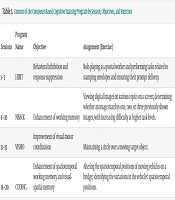
Participants engaged in the cognitive training program for 20 sessions, meeting twice a week for 30 minutes each session. The session content, detailing objectives and exercises, is presented in Table 1.
Table 1.
Content of the Computer-Based Cognitive Training Program by Session, Objectives, and Exercises
| Sessions | Program Name | Objective | Assignment (Exercise) |
|---|---|---|---|
| 1 - 5 | HIBIT | Behavioral inhibition and response suppression | Role-playing as a postal worker and performing tasks related to stamping envelopes and ensuring their prompt delivery. |
| 6 - 10 | NBACK | Enhancement of working memory | Viewing digital images on various topics on a screen; determining whether an image matches one, two, or three previously shown images, with increasing difficulty at higher task levels. |
| 11 - 15 | VISMO | Improvement of visual-motor coordination | Maintaining a circle over a moving target object. |
| 16 - 20 | CODING | Enhancement of spatiotemporal working memory and visual-spatial memory | Altering the spatiotemporal positions of moving vehicles on a bridge; identifying the variations in the vehicles' spatiotemporal positions. |
3.2. Study Procedure
Following the approval of the ethical code, a rehabilitation center in Tehran was selected using a convenience sampling method. The research objectives were explained to the administrators during a visit to the center. Individual sessions were conducted with parents, resulting in 50 volunteer parents of children diagnosed with high-functioning autism who completed a written consent form for their child's participation and responded to the autism screening questionnaire. A psychologist at the center scored the questionnaire, allowing for the selection of children based on specific inclusion criteria: Interest in computer games, age between 7 and 10 years, a score of 19 or higher on the ASSQ, absence of motor or intellectual disabilities, sensory impairments (vision and hearing), and no participation in similar cognitive training programs within the past six months.
The selected children were matched by age and randomly assigned to either the experimental group or the control group. Parents were asked to complete the Emotion Regulation Checklist (ERC). The experimental group participated in 20 individual sessions of a computer-based cognitive training program, each lasting 30 minutes, twice weekly. The control group received standard services at the center (occupational and speech therapy) along with mobile games. After the final session and two months later, all participants were reevaluated using the ERC. The researcher administered the questionnaires and computer-based training, while a psychologist, unaware of group assignments, scored the questionnaires.
3.3. Statistical Analysis
The research data were analyzed using correlation analysis, regression analysis, and GEE in SPSS version 27.
4. Results
Descriptive statistics for the age variable, categorized into experimental and control groups, are presented in Table 2.
Table 2.
Descriptive Statistics of Demographic Characteristics of Participants a
| Age (y) | Experimental Group | Control Group | P-Value |
|---|---|---|---|
| 7 - 8 | 5 (20) | 5 (20) | |
| 8 - 9 | 11 (44) | 12 (48) | |
| 9 - 10 | 9 (36) | 8 (32) | |
| Total | 25 (50) | 25 (50) | 0.375 |
a Values are expressed as No. (%).
To examine the age equivalence between the two groups, the c hi-square test was utilized, with the results presented in Table 2. As shown, the highest number of participants in the experimental group falls within the age range of 8 to 9 years (44%). The highest number of participants in the control group also falls within the age range of 8 to 9 years (48%). Given the significance level of the chi-square statistic (P = 0.375), it can be concluded that the age difference between the experimental and control groups is not statistically significant, indicating that both groups are equivalently matched in terms of age.
The mean and standard deviation of the emotion regulation variable for participants in both the experimental and control groups are presented in Table 3.
Table 3.
Mean and Standard Deviation of Emotion Regulation Components at Pre-test, Post-test, and Follow-up in Experimental and Control Groups a
| Emotion Regulation b | Pre-test | Post-test | Follow-up |
|---|---|---|---|
| AER | |||
| Experimental | 15.88 ± 2.54 | 12.88 ± 3.64 | 14.76 ± 2.49 |
| Control | 14.60 ± 3.16 | 15.24 ± 3.21 | 15.52 ± 3.68 |
| EL/N | |||
| Experimental | 48.35 ± 6.83 | 46.60 ± 7.29 | 40.48 ± 7.38 |
| Control | 41.60 ± 6.70 | 41.56 ± 6.35 | 40.56 ± 5.61 |
| OER | |||
| Experimental | 59.44 ± 5.98 | 55.12 ± 8.07 | 48.35 ± 6.83 |
| Control | 56.20 ± 4.51 | 56.84 ± 4.30 | 56.40 ± 5.61 |
Abbreviations: AER, adaptive emotion regulation; EL/N, emotional lability/negativity; OER, overall emotion regulation.
a Values are expressed as mean ± SD.
b Higer scores in adaptive ER (AER) indicate better emotion regulation ability. Lower scores in EL/N and OER signify improved regulation, consistent with prior literature.
Table 3 displays the mean scores and standard deviations for the emotion regulation components across the pre-test, post-test, and follow-up assessments in both the experimental and control groups. To improve interpretability and align with standard emotion regulation terminology, the scores for the "Adaptive ER" component were reverse-coded so that higher scores reflect better emotion regulation capability.
As shown in the table, the mean adaptive ER (AER) score increased in the experimental group from pre-test to follow-up, indicating improvements in adaptive emotion regulation following the intervention. Simultaneously, reductions in EL/N and overall emotion regulation (OER) scores across both groups indicate improvements in emotional regulation stability, possibly due to placebo effects, maturation, or other contextual factors.
To test the research hypotheses, which posit that the computer-based cognitive training program improves emotion regulation in children aged 7 to 10 with autism spectrum disorder, a nonparametric modeling approach (GEE) was employed. This regression model allows for the analysis of data over time. Initially, the Kolmogorov–Smirnov test and the Shapiro–Wilk test were conducted to assess the normality of the data distribution, with the results presented in Table 4.
Table 4.
Results of the Kolmogorov-Smirnov and Shapiro-Wilk Tests for Assessing the Normality of Data Distribution
| Variables | K-S | df | P-Value | Shapiro-Wilk | df | P-Value |
|---|---|---|---|---|---|---|
| AER | 0.079 | 150 | 0.023 | 0.984 | 150 | 0.098 |
| ES/N | 0.084 | 150 | 0.011 | 0.975 | 150 | 0.008 |
| OER | 0.098 | 150 | <0.001 | 0.980 | 150 | 0.029 |
Abbreviations: K-S, Kolmogorov-Smirnov; df, degree of freedom; AER, adaptive emotion regulation; EL/N, emotional lability/negativity; OER, overall emotion regulation.
Based on the results presented in Table 4 and following the normality tests, it was determined that the variables do not follow a normal distribution and that outliers are present. Specifically, the distribution of the data is not bell-shaped, with a significance level less than 0.05. Therefore, the GEE method was employed.
To test the research hypothesis that "the computer-based cognitive training program improves emotion regulation in children aged 7 to 10 with autism spectrum disorder," the GEE modeling approach was used.
Based on the results presented in Table 5, it can be concluded that the trend of changes in overall emotion regulation over time in the experimental group showed a significant decrease of 4.20 units compared to the control group (P < 0.001). Therefore, the research hypothesis is confirmed. In fact, the effectiveness of the cognitive training program on improving emotion regulation in the experimental group was sustained even after the two-month follow-up.
Table 5.
Results of the Generalized Estimating Equations Model to Determine the Effectiveness of Cognitive Training on Overall Emotion Regulation
| Interaction Effect (Group × Time) | Beta Coefficient | df | Z | 95% CI | P-Value | |
|---|---|---|---|---|---|---|
| Lower Limit | Upper Limit | |||||
| Values | -4.020 | 1 | -22.346 | -5.687 | -2.353 | < 0.001 |
Abbreviations: df, degree of freedom; CI, confidence interval.
To address the research question regarding whether the cognitive training program improves the adaptive emotion regulation and emotional lability/negativity in children aged 7 to 10 with autism spectrum disorder, Generalized Estimating Equations were were utilized.
Based on the results presented in Table 6, it can be concluded that the trend of changes in the adaptive emotion regulation component over time did not show a significant improvement in the experimental group compared to the control group (P = 0.59). Therefore, it can be inferred that the cognitive training program did not improve adaptive emotion regulation in children aged 7 to 10 with autism spectrum disorder.
Table 6.
The Results from the Generalized Estimating Equations Model Aimed at Determining the Effectiveness of Cognitive Training on the Adaptive Emotion Regulation Component
| Variables | Interaction Effect (Group × Time) | Beta Coefficient | df | Z | 95% CI | P-Value | |
|---|---|---|---|---|---|---|---|
| Lower Limit | Upper Limit | ||||||
| AER | 1.040 | 1 | 3.559 | 0.041 | 2.121 | 0.59 | |
| E L/N | -5.040 | 1 | 24.656 | -3.051 | -7.029 | < 0.001 | |
Abbreviations: df, degree of freedom; CI, confidence interval; AER, adaptive emotion regulation; EL/N, emotional lability/negativity.
Furthermore, it is concluded that the trend of changes in the emotional lability/negativity component showed a significant decrease of 5.40 units over time in the experimental group compared to the control group (P < 0.001). Thus, it can be concluded that the cognitive training program improved emotional lability/negativity in children aged 7 to 10 with autism spectrum disorder.
5. Discussion
Understanding the neurocognitive factors associated with ASD is crucial, as these factors significantly influence emotion regulation processes. Given the high prevalence of ASD among children and the cognitive deficits frequently observed in this population, these deficits may exacerbate difficulties in regulating emotions. Therefore, the primary objective of the present study was to evaluate the effect of a computer-based cognitive training program on enhancing emotion regulation in children with high-functioning ASD. This investigation aimed to provide insight into potential interventions that could support emotional development and improve overall functioning in this demographic.
Initial findings indicate that the cognitive training program significantly improved overall emotion regulation scores in children aged 7 to 10 years with ASD. These results are consistent with previous studies (21, 22). For instance, one study (23) demonstrated that interaction and engagement in computer game environments enhance working memory — a cognitive resource critical for meaningful learning. Furthermore, the direct training and in-game guidance provided in cognitive training programs may effectively compensate for the lack of learner-centered instruction, helping children complete tasks and manage problem-solving scenarios through gameplay. Participants not only accessed new mental constructs and acquired advanced skills but also employed more positive emotion regulation strategies during these interactive activities. Therefore, it is plausible that engaging with educational computer games promotes mindfulness, subsequently enhancing emotional regulation in children.
One potential mechanism underlying the observed improvement in emotional states is the increased focus on the eye region required by exercises involving facial recognition on the computer. Previous research has found that children with ASD tend to avoid eye contact, which impairs emotional recognition. Future research incorporating eye-tracking tools is recommended to determine whether increased attention to facial cues — especially the eyes — mediates these improvements. Additionally, mediation analyses could help determine whether attention to facial features or neurophysiological changes underlie the behavioral gains observed. For instance, neurophysiological data could help determine whether neuroplastic adaptations support the behavioral improvements seen in emotion regulation.
Eye-tracking studies (24) have demonstrated that children with autism display distinct visual fixation patterns compared to neurotypical peers when viewing faces. Specifically, they tend to focus more on the mouth region rather than the eyes, limiting their ability to extract emotional information critical for recognizing others' emotional states — potentially contributing to emotion regulation difficulties. In the current study, games such as VISMO likely promoted visual tracking and eye contact by requiring participants to follow the movements of a spacecraft, simulating a telescope-like mechanism. Similarly, the NBACK task strengthened working memory by prompting responses based on previously shown images, and the CODING game emphasized spatial and temporal working memory to adjust to changing visual stimuli. These tasks may explain the observed improvements in mindfulness and emotion regulation. However, to confirm these mechanisms, future studies should directly measure visual attention using eye-tracking data, which would help clarify the link between visual engagement and emotional outcomes.
The lack of significant improvement in adaptive emotion regulation strategies, such as problem-solving, may be due to the program’s emphasis on implicit learning rather than explicit instruction of adaptive strategies. Unlike previous studies (23) that reported positive effects from modules explicitly targeting mindfulness and reappraisal, our intervention did not include direct training in these techniques. Including psychoeducational components that teach adaptive emotion regulation strategies — such as cognitive reappraisal or acceptance — may enhance future program efficacy (25).
Notably, our results did indicate improvements in emotional lability/negativity, aligning with Shiri et al.’s findings (22), which showed that cognitive training can improve emotional recognition, particularly from facial expressions. Tasks requiring behavioral inhibition and response suppression — such as those in the HIBIT game — likely enhanced emotional control. Inadequate perception or evaluation of emotional information often results in emotional and cognitive disturbances (26), whereas effective regulation enables adaptive, problem-focused responses and minimizes reliance on maladaptive coping strategies (27). Our study similarly found that response inhibition exercises led to a measurable decrease in emotional lability/negativity in participants.
Overall, the acquisition of new cognitive skills through training appears to stimulate neural network changes (21). Since cognitive training programs are designed to target specific brain structures, they can modulate the activation and functionality of these regions. The brain is inherently responsive to environmental, educational, and psychological stimuli. Therefore, presenting children with progressive, cognitively challenging tasks can support improvements in emotion-related functions.
In this study, the control group engaged in an active game titled Brain Boost, which included shape matching, puzzles, and memory exercises. These activities were selected to ensure cognitive engagement without targeting emotion regulation directly, thereby making the control condition active rather than passive. However, we acknowledge that the cognitive demands of Brain Boost may not have been equivalent in complexity and cognitive load to those in the experimental intervention. Future research should explicitly describe the content and cognitive demands of control games to enhance reproducibility and aid interpretation of intervention effects. Furthermore, incorporating a placebo or sham cognitive training condition could control for expectancy effects and non-specific factors, thus improving internal validity (28).
It is important to recognize the limitations that constrain the generalizability of these findings. A major limitation is the study's exclusive focus on boys with high-functioning ASD, restricting the applicability of the results to girls and individuals across the broader autism spectrum. Although ASD is more prevalent in boys (29), emerging evidence indicates gender differences in symptom presentation and emotion regulation challenges. Future research should include girls and individuals with varying levels of ASD severity to improve external validity and provide a more comprehensive understanding of intervention effects across subgroups.
Additionally, the study employed a fixed 20-session intervention protocol. Evidence from neurocognitive training studies suggests a positive dose-response relationship, wherein longer or more intensive training yields stronger cognitive and emotional benefits (30). Future studies should examine different durations and intensities to determine the most effective intervention protocols.
Future research should incorporate such variations to optimize therapeutic effects and better tailor interventions to individual needs, especially given the heterogeneity within the autism spectrum. Lastly, the control condition, which involved “Brain Boost,” activity, may not have been perfectly matched for cognitive load with the intervention, potentially confounding the observed effects. Future studies should carefully specify the cognitive demands of control activities and consider including placebo controls to better isolate the specific impacts of the intervention. Finally, the recruitment of participants from a single rehabilitation center introduces potential selection bias, and the lack of blinding may have influenced perceptions of effectiveness. Addressing these limitations in future work — through broader sampling, improved control conditions, and rigorous methodological design — will be essential to maximizing the therapeutic potential of computer-based cognitive training for emotion regulation in children with ASD.
5.1. Conclusions
The findings of this study indicate that the computer-based cognitive training program significantly improved emotional lability/negativity, but did not produce significant changes in adaptive emotion regulation among children with ASD. Because such training programs are grounded in principles of re-educating cognitive functions through practice, adaptation, and implicit learning (31), they may enhance emotional functioning by engaging the brain’s information processing systems and reinforcing self-efficacy. The game-like nature of the intervention appears to increase children’s motivation and engagement with training tasks, which may contribute to these outcomes.
Since the training program is based on principles of neuroplasticity and brain self-repair, participating in these exercises can stimulate underactive brain areas, potentially leading to lasting synaptic changes that improve both cognitive and emotional functioning.
In summary, given that ASD is associated with profound challenges in social cognition and emotional engagement, it is vital for parents and educators to provide enriched environments and early intervention programs. Doing so may foster latent cognitive abilities and reduce the severity of emotion regulation difficulties from the early stages of diagnosis. These findings support the potential of computer-based cognitive training as a complementary tool in the broader therapeutic framework for supporting emotional development in children with ASD.