


1. Background
Victimization is a commonplace problem faced by imprisoned women. This phenomenon is largely due to power abuse and the tendency of prisoners to assert dominance over others, leading to unequal interpersonal relationships and the commission of aggressive acts against one another (1, 2). In prisons, inmates may experience victimization in the form of physical attacks, sexual assaults, or threats to their safety (3, 4). The rate of women’s victimization varies from 30% to 50% across different prisons, and they are more likely to fall victim to physical violence than women outside prison (5). Being victimized in jail can have more severe consequences for women who experienced physical, emotional, or sexual offenses in childhood (6). These women are likely to carry the emotional and mental traumas from childhood into adulthood (7).
As numerous researchers suggest, victimization among imprisoned women often originates from certain family interactions (8) during childhood and continues into adulthood (9). According to some studies, more than two-thirds of imprisoned women grew up in disorderly and dysfunctional family environments, experiencing parental addiction, poverty, loss of parents, sexual abuse, negligence, fear, and engagement in crime-like behaviors or criminal acts (10). It has also been reported that 60% of women in prison were exposed to violence prior to incarceration, and 99% experienced at least one harmful event in their lifetime (11). Misconduct during childhood is believed to increase the risk of victimization in adulthood two- to threefold (12). While global research provides extensive insight into women’s victimization in prisons, no independent and systematic study has been conducted in Iran or made publicly accessible. This gap limits understanding of the real extent of harm experienced by female inmates and obscures critical long-term consequences.
Adverse childhood experiences (ACEs) are highly prevalent among prisoners. A substantial body of evidence shows that incarcerated women with childhood traumas often feel incapable of controlling their lives in social interactions and daily activities due to low self-confidence (13, 14). They may struggle to defend themselves against physical risks or verbal aggression (15). These individuals commonly exhibit negative self-cognition and face a range of problems, including depression, anxiety, and post-traumatic stress disorder (2, 16). In fact, most of them grapple with significant mental health challenges (17).
Incarcerated women (68%) are more likely than men (41%) to report a diagnosed mental disorder (18), often resulting from early-life abuse and harmful experiences. Approximately 80% of imprisoned women are diagnosed with one or more psychotherapeutic problems, including depression (14.1%), post-traumatic stress disorder (1.21%), and drug abuse (30 - 60%). Additionally, the rate of self-harm among these women is 30%, and their suicide mortality is 20 times higher than that of women in the general population (19). Mental disorders occur at a higher incidence among incarcerated women (20), and the presence of such disorders substantially increases the risk of victimization, creating a vicious cycle (7, 21).
Despite extensive global research on women’s victimization in prisons, comparable studies in Iran remain scarce. Few investigations have systematically examined the prevalence, forms, or consequences of victimization among Iranian female prisoners. Given Iran’s distinct socio-cultural context — including its legal frameworks, gender norms, and support systems—these experiences are likely to differ significantly from those documented internationally, highlighting a critical knowledge gap. The study’s innovation lies in localizing international models, providing the first quantitative evidence among Iranian female prisoners, and offering a foundation for evidence-based, trauma-informed interventions tailored to women’s harms.
2. Objectives
The specific objectives of this study were: (1) To describe the characteristics of victimization experiences among incarcerated women in Iran, with particular attention to those who reported childhood trauma; (2) to investigate the association between childhood trauma and current mental health outcomes in this population; (3) to examine the role of childhood traumas and mental health in the victimization of incarcerated women.
3. Methods
This study employed a quantitative survey design using structured data collection and statistical analyses to describe the demographic characteristics of the research population, examine relationships among variables, and test the study hypotheses. A purposive, non-probability sampling strategy was adopted, guided by two predefined inclusion criteria: (1) Female inmates with a documented or self-reported history of childhood abuse, and (2) at least one year of continuous incarceration. Sampling initially commenced at Yazd Central Prison. However, due to the limited number of eligible participants, the sampling frame was extended to include Adel-Abad Prison in Shiraz to achieve an adequate sample size and improve the representativeness of the sample. The final sample consisted of 106 participants, which met the recommended minimum sample size for structural equation modeling (SEM) according to guidelines suggesting at least 100 - 200 participants for stable parameter estimates. Eligible inmates were approached by trained interviewers, provided with information about the study, and invited to participate voluntarily. A total of 106 women aged 18 - 60 years consented and completed the survey across the two sites. Data were collected between July and November 2023 using standardized self-administered instruments. Trained interviewers were present to clarify questions when needed, and confidentiality safeguards were implemented throughout the process to reduce reporting bias and protect participants’ privacy.
Childhood trauma was measured using a 13-item combined questionnaire adapted from the short form of the Childhood Trauma Questionnaire (CTQ-SF) (22) and the Adverse Childhood Experiences (ACE) Questionnaire (1998) (23). It comprised five 5-point Likert items (one per CTQ-SF subscale) and eight ACE-derived items (three 5-point Likert, five dichotomous). Both instruments have established validity and reliability in Iranian populations (α > 0.70) (24). Internal consistency of the eight Likert items in the present sample was α = 0.80. A composite childhood trauma score was created by z-standardizing and summing the CTQ-based total (range 5 - 25) and the ACE total score (range 0 - 10) for use in subsequent analyses.
Victimization during incarceration was assessed using the 8-item victimization subscale of the revised Olweus Bullying/Victimization Questionnaire (OVS) (25). This subscale measures the frequency of various forms of bullying and victimization experienced in the past few months, rated on a 5-point scale (0 = never to 4 = several times a week). The full scale has demonstrated good reliability and validity in previous studies, including Japanese and Iranian samples (26, 27). In the present sample, exploratory factor analysis (principal axis factoring) confirmed a single-factor structure, with an eigenvalue of 4.91 explaining 61.34% of the variance and all factor loadings ranging from 0.65 to 0.85. Internal consistency was high (Cronbach’s α = 0.80). To ensure appropriateness for adult female prisoners, three clinical psychologists independently reviewed the items for face and content validity; minor wording adjustments were made only to enhance clarity and contextual relevance without altering item meaning. Final scores were computed as the mean of the eight items (range 0 - 4), with higher scores indicating greater victimization.
Mental health was assessed using the General Health Questionnaire (GHQ-28), which includes 28 items organized into four subscales: Somatic symptoms, anxiety and sleep disturbance, social dysfunction, and depressive symptoms (28). Each subscale contains seven questions scored from 1 to 5. The reliability of the questionnaire in Iran was reported as 0.8 for a sample of 19,370 participants (29), and Cronbach’s alpha in the present study was 0.80.
Socioeconomic status (SES) was assessed through a self-reported single-item question with three response options (low, middle, high). Data normality was assessed using the Kolmogorov-Smirnov test (P > 0.05), indicating normal distribution. Descriptive statistics were used to summarize demographic characteristics (e.g., education, age, marital status) and study variables. Pearson’s correlation was applied to examine relationships among variables, and multiple linear regression was employed to predict outcomes while controlling for potential confounders such as age, education, and marital status. Structural equation modeling (SEM) was conducted using SPSS 25 and AMOS 27 to test the study.
4. Results
This section presents the descriptive and inferential findings of the study. First, participants’ demographic and background characteristics are summarized, followed by analyses related to the main study variables.
Table 1 presents the demographic characteristics of the sample. Regarding age, the highest proportion of participants was in the 30 - 42-year age group. Most of the women had education levels below a high school diploma. Overall, 38% of the participants had been incarcerated for one to four years. Robbery, fraud, and financial offenses were the most commonly reported crimes. Additionally, 46% of the female prisoners were married. Socioeconomic status was reported as low by 44.3% of participants and as middle to high by 55.7%.
Table 1.Demographic Characteristics of Sample
| Variables | No (%) |
|---|---|
| Age of female (y) | |
| 18 - 29 | 31 (29.2) |
| 30 - 42 | 49 (46.2) |
| > 43 | 24 (22.7) |
| Level of education | |
| Under diploma | 48 (49.1) |
| Diploma | 33 (31.1) |
| Bachelor | 13 (12.3) |
| Masters and above | 8 (7.5) |
| Length of imprisonment (y) | |
| < 1 | 38 (35.8) |
| 1 - 4 | 41 (38.7) |
| 5 - 9 | 13 (13.2) |
| Type of crime | |
| Robbery, fraud , finance | 51 (48.1) |
| Conflict, murder, kidnapping | 13 (12.2) |
| Sexual | 2 (1.9) |
| Material, shoti and others | 26 (24.5) |
| Marital status | |
| Single | 25 (23.6) |
| Married | 49 (46.2) |
| Absolute | 28 (26.4) |
| Economic status (SES) | |
| Good | 18 (17.0) |
| Average | 41 (38.7) |
| Down | 47 (44.3) |
Based on the findings reported in Table 2, the most frequent types of victimization experienced by the women were hatred directed at them (M = 2.47) and humiliation (M = 2.00). The most common adverse childhood experiences were impaired family functioning (M = 2.79) and domestic violence (M = 2.79). The lowest level of mental well-being was observed in the anxiety and sleep disturbance subscale (M = 18.74). In addition, participants reported experiencing parental loss (40.0%), parental substance abuse (22.0%), and parental divorce (23.0%) during childhood.
Table 2.Descriptive Statistics of Childhood Abuse, Mental Health, and Victimization
| Variables | Mean ± SD (y) |
|---|---|
| Items of childhood Abuse 1 | |
| Emotional abuse (threats, ridicule, insults) | 2.59 ± 1.678 |
| Physical neglect (lack of proper nutrition, and dirty clothing …) | 2.32 ± 1.589 |
| Emotional neglect (disregard for emotional needs, disregard …) | 2.71 ± 1.627 |
| Physical abuse (beating, bruising, biting, hair pulling) | 2.21 ± 1.547 |
| Sexual abuse (rape, sexual harassment, sexual violence…) | 1.61 ± 1.231 |
| Impaired home functioning(financial poverty, neglect of purchasing) | 2.79 ± 1.683 |
| Domestic violence (fighting and beatings) | 2.79 ± 1.666 |
| Forced to do hard work | 2.32 ± 1.540 |
| Items of Childhood Abuse 2 | |
| Nominal items (Yes/No) | |
| Parental separation or divorce | 22.6/75.4 |
| Death of one or both parents | 40.6/58.4 |
| The parents or one of them being in prison | 17.8/81.1 |
| Forced to drop out of school | 41.5/58.5 |
| Substance abuse by one or both parents | 21.7/77.4 |
| Items of victim | |
| In prison, I have been called derogatory names and titles, made fun of, or harassed in other uncomfortable ways. | 2.00 ± 1.48 |
| Other prisoners have excluded me from activities and inmate gatherings or have ignored me completely. | 1.66 ± 1.194 |
| I have been beaten, kicked, pushed, dragged around, or locked up many times. | 1.87 ± 1.367 |
| Other prisoners have lied or spread rumors about me and tried to make others hate me. | 2.47 ± 1.55 |
| My money or other belongings have been damaged or taken from me. | 1.90 ± 1.387 |
| I have been threatened or forced to do something I did not want to do. | 1.95 ± 1.362 |
| I have been bullied by being called hurtful names or being made fun of because of my ethnicity. | 1.58 ± 1.104 |
| I have been bullied with inappropriate nicknames and words that have sexual connotations. | 1.42 ± 1.02 |
| Mental health | |
| Subscale of Feeling healthy | 19.73 ± 7.16 |
| Subscale of Anxiety and insomnia | 18.74 ± 8.10 |
| Subscale of Correct execution of affairs | 23.50 ± 6.58 |
| Subscale of severe depression | 21.46 ± 8.82 |
| Overall mental health | 83.44 ± 25.26 |
Table 3 shows Pearson correlation coefficients. Childhood trauma among imprisoned women was significantly positively correlated with victimization (r = 0.52, P < 0.01) and significantly negatively correlated with overall mental health (r = -0.358, P < 0.01).
Table 3.Correlation Matrix
| Variables | Feeling Healthy | Anxiety and Insomnia | Execution of Affairs | Severe Depression | Mental Health | Being a Victim |
|---|---|---|---|---|---|---|
| Child abuse | -0/259 a | -0/260 a | -0/161 b | -0/159 b | -0/294 a | 0/520 a |
| Feeling healthy | 1 | 0/662 a | 0/135 b | 0/407 a | 0/783 a | -0/192 a |
| Anxiety and insomnia | - | 1 | 0/099 | 0/365 a | 0/771 a | -0/238 a |
| Execution of affairs | - | - | 1 | 0/268 a | 0/477 a | -0/244 a |
| Severe depression | - | - | - | 1 | 0/765 a | -0/342 a |
| Mental health | - | - | - | - | 1 | -0/358 a |
a P < 0.01.
b P < 0.05.
Table 4 presents the multiple linear regression model, which was statistically significant and explained 52.9% of the variance in victimization (R² = 0.529). Childhood abuse was the strongest predictor (β = 0.641, P < 0.001). Among the control variables, length of imprisonment showed a positive effect (β = 0.230, P = 0.001), and age had a negative association (β = –0.165, P = 0.025), suggesting that younger women reported higher levels of victimization. Socioeconomic status (SES) did not contribute significantly to the prediction of victimization (β = 0.028, P = 0.697). Assumptions of multiple linear regression were checked prior to analysis, including normality, linearity, homoscedasticity, independence of errors, and collinearity (VIF < 1.5, tolerance > 0.7), confirming no violations.
Table 4.Enter Multiple Linear Regression Predicting Victimization a
| Models | Unstandardized Coefficients | Standardized Coefficients | Collinearity Statistics | ||||
|---|---|---|---|---|---|---|---|
| B | Std. Error | Beta | t | Sig | Tolerance | VIF | |
| Constant | 1.198 | 3.561 | - | 0.336 | 0.737 | - | - |
| Traumas | 0.435 | 0.054 | 0.641 | 8.024 | 0.000 | 0.745 | 1.342 |
| Mental health | 0.026 | 0.022 | 0.089 | 1.155 | 0.251 | 0.803 | 1.246 |
| Age | -0.108 | 0.048 | -0.165 | -2.276 | 0.025 | 0.906 | 1.104 |
| Length of imprisonment | 1.800 | 0.548 | 0.230 | 3.285 | 0.001 | 0.971 | 1.030 |
| SES | 0.277 | 0.710 | 0.028 | 0.391 | 0.697 | 0.921 | 1.086 |
a R = 0.727, R² = 0.529, Adjusted R² = 0.505, f = 22.221 (P < 0.001).
Table 5 presents structural equation modeling (SEM) model fit indices. The RMSEA was 0.032, CFI = 0.92, TLI = 0.91, and AGFI = 0.95, all indicating good model fit. The CMIN/DF Index was 1.520 (< 3), further supporting the adequacy of the model. These findings confirm the proposed relationships among childhood trauma, mental health, and victimization in the study population.
Table 5.Model Fit Indices
| Indicator | Modified Parsimonious Fit Index | Ramsey's Fitness Index | Root Mean Square Error of Approximation | Adaptive Fitness Index | Normalized Fit Index | Toker-Louis Index | Adjusted Goodness-of-Fit Index |
|---|---|---|---|---|---|---|---|
| PGFI | CMIN/DF | RMSEA | CFI | NFI | TLI | AGFI | |
| Desirable | ≥ 0/9 | ≤ 0. 3 | ≤ 0.08 | ≥ 0.9 | ≥ 0.9 | ≥ 0.9 | ≥ 0.9 |
| Amount | 0.905 | 1.520 | 0.032 | 0.915 | 0.904 | 0.914 | 0.902 |
Figure 1 illustrates the model with standardized coefficients. The structural equation model indicated that trauma had the strongest direct effect on victimization. Mental health partially mediated this relationship and also independently predicted victimization. Trauma and mental health together explain 23% of the variance in victimization.
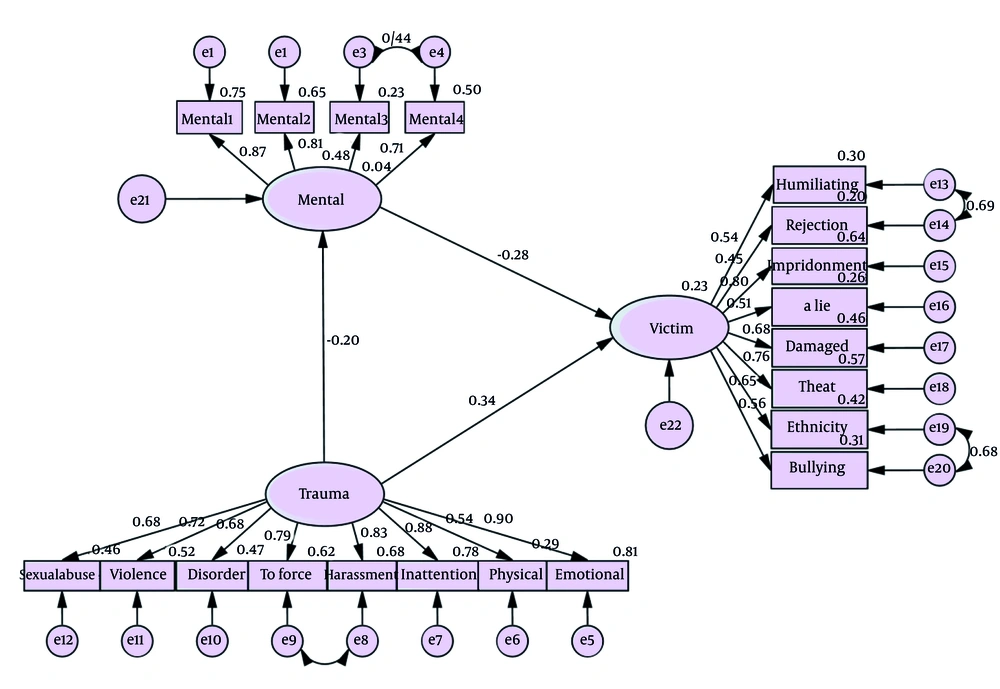
Figure 1.
Structural equation model
5. Discussion
The present study examined the role of childhood trauma in shaping mental health and victimization among incarcerated women. Overall, the findings suggest that childhood trauma operates as a central vulnerability factor that undermines psychological well-being and increases susceptibility to victimization in prison. These results align with prior Iranian and international studies showing that women with adverse childhood experiences face higher risks of victimization and mental health challenges in adulthood (6, 11, 12). Similarly, early-life abuse has been linked to impaired coping strategies and heightened vulnerability to coercion and interpersonal aggression in prison settings (2, 16).
The findings revealed a significant positive association between early-life trauma and victimization, demonstrating that women with histories of childhood abuse are disproportionately vulnerable to coercion, aggression, and threats within prison settings. This aligns with prior research (5, 9, 13). Anderson et al. (11) found that childhood traumas reduce women’s self-esteem, giving them a feeling of limited control over their life in adulthood. Similarly, Faridouni et al. (12) observed that women with childhood traumas are more likely to self-blame, feel lonely, exhibit risky sexual behavior, and face a higher risk of victimization.
Childhood trauma was also associated with poorer mental health among incarcerated women. Consistent with previous research, these findings indicate that children exposed to unsafe environments and lacking stable family and emotional support (2, 9, 10, 16) often develop a fragile psychological self-concept (14). Such individuals face difficulties in forming secure and meaningful interpersonal relationships (1, 2), exhibit impaired emotional regulation, and possess limited psychological resilience (18), which heightens vulnerability to stress and mental health challenges in later life (17). Edison and Haynie (2) reported that women with childhood traumas typically have negative self-cognition and struggle to manage interactional conflicts effectively.
Furthermore, poorer mental health was associated with an increased risk of victimization in prison. Women exhibiting higher levels of depression, anxiety, post-traumatic stress disorder, or emotional dysregulation were more likely to experience in-prison victimization. These findings are consistent with prior research indicating that mental health difficulties can impair situational awareness and help-seeking behaviors (14), contribute to negative self-perception (2, 16), reduce the ability to cope with physical and verbal harms in prison (11, 15, 16, 21), and affect emotional and interpersonal regulation (14).
In the regression model, age, length of incarceration, and socioeconomic status were included as control variables alongside the main predictors. The results indicated that both age and length of incarceration were significantly related to victimization, with younger women experiencing higher levels of harm, possibly due to limited coping strategies and lower social capital in prison. Socioeconomic status was not significantly associated with victimization, suggesting that the homogenizing conditions of the prison environment may mitigate economic differences.
Based on these findings, the relationship between adverse childhood experiences, psychological distress, and female victimization can be conceptualized as a “trauma-psychological damage – revictimization cycle”. This cycle illustrates how early traumatic exposures and the resulting psychological injuries undermine emotional stability and self-cohesion. Through internalization, such experiences foster a fragile self-concept and heightened emotional vulnerability, which, in turn, increase susceptibility to further victimization, perpetuating patterns of violence across the individual’s life course.
5.1. Limitations
This study encounters several limitations that warrant careful consideration. First, the small sample (106 prisoners) and purposive non-probability sampling restrict generalizability and may introduce bias. Second, reliance on self-report questionnaires renders the data vulnerable to recall errors and social desirability bias. Third, the cross-sectional design precludes causal inference, while omission of possible mediating or moderating variables may have shaped the observed associations. Fourth, the prison context makes the findings highly context-specific and less transferable to other populations.
5.2. Conclusions
The present study highlights a vicious cycle of trauma–psychological damage–revictimization, underscoring how adverse childhood experiences may set the stage for long-term vulnerability to repeated victimization. The findings also suggest that women’s victimization should not be viewed solely as an individual phenomenon, but rather as a process intricately linked to familial dynamics, deprivation, addiction, and parental divorce. Variations across familial and community contexts influence how victimization manifests, thereby limiting the generalizability of these findings to wider populations. To address these limitations, future research should employ larger and more diverse samples, adopt longitudinal designs, and utilize triangulated approaches that incorporate both quantitative and qualitative methods. Such strategies would enable a deeper understanding of the complex social and environmental determinants of victimization and inform the development of more effective policies and interventions to mitigate risk and support vulnerable populations.


