



1. Background
Tardive dystonia is a persistent hyperkinetic movement disorder characterized by sustained or intermittent muscle contractions that cause abnormal, often repetitive movements or postures and that develop after exposure to dopamine receptor-blocking agents, particularly antipsychotic medications (1, 2). It is part of the spectrum of tardive syndromes, which also includes tardive dyskinesia and other delayed-onset abnormal movements associated with these medications (3-5). These complications range from mild to disabling and can negatively affect treatment adherence, psychosocial functioning, and quality of life (6, 7). Because antipsychotic medications are widely used in psychiatric practice, recognition of tardive syndromes has important clinical implications. In addition to the burden of motor symptoms, these disorders may complicate long-term treatment (8). Tardive dystonia not only impairs motor function but may also reduce treatment adherence, increase psychosocial concerns, and, in some cases, lead to social isolation. Factors such as drug dosage, duration of use, individual characteristics, and the patient’s personality profile may also play important roles in the onset and severity of this disorder (9).
Numerous international studies have investigated the epidemiology and risk factors for tardive dystonia (10). For example, some studies have shown that older age, sex (with men being more affected in some cases), and long-term antipsychotic use are important factors in the onset of this syndrome (9, 11, 12). Previous studies suggest that tardive dystonia may differ clinically from tardive dyskinesia. Tardive dystonia has been reported more often in younger male patients, whereas classic tardive dyskinesia has often been described more frequently in older women (1, 13). However, findings have not always been consistent across settings and populations, and local data remain limited.
In Iran, data on tardive dystonia in psychiatric clinical populations are scarce. Therefore, the present study was conducted to describe the frequency of tardive dystonia and related clinical factors among psychiatric patients presenting with late-onset movement complications at referral centers in Yazd. Because the study population consisted only of patients already presenting with late-onset movement complications, the findings should be interpreted within this selected clinical population rather than generalized to all psychiatric patients or all antipsychotic-treated patients.
2. Objectives
This study aimed to determine the frequency of tardive dystonia and associated clinical factors among psychiatric patients presenting with late-onset movement complications at referral centers in Yazd, Iran.
3. Methods
3.1. Study Design and Setting
This descriptive cross-sectional study was conducted at the Taft Psychiatric Center and the Imam Ali Subspecialty Clinic, affiliated with Shahid Sadoughi University of Medical Sciences, Yazd, Iran, during 1401 - 1402. Data were collected through face-to-face interviews and review of medical records in psychiatric inpatient and outpatient referral settings.
3.2. Participants and Source Population
The source population comprised psychiatric patients referred to the study centers during the recruitment period who were clinically suspected of having late-onset drug-induced movement complications. The analytic sample included only adult psychiatric patients with confirmed late-onset movement disorders after assessment by a neuropsychiatrist. Therefore, the reported frequencies in this study pertain to psychiatric patients with late-onset movement complications and not to all psychiatric patients attending the centers or to all patients receiving antipsychotic medication.
Of 50 potentially eligible referred patients during the study period, 45 were assessed for eligibility. Five patients were excluded: 3 because of acute movement disorders and 2 because they declined participation. The remaining 40 patients met the eligibility criteria and were included in the analysis.
3.3. Eligibility Criteria
The inclusion criteria were age 18 years or older, the presence of a psychiatric disorder, a history of long-term antipsychotic exposure, and a clinically confirmed late-onset movement disorder.
The exclusion criteria were acute movement disorders, movement disorders judged not to be related to antipsychotic exposure, and insufficient clinical information for classification.
3.4. Sampling
Sampling was performed by census of all eligible patients presenting to the study centers during the recruitment period.
3.5. Outcome Definitions and Clinical Assessment
Patients were evaluated by a neuropsychiatrist using psychiatric history, medication history, clinical neurological examination, and the Abnormal Involuntary Movement Scale (AIMS). The AIMS was used as a structured tool to document abnormal involuntary movements and body-region involvement. Final clinical classification was based on specialist judgment integrating clinical phenomenology and history.
Tardive dystonia was defined clinically as persistent or intermittent sustained muscle contractions, abnormal posturing, or twisting movements that developed after exposure to antipsychotic medication and were not better explained by an acute drug reaction or a primary neurological disorder.
Tardive dyskinesia was defined clinically as delayed-onset involuntary choreiform, athetoid, or repetitive abnormal movements occurring after antipsychotic exposure.
Overlap cases were defined as patients in whom both dystonic and dyskinetic phenomenology were present on specialist examination.
Alternative causes of abnormal movements were excluded through clinical history and specialist examination as far as possible within the study setting. However, because no formal neurological workup protocol was applied to all participants, some possibility of misclassification remains.
3.6. Data Collection
Data were collected using a researcher-developed demographic and clinical checklist and medical records. Variables included age, sex, smoking, alcohol and substance use, handedness, comorbid medical conditions, psychiatric diagnosis, and medication history. Information on movement distribution by body region and current or past medication use was also recorded.
Medication data were available primarily as treatment history and duration of antipsychotic exposure. Detailed dose standardization and cumulative exposure data were not consistently available for all participants; therefore, these variables were not analyzed in detail.
3.7. Statistical Analysis
Data were analyzed using SPSS version 27. Descriptive statistics were reported as frequency and percentage for categorical variables and mean ± standard deviation for quantitative variables. Comparisons between categorical variables were performed using the chi-square test or Fisher's exact test. Because of the small number of tardive dystonia cases, association analyses were considered exploratory. No multivariable analysis was performed because the sample size was insufficient for reliable adjusted modeling.
4. Results
4.1. Baseline Characteristics
Of 50 potentially eligible referred patients during 1401 - 1402, 45 were assessed for eligibility. Five patients were excluded, including 3 with acute movement disorders and 2 who declined participation. A total of 40 patients were included in the final analysis.
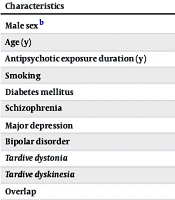
Among the 40 included patients, 28 (70.0%) were male and 12 (30.0%) were female. The mean age was 42.5 years (SD 10.2), although age data were missing for 2 participants. The mean duration of antipsychotic exposure was 5.2 years (SD 2.1). Ten patients (25.0%) had a history of smoking, with smoking data missing for 1 participant. Four patients (10.0%) had diabetes mellitus (Table 1).
Table 1.Demographic and Clinical Characteristics of Participants a
| Characteristics | Total (n = 40) |
|---|---|
| Male sex b | 28 (70.0) |
| Age (y) | 42.5 ± 10.2 |
| Antipsychotic exposure duration (y) | 5.2 ± 2.1 |
| Smoking | 10 (25.0) |
| Diabetes mellitus | 4 (10.0) |
| Schizophrenia | 12 (30.0) |
| Major depression | 12 (30.0) |
| Bipolar disorder | 5 (12.5) |
| Tardive dystonia | 6 (15.0) |
| Tardive dyskinesia | 33 (82.5) |
| Overlap | 1 (2.5) |
a Values are expressed as No. (%) or mean ± SD.
b Percentages are calculated based on the total number of included patients (n = 40).
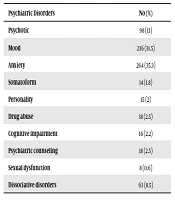
The distribution of psychiatric diagnoses in the study sample was as follows: schizoaffective disorder in 1 patient (2.5%), schizoaffective disorder with obsessive-compulsive disorder in 1 patient (2.5%), substance-induced psychosis in 2 patients (5.0%), anxiety with depression in 2 patients (5.0%), anxiety disorder in 3 patients (7.5%), obsessive-compulsive disorder in 2 patients (5.0%), bipolar disorder in 5 patients (12.5%), depression in 12 patients (30.0%), and schizophrenia in 12 patients (30.0%).
Among the 40 psychiatric patients with late-onset movement complications, 33 (82.5%; 95% CI: 67.2 - 92.7%) were classified as having tardive dyskinesia, 6 (15.0%; 95% CI: 5.7 - 29.8%) as having tardive dystonia, and 1 (2.5%; 95% CI: 0.1 - 13.2%) as having overlapping dystonic and dyskinetic features.
These percentages reflect the distribution of movement-disorder phenotypes within this selected sample of psychiatric patients with late-onset movement complications and should not be interpreted as prevalence estimates for all psychiatric patients or all patients treated with antipsychotics.
All six patients classified with tardive dystonia were male. Tardive dystonia was also observed more frequently among patients with schizophrenia than among those with other psychiatric diagnoses in this sample. These subgroup findings should be interpreted descriptively and with caution. No adjusted analyses were performed.
No association was detected between tardive dystonia and smoking, handedness, or recorded medical comorbidities in this sample.
5. Discussion
This cross-sectional study examined the distribution of tardive dystonia and related clinical factors among psychiatric patients with late-onset movement complications presenting to referral centers in Yazd, Iran. In this selected sample, tardive dystonia was identified in 15.0% of patients, tardive dyskinesia in 82.5%, and overlapping dystonic-dyskinetic phenomenology in 2.5%.
An important consideration in interpreting these findings is the study denominator. The participants were not a general sample of all psychiatric patients or all antipsychotic-treated patients, but a selected group already presenting with late-onset movement complications. Therefore, the reported figures reflect the relative frequency of different tardive movement phenotypes within this referral-based sample rather than the prevalence in the broader psychiatric population.
In this study, all patients classified as having tardive dystonia were male, and tardive dystonia was more frequently observed among patients with schizophrenia. These observations are generally consistent with previous reports suggesting that tardive dystonia may occur more often in male patients and in those with severe chronic psychiatric illness, including schizophrenia (1).
These findings underscore the importance of vigilance for tardive dystonia in the management of psychiatric patients, with particular consideration of sex and type of mental disorder. They may also inform improved treatment and prevention of drug-related adverse effects in this population. These results, along with previous findings, indicate that tardive dystonia remains a major treatment challenge in psychiatric patients and that multiple factors contribute to its occurrence (14, 15). Research suggests that ethnic and racial differences may influence susceptibility to this disorder; in some studies, Caucasian or African ethnicity has been identified as a risk factor, whereas Asian ethnicity has been identified as a protective factor (16). However, some researchers argue that the observed differences in prevalence are more strongly related to the duration and cumulative dose of antipsychotic medications than to genetic factors (17). Overall, depending on the study type and the population examined, the cumulative incidence of tardive dystonia has been reported to be approximately 4% to 5% annually, and its overall prevalence has been reported to range between 20% and 30%. Additionally, older age, particularly age older than 45 years, and high doses of antipsychotics are considered among the most important risk factors for this adverse effect (18).
Another important finding in our study was the association of tardive dystonia with a wide range of psychiatric disorders. In addition to schizophrenia, this adverse effect appears particularly prominent in patients with mood disorders; however, confounding factors such as older age, sex differences, and inconsistent use of antipsychotic medications may influence this association (19-21). Clinically, we observed that some patients with depression or bipolar disorder also had tardive dystonia, but interpretation is limited by the relatively small sample size.
Several studies have shown that drug-related adverse effects such as tardive dystonia may be associated with various clinical factors, including diabetes or alcohol abuse, as well as the duration of exposure to antipsychotic medications (9, 22, 23). However, in the current study, no significant association was observed between tardive dystonia and smoking, alcohol consumption, handedness, or co-occurring medical conditions such as hypertension, diabetes, and heart disease. A key finding in this research was the higher frequency of tardive dystonia in men, which has also been reported in other studies, particularly in Asian populations (24).
Investigating mitigating factors and patients' lived experiences is also important. In some cases, patients have attempted to reduce symptoms using strategies such as reducing the antipsychotic dose or engaging in activities such as chewing gum, which are referred to in the literature as sensory tricks (25). Although the current study found that these methods did not result in a statistically significant improvement in dystonia, clinical evidence and patients' experiences highlight the importance of individualized strategies and psychosocial support. In addition, Botox injections have shown beneficial effects in cases of focal dystonia, although less research has been conducted on orofacial dystonia (26).
Overall, factors such as the chronic nature of psychiatric disorders, the severity of negative symptoms in schizophrenia, and older patient age may contribute to the development of tardive dystonia through multiple mechanisms (27, 28). Social support, psychotherapeutic approaches addressing stigma and anxiety, and coping techniques such as meditation or yoga may help improve patients' condition (29, 30).
In this sample, no clear association was found between tardive dystonia and smoking, alcohol use, handedness, or recorded medical comorbidities. However, the absence of statistically significant findings should not be interpreted as evidence of no relationship, given the limited sample size and low statistical power.
5.1. Limitations
Our study has several limitations that should be acknowledged. First, the small sample size and low number of confirmed dystonia cases limited statistical power and precluded multivariable adjusted modeling. Second, because the study was conducted in referral centers and focused on patients already experiencing movement complications, referral bias is inherent to the design. Finally, detailed cumulative antipsychotic dose records were not available.
5.2. Conclusions
In this referral-based sample of psychiatric patients with late-onset movement complications, tardive dystonia was identified in a minority of patients and was more frequently observed in men and in patients with schizophrenia. Because the sample was small and the analyses were unadjusted, larger prospective studies with clearer exposure measurement and standardized diagnostic criteria are needed to better define the epidemiology and associated factors of tardive dystonia in psychiatric populations.