



1. Background
Students experience high levels of anxiety. These anxieties are sometimes severe enough to affect their daily lives and academic performance adversely. Test anxiety is one of the main anxieties that students experience and about 10 to 30 percent of students suffer from it (1, 2).
Test anxiety is higher in students of Kermanshah University of medical sciences. Mohammadi and Parandin reported 38.8% of students had mild test anxiety, 27.5% had moderate, and 33.7% had severe test anxiety (3).
Test anxiety is a mixed state of excitement, fear, and worry (4). Sarason (5) suggests that the concept of anxiety includes: 1. Stress: emotional feelings before or during the exam; 2.Worries: which are about the result of exam; 3. Irrational thoughts about the exam: thoughts that divert students’ attention from the exam; 4. Somatic symptoms: somatic reaction before or during the test (6). Given the high prevalence of test anxiety among the students and its adverse effects on test performance, academic achievement, and general well-being, it is necessary to identify and evaluate the influencing factors such as variables that appear to be associated with test anxiety, coping strategies, and emotional intelligence. According to the definition by Lazavs and Folkman (1948), copings are behavioral and cognitive activities to prevent, manage, or reduce stress. Indeed, coping strategies are not a constant personal way; but an interactive process which always alters and is modified due to experience (7). Indeed, coping strategies are not a constant personal way; but an interactive process which always alters and is modified due to experience, in this direction, problem-focused and emotion-focused coping strategies are discussed. In the Problem-focused coping strategy, people try to define and accurately assess the problem and try to catch the possibility of changing or dominating it to reduce the adverse effects of mental stress. On the other hand, in the emotion-focused coping, people forget about the problem or enlist the emotional support to reduce their anxiety (8). Using appropriate and effective coping strategies brings good results including higher levels of development, fewer behavioral problems, higher self-esteem, fewer depression symptoms, and positive adjustment (9). Cohen, Ben-Zur, and Rosenfeld (2008) showed that emotion-focused coping with test anxiety and the negative results of students’ exam have a significant and positive relationship; while problem-focused coping is associated with better function in the exam (10).
Some evidence show that emotional intelligence is effective on adaptive strategies selection in particular behavioral and psychological strategies that people usually apply in the face of negative events (11-15) and also has an important role in reducing test anxiety (16, 17). Emotional Intelligence is a series of non-cognitive capacities, abilities, and skills that affect the success rate, coping with the environmental demands and pressures (18). Emotional intelligence is a combination of four components: emotional perception, emotional simplification, emotional understanding, and emotional management. Studies show that emotional intelligence is closely related to mental health and can predict it (19). Salvi et al. (1999) believe that people who have more emotional intelligence are more successful in communication with the world around them and dealing with stressful situations, because they understand and express their emotional states accurately and also they know how and when to express their feelings and regulate their mood efficiently (20).
In this way, Bar-on and Parker (2000) Believe that stress management and adaptability are two main dimensions of emotional intelligence. In other words, adaptive coping causes the individual to develop in a challenging world. The ability to identify appropriate emotional responses, in the face of daily stressful life events, promotes a positive attitude toward life events. Vice versa, people with low emotional intelligence are less able to solve problems (21).
2. Objectives
As mentioned below, coping strategies have an importance in test anxiety; but the question is how coping strategies affect anxiety? It seems emotional intelligence could play a mediating role in the relation of coping strategies and test anxiety. The present study aimed to clarify the mediating role of emotional intelligence in the relation of coping strategies and test anxiety in the students.
3. Materials and Methods
3.1. Study Population and Sampling
The present research is descriptive and correlational. The study population consisted of all the students in Kermanshah University of Medical Sciences in 2013 - 2014 among whom 196 students were selected by convenience sampling. The age range of participants was 18 to 28 years old, not previously enrolled in another course. There was no history of serious or chronic medical or mental diseases. This study was approved by ethics committee of Kermanshah University of Medical Sciences prior to the collection of data. To collect the data, the research team referred to faculties and explained the project in case of confidentiality. After sampling, they asked the students to respond to the questionnaires. Students who were studying in Kermanshah University of Medical Sciences in 2013 - 2014, were in the second year of their education course or higher, and were voluntarily consent to participate in the study were included. Exclusion criteria were: being a first-year student, having a history of chronic psychiatric or medical disorders, disability and deformity, and non-satisfaction to participate in the study. Responding to the questionnaires was conducted individually and in the presence of the researcher. Due to the probability of dropping and failure to complete some questionnaires, the sample size had been estimated 220 and at the end of the study 196 questionnaires were collected.
3.2. Materials
3.2.1. Test Anxiety Inventory
Sarason (1975) has designed this scale with 37 closed answered items as yes or no with a scoring of 0 and 1. The score range is 0 to 37. A score ≤ 12 is considered as mild test anxiety, a score of 12 - 20 is considered as moderate test anxiety, and a score > 20 is considered as sever test anxiety (22). Troyn (1980) reported the reliability of the scale 0.80 by test-retest reliability and by the split-half method reported it as 0.91 (23). In the study by Yazdani (2012), Cronbach’s alpha coefficient of the questionnaire was reported 0.88, internal consistency was reported 0.95, and standard validity was reported 0.72 (24). In the present study, Cronbach’s alpha of the questionnaire was 0.84.
3.2.2. Coping Strategies Questionnaire
The questionnaire has been prepared by Lazarus and Folkman (19), includes 66 questions that measure 8 coping strategies. These eight patterns are divided into two categories: Problem-focused methods and emotion-focused methods. This 66-question inventory is with four-point Likert scale. Lazarus has reported for each coping strategy 0.79 to 0.66. Cronbach’s alpha for coping strategies is 0.86 generally, for emotion-focused coping and problem- focused coping are 0.72 and 0.79, respectively (25). In Iran, Ghadamgahi and Dejkam reported internal consistency with Cronbach’s alpha coefficient 0.61 to 0.79 and reported a four-week interval test-retest reliability 0.59 to 0.83 (26). In this study, Cronbach’s alpha was 0.84.
3.2.3. Emotional Intelligence Questionnaire
This questionnaire by Schutte et al. in 1998 according to Mayer and Salovey’s (1990) model of emotional intelligence has been designed to assess emotional intelligence. It includes 33 five-option self – reported sentences and has 3 subscales including emotional regulation, evaluation and emotional expression, and utilization of emotions (27). The validity of this scale was obtained 0.84 to 0. 90 using Cronbach’s alpha coefficient (28). The reliability of the emotional intelligence scale, through measuring its correlation with related structures, is sufficient. For the Persian version of scale, Cronbach’s alpha in a sample of 422 students was 0.88 to 0.91 which showed good internal consistency of the questionnaire. In the present study, Cronbach’s alpha was obtained 0.84.
3.3. Statistical Analysis
Data analysis was done using statistical software spss19 and AMOS18, and Statistical Methods mean, standard deviation, Pearson correlation coefficient, and path analysis were used.
4. Results
The statistical sample consisted of 196 students of Kermanshah University of Medical Sciences, among whom 56 (28.6%) were females and 114 (71/4%) were males. The mean age and standard deviation of participants were 22.39 ± 2.08 and the age range was 18 to 28. A total of 43 (21%) of participants were married and 153 (79%) were single. A total of 99 (50.5%) students lived with their family, 67 (34.2%) lived in dormitory, and 30 (15.3%) lived in their own private homes. A total of 31 (15.8%) students were high income, 54 (78.6%) were moderate income, and 11 (5.6%) were low income. A total of 86 (43.9%) students reported problem-focused coping strategies and 110 (56.1%) had emotion-focused coping strategies. In terms of the level of test anxiety, 34 (17.3%) had mild, 89 (45.40%) had moderate, and 73 (37.30%) had severe test anxiety (Table 1).
Table 1.Demographic Characteristics in the Studied Sample
| No. (%) | ||
|---|---|---|
| Gender | Female | 056 (28.60) |
| Male | 114 (71.40) | |
| Marital status | Single | 043 (21) |
| Married | 153 (79) | |
| Age | 18 - 20 | 036 (18.40) |
| 21 - 23 | 099 (50.50) | |
| 24 - 28 | 061 (31.10) | |
| Residential place | Living with family | 099 (50.50) |
| Living in dormitory | 067 (34.20) | |
| Private home | 030 (15.30) | |
| Coping strategies | problem- focused coping strategies | 086 (43.90) |
| emotion-focused coping strategies | 110 (56.10) | |
| Test Anxiety | Low (18 - 20) | 034 (17.30) |
| Moderate (21 - 23) | 089 (45.40) | |
| Severe (24 - 28) | 073 (37.30) |
The mean, standard deviation, and correlation matrix test anxiety, emotional intelligence, Problem-focused coping strategies and Emotion-focused coping strategies variables are shown in Table 2.
Table 2.Mean, Standard Deviation, and Correlation Between Variables
| Variables | Mean (SD) | Correlation coefficient | |||
|---|---|---|---|---|---|
| Sig. | |||||
| 1 | 2 | 3 | 4 | ||
| 1. Test Anxiety | 19.47 (7.07) | 1 | |||
| 2. Emotional Intelligence | 79.92 (17.20) | -0.32** | 1 | ||
| 0.001 | |||||
| 3. Problem-focused coping strategies | 34.68 (7.24) | -0.18** | 0.52** | 1 | |
| 0.008 | 0.001 | ||||
| 4. Emotion-focused coping strategies | 35.55 (7.73) | 0.27 | 0.11 | 0.24** | 1 |
| 0.001 | 0.10 | 0.001 | |||
To investigate the intermediary role of emotional intelligence in the association with problem-focused coping strategies and test anxiety, path analysis was used. Results showed that the direct relationship of problem focused coping strategies - emotional intelligence is 0.53 and the direct relationship of problem focused coping strategies – test anxiety was 0.02. Also, the direct relationship of emotional intelligence - test anxiety was -0.31. These coefficients were significant at the level of P < 0.01. Standard and non-standard coefficients among the variables are inserted in Table 3.
Table 3.Standard and Non-Standard Coefficients Between Variables
| Path | Direct Coefficients | Indirect Coefficients | ||||
|---|---|---|---|---|---|---|
| B | β | P Value | B | β | P Value | |
| 1. Problem-focused coping strategies- Emotional intelligence | 1.25 | 0.53 | 0.001 | - | - | - |
| 2. Problem-focused coping strategies- Test Anxiety | 0.02 | -0.02 | 0.07 | 0.16 | -0.16 | 0.04 |
| 3. Emotional intelligence - Test Anxiety | 0.13 | -0.31 | 0.001 | - | - | - |
The results showed that problem-focused coping strategies regarding the standard rate and anxiety through emotional intelligence are 0.16, which is significant in 0.05 (Figure 1).
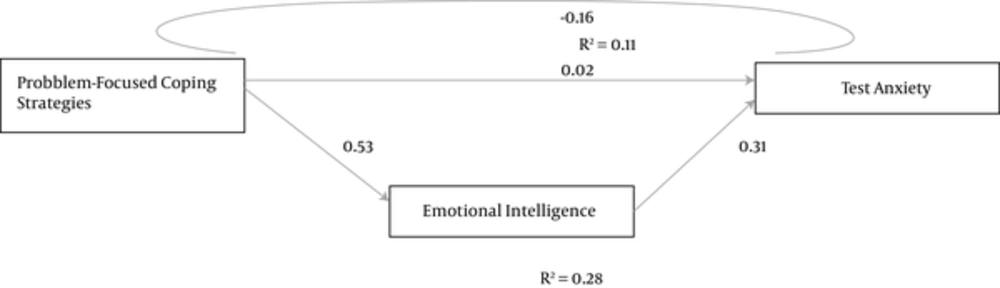
Figure 1.
Research Model Graph
5. Discussion
In this study, the mediating role of emotional intelligence in relation with coping strategies and test anxiety in medical students of Kermanshah University of Medical Sciences, Iran was studied. The results showed that there was a negative correlation between problem-focused coping strategies and test anxiety. Also there was a positive correlation between emotional coping strategies and test anxiety. In other words, students who apply problem-focused coping strategies in comparison with who apply emotion-focused coping strategies feel less test anxiety. This result is consistent with the study by Cohen et al. (2008) which showed that there was a positive and significant relationship between emotion-focused coping strategies with test anxiety and negative exam results (10).
To explain these results, we can say that students who have test anxiety, by using problem-focused coping strategies, try to define, carry out a detailed assessment, get the possibility of alteration and control over anxiety and finally find a solution for the problem. Through this way, they achieve psychological satisfaction and it causes psychological order and coherence and also reduces emotional disturbance.
These students with devising a practical plan and new study techniques reduce their test anxiety. In contrast, students who use emotion-focused coping strategies, avoid facing problems effectively and directly. Instead of practical strategies to deal with test anxiety such as studying, they ignore the problem and gain emotional support. Taken together the type of coping strategies that people select, they present their psychological Vulnerability. Efficient and effective coping styles reduce test anxiety and increase positive outcomes while ineffective coping styles may cause more test anxiety among students and affect their physical and mental health. The results showed that there is a negative relationship between emotional intelligence and test anxiety; this means that students with high emotional intelligence experience less test anxiety. People with high emotional intelligence have more self-awareness, understand their emotions and others’ emotions better, deal effectively with them, and are realistic about their abilities. Because of having had a good history in dealing with various situations, they are able to regulate and express emotions in stressful conditions properly.
Students who have a high emotional intelligence, in the face of stressful factors such as exam stress, show greater control and management, this ability helps them deal with problems and flexibly control their emotions, as a result of less anxiety. Hunt and Evans (20) found that people with high emotional intelligence syndrome, experience less stress in dealing with traumatic events. These people have a higher self-efficacy to fairly deal with and assess challenging, threatening, and frightening situations (20). These results are consistent with some studies of (16, 17). The results showed that the addition of emotional intelligence, coping strategies and anxiety there is direct relationship between problem-focused coping strategies and emotional intelligence test anxiety through indirect relationship exists, and relationship problem-focused coping strategies and test anxiety -0.16 is through emotional intelligence, problem-focused coping strategies that affect the emotional intelligence and emotional intelligence test anxiety also affects the relationship between problem-focused coping strategies and anxiety through emotional intelligence facilitated.
Emotional intelligence can predict the relationship between coping strategies and test anxiety. In view of Mayer and Salovey, emotional intelligence is a kind of social intelligence which includes the ability to control our emotions and others’ and distinguishing between them and finally using them as strategies in thought and action. It makes it possible to predict success (29). Emotional competence makes an effective diagnosis of emotional responses associated with everyday events, correct event detection, expanding the scope of individual insight, and creating a positive attitude in people. Given that, according to several studies, problem-focused coping strategies are the most adaptive coping strategies and those who use practical coping are more satisfied with controlling stressful events, these people are less likely to experience test anxiety.
Given that, according to several studies addressing the most adaptive problem-oriented coping strategies, those of actual combat handling stressful events are more satisfied and experience less anxiety. Other research showed that emotional intelligence on adaptive strategies, especially strategies and psychological abuse that are usually applied in the face of negative events, affect (11-15) and also play an important role in reducing anxiety (16, 17). According to the results, it can be concluded that students who use problem-focused coping strategies, have a greater emotional intelligence and emotional intelligence enhancement, their anxiety decreased significantly.
The results suggest that the importance of emotional intelligence in reducing test anxiety, mediator should be considered. And since much of the emotional intelligence can be taught, it is proposed to develop and implement effective training programs which help to strengthen it.
So far, no research has been done studying the mediation role of emotional intelligence in relation with coping strategies and test anxiety. Because this study is a correlational descriptive study, it cannot possibly find the causal relationship between variables. It is suggested that one research be done as a trial.
The results of the present study were in line with previous studies and showed using emotion-focused coping strategies dominantly. Culturally, it could indicate that even among educated people such coping strategies were more dominant. It seems necessary to do skill training on adaptive strategies in the recurrent critical situations such as exam periods for these students.
In this study, the sampling method used may not guarantee the sample to be representative of the whole community, so generalizability of the results to the entire population of Kermanshah University of Medical Sciences must take the necessary precautions. By considering the fact that this study was conducted among the students of Kermanshah University of Medical Sciences, the possibility of generalization of the results to other populations includes students and other students there. It is recommended that further research be done on students in other universities.
5.1. Conclusion
In conclusion, changing the coping strategy from emotion-focused to problem-solving could decrease the anxiety of exam and increase successfulness. Also, improvement in EQ could result in less anxiety level and high success.



