2.1.1. Materials and Methods
All chemicals were purchased from the Sigma-AldrichTM (USA) and MerckTM (Germany) chemical companies with a minimum purity of 97% and used without further purification. Reaction’s progress was envisioned by thin-layer chromatography (TLC) performed on pre-coated silica gel plates (MerckTM, Kieselgel 60 F-254, 0.2 mm). Melting points were determined on the Electrothermal-9100 apparatus and were uncorrected. The structures of the novel compounds were confirmed by IR, LC/MS, 1H-NMR, 13C-NMR, and elemental analysis. Infrared (IR) spectra were acquired on a Perkin-ElmerTM 843 IR spectrometer. BrukerTM advance II (100, 125, 400, 500 MHz) spectrophotometer (BrukerTM Biosciences, USA) obtained NMR spectra at ambient temperature using TMS as the internal standard and d6-DMSO or CDCl3 as the solvent. The NMR spectra were recorded in ppm using automatic calibration to tetramethylsilane (TMS) as the internal standard. The 1H NMR data were presented as follows: chemical shift (δ ppm), multiplicity (s = singlet, d = doublet, dd = doublet of doublet, t = triplet, q = quartet, m = multiplet), coupling constants (Hz) and integration. The 13C-NMR analyzes were reported in terms of chemical shift (δ ppm). The mass spectrophotometry was carried out on a 6410 Agilent LC-MS triple quadrupole mass spectrometer (LC-MS) equipped with an electrospray ionization (ESI) interface. An elemental analyzer (CostechTM, Italy) was also used to carry out the elemental analysis. Purification of the compounds was performed with the specified eluent using silica gel column chromatography (230 - 400 mesh size).
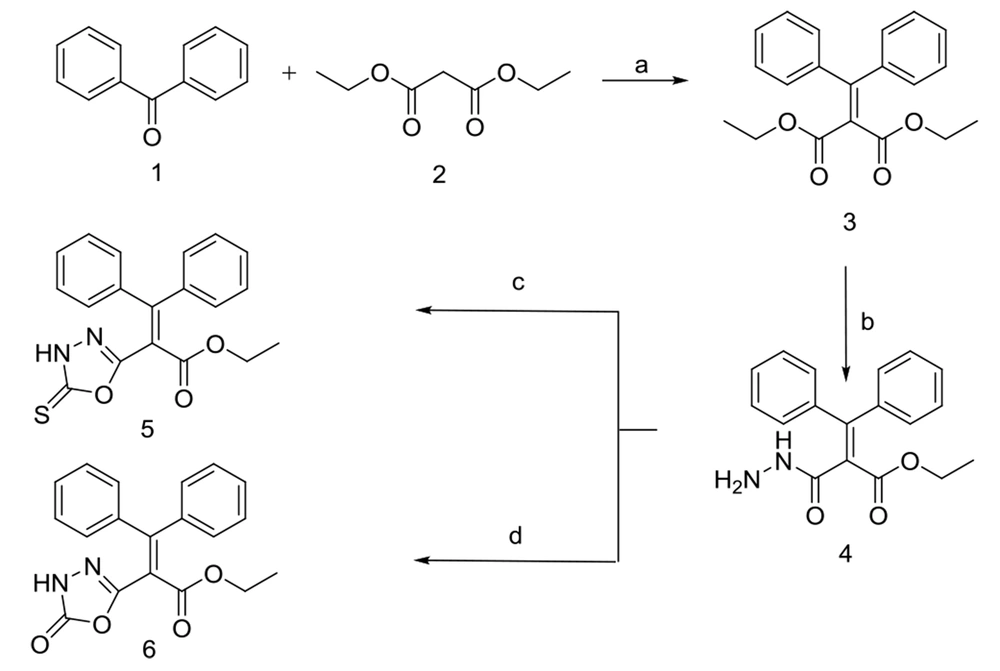
2.1.1.1. Preparation of Diethyl2-(Diphenyl Methylene) Malonate (3)
TiCl4 (12.05 mL, 109.6 mmol) was added gradually to dry THF (110 mL), and the reaction flask was placed in an ice bath. Afterward, benzophenone 1 (5 g, 27.4 mmol) and diethyl malonate 2 (10.5 mL, 68.5 mmol) were added. Subsequently, dry pyridine (17.7 mL, 219.2 mmol) was added to the reaction mixture dropwise in 0.5 to 1 h and stirred at 25°C for 48 h. The crude residue was dispersed in 25 mL water and extracted with diethyl ether upon the reaction completion. The organic layer was shaken with a saturated NaHCO3 aqueous solution, then with brine, and finally dried over anhydrous Na2SO4. Silica gel column chromatography eluting with EtOAc/n-hexane (0.5: 9.5) was utilized to give the purified compound 3.
Colorless crystals, yield: 67%; mp 73.5 - 75°C; 1HNMR (500 MHz, DMSO-d6,) (δ, ppm): 0.88 (t, J = 7.09 Hz, 6H, CH3), 3.95 (q, J = 7.1 Hz, 4H, OCH2), 7.07 (dd, J = 6.43 Hz, 1.65 Hz, 4H, Ar-H), 7.32-7.39 (m, 6H, Ar-H); 13CNMR (125 MHz, DMSO-d6) (δ, ppm): 14.27, 61.77, 126.94, 129.21, 129.55, 130.13, 140.39, 155.32, 166.06; ESI-MS (m/z): 347 [M + Na]+, 671 [2M + Na]+; IR (KBr disk) ν (cm-1): 1760, 1773 (C = O), 1450-1600 (aromatic). Anal. Calcd. for C20H20O4: C, 74.06; H, 6.21. Found: C, 74.11; H, 6.19.
2.1.1.2. Preparation of Ethyl 2-(Hydrazinecarbonyl)-3,3-Diphenylacrylate (4)
Compound 3 was dissolved in DMF (0.2 mL) and treated with hydrazine hydrate (1: 5). The mixture was stirred for 18 hours at room temperature. Then, water was added into the reaction mixture, and the resulting precipitate was collected by filtration, boiled in ethanol 96%, and washed with n-hexane to afford compound 4.
White solid, yield: 67%; mp: 199-200 °C; 1HNMR (400 MHz, DMSO-d6) (δ, ppm): 0.92 (t, J = 7.2 Hz, 3H, CH3), 3.95 (m, 2H, OCH2), 4.20 (s, 1H, NH), 6.04 (s, 1H, NH), 7.21 (dd, 7.2 Hz, 2H, Ar-H), 7.28 - 7.37 (m, 6H, Ar-H), 7.74 (d, J = 7.2 Hz, 2H, Ar-H), 9.96 (s, 1H, NH); 13CNMR (100 MHz, DMSO-d6) (δ, ppm): 14.01, 59.44, 61.33, 73.93, 125.74, 126.52, 127.62, 127.72, 128.87, 128.92, 142.05, 144.31, 168.14, 172.11; ESI-MS (m/z): 311 [M + H]+, 333 [M + Na]+, 349 [M + K]+; IR (KBr disk) ν (cm-1): 3117, 3188, 3256 (N-H), 1702, 1740 (C = O), 1450 - 1600 (aromatic). Anal. Calcd. for C18H18N2O3: C, 69.66; H, 5.85; N, 9.03. Found: C, 69.61; H, 5.84; N, 9.06.
2.1.1.3. Preparation of Ethyl 3,3-Diphenyl-2-(5-Thioxo-4,5-Dihydro-1,3,4-Oxadiazol-2-yl) Acrylate (5)
Compound 4 (1 g, 3.23 mmol) was dissolved in dry DMF, and 0.4 g KOH (7.13 mmol) and then 2.3 mL CS2 (38.71 mmol) were added dropwise to the solution while the reaction flask was placed into an ice bath. The reaction mixture was stirred for 48 hours at 80 °C. The resulting solution was cooled to room temperature and acidified with HCl (2N). The precipitate was filtered and washed entirely with distilled water. The crude residue was subjected to column chromatography (silica gel, hexane/EtOAc, 6.5:3.5) to afford the pure compound 5.
Yellow solid, yield: 30%; mp: 95-97 °C; 1HNMR (500 MHz, DMSO-d6) (δ, ppm): 0.83 (t, J = 7.06 Hz, 3H, CH3), 3.90 (q, J = 7.09 Hz, 2H, OCH2), 6.95 (d, J = 6.85 Hz, 2H, Ar-H), 7.07 (t, J = 3.61 Hz, 2H, Ar-H), 7.24-7.34 (m, 6H, Ar-H); 13CNMR (125 MHz, DMSO-d6) (δ, ppm): 14.25, 61.68, 119.73, 128.95, 129.16, 129.50, 129.60, 130.24, 140.68, 141.66, 150.59, 159.34, 167.35, 180.73; ESI-MS (m/z): 353 [M + H]+; IR (KBr disk) ν (cm-1): 1711 (C = O), 1450 - 1600 (aromatic). Anal. Calcd. for C19H16N2O3S: C, 64.76; H, 4.58; N, 7.95; Found: C, 64.74; H, 4.60; N, 7.98.
2.1.1.4. Preparation of Ethyl 2-(5-oxo-4,5-Dihydro-1,3,4-Oxadiazol-2-yl)-3,3-Diphenylacrylate (6)
Compound 4 (1 g, 3.23 mmol) was dissolved in dry THF, while the reaction flask was placed into an ice bath. Triethylamine (2.6 mL, 18.52 mmol) was added, and the mixture was stirred for 2 minutes. Then 1, 1’-Carbonyldiimidazole (3.2 g, 19.73 mmol) was added and stirred continuously for 28 hours. The mixture was then filtered. The subfiltrate was acidified with HCl 20% till pH 2 - 3, and the organic layer was extracted by EtOAc. Finally, the solvent was evaporated under vacuo, and the residue was subjected to column chromatography (silica gel, n-hexane/ EtOAc, 6.5: 3.5) to obtain the purified compound 6.
White solid, yield: 20%; mp: 115 - 117°C; 1HNMR (500 MHz, DMSO-d6) (δ, ppm): 0.83 (br, 3H, CH3), 3.91 (br, 2H, OCH2), 6.80 - 7.80 (m, 10 H, Ar-H); 13CNMR (100 MHz, DMSO-d6) (δ, ppm): 14.02, 56.21, 117.75, 125.77, 127.05, 128.06, 128.39, 129.06, 130.00, 137.47, 139.67, 142.14, 152.42, 156.05, 165.60, 167.71; ESI-MS (m/z): 337 [M + H]+, 359 [M + Na]+; IR (KBr disk) ν (cm-1): 1720, 1775 (C = O), 1684 (C = N), 1450-1600 (aromatic). Anal. Calcd. for C19H16N2O4: C, 67.85; H, 4.79; N, 8.33. Found: C, 67.80; H, 4.78; N, 8.34.
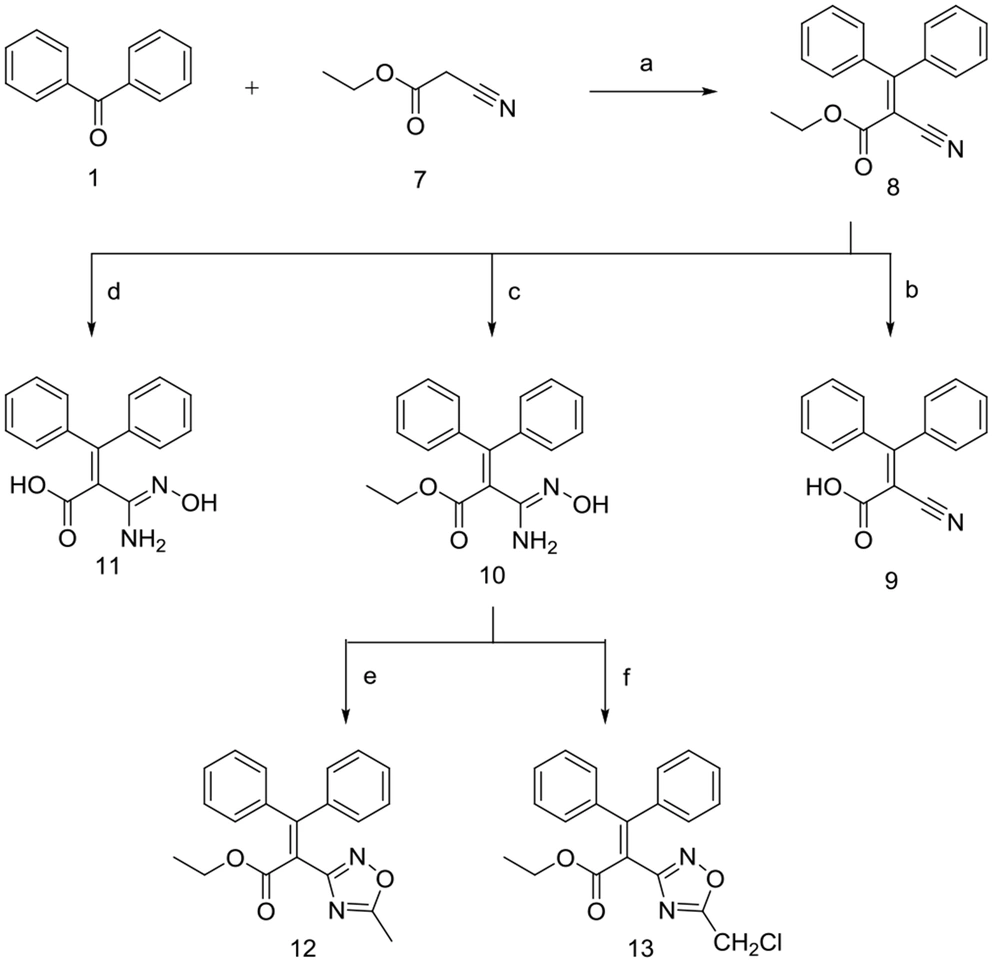
2.1.1.5. Preparation of Ethyl 2-Cyano-3,3-Diphenylacrylate (8)
TiCl4 (14.5 mL, 132 mmol) was gradually added to dry THF (90 mL) while the reaction flask was placed in an ice bath. Afterward, benzophenone 1 (6 g, 33 mmol) and ethyl cyanoacetate 7 (17.6 mL, 165 mmol) were added. Consequently, dry pyridine (21.2 mL, 263 mmol) was added to the reaction mixture dropwise in 0.5 to 1 h. The reaction mixture was stirred for 48 h at room temperature. The crude residue was dispersed in 30 mL water and extracted with diethyl ether upon the reaction completion. The organic layer was washed with a saturated NaHCO3 aqueous solution, then with brine, and finally dried over anhydrous Na2SO4. The resulting precipitate was collected by filtration, washed with distilled water, then with n-hexane, and subsequently dried under vacuum to afford compound 8.
Yellow solid, yield: 71%; mp: 73 - 75°C; 1HNMR (500 MHz, DMSO-d6) (δ, ppm): 0.94 (t, J = 7.09 Hz, 3H, CH3), 4.02 (q, J = 7.08 Hz, 2H, OCH2), 7.12 (d, J = 7.46 Hz, 2H, Ar-H), 7.35 - 7.39 (m, 4H, Ar-H), 7.43 - 7.46 (m, 3H, Ar-H), 7.51 (t, J = 7.26 Hz, 1H, Ar-H); 13CNMR (125 MHz, DMSO-d6) (δ, ppm): 14.25, 62.69, 104.94, 117.56, 129.11, 129.49, 129.87, 130.59, 131.13, 132.15, 139.17, 139.20, 162.92, 169.43; ESI-MS (m/z): 278 [M + H]+, 300 [M + Na]+, 577 [2M + Na]+; IR (KBr disk) ν (cm-1): 2202 (CN), 1706 (C = O), 1450-1600 (aromatic). Anal. Calcd. for C18H15NO2: C, 77.96; H, 5.45; N, 5.05. Found: C, 77.91; H, 5.49; N, 5.07.
2.1.1.6. Preparation of 2-Cyano-3, 3-Diphenylacrylic Acid (9)
A methanolic solution of NaOH (0.112 g, 2.88 mmol) was added to a solution of the compound 8 (0.4 g, 1.44 mmol), in a CH2Cl2/CH3OH (9:1, v/v) mixture. The mixture was stirred for 1.5 hours until all the starting material was consumed. The solvent was then removed under a vacuum. To the dried residue, water was added, and the resulting solution was extracted with diethyl ether. The aqueous layer was then cooled and acidified with dilute HCl till pH 2-3. The solid started precipitating, filtered to obtain the purified compound 9.
White solid, yield: 60%; mp: 209-210 °C; 1HNMR (500 MHz, DMSO-d6) (δ, ppm): 7.14 (d, J = 7.13 Hz, 2H, Ar-H), 7.32-7.38 (m, 4H, Ar-H), 7.40-7.51 (m, 4H, Ar-H); 13CNMR (125 MHz, DMSO-d6) (δ, ppm): 106.28, 118.04, 129.02, 129.44, 129.91, 130.45, 130.93, 131.80, 139.28, 139.56, 164.13, 168.14; ESI-MS (m/z): 250 [M+H]+, 272 [M+Na]+; IR (KBr disk) ν (cm-1): 2526-3061 (O-H), 2218 (CN), 1680 (C = O), 1450-1600 (aromatic). Anal. Calcd. for C16H11NO2: C, 77.10; H, 4.45; N, 5.62. Found: C, 77.16; H, 4.44; N, 5.60.
2.1.1.7. Preparation of Ethyl 2-(N’-Hydroxycarbamimidoyl)-3,3-Diphenylacrylate (10)
To 3.76 g of hydroxylammonium chloride (54.1 mmol) and 5.74 g of Na2CO3 (54.1 mmol), 30 mL water was added, and the mixture was stirred for 10 min until it became a clear solution. Then a methanolic solution (30 mL) of compound 8 (3 g, 11 mmol) was added, and the mixture was stirred for 72 h at room temperature. The resulting precipitate was filtered and subjected to flash chromatography (silica gel, n-hexane/EtOAc, 8: 2) to afford the purified compound 10.
White solid, yield: 42%; mp: 121.7 - 123.7°C; 1HNMR (500 Hz, DMSO-d6) (δ, ppm): 1.01 (br, 3H, CH3), 3.95 (q, J = 6.99 Hz, 2H, OCH2), 7.19 - 7.33 (m, 12H, Ar-H, NH2), 7.89 (s, 1H, OH); 13CNMR (100 MHz, DMSO-d6) (δ, ppm): 14.49, 60.81, 120.81, 124.61, 125.06, 127.36, 127.94, 128.12, 128.81, 128.95, 129.16, 129.35, 129.58, 136.01, 139.31, 164.90, 168.39, 169.89; ESI-MS (m/z): 311 [M + H+], 333 [M + Na]+, 643 [2M + Na]+; IR (KBr disk) ν (cm-1): 3332, 3449 (N-H), 3100 - 3500 (O-H), 1680 (C = O), 1450 - 1600 (aromatic). Anal. Calcd. for C18H18N2O3: C, 69.66; H, 5.85; N, 9.03. Found: C, 69.70; H, 5.86; N, 9.00.
2.1.1.8. Preparation of 2-(N’-Hydroxycarbamimidoyl)-3,3-Diphenylacrylic Acid (11)
To 3.76 g of hydroxylammonium chloride (54.1 mmol) and 5.74 g of Na2CO3 (54.1 mmol), 30 mL water was added, and the mixture was stirred for 10 minutes until it became a clear solution. A methanolic solution (30 mL) of compound 8 (3 g, 11 mmol) was then added, and the mixture was stirred for 72 h at room temperature. The resulting precipitate was collected by filtration under a vacuum. The crude solid was further purified by flash chromatography (silica gel) eluted by n-hexane/EtOAc (8: 2) to yield the pure compound 11.
White solid, yield: 58%; mp: 134-136 °C; 1HNMR (500 MHz, DMSO-d6) (δ, ppm): 7.24 (d, J = 6.89 Hz, 2H, Ar-H), 7.32 - 7.44 (m, 10 H, Ar-H, NH2), 11.30 (s, 1H, OH); 13CNMR (125 MHz, DMSO-d6) (δ, ppm): 127.82, 129.00, 129.20, 129.24, 129.69, 129.74, 134.40, 137.62, 156.00; ESI-MS (m/z): 283 [M + H]+; IR (KBr disk) ν (cm-1): 3273 (N-H), 2732 - 3535 (O-H), 1721 (C = O), 1450 - 1600 (aromatic). Anal. Calcd. for C16H14N2O3: C, 68.07; H, 5.00; N, 9.92. Found: C, 68.15; H, 5.01; N, 9.87.
2.1.1.9. Preparation of Ethyl 2-(5-Methyl-1,2,4-Oxadiazol-3-Yl)-3,3-Diphenylacrylate (12)
Compound 10 (0.32 g, 1.03 mmol) and 110.2 μL acetyl chloride (1.54 mmol) were added to 15 mL dry toluene and refluxed for 6 h in the presence of 0.25 mL dry pyridine. The solvent was vaporized, and the precipitate filtered. The crude residue was washed with water and then n-hexane to obtain compound 12.
White solid, yield: 47%; mp: 209.1 - 210.3°C; 1HNMR (500 MHz, DMSO-d6) (δ, ppm): 0.74 (t, J = 7.06 Hz, 3H, CH3), 2.16 (s, 3H, CH3), 3.85 (q, J = 7.07 Hz, 2H, OCH2), 7.15 - 7.20 (m, 5H, Ar-H), 7.24 - 7.30 (m, 3H, Ar-H), 7.47 (d, J = 7.82 Hz, 2H, Ar-H); 13CNMR (125 MHz, DMSO-d6) (δ, ppm): 14.24, 23.65, 61.85, 119.21, 128.60, 129.59, 129.91, 130.25, 130.51, 130.71, 130.82, 138.28, 153.46, 163.01, 163.52, 164.13; ESI-MS (m/z): 335 [M + H]+, 669 [2M + H]+; IR (KBr disk) ν (cm-1): 1736 (C = O), 1678 (C = N), 1450-1600 (aromatic). Anal. Calcd. for C20H18N2O3: C, 71.84; H, 5.43; N, 8.38. Found: C, 71.79; H, 5.44; N, 8.40.
2.1.1.10. Preparation of Ethyl 2-(5-(Chloromethyl)-1,2,4-Oxadiazol-3-Yl)-3,3-Diphenylacrylate (13)
A solution of compound 10 (0.45 g, 1.45 mmol) in 20 mL dry toluene containing 139 μL of chloroacetyl chloride (1.74 mmol) and 0.35 mL dry pyridine was refluxed for 6 h. The mixture was vacuum-concentrated after the completion of the reaction. The crude residue was filtered and washed with water and n-hexane. Finally, compound 13 was obtained by recrystallization from methanol.
Purple solid, yield: 13.5%; mp: 141 - 144°C; 1HNMR (500 MHz, CDCl3) (δ, ppm): 0.52 (t, J = 7.15 Hz, 3H, CH3), 3.67 (q, J = 7.15 Hz, 2H, OCH2), 4.47 (s, 2H, CH2), 6.71 (d, J = 7.83 Hz, 2H, Ar-H), 7.03 (t, J = 7.25 Hz, 1H, Ar-H), 7.10 (t, J = 7.83 Hz, 2H, Ar-H), 7.18 (d, J = 7.33 Hz, 2H, Ar-H), 7.26 (t, J = 7.31 Hz, 2H, Ar-H), 7.33 (t, J = 7.18 Hz, 1H, Ar-H); 13CNMR (125 MHz, CDCl3) (δ, ppm): 13.44, 45.24, 61.00, 94.08, 125.24, 126.43, 128.77, 128.94, 129.26, 130.14, 135.55, 138.19, 167.38, 167.96, 169.08, 170.37; ESI-MS (m/z): 369, 371 (3: 1) [M + H]+, 391, 393 (3:1) [M + Na]+; IR (KBr disk) ν (cm-1): 1715 (C = O), 1632, 1659 (C = N), 1450 - 1600 (aromatic). Anal. Calcd. for C20H17ClN2O3: C, 65.13; H, 4.65; N, 7.60. Found: C, 65.21; H, 4.60; N, 7.62.
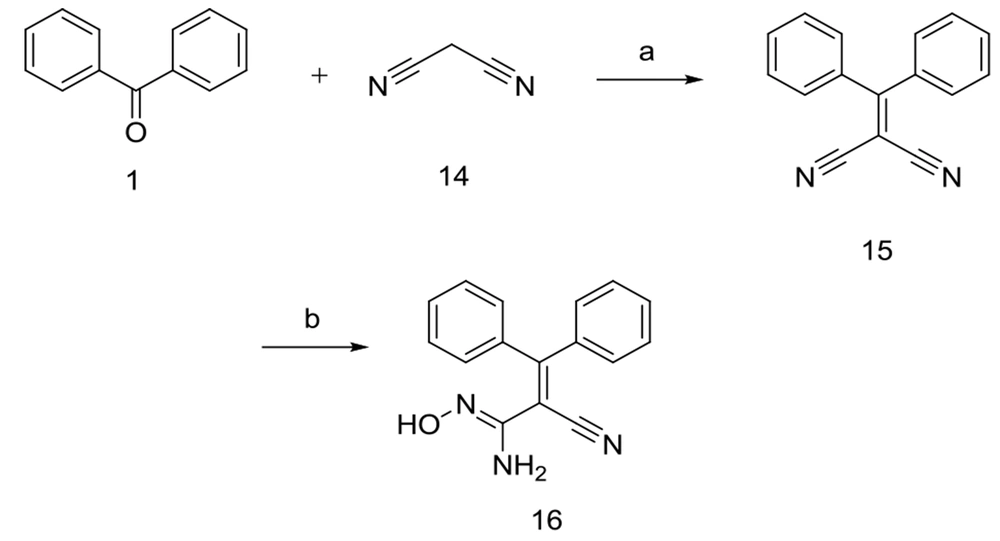
2.1.1.11. Preparation of 2-(Diphenyl Methylene) Malononitrile (15)
A mixture of benzophenone 1 (3 g, 16 mmol) and malononitrile 14 (1.63 g, 25 mmol) was stirred at 150°C for 1 h in the presence of ammonium acetate (1.27 g, 16 mmol). The mixture was permitted to cool down to 25°C after the reaction was completed. The solid was collected by filtration and washed with a minimum of distilled water and n-hexane. The purified compound 15 was recrystallized from ethanol 96%.
Yellow solid, yield: 32.5%; mp: 140.2 - 140.8°C; 1HNMR (500 MHz, DMSO-d6) (δ, ppm): 7.45 (d, J = 7.57 Hz, 4H, Ar-H), 7.52 (t, J = 7.53 Hz, 4H, Ar-H), 7.60 (t, J = 7.19 Hz, 2H, Ar-H); 13CNMR (125 MHz, DMSO-d6) (δ, ppm): 82.96, 115.09, 129.72, 131.03, 133.40, 136.86, 175.10; ESI-MS (m/z): 231 [M + H]+, 253 [M + Na]+; IR (KBr disk) ν (cm-1): 2212 (CN), 1450 - 1600 (aromatic). Anal. Calcd. for C16H10N2: C, 83.46; H, 4.38; N, 12.17. Found: C, 83.52; H, 4.37; N, 12.15.
2.1.1.12. Preparation of 2-Cyano-N’-Hydroxy-3,3-Diphenylacrylimidamide (16)
A mixture of 2.26 g hydroxylammonium chloride (32 mmol) and 3.46 g Na2CO3 (32 mmol) in 25 mL water was stirred for 10 min until it became a clear solution. Then, a methanolic solution of compound 15 (1.5 g, 6.5 mmol) was added, and the mixture was stirred for 48 hours at room temperature. The resulting precipitate was collected by filtration under vacuum, washed with water and dried to afford compound 16.
Yellow solid, yield: 87.7%; mp: 128.1 - 128.7°C; 1HNMR (500 MHz, DMSO-d6) (δ, ppm): 7.25 - 7.28 (m, 2H, Ar-H), 7.33 - 7.34 (m, 8H, Ar-H), 7.38 (s, 2H, NH2), 8.28 (s, 1H, OH); 13CNMR (100 MHz, DMSO-d6) (δ, ppm): 76.31, 119,62. 120.69, 124.30, 125.71, 126.07, 127.44, 128.40, 129.06, 130.10, 131.23, 132.16, 137.47, 138.42, 166.83, 170.01; ESI-MS (m/z): 285 [M + Na]+, 549 [2M + Na]+; IR (KBr disk) ν (cm-1): 3331, 3399 (N-H), 2859 - 3633 (O-H), 2180 (CN). Anal. Calcd. for C16H13N3O: C, 72.99; H, 4.98; N, 15.96. Found: C, 72.87; H, 4.96; N, 15.98.


![Structures of the HIV-inhibitors from different antiretroviral drug classes [Indinavir: protease inhibitor (PI), Azidothymidine: nucleoside reverse transcriptase inhibitor (NRTI), Raltegravir: integrase inhibitor (INI), Nevirapine: non-nucleoside reverse transcriptase inhibitor (NNRTI)].](https://brieflands.com/journals/ijpr/articles/123827/figures/ijpr-123827-i001-F1-preview.webp "Structures of the HIV-inhibitors from different antiretroviral drug classes [Indinavir: protease inhibitor (PI), Azidothymidine: nucleoside reverse transcriptase inhibitor (NRTI), Raltegravir: integrase inhibitor (INI), Nevirapine: non-nucleoside reverse transcriptase inhibitor (NNRTI)].")
![Anti-HIV activity and docking results of the synthesized compounds (<sup>a</sup> the cellular toxicity was evaluated by XTT (sodium 3-[1(phenylaminocarbonyl)-3,4-tetrazolium]-bis(4-methoxy-6-nitro) benzene sulfonic acid) proliferation assay (Roche<sup>TM</sup>, Germany); <sup>b</sup> Binding affinity of the novel compounds (ΔG) on the active site of the reverse transcriptase (RT), protease (PR), integrase (IN) enzymes were evaluated using crystallographic structures with PDB ID: 4KO0, PDB ID: 1AJX, PDB ID: 3OYA respectively; <sup>c</sup> Not determined; <sup>d</sup> Azidothymidine: reverse transcriptase inhibitor was used as a reference compound).](https://brieflands.com/journals/ijpr/articles/123827/figures/ijpr-123827-i006-F6-preview.webp "Anti-HIV activity and docking results of the synthesized compounds (<sup>a</sup> the cellular toxicity was evaluated by XTT (sodium 3-[1(phenylaminocarbonyl)-3,4-tetrazolium]-bis(4-methoxy-6-nitro) benzene sulfonic acid) proliferation assay (Roche<sup>TM</sup>, Germany); <sup>b</sup> Binding affinity of the novel compounds (ΔG) on the active site of the reverse transcriptase (RT), protease (PR), integrase (IN) enzymes were evaluated using crystallographic structures with PDB ID: 4KO0, PDB ID: 1AJX, PDB ID: 3OYA respectively; <sup>c</sup> Not determined; <sup>d</sup> Azidothymidine: reverse transcriptase inhibitor was used as a reference compound).")




