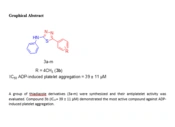
Platelets play an important role in maintaining cardiovascular integrity and in regulating the bleeding process by blood-clot formation (
1). However, uncontrolled platelet aggregation is dangerous in arterial blockage and may lead to life threatening disorders (
2). Antiplatelet agents are therefore considered as a significant tool in the treatment and/or prevention of cardiovascular thrombotic disease (
3-
5). Antiplatelet agents such as aspirin (acetylsalicylic acid), clopidogrel or ticlopidine and anticoagulants such as warfarin are currently two predominant groups of orally consumable drugs in standard therapeutic protocols for prophylaxis and treatment of venous thrombosis and reducing the risk of recurrent myocardial infarction (
6-
8).
Currently aspirin, which irreversibly inhibits cyclooxygenase I-mediated transformation of arachidonic acid to thromboxane A
2 (TXA
2), and the P
2Y
12 antagonists clopidogrel and prasugrel, which selectively and irreversibly bind to theP
2Y
12 ADP receptor are routinely used as antiplatelet agents (
9,
10).
However there are still some serious limitations to these agents which include weak inhibition of platelet function (
eg. aspirin) (
11), slow onset of action (
eg. clopidogrel) (
12), variable response to treatment among the patients (
eg. clopidogrel and aspirin) (
11,
12) and high incidence of bleeding events which occur in both aspirin and clopidogrel drug therapy (
13,
14). Considering the current situation, development of novel antiplatelet agents which are safe and effective is an urgent need (
15).
Aminopyrimidine derivatives are an interesting group of compounds with various reported biological properties. Pyrimidine ring can be found in the structures of many important drugs such as nucleoside antibiotics, antibacterials and cardiovascular agents (
16,
17).
Active antiplatelet pyrimidine derivatives. A. 6-alkylamino-2,4-dialkyl(aryl)thiopyrimidines [7], R = Me,
Based on the hypothesis suggested by Cattaneo
et al. (
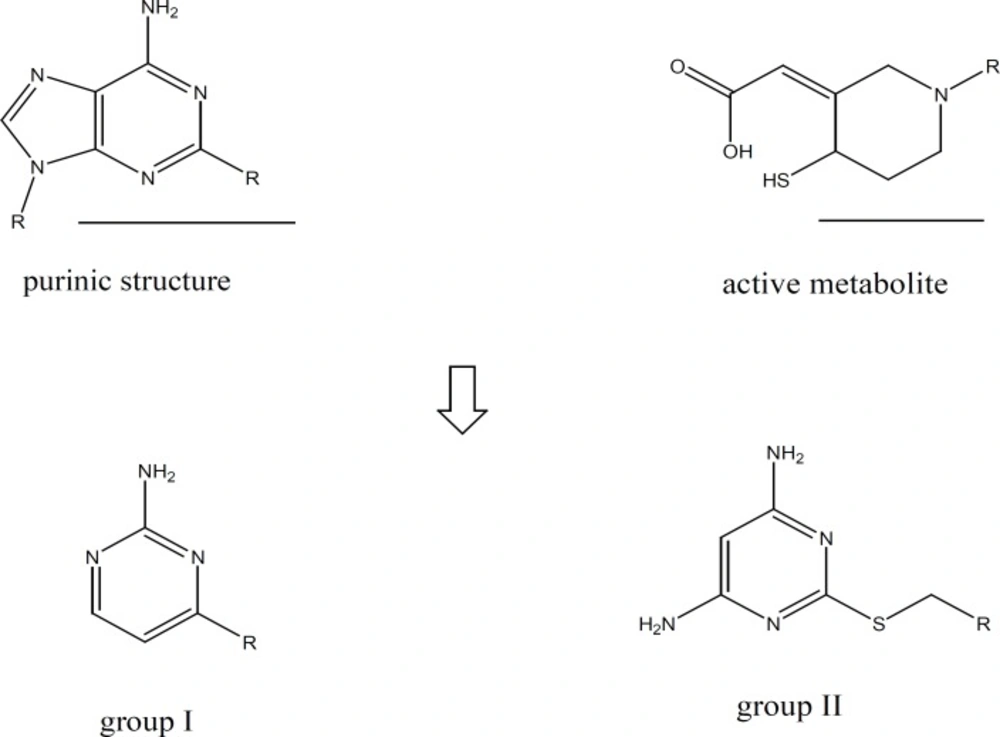
18), amino pyrimidine ring could be considered as a simplified form of the active metabolites of the thienopyridines and ATP derivatives. The active metabolites of thienopyridines have a simple monocyclic structure which implies that the presence of a bicyclic structure like that of a purine ring is not an absolute requirement for the affinity for the ADP receptor or so on platelet membrane.
Comparing the structures of aminopyrimidines with the structures of purine and the active metabolite of clopidogrel.
A group of amino pyrimidine derivative with thioether substituents has been synthesized and evaluated by Cattaneo
et al. The compound showed satisfactory anti platelet aggregation effects when ADP had been used for aggregation induction (
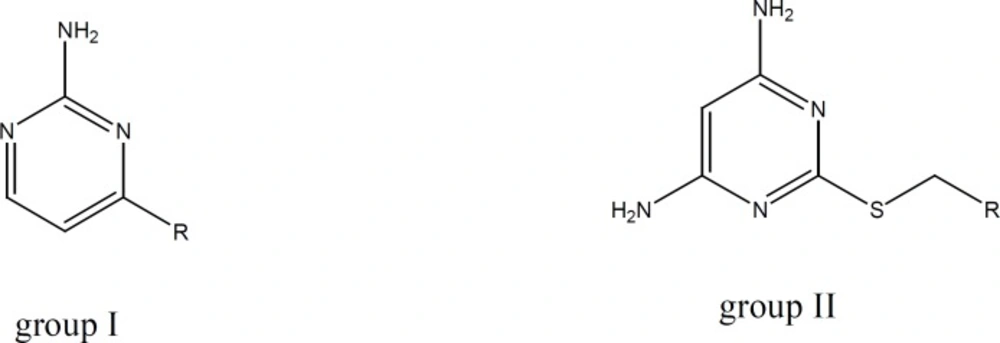
18). Based on the mentioned reports and in order to investigate the capability of amino pyrimidine derivatives in inhibition of platelet aggregation pathways, we synthesized two groups of amino pyrimidines with the following structures:
Chemical structure of the synthesized compounds
Comparing the activity of these compounds in inhibition of platelet aggregation induced by ADP and arachidonic acid will provide some insights into the structure activity relationship of these compounds.
Chemistry
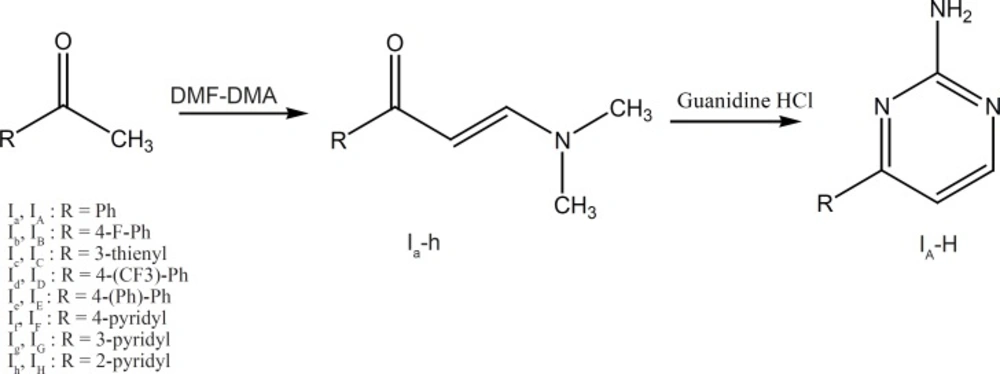
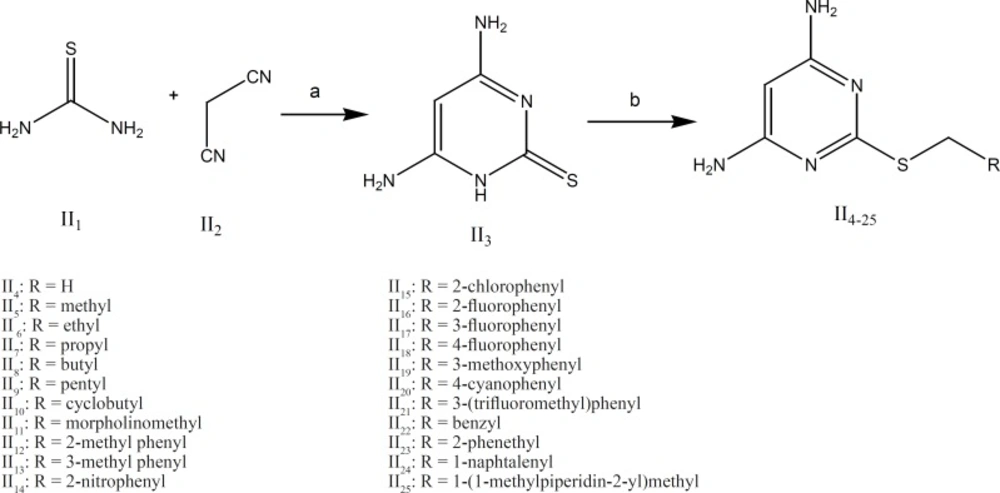
The synthetic procedures for groups I and II are illustrated in
Figures 4 and
5.
Group I: Methyl ketones (1a-h) were allowed to react with dimethylformamide-dimethylacetate (DMF-DMA) to produce 3-(dimethylamino)-1-aryl-2en-1-ones (2a-h). These intermediates could be then condensed with guanidine HCl to obtain the corresponding amino pyrimidine ring systems (
19).
Compounds (Ia-h) and (IA-H) synthesis scheme. Reagent and conditions: (a) DMF, reflux, 24 h; (b) NaOCH3, Isopropanol, reflux, 48 h.
Group II: As it is shown in
Figure 5 the intermediate II
3 (4,6-diaminopyrimidine-2-thiol) was obtained by the reaction of thiourea and malononitrile in absolute ethanol as the solvent. Subsequent reaction of compound II
3with various alkylhalides at room temperature afforded compounds II
4-25 in good yields.
Structure confirmation of the synthesized intermediates and the final products was performed using IR, NMR and Mass spectrometry (
20).
Compounds (II4-25) synthesis scheme. Reagents and conditions: (a) EtONa, reflux, 3 h; (b) NaOH 0.1 M, CH3OH, R-CH2-X (X = Cl, Br), rt, 18 h10).


![Active antiplatelet pyrimidine derivatives. A. 6-alkylamino-2,4-dialkyl(aryl)thiopyrimidines [7], R = Me,](https://brieflands.com/journals/ijpr/articles/125362/figures/ijpr-14-417-g001-preview.webp)