Introduction
In recent years, a variety of materials are chosen as drug carriers for their excellent properties. Hydrotalcites (1) have attracted attention as controlled release system which was intercalated kinds of drug anions in the interlayer gallery as well as montmorillonite (2). In addition, polymer-based sustained release system has been studied as means of delivery drugs. Such as polymeric matrix (3, 4), which is one of the useful devices for controlled delivery and stabilization of a drug, and hydrogel (5), which has played an important role in regional delivery in order to provide high local concentration and to decrease the incidence of side effects commonly observed with systemic therapy (6).
Carbon nanotubes (CNTs) have attracted considerable attention on application of drug carrier system since their discovery by Iijima in 1991 for the excellent physicochemical properties (7) as well as the unique hollow structure and nano diameter (8). However, the chemical inertness limits its vast application (9). Over the last decade, lots of effects have been made to optimize conditions for functionalization of CNTs using polymers (10, 11).
Chitosan is well-known as nontoxic and biologically degradable (12, 13) and increase its use in a suitable functional material for biomedical utilization for its bioactivity and biocompatibility. In this work, multi-walled carbon nanotubes/Chitosan hydrogel served as carrier and naproxen was used as model drugs. The In-vitro releases of the drug were study in different pH conditions. Release mechanisms of the model drugs from hydrogel were investigated via four kinetics equations. The comparison studies on drug delivery behavior and swelling ability of CNTs-GEL with hydrogel synthesized without CNTs (GEL) were conducted.
Experimental
Materials
Multi-walled carbon nanotubes were purchased from Nanoport Co.Ltd. Shenzhen, China. According to the specification of the manufacturer, the samples of nanotubes are 20-40 nm in diameter and about 5-15 μm in length, with approximately less than 3% amorphous carbon. Chitosan with viscosity < 200 mPa.s was purchased from Chengdu Kelong Reagent Co.Ltd. Naproxen with purity > 99% were obtained from Xiya Co.Ltd. Chengdu, China. Glutaraldehyde was purchased from Sinopharm Chemical Reagent Co.Ltd. All other chemicals used were of analytical grade, without further purification.
Synthesis of hydrogels
Hydrogels containing CNTs (CNTs-GEL) and the pure hydrogel without CNTs (GEL) were both prepared in this experiment in order to compare the effectiveness of CNTs on the sustained release of this kind of hydrogel.
The commercial MWCNTs were treated with concentrated nitric acid at 100°C for 8 h, washed with deionized water several times and dried at 80°C. Acid-treated MWCNTs were placed into reactor containing N, N-2-dimethyl formamide (DMF) and acetic acid solution of chitosan in scheduled proportion. After dispersing in sonicator with ultrasonic power: 200 W and frequency: 40 KHZ for 30 min under room temperature, the reaction was performed at 95°C for 24 h. The products, named CS-MWCNTs, obtained by twice adjusting pH value of the mixture and centrifuging with 3000 rpm in succession to remove un-reacted materials, were vacuum filtered, and the filter cakes were washed with ethanol for three times, and then dried under vacuum at 80°C for 24 h. Scanning electron microscope (SEM) and Fourier transform infrared (FTIR) spectroscopy were both used to observe the products.
CNTs-GEL was prepared by CS-CNTs gelling with Chitosan (mass ratio of CS/CS-MWCNTs=1:3), taking glutaraldehyde (2.5% about 2 mL) as gelling agent. In addition, a cleaning process was needed to remove all the impurities and unreacted chemicals in the method of immersing hydrogels in deionized water and changing water at regular time. GEL was prepared in a similar way, but only by chitosan with help of glutaraldehyde serving as gelling agent and with a cleaning process as well. Both kinds of hydrogels should be dried in an oven under vacuum at about 40°C for 7 h.
Synthesis of naproxen-loaded CNTs-GEL and GEL
Naproxen was entrapped into the CNTs-GEL and GEL by soak method. A certain amount of CNTs-GEL () and GEL () was soaked in naproxen solution for 4 h respectively. Drug-loaded CNTs-GEL and GEL were vacuum dried to constant weight (m1). Loading amount of naproxen was determined as: m1-m0. Loading efficiency of naproxen was determined as follows:
(1)
Swelling studies
Swelling studies of CNTs-GEL and GEL were carried out in two aqueous media: 0.1 mol/L HCl solution (pH 1.2) as simulated gastric fluid and phosphate buffer solutions (pH 7.4) as simulated intestinal fluid. The sample was placed at 37°C in the vessel containing the two kinds of media, respectively. At regular intervals, the gel was reweighed after carefully wiping off excess liquid with filter paper. The swelling ratio of the hydrogel was determined as follows:
(2)
where W0 represents weights of initial hydrogel, Ws is weight of wet hydrogel and S is swelling ration of hydrogel.
In-vitro release experiments
The in-vitro drug release tests were performed in a vessel containing 100 mL medium of simulated gastric fluid (pH 1.2) or simulated intestinal fluid (pH 7.4), respectively. The temperature was maintained at 37 ± 0.5 °C, and the stirring speed was 100 rpm. 3 mL solution was collected from the release medium at regular intervals. After each sample collection, the medium was replenished with equal amount of fresh buffer to maintain a constant volume. Samples were analyzed by UV-vis spectrophotometer at maximum absorption wavelength based on the established UV standard absorbance curves for drugs.
Results and Discussions
SEM of CNTs before and after modification
Scanning electron microscopy (SEM) studies were performed for characterizing the structure of the acid-treated MWCNTs and CS-MWCNTs. Figure 1 shows the SEM images of MWCNTs before and after modification. It is found that the MWCNTs treated by concentrated nitric acid (Figure 1a) presents slender with bulge on partial surface, It may be attributed to that nitric acid treatment produces carboxylic groups and the functionalized amorphous carbon on the MWCNTs according to theory from the previous works (14, 15). After surface modification of MWCNTs with biopolymer CS by direct heating approach (Figure 1b), the surface topography of MWCNTs changed significantly, which proves that surface of MWCNTs is covered with chitosan, simultaneous with wrapping of the polymers to the surface of MWCNTs.
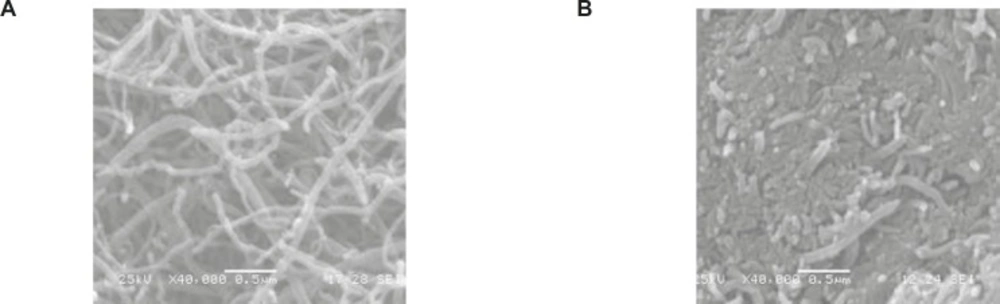
Figure 1
SEM images of acid-treated CNTs (a) and CS-CNTs (b).
FTIR analysis of CNTs before and after modification
Fourier Transform Infrared (FTIR) spectra of acid-treated MWCNTs (a) and CS-MWCNTs (b) are shown in Figure 2. In Figure 2(a), the wide and intense band at 3220 cm-1 is attributed to the vibration of -OH in carboxyl group, the characteristic peaks at 1513 cm-1 and 1040 cm-1 are due to the vibration of C=O and C-O, respectively. In Figure 2(b), the intense bands at 3480 cm-1 and 1040 cm-1 are attributed to the stretching vibration of N-H and C=O in -CONH, respectively, which confirm that the polymer was grafted onto MW CNTs via the amide linkage.
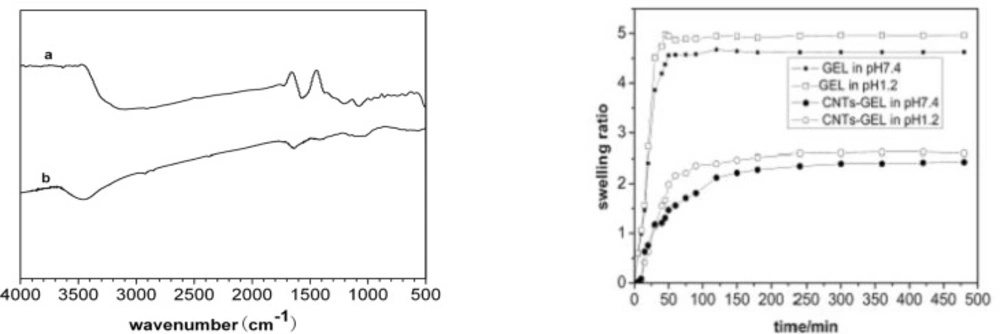
Figure 2
Infrared spectra of acid-treated CNTs (a) and CS-CNTs (b).
Swelling studies on hydrogel
In order to simulate the possible effect of pH on drug release rate, a swelling studies of CNTs- GEL and GEL were conducted in simulated gastric fluid (pH 1.2) and simulated intestinal fluid (pH 7.4) at physiological temperature of 37°C±0.5°C. Hydrogel is a cross-linked hydrophilic polymer, so it can interact with the aqueous medium and swell in water to an equilibrium volume, but preserve its shape. As shown in Figure 3, swelling ratios of the two kinds of hydrogel in artificial intestinal juice is much higher than in artificial gastric juice. Side-chain amino of chitosan is pH-sensitive. In alkaline medium, Amino group exists in the free state, and the hydrogen bonding interaction is enhanced, so the swelling ratio is relative small. It is found that the swelling rate for the CNTs-GEL is slower than that for hydrophilic GEL. The significant difference of final ratio is probably due to the change of the osmotic pressure in two artificial juices. Each experiment was conducted in triplicate (RSD ≤ 5.0).
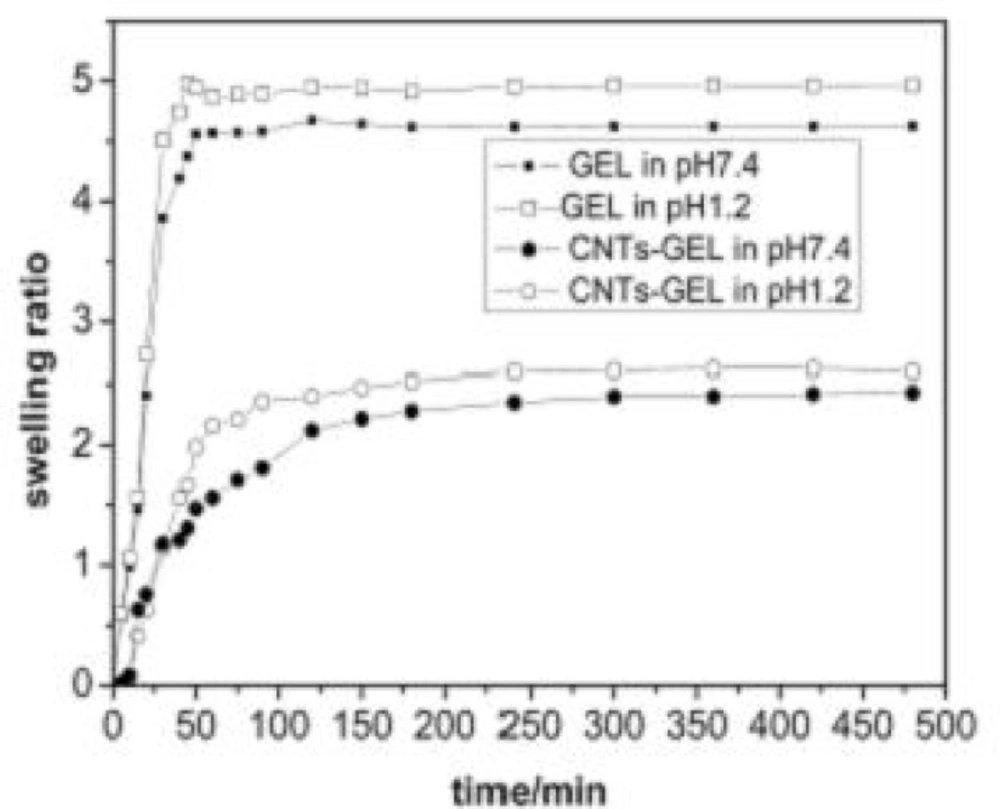
Figure 3
Swelling ratio profiles of the CNTs-GEL and GEL in simulative gastrointestinal fluids.
In-vitro drug release studies
Table1 shows that naproxen-loaded efficiency of CNTs-GEL is quite different from naproxen- loaded GEL. Naproxen-loaded efficiency of CNTs-GEL is much higher than that of GEL. It can be inferred from that GEL of cross-linked chitosan cannot interact effectively with hydrophobic naproxen. Naproxen may interact with CS-MWCNTs by intermolecular interactions.
Figure 4 showed the release behaviors of drugs in buffer solutions. In this study, naproxen was taken as model drug to examine the release behavior from the CNTs-GEL and GEL in simulative gastrointestinal fluid (pH 7.4 and pH 1.2), respectively. Each experiment was conducted in triplicate (RSD≤4.6).
Release of naproxen from the hydrogel was shown in Figure 4, which indicated a burst effect in both CNTs-GEL and GEL mediums in first 30 min, which should be attributed to the concentration gradient of the drugs between the gel and the media. Then naproxen release slowly in CNTs-GEL mediums. The release behavior of naproxen is identical with the swelling of both kinds of gels in two different fluids.
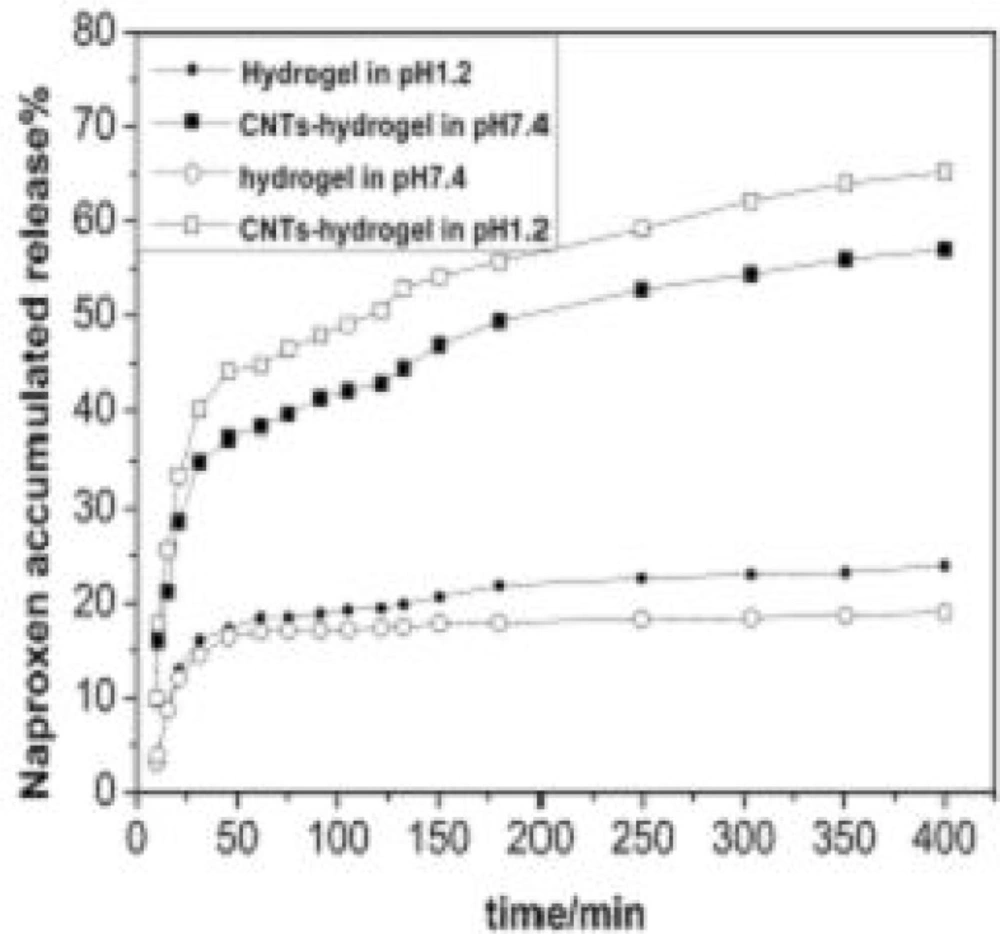
Figure 4
Accumulative release profiles of naproxen in simulative gastrointestinal fluid
Table 1
Drug-loading ratios of CNTs-GEL or GEL
| Item | e% | RSD |
|---|---|---|
| CNTs-GEL (n = 3) | 78.4 | <5% |
| GEL (n = 3) | 29.7 | <5% |
It is noted that the dissolution rate of naproxen is somehow pH dependent. The release performance in acidic solution was more obvious. pH have great impact on swelling ratio and swelling degree. pH value of solution also influence the characteristics of molecular. In the acidic solution, repulsive forces between naproxen molecular and CNTs, collaborating with swelling effect force naproxen release to solution. Because of naproxen hydrophobicity, naproxen release performance will decrease in relative high concentrations of naproxen solution.
Kinetics release
With the purpose of getting insight into the release mechanism of carbon nanotubes hydrogel, the release data of two types of medicine carrying hydrogel in simulative gastrointestinal fluid were fitted to classic drug-release kinetics models. Bhaskar model (eq.(3)), Higuchi model (eq.(4)), first order model (eq. (5)) and Ritger-Peppas empirical model (eq.(6)) (16, 17).
ln(1−R)= c×t0.65 (3)
R =c × t0.5 (4)
−ln(1−R) = c×t (5)
lg R = k ×lg(c×t) (6)
Where R represents release percentage, t is the time, c is release rate constant and k, release exponent.
The analysis results are summarized in Table 2. As is shown, release data of naproxen is better fitted Ritger-Peppas empirical model in pH=1.2, indicating that it was fick-diffusion (k ≤ 0.43) while in pH=7.4 it was non-fick diffusion involving surface diffusion and corrosion diffusion processes (0.45≤ k ≤0.89).
Table 2
Kinetics data of carbon nanotubes hydrogel in different conditions
| Kinetics | Bhaskar | Higuchi | First order | Ritger-peppas | |||||
|---|---|---|---|---|---|---|---|---|---|
| c | r | c | r | c | r | c | k | r | |
| Naproxen pH=1.2 | -0.0127 | 0.9503 | 4.1029 | 0.9691 | 0.0016 | 0.8391 | 0.1471 | 0.4112 | 0.9903 |
| Naproxen pH=7.4 | -0.00948 | 0.9541 | 3.5697 | 0.9607 | 0.0013 | 0.8379 | 0.3748 | 0.6724 | 0.9871 |
Conclusion
A new kind of drug carrier, carbon nanotubes hydrogel (CNTs-GEL) was synthesized by chitosan modified multi-walled carbon nanotubes (CS-MWCNTs). The comparison of in-vitro drug release behaviors between CNTs-GEL and the hydrogel without MWCNTs was conducted, so as to corroborate that MWCNTs contributed to improve the effect of sustained release of hydrogel. The release mechanism in pH=1.2 was found as fick-diffusion but a non-fick diffusion process involving surface diffusion and corrosion diffusion in pH = 7.4.