Materials and Methods
Chemicals of high purity were obtained from E. Merck India Ltd, CDH, S D Fine- Chem Limited, India and Qualigens Fine Chemicals, India. Melting points were taken on slides in an electrical apparatus (Lab India visual melting range apparatus) and are uncorrected. IR spectra were recorded on Jasco FT-IR spectrophotometer and vmaxvalues are given in cm-1. 1H and 13C NMR spectra were recorded in CDCl3 and DMSO-d6 on a Bruker Nuclear Magnetic Resonance (NMR) spectrometer at 400 MHz and 100 MHz respectively using tetramethylsilane (TMS) as an internal reference. Chemical shifts are expressed in delta (δ). Mass spectra were recorded on a Jeol SX- 102/DA-6000 (Tokyo, Japan) spectrometer.
Synthesis of substituted benzothiazole derivatives
Synthesis of 2-(3/4-amino phenyl) benzothiazole derivatives
Accurately weighed quantities of molecular iodine (0.008 mM) and 3/4-amino benzoic acid (0.0084 mM) were placed in a mortar. Then, 2-aminothiophenol (0.008 mM) was added drop wise to the mortar with trituration. The progress of reaction was monitored with the help of TLC (toluene: ethyl acetate: formic acid, 5:4:1). Trituration was continued for approximately 10 min i.e. till the completion of reaction. The crude solid product was recrystallized in 70% methanol.
Synthesis of different substituted benzene sulfonyl chlorides
Benzene or its substituted derivatives (0.148 M) was placed in a two necked flask with a dropping funnel and a reflex condenser. Chlorosulfonic acid (0.77 M) was taken in a dropping funnel with a calcium chloride guard tube attached to it. The chlorosulfonic acid was added in small portions with stirring. The resulting mixture was further heated on a water bath for one hour. The oily mixture was cooled and poured in a thin stream into a beaker containing crushed ice. The flask was rinsed with ice water and the rinsing was added to the beaker.
The mixture was stirred to obtain the sulfonyl chloride derivative which was filtered off. The product was washed with cold water and dried (
19).
Synthesis of N-(4-(benzothiazole-2-yl) phenyl) ¾ substituted benzene sulfonamides
2-(3/4-amino phenyl) benzothiazole derivatives (0.01 M) was added to the mixture of pyridine (4 mL) and acetic anhydride (20 mL). After the addition of benzene sulfonyl chlorides (0.01 M) to the above mixture, it was heated on a water bath for 2 h.
The reaction mixture was poured onto 30 mL of water and the solid product so obtained was filtered and recrystallized from 80% ethanol (
20).
N-(4-(benzothiazole-2-yl) phenyl) benzenesulfonamide (1)
mp. 236-238 °C; yield 56%; Rf 0.64; IR (vmax, KBr, cm-1): 3333 (N-Hstr), 3090 (-SO2NHstr), 1625 (C=N), 1468, 1356 (C-Nstr), 1142; 1H NMR (CDCl3): δ 4.34 (s, 1H, NH), 7.22-7.89 (m, 13H, Ar-H); 13C NMR (CDCl3): δ 115.1-148.5 (18C, Ar), 168.6 (1C, -C=N); (MS: m/z 366(M+; C19H14N2O2S2), 368(M++2).
N-(4-(benzothiazole-2-yl) phenyl)-4-chlorobenzene sulfonamide (2)
mp. 296-299 °C; yield 48%; Rf 0.76, IR (vmax, KBr, cm-1): 3352(N-Hstr), 3115 (-SO2NHstr), 1654(C=N), 1453,1370(C-Nstr), 1145, 694; 1H NMR (CDCl3): δ 4.23 (s, 1H, NH), 7.15-7.89 (m, 12H, Ar-H); 13C NMR (CDCl3): δ 115.3-151.2 (18C, Ar), 169.3 (1C, -C=N); MS: m/z 400(M+; C19H13ClN2O2S2), 402(M++2).
N-(4-(benzothiazole-2-yl) phenyl)-4-bromobenzenesulfonamide (3)
mp. 220-223 °C; yield 53%; Rf 0.79; IR (vmax, KBr, cm-1): 3333(N-Hstr), 3108 (-SO2NHstr), 1612(C=N), 1474, 1389(C-Nstr), 1142, 687; 1H NMR (DMSO-d6): δ 4.70 (s, 1H, NH), 7.36-7.97 (m, 12H, Ar-H); 13C NMR (DMSO-d6): δ 115.3-148.7 (18C, Ar), 168.6 (1C, -C=N); MS: m/z 444(M+; C19H13BrN2O2S2), 446 (M++2).
N-(4-(benzothiazole-2-yl) phenyl)-4-fluorobenzenesulfonamide (4)
mp. 274-278 °C; yield 41%; Rf 0.73; IR (vmax, KBr, cm-1): 3318(N-Hstr), 3119 (-SO2NHstr), 1650(C=N), 1465,1345(C-Nstr), 1156; 1H NMR (DMSO-d6): δ 4.58 (s, 1H, NH), 7.16-7.78 (m, 12H, Ar-H); 13C NMR (DMSO-d6): δ 115.3-148.8 (18C, Ar), 168.9 (1C, -C=N); MS: m/z 384(M+; C19H13FN2O2S2), 386 (M++2).
N-(4-(benzothiazole-2-yl) phenyl)-4-methylbenzene sulfonamide (5)
mp. 225-227 °C; yield 67%; Rf 0.75; IR (vmax, KBr, cm-1): 3392(N-Hstr),3084 (-SO2NHstr), 1658(C=N), 1445, 1352(C-Nstr), 1163; 1H NMR (CDCl3): δ 2.50 (s, 3H, CH3), 4.11 (s, 1H, NH), 7.12-7.90 (m, 12H, Ar-H); 13C NMR (CDCl3): δ 21.4 (1C, -CH3),114.9-147.4 (18C, Ar), 169.1 (1C, -C=N); MS: m/z 380(M+; C20H16N2O2S2), 382(M++2).
N-(4-(benzothiazole-2-yl) phenyl)-4-nitrobenzene sulfonamide (6)
mp. 245-248 °C; yield 59%; Rf 0.81; IR (vmax, KBr, cm-1): 3279(N-Hstr), 3088 (-SO2NHstr), 1651(C=N), 1504, 1319(C-Nstr), 1149; 1H NMR (CDCl3): δ 4.19 (s, 1H, NH), 7.26-8.13 (m, 12H, Ar-H); 13C NMR (CDCl3): δ 114.9-149.9 (18C, Ar), 170.1 (1C, -C=N); MS: m/z 411 (M+; C19H13N3O4S2), 413(M++2).
N-(4-(benzothiazole-2-yl) phenyl)-4-bromo-3-methylbenzenesulfonamide (7)
mp. 264-267 °C; yield 39%; Rf 0.84; IR(vmax, KBr, cm-1): 3418(N-Hstr), 3112 (-SO2NHstr), 1595(C=N), 1445, 1352(C-Nstr), 1150, 635; 1H NMR (DMSO-d6): δ 2.67 (s, 3H, CH3), 4.39 (s, 1H, NH), 7.29-8.01 (m, 12H, Ar-H); 13C NMR (DMSO-d6): δ 18.9 (1C, -CH3),116.2-149.1 (18C, Ar), 169.8 (1C, -C=N); MS: m/z 458 (M+; C20H15BrN2O2S2), 460 (M++2).
N-(4-(benzothiazole-2-yl) phenyl)-3-benzenesulfonamide (8)
mp. 224-225 °C; yield 58%; Rf 0.69; IR (vmax, KBr, cm-1): 3455(N-Hstr),3085 (-SO2NHstr), 1620(C=N), 1470, 1350(C-Nstr), 1145; 1H NMR (DMSO-d6): δ 4.46 (s, 1H, NH), 7.20-7.83 (m, 13H, Ar-H); 13C NMR (DMSO-d6): δ 115.6-148.1 (18C, Ar), 169.8 (1C, -C=N); MS: m/z 366(M+; C19H14N2O2S2), 368(M++2).
N-(4-(benzothiazole-2-yl) phenyl)-3-chlorobenzenesulfonamide (9)
mp. 268-271°C; yield 49%; Rf 0.72; IR (vmax, KBr, cm-1): 3375(N-Hstr),3102 (-SO2NHstr), 1640(C=N), 1445, 1370(C-Nstr), 1155, 705; 1H NMR (CDCl3): δ 4.39 (s, 1H, NH), 7.28-7.87 (m, 12H, Ar-H); 13C NMR (CDCl3): δ 115.5-149.9 (18C, Ar), 169.2 (1C, -C=N); MS: m/z 400(M+; C19H13ClN2O2S2), 402(M++2).
N-(4-(benzothiazole-2-yl) phenyl)-3-bromobenzenesulfonamide (10)
mp. 211-214 °C; yield 48%; Rf 0.74; IR (vmax, KBr, cm-1): 3425(N-Hstr),3068 (-SO2NHstr), 1636(C=N), 1470, 1355(C-Nstr), 1145; 1H NMR (CDCl3): δ 4.51 (s, 1H, NH), 7.37-7.91 (m, 12H, Ar-H); 13C NMR (CDCl3): δ 115.6-149.8 (18C, Ar), 169.2 (1C, -C=N); MS: m/z 444(M+; C19H13BrN2O2S2), 446 (M++2).
N-(4-(benzothiazole-2-yl) phenyl)-3-fluorobenzene sulfonamide (11)
mp. 252-255 °C; yield 46%; Rf 0.69; IR (vmax, KBr, cm-1): 3401(N-Hstr),3095 (-SO2NHstr), 1650(C=N), 1465, 1365(C-Nstr), 1160; 1H NMR (CDCl3): δ 4.34 (s, 1H, NH), 7.21-7.78 (m, 12H, Ar-H); 13C NMR (CDCl3): δ 115.6-149.9 (18C, Ar), 169.8 (1C, -C=N); MS: m/z 384(M+; C19H13FN2O2S2), 386(M++2).
N-(4-(benzothiazole-2-yl) phenyl)-3-methylbenzenesulfonamide (12)
mp. 184-186 °C; yield 62%; Rf 0.78; IR (vmax, KBr, cm-1): 3355(N-Hstr),3078 (-SO2NHstr), 1650(C=N), 1445, 1345(C-Nstr), 1150; 1H NMR (CDCl3): δ 2.38 (s, 3H, CH3), 4.56 (s, 1H, NH), 7.15-7.77 (m, 12H, Ar-H); 13C NMR (CDCl3): δ 19.8(1C, -CH3), 115.3-147.2 (18C, Ar), 168.9 (1C, -C=N); MS: m/z 380(M+; C20H16N2O2S2), 382(M++2).
N-(4-(benzothiazole-2-yl) phenyl)-3-nitrobenzenesulfonamide (13)
mp. 232-235 °C; yield 55%; Rf 0.83; IR (vmax, KBr, cm-1): 3410(N-Hstr), 3085 (-SO2NHstr), 1640(C=N), 1460, 1365(C-Nstr), 1160; 1H NMR (CDCl3): d 4.19 (s, 1H, NH), 7.19-8.06 (m, 12H, Ar-H); 13C NMR (CDCl3): d 115.9-150.1 (18C, Ar), 169.7 (1C, -C=N); MS: m/z 411(M+; C19H13N3O4S2), 413(M++2).
N-(4-(benzothiazole-2-yl) phenyl)-4-bromo-3-methylbenzenesulfonamide (14)
mp. 251-254 °C; yield 42%; Rf 0.87; IR (vmax, KBr, cm-1): 3378(N-Hstr),3092 (-SO2NHstr), 1590(C=N), 1495, 1350(C-Nstr), 1150, 630; 1H NMR (CDCl3): d 2.51 (s, 3H, CH3), 4.32 (s, 1H, NH), 7.23-8.01 (m, 12H, Ar-H); 13C NMR (CDCl3): d 18.1 (1C, -CH3),115.9-149.8 (18C, Ar), 169.6 (1C, -C=N); MS: m/z 458(M+; C20H15BrN2O2S2), 460 (M++2).
Pharmacological assay
Animals
Animal ethical clearance approval was obtained for the use of animals in the current study from Institutional Ethical Committee (IEC). Albino male mice weighing 25-30 gm were used in this study. A total of 5 animals were kept in each polypropylene cage under laboratory conditions with controlled environment of temperature 25 ± 2°C and 12 h light/dark cycle as per CPCSEA guidelines. The bedding of cages was made with dust free rice husk and animals were given free access to drinking water and fed ad libitum with standard laboratory rodent’s chow food. The animals were acclimatized with laboratory conditions for a period of one week. The animals were fasted overnight prior to the experiment.
Drug
Pentylenetetarazole (PTZ) – was used to induce convulsions. Phenytoin sodium and diazepam were used as standards in Maximal electroshock seizures (MES) and PTZ methods respectively. The solution of test compounds/drugs was prepared in 0.9 w/v% normal saline and then administered intraperitoneally (i.p.) in volumes of 0.1 mL/25 g of body weight.
| S. No. | Treatment (Comp no.) | Phases of convulsions: Mean ± SEM
|
|---|
| Flexion | Extension | Clonus | Stupor | Recovery |
|---|
| 1 | Control | 5.2 ± 0.58 | 12.6 ± 0.68 | 6.4 ± 0.68 | 12.4 ± 0.51 | 186.2 ± 5.3 |
| 2 | Standard | 3.6 ± 0.68* | 0* | 1.6 ± 0.24* | 1.6 ± 0.24* | 171.8 ± 2.92 |
| 3 | 1 | 3.4 ± 0.51* | 1.8 ± 0.37* | 4.4 ± 0.75* | 15.2 ± 1.07 | 145.2 ± 4.5* |
| 4 | 2 | 2.8 ± 0.37* | 1.6 ± 0.24* | 4.8 ± 0.37* | 16.6 ± 1.36 | 126.8 ± 208* |
| 5 | 3 | 8.4 ± 0.51 | 1.8 ± 0.58* | 5.0 ± 0.71 | 21 ± 2.24 | 131.4 ± 5.15* |
| 6 | 4 | 3.2 ± 0.86* | 1.6 ± 0.40* | 4.2 ± 0.86* | 18 ± 3.56 | 127.8 ± 4.55* |
| 7 | 5 | 4.6 ± 0.51 | 2.4 ± 0.51* | 4.4 ± 0.75* | 18.4 ± 2.06 | 128.6 ± 6.04* |
| 8 | 6 | 2.4 ± 0.51* | 1.8 ± 0.37* | 4.0 ± 0.71* | 17.8 ± 1.86 | 135.6 ± 0.69* |
| 9 | 7 | 2.2 ± 0.37* | 2.4 ± 0.51* | 4.8 ± 0.58 | 18 ± 2.07 | 133.8 ± 8.42* |
| 10 | 8 | 2.2 ± 0.58 | 1.6 ± 0.40* | 4.4 ± 0.51 | 19.8 ± 1.32 | 129.2 ± 3.67* |
| 11 | 9 | 1.8 ± 0.37* | 1.2 ± 0.20* | 3.8 ± 0.8* | 2.4 ± 2.83* | 129 ± 5.32* |
| 12 | 10 | 3.4 ± 0.40* | 1.4 ± 0.20* | 5.2 ± 0.86 | 19.4 ± 2.5 | 135.8 ± 11.2* |
| 13 | 11 | 2.2 ± 0.58* | 1.4 ± 0.40* | 4.8 ± 1.16* | 18 ± 2.07 | 120.4 ± 3.71* |
| 14 | 12 | 2.4 ± 0.74* | 1.6 ± 0.60* | 4.0 ± 0.70* | 17.8 ± 2.40 | 132.6 ± 3.01* |
| 15 | 13 | 2.2 ± 0.73* | 2.0 ± 0.77* | 5.0 ± 0.86 | 17.6 ± 3.31 | 128.8 ± 6.09* |
| 16 | 14 | 2.6 ± 0.4* | 1.8 ± 0.58* | 5.0 ± 1.14 | 15.8 ± 1.99 | 130.2 ± 3.65* |
p > 0.01 compared to control group.
| S. No. | Treatment (Compound No.) | % Inhibition in extensor phase (as compared to control group) |
|---|
| 1 | Control | 0 |
| 2 | Standard | 98.41 |
| 3 | 1 | 85.71 |
| 4 | 2 | 87.30 |
| 5 | 3 | 85.71 |
| 6 | 4 | 87.30 |
| 7 | 5 | 80.95 |
| 8 | 6 | 85.71 |
| 9 | 7 | 80.95 |
| 10 | 8 | 87.30 |
| 11 | 9 | 90.47 |
| 12 | 10 | 88.88 |
| 13 | 11 | 88.88 |
| 14 | 12 | 87.30 |
| 15 | 13 | 84.12 |
| 16 | 14 | 85.71 |
| S. No. | Treatment (Compound No) | Onset of convulsions | Onset of action (Mean ± SEM) | Quantal death |
|---|
| 1 | Control | 3.6 ± 0.51 | 10.8 ± 0.73 | 5/5 |
| 2 | Standard | 0* | 0 | 0/5 |
| 3 | 1 | 3.8 ± 0.37 | 10.6 ± 1.21 | 5/5 |
| 4 | 2 | 3.6 ± 0.81 | 13.0 ± 1.58 | 5/5 |
| 5 | 3 | 3.2 ± 0.37 | 12.6 ± 0.93 | 5/5 |
| 6 | 4 | 3.0 ± 0.32 | 12.8 ± 0.86 | 5/5 |
| 7 | 5 | 3.2 ± 0.58 | 17.6 ± 2.44 | 5/5 |
| 8 | 6 | 3.0 ± 0.71 | 19.0 ± 2.97 | 5/5 |
| 9 | 7 | 3.0 ± 1.05 | 16.6 ± 1.63 | 5/5 |
| 10 | 8 | 1.8 ± 0.37* | 16.6 ± 3.75 | 5/5 |
| 11 | 9 | 2.2 ± 0.49* | 18.4 ± 1.63 | 5/5 |
| 12 | 10 | 2.4 ± 0.75* | 13.4 ± 1.33 | 5/5 |
| 13 | 11 | 3.8 ± 0.49 | 14.6 ± 1.97 | 5/5 |
| 14 | 12 | 3.8 ± 0.58 | 13.6 ± 1.36 | 5/5 |
| 15 | 13 | 3.4 ± 1.03 | 14.6 ± 1.97 | 5/5 |
| 16 | 14 | 3.0 ± 0.77 | 15.0 ± 1.55 | 5/5 |
p > 0.01 compared to control group.
| S. No. | Structure | Mol Dock Score | Docking Score | H-bonds | H-bonds distance (Å) | Interacting Residue | Interacting Molecule |
|---|
| Standard | EPS_1050 [A] | -116.65 | -113.74 | 3 | 2.60,3.16,2.90 | Arg 277,Arg 277,Gln 276 | O of SO2-N,O of SO2-N,N of NH-O |
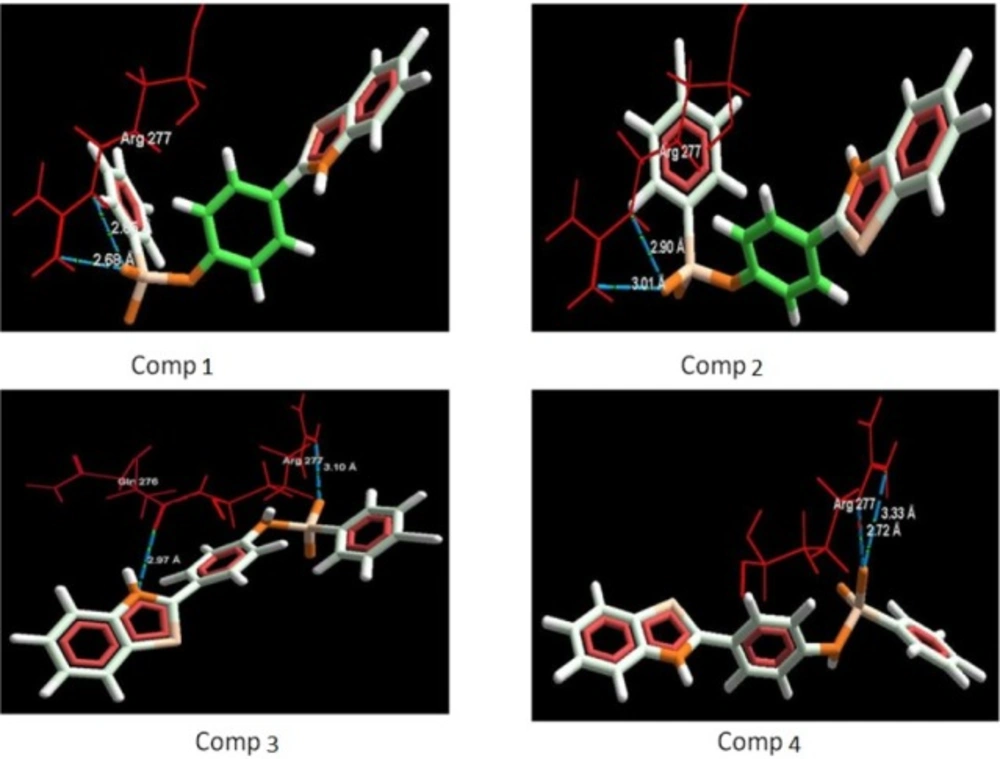
| 1 | H | -106.33 | -107.38 | 2 | 2.85,2.68 | Arg 277,Arg 277 | O of SO2-N,O of SO2-N |
| 2 | Cl | -110.31 | -110.90 | 2 | 2.90,3.00 | Arg 277,Arg 277 | O of SO2-N,O of SO2-N |
| 3 | Br | -111.83 | -112.06 | 2 | 3.10,2.96 | Arg 277,Gln 276 | O of SO2-N,N of thiazole-O |
| 4 | F | -107.09 | -107.16 | 2 | 2.72,3.32 | Arg 277,Arg 277 | O of SO2-N,O of SO2-N |
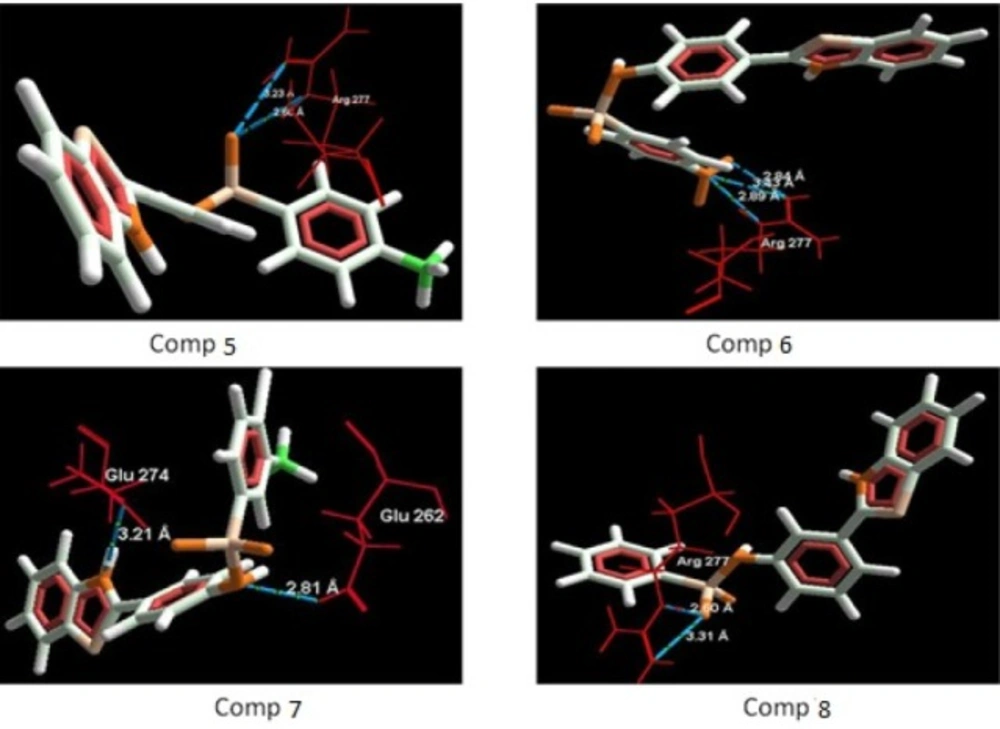
| 5 | CH3 | -110.72 | -111.97 | 2 | 2.60,3.20 | Arg 277,Arg 277 | O of SO2-N,O of SO2-N |
| 6 | NO2 | -114.67 | -118.59 | 3 | 3.88,2.42,2.84 | Arg 277,Arg 277, Arg 277 | N of NO2-N,N of NO2-N,O of NO2-N |
| 7 | Br, CH3 | -112.39 | -113.68 | 2 | 2.81,3.21 | Glu 262,Glu 274 | N of NH-O,N of thiazole-O |
| 8 | H | -104.49 | -104.69 | 2 | 2.60,3.21 | Arg 277, Arg 277 | O of SO2-N,O of SO2-N |
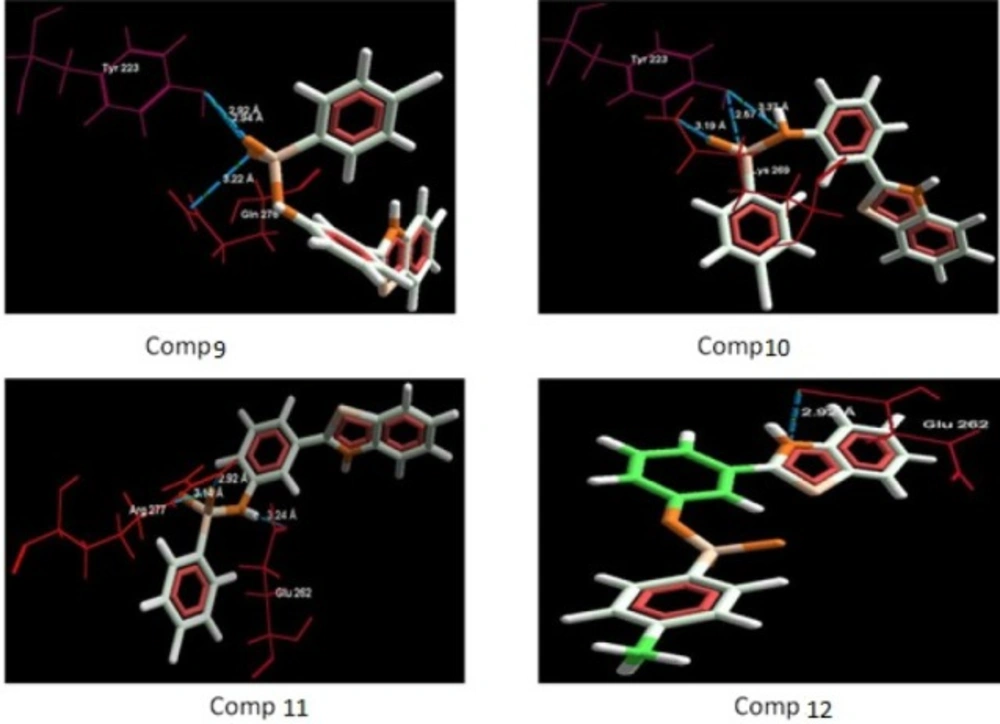
| 9 | Cl | -104.72 | -109.47 | 3 | 3.21,2.93,2.92 | Gln 276,Tyr 223,Tyr 223 | O of SO2-N,O of SO2-N,O of SO2-O |
| 10 | Br | -103.75 | 106.22 | 3 | 3.37,2.57,3.18 | Tyr 223,Tyr 223,Lys 269 | N of NH-O,O of SO2-O,O of SO2-N |
| 11 | F | -113.84 | -112.07 | 3 | 3.14,3.24,2.91 | Arg 277,Glu 262,Arg 277 | O of SO2-N,N of NH-O,O of SO2-N |
| 12 | CH3 | -107.75 | -106.90 | 1 | 2.92 | Glu 262 | N of thiazole-O |
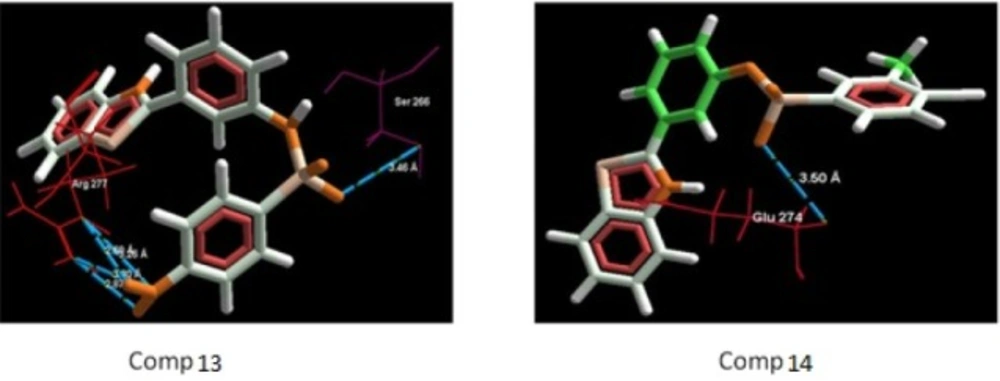
| 13 | NO2 | -115.37 | -120.35 | 5 | 3.29,3.25,3.45,2.59,2.85 | Arg 277,Arg 277,Ser 266,Arg 277,Arg 277 | N of NO2-N,N of NO2-N,O of SO2-O,O of NO2-N,O of NO2-N |
| 14 | CH3,Br | -110.09 | -110.29 | 1 | 3.50 | Glu 274 | O of SO2-O |
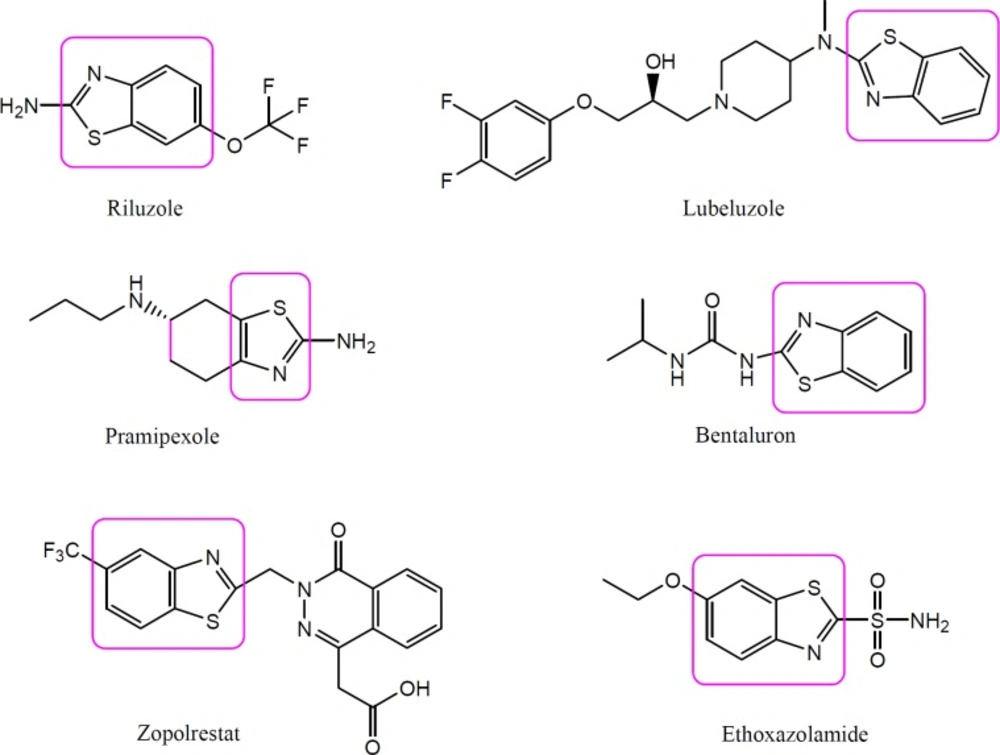
Chemical structures of few drugs containing benzothiazole nucleus
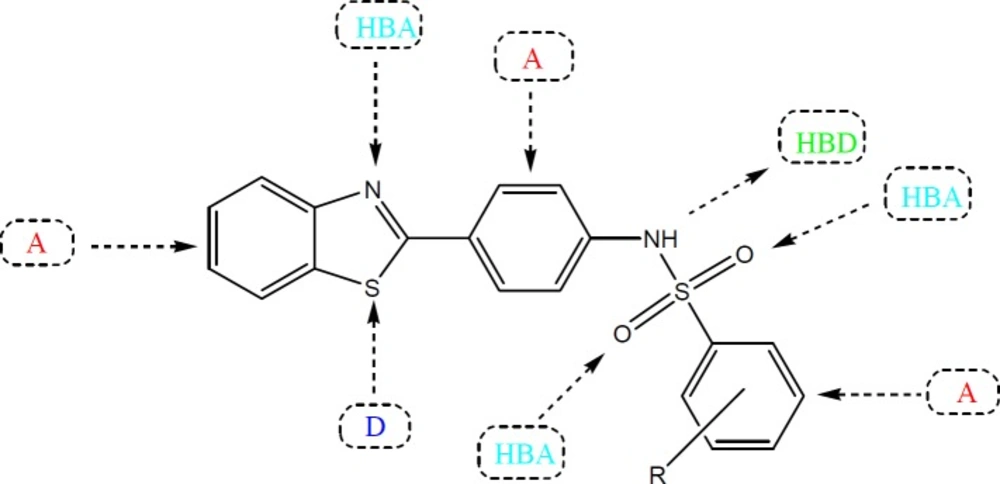
General chemical structure of title compounds showing essential pharmacophoric features of anticonvulsant agents (A: hydrophobic aryl ring, D: Electron donor atom, HBA; Hydrogn bond acceptor; HBD: Hydrogen bond donor).
Binding mode of compounds (1-4) in to nicotinic acetylcholine ion gated receptors. Hydrogen bonds are shown with blue dotted lines
Binding mode of compounds (5-8) in to nicotinic acetylcholine ion gated receptors. Hydrogen bonds are shown with blue dotted lines.
Binding mode of compounds (9-12) in to nicotinic acetylcholine ion gated receptors. Hydrogen bonds are shown with blue dotted lines
Binding mode of compounds (13-14) in to nicotinic acetylcholine ion gated receptors. Hydrogen bonds are shown with blue dotted lines
Synthesis of N-[(4-benzothiazole-2-yl) phenyl] ¾ substituted benzenesulfonamides
Anti-convulsant activity
Maximal electroshock (MES) method
In MES method, an electrical stimulus (12 mA, 50 Hz, 0.2 sec duration) was applied through ear-clip electrodes to induce tonic hind limb extension (THLE). The mice which showed extension of hind limb in preliminary screening were chosen for the current study. Sixteen groups (
1-
16) of five mice each pre-treated with normal saline: tween (10 mL/kg, as control), phenytoin (25 mg/kg as positive control) and test drugs (50 mg/kg), received the electroconvulsive shock 60 min later. The time of peak effect of phenytoin was previously established. After electrical stimulation, occurrence of THLE, duration and incidence of mortality were noted. Disappearance of the hind limb extensor tonic convulsion is used as positive criterion. Percentage of inhibition of seizures relative to controls is calculated as shown in
Table 1. The abolition in time of tonic extensor phase of MES-convulsions was recorded (
21)
PTZ induced seizures method
PTZ is a CNS stimulant that produces jerky type of clonic convulsions in rat and mice. The minimal
i.p. dose of PTZ at which 99% of the animals induce hind limb tonic extension (HLTE) was selected from the literature data (
22). PTZ at the dose of 60 mg/kg b.w. (minimal dose needed to induce convulsions) was injected
i.p. to induce clonic-tonic convulsions in animals. The groups (
3-
16) of animals (n = 5) received test compounds (50 mg/kg b.w,
p.o), the positive control group 2 received standard drug diazepam (1 mg/kg
i.p) and normal control group 1 was given normal saline: tween (10 mL/kg,
p.o). After 60 min of pre-treatment with test compounds/standard drug, PTZ (
i.p.) was administered to all sixteen groups and mice were observed for 30 min to detect the occurrence of general clonus, HLTE, and mortality. The delay of onset was calculated in comparison with the control group.
Neurotoxicity screening
The effect of synthesized compounds on neurotoxicity or minimal motor impairment in the mice was assessed by the rotarod test as per the standard method (
23). Albino mice were trained to stay for at least one minute on an accelerating rotating rod of diameter 3.2 cm and rotating at a speed of 10 rpm. Trained rodents which stayed on a rod for one minute were injected with the prepared compounds (
1-14) by
i.p. route at a dose of 300 mg/kg. Motor impairment was indicated by the inability of the animal to maintain equilibrium on the rod for at least 1 min in each of the three trials.
Statistical analysis
Data for anti-convulsant activity are expressed as mean ± SEM. One-way ANOVA followed by Dunnett’s test were used to test the statistical differences between vehicle control and treatment groups. A probability value of less than 0.01 was considered as significant.
Computational methodology
Molegro Virtual Docker (MVD) was used to perform the docking studies in order to probe the anti-convulsant actions of synthesized sulfonamide benzothiazole derivatives (
1-14) based on their structural features (
24). The binding modes, binding affinities and orientation of the target compounds at the ion gated channel receptor was predicted with the help of docking score and number of hydrogen bonds formed with the amino acid residues.
Ligand preparation
The 2D chemical structures of molecules were drawn using Marvin Sketch 5.11.0 and converted to 3D structures by optimization method. After the addition of explicit hydrogens the structures were saved as MDL Mol File (*.mol2).
Enzyme setup and procedure
Molegro Virtual Docker 4.0.2 program was used to perform the docking studies. All the five chains i.e. A, B, C, D and E of the crystal structure of Ion Channel receptor (2BG9) were selected for the docking studies. The structure was downloaded from protein data bank and docked with synthesized compounds. After docking, the compounds were ranked according to their docking scores and then visualised inside the protein’s binding pocket to obtain information about the fitting and nature of interactions with the active sites of main amino acid residues. The Hydrogen bond network was optimized in the subsequent stage of protein preparation by reorienting hydroxyl group, water molecules, and amide groups of the amino acid residues which are believed to act as gate for the ligand entrance in to the 2BG9 active sites such as Arg 277, Gln 276, Glu 262, Glu 274, Tyr 223, Lys 269 and Ser 266.


![Synthesis of <i>N</i>-[(4-benzothiazole-2-yl) phenyl] ¾ substituted benzenesulfonamides](https://brieflands.com/journals/ijpr/articles/126127/figures/ijpr-18-001-g007-preview.webp)
