General
All chemicals, reagents, and solvents were purchased from Merck AG and Aldrich Chemical. Melting points were determined on a Thomas–Hoover capillary apparatus. Infrared spectra were taken on a Perkin Elmer Model 1420 spectrophotometer in KBr pellets. 1H and 13C-NMR spectra were recorded on a Bruker FT-300 and 400 (Bruker Biosciences, USA) instrument at 300 (and 400) MHz and 75 MHz respectively, in DMSO-d6 or CDCl3 as solvents. The chemical shifts are recorded in ppm relative to tetramethylsilane as internal standard. Coupling constant (J) values are in hertz (Hz) and spin multiples are given as s (singlet), d (double), t (triplet), q (quartet), and m (multiplet). Mass spectral data were recorded on a 6410 Agilent LCMS triple quadrupole mass spectrometer (LCMS) with an electrospray ionization (ESI) interface.
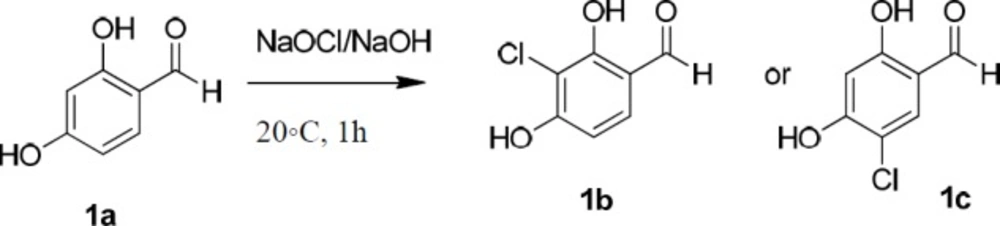
Synthesis of 3-chloro-2,4-dihydroxybenzaldehyde (1b)
Pale yellow solid; IR (vmax cm-1) (KBr): 3321 (OH), 1662 (C=O); 1H NMR (300 MHz-CDCl3) δ = 11.93 (s, 1H, CHO), 9.65 (s, 1H, OH), 7.33-7.36 (d, 1H, 2-chlorobenzenediol, J = 9.6 Hz), 7.48-8.03 (s, 1H, OH), 6.63-6.66 (d, 1H, 2-chlorobenzenediol, J = 9.3 Hz).
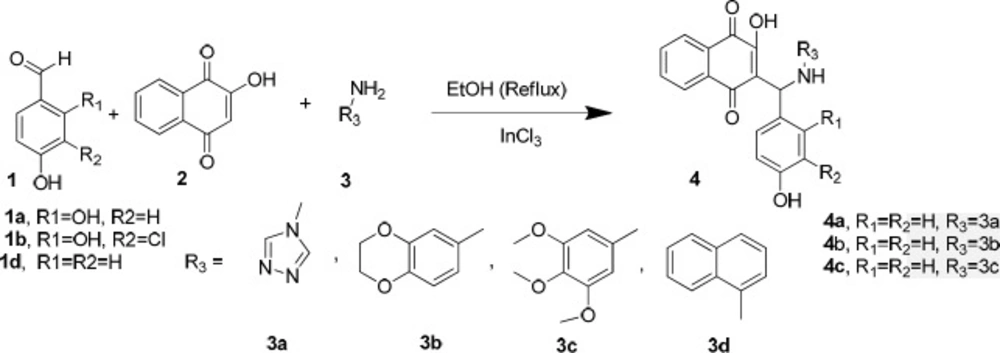
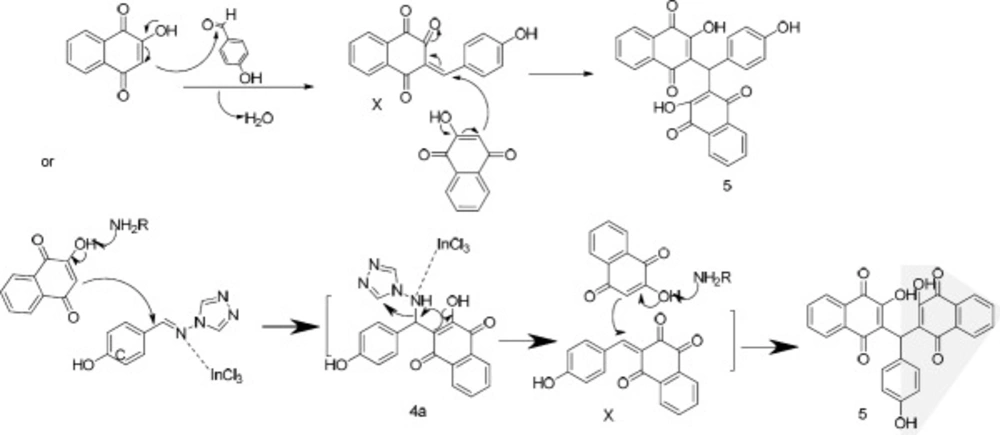
Synthesis of 2-((1,4-dihydro-2-hydroxy-1,4-dioxonaphthalen-3-yl) (4-hydroxyphenyl) methyl)-3-hydroxynaphthalene-1,4-dione (5)
A solution of amine 3a (1 mmol) and aldehyde 1d (1 mmol) was refluxed in ethanol for 3 h. Then, 1 mmol 2-hydroxy-1, 4-naphthoquinone, and 20 mol% InCl3 as catalyst were added to the mixture and put under reflux for an overnight. The resulted mixture was cooled down to room temperature and filtered. The precipitate was washed with a blend of ethanol-water (1:1 v/v ratio) and continued with ethanol lonely until the pure product was obtained.
Dark brick red solid; m.p: 175-177 °C (same as reference (17, 18)); IR (vmax cm-1) (KBr): 3321 (OH), 1662 (C=O); 1H NMR (300 MHz-DMSO) δ = 6.33 (s, 1H, CH), 6.55-6.57 (d, 2H, 4-hydroxyphenyl, H3 & H5, J = 8.8 Hz), 6.91-6.93 (d, 2H, 4-hydroxyphenyl, H2 & H6, J = 8.4 Hz), 7.68- 7.72 (t, 2H, 3-hydroxynaphthalen-1,4-dione, H7, J = 8 Hz), 7.76- 7.80 (t, 2H, 3-hydroxynaphthalen-1,4-dione, H6, J = 8 Hz), 7.90- 7.92 (d, 2H, 3-hydroxynaphthalen-1,4-dione, H8, J = 8 Hz), 7.93-7.95 (d, 2H, 3-hydroxynaphthalen-1,4-dione, H5, J = 8.4 Hz), 9.01(s, 1H, OH), 9.08 (s, 1H, OH); LC-MS (ESI): 453.1 (M+1)+.
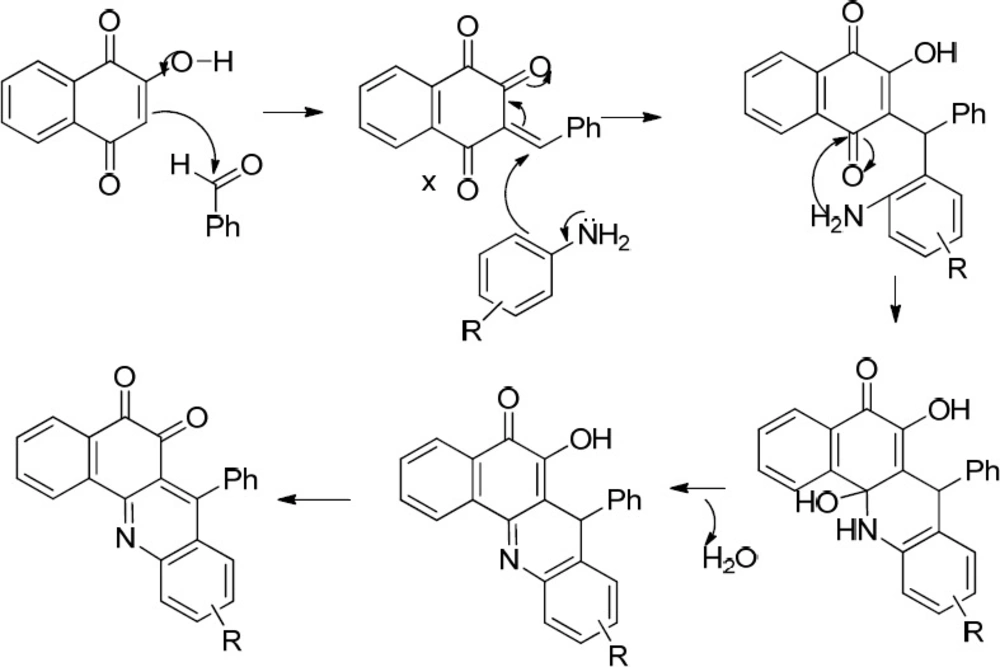
Synthesis of 7-(4-hydroxyphenyl)-10,11-dihydrobenzo[h][1,4]dioxino[2,3-b]benzoacridine-5,6-dione(6b)
1 mmol arylamine 3b and 1 mmol benzaldehyde 1d were solved in 4 mL ethanol. After 30 min stirring, 1 mmol naphthoquinone, 40 mol% InCl3 and 3 mL ethanol were added to the mixture reaction. The mixture was refluxed for an overnight. Subsequently, 80 mL water was added, resulting in the formation of fine precipitate. It was then filtered and the pure product was finally separated by preparative layer chromatography (eluent: chloroform/ethanol (60/6, v/v)).
Dark orange solid; m.p: 205 °C (decomposed); IR (vmax cm-1) (KBr): 3368 (OH), 1662 (C=O); 1H NMR (300 MHz-DMSO) δ = 4.37-4.38 (s, 2H, OCH2), 4.43-4.45 (s, 2H, OCH2), 6.79 (s, 1H, benzodioxin), 6.90-6.93 (d, 2H, 4-hydroxyphenyl, H3 & H5, J = 8.4 Hz), 7.05-7.08 (d, 2H, 4-hydroxyphenyl, H2 & H6, J = 8.4 Hz), 7.55 (s, 1H, benzodioxin), 7.63-7.69 (dt, 1H, benzoacridinedione, H2, J = 17.7 Hz, J = 8.4 Hz), 7.87- 7.92 (dt, 1H, benzoacridinedione, H3, J = 16.5 Hz, J = 8.1 Hz), 7.99-8.03 (dd, 1H, benzoacridinedione, H1, J = 12 Hz, J = 4.2 Hz), 8.83-8.86 (d, 1H, benzoacridinedione, H4, J = 7.5 Hz), 9.65-9.75 (s, 1H, OH); 13C NMR (75 MHz-DMSO) δ = 64.4, 67.5, 112.53, 114.28, 115.60, 122.13, 124.18, 126.61, 127.6, 128.36, 128.90, 129.92, 131.10, 132.25, 132.57, 135.78, 137.88, 145.59, 150.06, 150.31, 151.92, 157.60, 180.22, 180.26; LC-MS (ESI): 410.1 (M+1)+. Anal. Calcd for C25H17NO5: C, 72.99; H, 4.16; N, 3.40. Found: C, 69.85; H, 3.98; N, 3.22.
Synthesis of 7-(4-hydroxyphenyl)-8,9,10-trimethoxybenzo[c]acridine-5,6(7H,12H)-dione (7b)
One mmol arylamine 3c and 1 mmol benzalaldehyde 1d were solved in 4 mL ethanol and refluxed for 3 h, then 1 mmol naphthoquinone and 40 mol% InCl3 were added to the resulted solution. After an overnight reflux, 60 mL water was added. The resulting precipitate was filtered and washed with hexane to give the pure product.
Violet solid; m.p: 209-211 °C; IR (vmax cm-1) (KBr): 3293 (OH), 1690 (C=O); 1H NMR (300 MHz-DMSO) δ = 3.53 (S, 3H, OCH3), 3.70 (s, 3H, OCH3), 3.85 (s, 3H, OCH3), 5.33 (s, 1H, CH), 6.57-6.59 (d, 2H, 4-Hydroxyphenyl, H3 & H5, J = 8.7 Hz), 6.98-7.01 (d, 2H, 4-Hydroxyphenyl, H2 & H6, J = 8.7 Hz), 7.04 (s, 1H), 7.61-7.66 (t, 1H, Benzoacridinedione H2, J = 7.5Hz), 7.83-7.88 (t, 1H, Benzoacridinedione, H3, J = 7.5 Hz), 7.94-7.97 (d, 1H, Benzoacridinedione, H1, J = 7.8 Hz), 8.3-8.32 (d, 1H, Benzoacridinedione, H4, J = 7.8 Hz), 9.14 (s, 1H, OH), 10.18 (s, 1H, NH) ; 13C NMR (75 MHz-DMSO) δ = 56.21, 60.76, 60.90, 97.55, 111.89, 112.76, 115.16, 124.03, 128.62, 129.12, 130.71, 130.97, 131.29, 131.81, 134.79, 137.89, 139.41, 145.09, 150.94, 152.92, 155.95, 172.49, 174.97, 180.32. LC-MS (ESI): 444.2 (M+1) +. Anal. Calcd for C26H21NO6: C, 70.42; H, 4.77; N, 3.16. Found: C, 66.75; H, 4.59; N, 3.02.
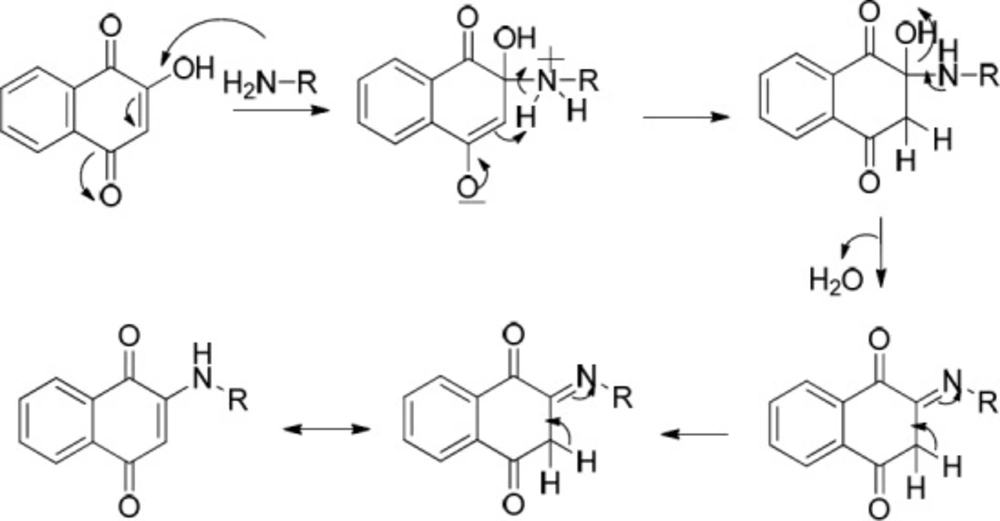
Synthesis of 2-((2,3-dihydrobenzo[b][1,4]dioxin-6-yl)amino) naphthalene-1,4-dione(8)
All steps described in synthesis of product 6b were done with appropriate aldehyde and amine, but the eluent for preparative layer chromatography was the combination of chloroform/ethanol (60/4.5 v/v).
Violet solid; m.p: 165 °C (decomposed); IR (vmax cm-1) (KBr): 3321 (NH), 1676 (C=O); 1H NMR (300 MHz-DMSO) δ = 4.25 (s, 4H, OCH2CH2O), 5.96 (s, 1H), 6.85-6.93 (m, 3H, arom), 7.76-7.79 (dt, 1H, J = 7.2 Hz, J = 1.2 Hz), 7.82-7.87 (dt, 1H, J = 7.2 Hz, J = 1.2 Hz), 7.91-7.94 (dd, 1H, J = 7.8 Hz, J = 1.5 Hz), 8.02-8.05 (dd, 1H, J = 7.5 Hz, J = 1.2 Hz), 9.12 (s, 1H, NH); 13C NMR (75 MHz-DMSO) δ = 64.33, 64.42, 102.91, 112.49, 116.60, 118.04, 126.16, 126.46, 130.43, 130.71, 132.23, 133.37, 134.87, 141.77, 144.09, 145.40, 182.13, 183.80; LC-MS (ESI): 308.1 (M+1)+. Anal. Calcd for C18H13NO4: C, 70.35; H, 4.26; N, 4.56; Found: C, 68.39; H, 3.99; N, 4.43.
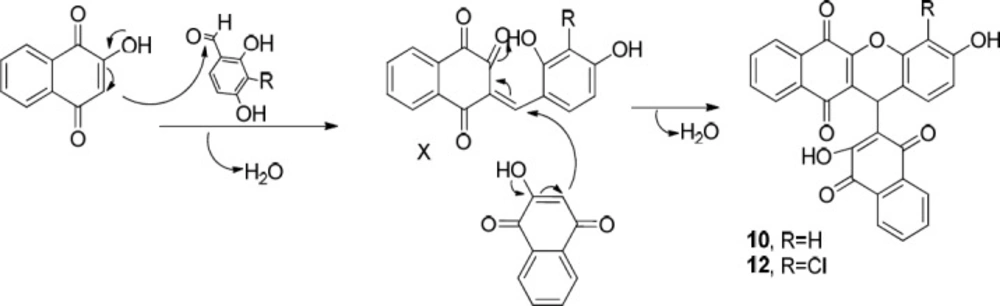
General procedure for the synthesis of 9-12
Appropriate amine and aldehyde (1 mmol of each) were refluxed in ethanol for 3 h. one mmol naphthoquinone and 20 mol% InCl3 were added to the mixture and after one overnight refluxing, 100 mL water was added and the resulted precipitate collected by filtration. The pure product was separated by preparative layer chromatography in appropriate eluent as described below:
Chloroform/ethanol (90/8 v/v) for compounds 9 and 10, chloroform/ethanol (60/3 v/v) for compound 11 and chloroform/ethanol (60/10 v/v) for compound 12.
3-hydroxy-12-(3-hydroxy-1,4-dioxo-1,4-dihydronaphthalen-2-yl)-6H-benzo[b]xanthene-6,11(12H)-dione(9)
Red orange solid; m.p: 185 °C (decomposed); IR (vmax cm-1) (KBr): 3070 (OH), 1667, 1639 (C=O); 1H NMR (300 MHz-DMSO) δ = 5.65 (s, 1H, CH), 6.41-6.45 (m, 2H), 6.88 (s, 1H ), 7.01-7.04 (d, 1H, J = 9 Hz), 7.45- 7.50 (t, 1H, J = 9 Hz), 7.60-7.65 (t, 1H, J = 9 Hz), 7.69- 7.72 (d, 1H, J = 9 Hz), 7.77-7.87 (m, 4H), 8.02-8.05 (dd, 1H, J = 6.6, J = 2.4), 9.45 (s,1H); 13C NMR (75 MHz-DMSO) δ = 67.49, 102.62, 112.79, 123.45, 124.43, 125.20, 125.38, 125.66, 126.0, 126.09, 129.75, 130.69, 130.89, 131.54, 132.02, 133.88, 134.28, 134.69, 135.85, 139.67, 149.82, 151.54, 156.78, 178.74, 188.12, 183.58, 188.35; LC-MS (ESI): 451.1 (M+1)+. Anal. Calcd for C27H14O7: C, 72.00; H, 3.13. Found: C, 69.92; H, 3.28.
2-(3,4,5-trimethoxyphenylamino) naphthalene-1,4-dione(10)
Dark pink solid; m.p: 138-140 °C; IR (vmax cm-1) (KBr): 3298 (NH), 1681 (C=O); 1H NMR (300 MHz-DMSO) δ = 3.68 (s, 3H, OCH3), 3.78 (s, 6H, OCH3), 6.13 (s, 1H), 6.72 (s, 2H, trimethoxyphenyl), 7.77-7.82 (dt, 1H, J = 7.5 Hz, J = 1.5 Hz), 7.851-7.906 (dt, 1H, J = 7.5 Hz, J = 1.5Hz), 7.95-7.98 (dd, 1H, J = 7.5 Hz, J = 0.9 Hz), 8.06-8.09 (dd, 1H, J = 7.5 Hz, J = 0.9 Hz), 9.14 (s, 1H, NH); 13C NMR (75 MHz-DMSO) δ = 56.33, 61.04, 100.79, 103.43, 126.22, 126.52, 130.35, 132.36, 133.17, 133.28, 134.97, 136.13, 145.15, 153.98, 182.03, 183.81; LC-MS (ESI): 340.1 (M+1)+. Anal. Calcd for C19H17NO5: C, 67.25; H, 5.05; N, 4.13 Found: C, 65.33; H, 4.79; N, 3.99.
2-(naphthalen-1-ylamino) naphthalene-1,4-dione (11)
Dark red pink solid; M.p: 140-143 ˚C; IR (vmax cm-1) (KBr): 3303 (OH), 1672 (C=O); 1H NMR (300 MHz-DMSO) δ = 5.23 (s, 1H), 7.51-7.66 (m, 4H, arom), 7.79-8.14 (m, 7H, arom), 9.57 (s, 1H, OH); 13C NMR (75 MHz-DMSO) δ = 103.89, 121.75, 122.43, 125.58, 126.21, 126.47, 126.74, 126.99, 127.39, 128.76, 130.49, 132.33, 132.90, 133.35, 134.55, 134.91, 146.50, 182.17, 183.78; LC-MS (ESI): 300.1 (M+1)+. Anal. Calcd for C20H13NO2: C, 80.25; H, 4.38; N, 4.68; Found: C, 75.34; H, 4.29; N, 4.59.
4-chloro-3-hydroxy-12-(3-hydroxy-1,4-dioxo-1,4-dihydronaphthalen-2-yl)-6H-benzo[b]xanthene-6,11(12H)-dione (12)
Dark orange solid; m.p: 250 °C (decomposed); IR (vmax cm-1) (KBr): 3433 (OH), 1644 (C=O); 1H NMR (300 MHz-DMSO) δ = 5.69 (s, 1H, CH), 6.62-6.64 (d, 1H, 4-Clorophenyl, J = 8.4 Hz), 6.90 (s, 1H, OH), 6.95-6.98 (d, 1H, 4-Clorophenyl, J = 8.7 Hz), 7.48-7.50 (t, 1H, J = 7.2 Hz), 7.63-7.72 (t, 1H, J = 7.2 Hz), 7.80-7.81 (d, 1H, J = 3.6 Hz), 7.82-7.86 (m, 4H, arom), 8.03-8.06 (dd, 1H, J = 7.2 Hz, J = 2.4 Hz), 10.15 (s, 1H, OH); 13C NMR (75 MHz-DMSO) δ = 67.49, 107.56, 112.78, 117.83, 123.17, 124.46, 125.24, 125.66, 126.04, 126.13, 127.09, 130.69, 130.92, 131.61, 131.96, 134.01, 134.21, 134.70, 135.85, 139.67, 146.02, 151.17, 152.86, 1169.47, 178.28, 183.51, 187.80; LC-MS (ESI): 485.1 (M+1)+. Anal. Calcd for C27H13ClO7: C, 66.89; H, 2.7. Found: C, 61.35; H, 2.57.
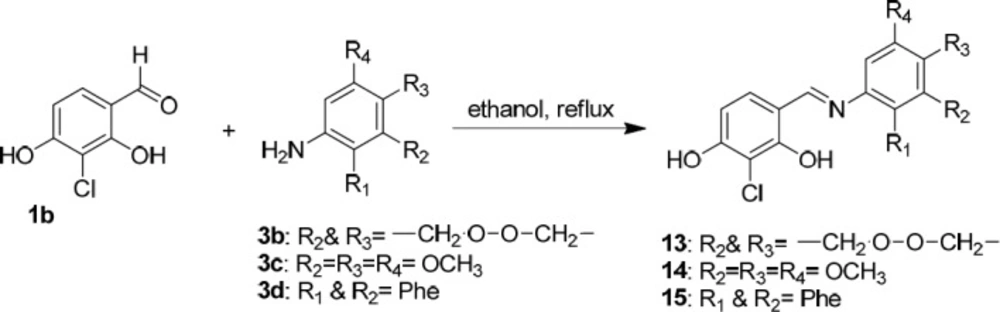
General procedure for the synthesis of imines (13-15)
Appropriate aldehyde (1 mmol) and amine (1 mmol) were solved in 4 mL ethanol. The reaction condition was 2 h stirring for imine 13 and an overnight refluxing for imine 14 and 15. Then the reaction mixture was allowed to cool down to room temperature, filtered, and washed sufficiently with ethanol to give the desired pure product.
(E)-2-chloro-4-(((2,3-dihydrobenzo[b][1,4]dioxin-6-yl)imino)methyl)benzene-1,3-diol (13)
Yellow solid; m.p: 194-196 °C; IR (vmax cm-1) (KBr): 3437 (OH), 1611 (C=N); 1H NMR (300 MHz-DMSO) δ = 4.27 (s, 4H, OCH2CH2O), 6.53-6.60 (m, 2H, benzodioxine, H4,5), 6.65-6.68 (d, 1H, 2-chlorobenzenediol, J = 9 Hz), 6.94 (s, 1H, benzodioxine, H2), 7.53-7.56 (d, 1H, 2-chlorobenzenediol, J = 9Hz), 8.83 (s, 1H, CH), 9.80 (s, 1H, OH), 15 (s, 1H, OH); LC-MS (ESI): 306.1 (M+1)+. Anal. Calcd for C15H12ClNO4: C, 58.93; H, 3.96; N, 4.58. Found: C, 55.96; H, 3.77; N, 4.26.
(E)-2-chloro-4-(((3,4,5-trimethoxyphenyl)imino)methyl)benzene-1,3-diol (14)
Yellow solid; M.p: 205-208 °C; IR (vmax cm-1) (KBr): 3052 (OH), 1597.7 (C=N); 1H NMR (300 MHz-DMSO) δ = 3.70 (s, 3H, OCH3), 3.85 (s, 6H, OCH3), 6.56-6.59 (d, 1H, 2-chlorobenzenediol, J = 9Hz), 6.83 (s, 2H, trimethoxyphenyl), 7.34-7.37 (d, 1H, 2-chlorobenzenediol, J = 9 Hz), 8.92-8.93 (s, 1H, CH), 11.02 (s, 1H, OH), 15.04 (s, 1H, OH); LC-MS (ESI): 338.1 (M+1)+. Anal. Calcd for C16H16ClNO5: C, 56.90; H, 4.77; N, 4.15. Found: C, 54.90; H, 4.57; N, 4.04.
(E)-2-chloro-4-((naphthalen-1-ylimino)methyl)benzene-1,3-diol (15)
Yellow solid; M.p: 185-189 °C; IR (vmax cm-1) (KBr): 3047.4 (OH), 1611.6 (-C=N-); 1H NMR (300 MHz-DMSO) δ = 6.64-6.67 (d, 1H, 2-chlorobenzenediol, J = 9.6 Hz), 7.48-8.03 (m, 7H, arom), 8.17-8.20 (d, 1H, 2-chlorobenzenediol, J = 9.3 Hz), 9.00 (s, 1H, CH), 11.15 (s, 1H, OH), 15.09 (s, 1H, OH); LC-MS (ESI): 298.1 (M+1)+. Anal. Calcd for C17H12ClNO2: C, 68.58; H, 4.06; N, 4.70. Found: C, 64.90; H, 4.57; N, 4.54.
Cytotoxicity assay
General procedure
The MTT (3-[4, 5-dimethylthiazol-2-yl]-2,5-diphenyl tetrazolium bromide) based assay was carried out by seeding 5000 cancer cells per 180 µL RPMI complete culture medium in each well of 96-well culture plates (
19,
20). The day after seeding, culture medium was replaced with medium containing standard anti-tumor agent doxorubicine as well as different concentrations of newly synthesized compounds and RPMI control (no drug). The cells were then incubated at 37 ºC in 5% CO
2 incubator for 48 h. Then 25 µL of MTT solution (4 mg mL
-1) was added to each well and further incubated at 37 ºC for 3 h. At the end of incubation, formazan crystals were dissolved in 100 µL of DMSO and plates were read in a plate reader (Synergy H4, USA) at 540 nm. This experiment was performed in triplicate determination each time