The development of a robust method for the precise and swift diagnosis of poisonings is of paramount importance, particularly concerning drugs with pronounced side effects, toxicities, and a high incidence of poisoning, substance abuse, and addiction. During this critical window, timely interventions such as gastric lavage, dialysis, and antidote administration can significantly improve the patient’s condition. Swift initiation of treatment not only reduces the risk of complications but also expedites the patient’s recovery. However, existing laboratory and confirmatory techniques often entail prolonged processing times, require sophisticated instrumentation, and demand specialized personnel. Consequently, there is a pressing need for an automated and efficient diagnostic approach that can yield rapid and accurate results within minutes. This urgency extends to scenarios where patients are unconscious or lack immediate companionship. Developing an effective diagnostic technique capable of swift identification and differentiation of poisoning cases holds immense clinical significance, contributing to improved patient outcomes and streamlined healthcare delivery.
Fourier-transform infrared is a fast and accurate technique for analyzing various chemical and biological samples, which can be highly beneficial in clinical settings. Saliva analysis is a non-invasive, rapid, and accurate method that can aid in diagnosing illnesses or poisonings and guide treatment staff towards appropriate treatment options. Saliva is one of the most promising biological samples, with over 800 metabolites identified, and it is similar to serum in terms of complexity. The concentration of many diagnostic analytes in saliva correlates with their blood concentration (
15). Saliva analysis can be used for the early detection and diagnosis of drug toxicities. In 2021, the biochemical composition and properties of saliva were analyzed by FTIR, investigating 34 indicators related to carbohydrates, proteins, minerals, and lipids metabolism. This expands the possibilities for interpreting FTIR spectra of saliva in biomedical applications (
16).
Many studies have been conducted on the simultaneous use of FTIR spectroscopy and saliva content measurements, yielding promising results in diagnosing diseases such as cancer, diabetes mellitus, chronic kidney disease (CKD), neonatal sepsis, and infectious diseases like COVID-19 (
17-
21). Other studies have investigated the application of saliva IR-spectroscopy in monitoring drug levels. These studies are significant in two ways: For real-time drug monitoring and personalized medicine, and for diagnosing drug poisoning (
22).
We used an FTIR instrument equipped with an ATR device. The advantage of using ATR for the spectroscopy of biological samples is its ability to better present the molecules' spectra in a water base, which might otherwise mask many spectral features of the sample due to the wide peak of water molecules. ATR use enables stronger absorbance by the sample due to the multiple points where the radiation interacts.
The quest for accurate and efficient methods to detect and quantify alprazolam, a widely used anxiolytic drug, has driven extensive research efforts. Commonly used methods include nuclear magnetic resonance (NMR), chromatography (GC-MS, HPLC, and TLC), immunoassay (ELISA, RIA, LFA, CEDEA, FPIA, and KIMS), and electroanalytical methods (voltammetry and potentiometry) (
23). Our method focuses on the effects of alprazolam on saliva, rather than the drug itself. This approach is innovative and potentially faster and simpler, especially in emergency and poisoning centers.
HPLC is a commonly used method for the detection and quantification of benzodiazepines, including alprazolam. However, compared to our method, HPLC has a higher limit of detection (lower sensitivity) and requires more time to complete the detection process (
24). GC-MS is another method used for alprazolam detection. While it can provide accurate results, it may not be as fast or simple as our FTIR method.
The distinctive advantage of FTIR lies in its ability to provide a concise and informative representation of peak presence or absence. Unlike other techniques that often necessitate specialized personnel for handling and result interpretation, FTIR offers a straightforward approach. By analyzing specific peaks within saliva samples, clinicians can swiftly arrive at preliminary judgments, facilitating timely interventions even in cases where patients are unconscious or lack immediate companionship.
What does FTIR detect in the patient's saliva? Is the result obtained due to the presence of alprazolam in the saliva, or due to the changes that occur in people's saliva after taking this drug? Although the chemical structure of alprazolam does not favor peaks in the selected lipid region of 2850 - 3000 cm
-1, more clues might come from previous Raman spectroscopy studies of saliva from patients who used alprazolam. The result of a study conducted by Allqvist et al. in 2005 was that the traceable amounts of alprazolam in the saliva of a person who consumes this drug are at the trace level, with nanogram concentrations per milliliter of the person's oral fluids, making it very difficult to detect clear peaks in the rather complex composition of saliva (
25). Therefore, it is likely that alprazolam poisoning affects the spectrum of saliva by changing its structure and composition rather than through the presence or secretion of detectable residue in the saliva.
Research has indicated that prolonged use of alprazolam in therapeutic doses can result in alterations in lipid and carbohydrate profiles, as well as changes in the composition of saliva. Studies suggest that the secretion of proline-rich proteins decreases with alprazolam use, potentially impacting the consistency of saliva by reducing the presence of compounds like mucin. This effect is not directly related to the pharmacological mechanism of alprazolam but could be considered a side effect of the drug. Nonetheless, changes in saliva composition might serve as an additional factor for more precise diagnostic considerations (
26).
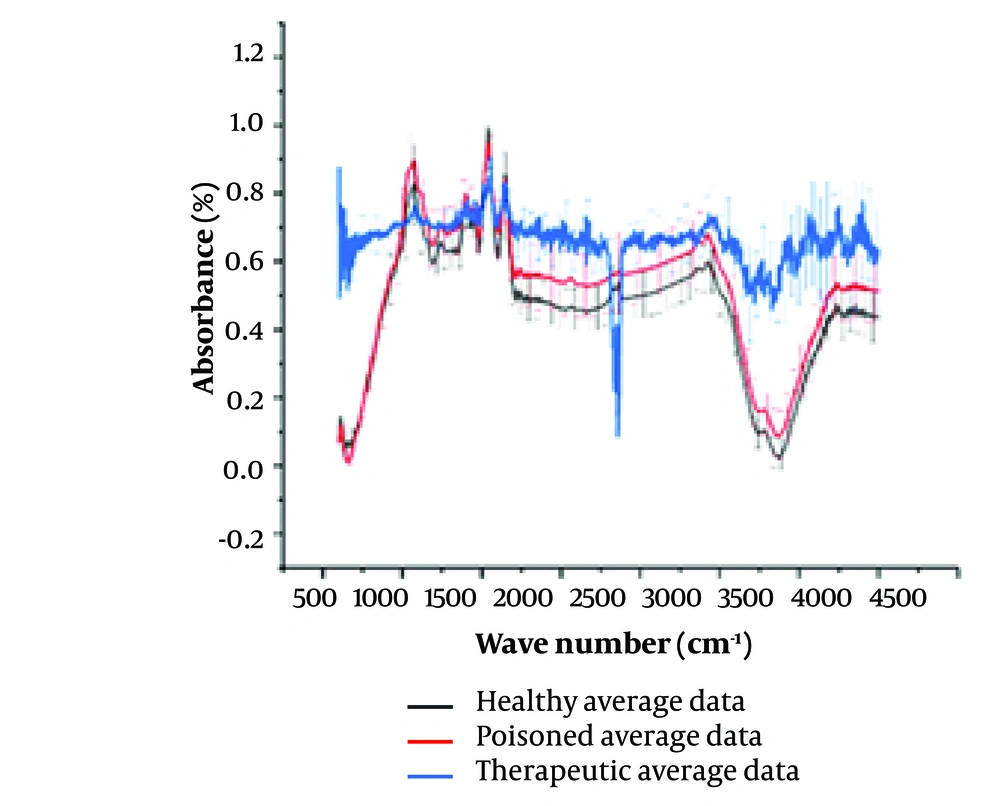
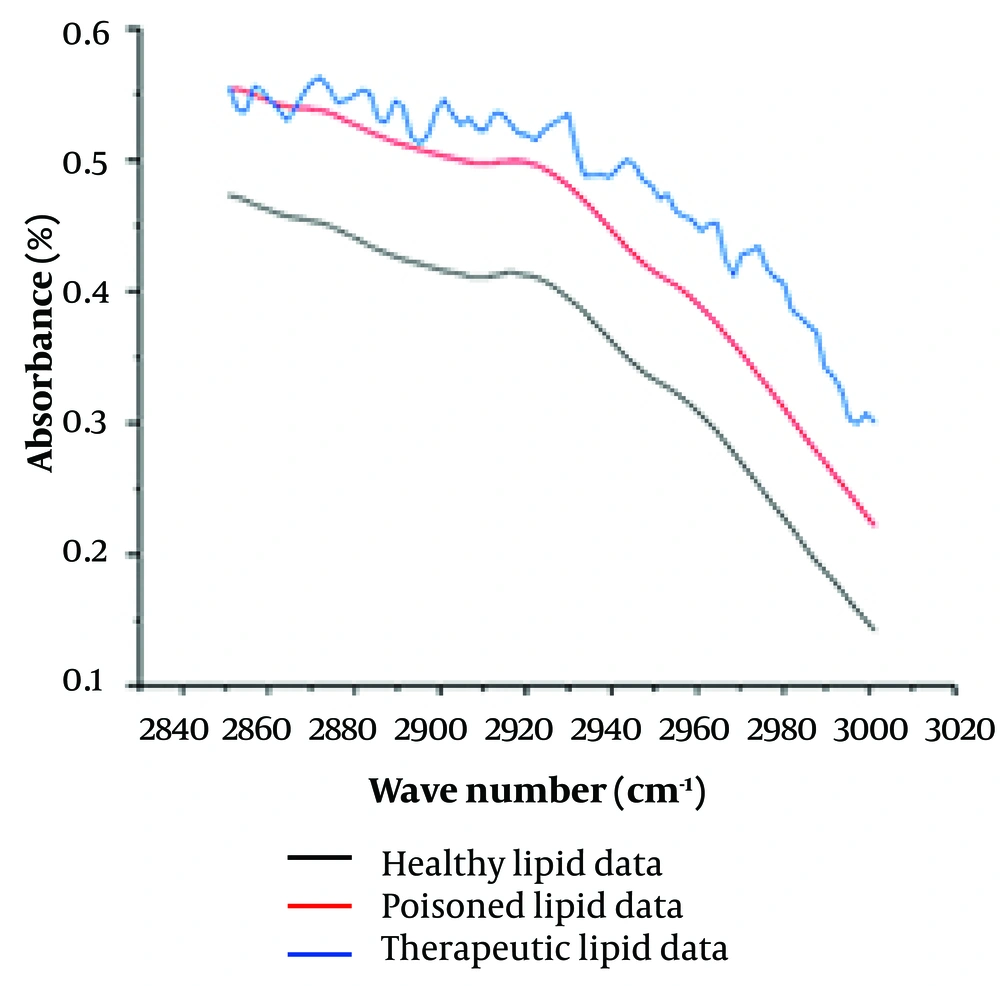
To ascertain the efficacy of our spectrometry method and subsequent spectral calculations in discerning between healthy individuals, those poisoned, and those receiving therapeutic doses, further investigations involving a larger population are imperative. Rigorous studies can provide robust evidence regarding the discriminatory power of this approach. Before applying necessary peak adjustments for analysis, preliminary observations were made concerning the lipid region of saliva spectra, specifically within the wave number range of 2850 to 3000 cm
-1. Notably, all three groups—healthy individuals, those utilizing alprazolam at therapeutic levels, and the poisoned group—exhibited a consistent decreasing trend in this spectral domain. However, a more pronounced negative slope was observed in the poisoned and therapeutically dosed alprazolam groups. Intriguingly, the shape of the spectral graph differed markedly: While the poisoned group displayed a smooth profile, the other groups exhibited jagged patterns. Subsequent baseline definition across all three groups in this specific spectral region led to a convergence of the spectra, albeit with discernible variations. These findings underscore the potential of spectrometry as a rapid and informative diagnostic tool, even in scenarios where patients lack consciousness or immediate companionship (
27,
28).
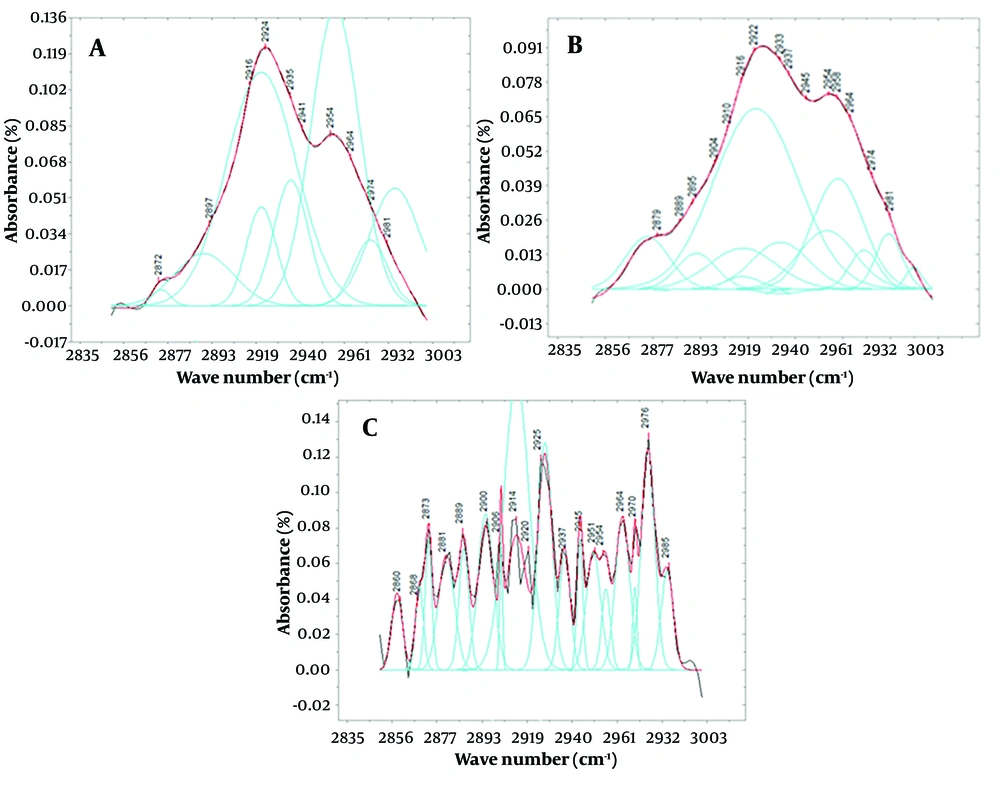
Before selecting the peaks using the OriginPro software, there may not have been much difference in the appearance of the fitted peaks between poisoned and healthy individuals, but the difference in the intensity of the peaks was easily recognizable. The peaks of poisoned individuals were observed to have much lower intensity than those of healthy individuals in this range. In individuals receiving a therapeutic dose, the peaks were less intense than in healthy individuals but appeared stronger than the peaks in the spectrum of poisoned individuals.
Based on the observed changes in the saliva spectrum in the lipid region due to the consumption of this drug, and considering that the detected amounts of the drug in saliva are in the range of nanograms and can be disregarded, it can be inferred that one of the effects of this drug is related to the lipid profile in saliva. It appears that this drug somehow alters the lipid profile in saliva or the fats present in saliva (
29,
30). For instance, the reduction in peak intensity in this area may be attributed to chemical reactions resulting in a decrease in the amount of fat in saliva.
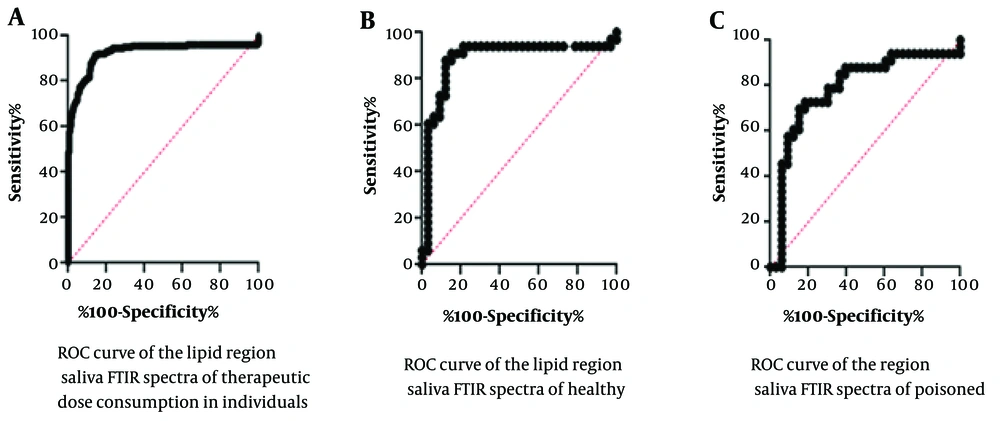
Analysis of variance (ANOVA) has confirmed that the peaks resulting from the lipid content of saliva from each of the poisoned, therapeutic consuming, and healthy groups are significantly different from each other, providing a good chance to diagnose toxicity from other groups. Receiver operating characteristic calculations and graphs have confirmed the validity and applicability of this technique for clinical and emergency applications as a fast, easy, and precise method.
5.1. Conclusions
Although this research is based on preliminary data with limited samples, it has shown that FTIR analysis of saliva might provide clues about the consumption of alprazolam in individuals at therapeutic or toxic levels. Notably, the technique does not measure alprazolam directly but analyzes saliva affected by alprazolam, which can discriminate between the three groups: Those who have not used alprazolam, those who have used it at therapeutic levels, and those who have used it at toxic levels. One limitation of this study is the potential interfering factors that might be discovered in future larger studies.
The technique is simple, requires no sample preparation, and can provide results in a minute. Changes in the FTIR spectra of saliva in the region associated with lipids have confirmed its potential use for diagnostic purposes, supported by statistical calculations with sufficient accuracy and precision. This method could be particularly useful in emergency and poisoning centers.
In comparison with other current techniques used for alprazolam detection in the body, such as HPLC, GC, mass spectrometry, and NMR, which are based on the detection and measurement of alprazolam in biological fluids, the advantage of this technique is its ability to categorize individuals as normal, therapeutic users, or poisoned based on the biological effects of alprazolam. This is the first time FTIR has been used in this manner.