


1. Background
2. Objectives
3. Patients and Methods
3.1. Patients
3.2. Institutional Protocol
3.3. Definitions
3.4. Follow-up
3.5. Statistical Analysis
4. Results
4.1. Baseline Characteristics
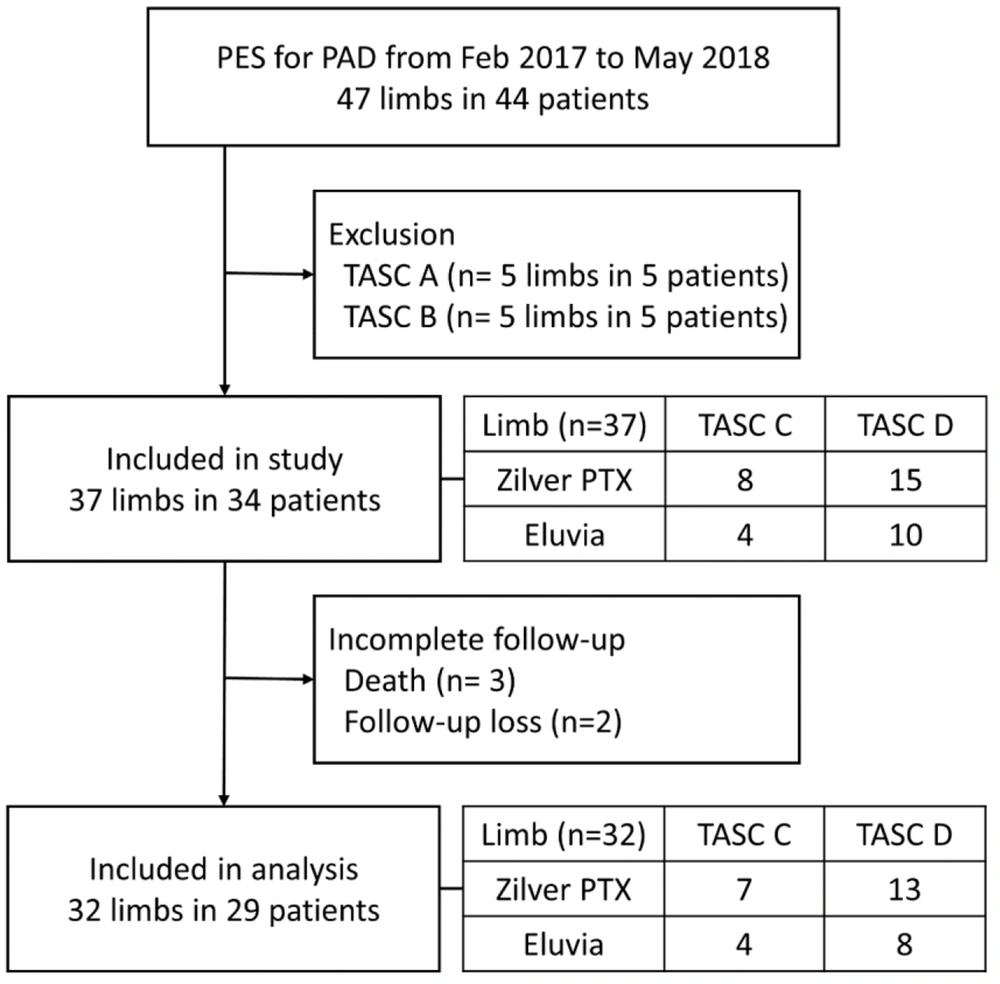
The flowchart of patient selection (PES, paclitaxel-eluting stents; PAD, peripheral arterial disease; TASC, trans-Atlantic inter-society consensus document).
| TASC C lesions | TASC D lesions | P-value | |
|---|---|---|---|
| Patient (index limb) | 10 (12) | 24 (25) | |
| Age, y | 68.77 ± 10.04 | 73.18 ± 8.58 | 0.203 |
| Male | 9 | 21 | 1.000 |
| BMI | 22.8 ± 2.25 | 23.2 ± 2.93 | 0.677 |
| Chief complaint | 0.567 | ||
| Claudication | 6 | 14 | |
| Pain | 3 | 6 | |
| Non-healing wound | 3 | 5 | |
| Mean period of symptoms, mo | 28.05 ± 23.78 | 27.98 ± 51.37 | 0.997 |
| Rutherford category | 0.930 | ||
| 0 | 0 | 0 | |
| 1 | 1 | 2 | |
| 2 | 1 | 5 | |
| 3 | 4 | 9 | |
| 4 | 2 | 4 | |
| 5 | 4 | 5 | |
| Previous treatment of the index limb | |||
| Stent | 3 | 5 | 1.000 |
| Angioplasty | 2 | 0 | 0.099 |
| Surgery | 1 | 2 | 1.000 |
| Comorbidities | |||
| DM | 7 | 13 | 0.467 |
| HTN | 6 | 15 | 1.000 |
| ESRD (HD) | 4 | 1 | 0.019 |
| CKD (no HD) | 2 | 0 | 0.080 |
| Cerebrovascular accidents | 2 | 5 | 1.000 |
| Coronary artery disease | 3 | 4 | 0.394 |
| Malignancy | 1 | 1 | 0.508 |
Abbreviations: TASC, trans-Atlantic inter-society consensus; BMI, body mass index; DM, diabetes mellitus; HTN, hypertension; ESRD, end-stage renal disease; HD, hemodialysis; CKD, chronic kidney disease.
aValues are shown as number or mean ± standard deviation (SD).
| TASC C lesions | TASC D lesions | P-value | |
|---|---|---|---|
| Index limb | 12 | 25 | |
| Occlusion (%) | 5 (42) | 24 (96) | 0.001 |
| Lesion length (cm) | 22.9 ± 5.0 (16 - 33) | 25.5 ± 7.2 (10 - 46) | 0.227 |
| Calcific burden | 0.568 | ||
| None | 2 | 7 | |
| Mild | 2 | 8 | |
| Moderate | 2 | 4 | |
| Severe | 6 | 6 | |
| Occlusion or stenosis > 80% | |||
| CFA | 1 | 3 | |
| Proximal SFA | 8 | 22 | |
| Mid-SFA | 9 | 23 | |
| Distal SFA | 7 | 12 | |
| Popliteal artery | 0 | 6 | |
| Distal runoff | 0.026 | ||
| 0 | 1 | 2 | |
| 1 | 2 | 9 | |
| 2 | 7 | 3 | |
| 3 | 2 | 11 |
Abbreviations: TASC, trans-Atlantic inter-society consensus; CFA, common femoral artery; SFA, superficial femoral artery.
aValues are shown as number or mean ± standard deviation (SD).
4.2. Procedure Outcomes
| TASC C lesions | TASC D lesions | P-value | |
|---|---|---|---|
| Type of stent | 0.493 | ||
| Zilver PTX (Cook Medical) | 8 | 15 | |
| Eluvia (Boston Scientific) | 4 | 10 | |
| Number of stents | 0.066 | ||
| 1 | 2 | 2 | |
| 2 | 6 | 5 | |
| 3 | 4 | 18 | |
| Mean | 2.2 ± 0.7 | 2.6 ± 0.6 | |
| Mean total length of stent (cm) | 21.9 ± 8.6 | 25.6 ± 7.5 | 0.191 |
| Target lesion passage | 0.865 | ||
| Intraluminal passage | 5 | 8 | |
| Subintimal passage | 6 | 15 | |
| Outback re-entry device | 4 | 6 | |
| Retrograde puncture | 1 | 2 | |
| SAFARI | 1 | ||
| CART | 1 | ||
| Rendezvous | 1 |
Abbreviations: TASC, trans-Atlantic inter-society consensus; SAFARI, subintimal arterial flossing with antegrade-retrograde intervention; CART, controlled antegrade retrograde subintimal tracking.
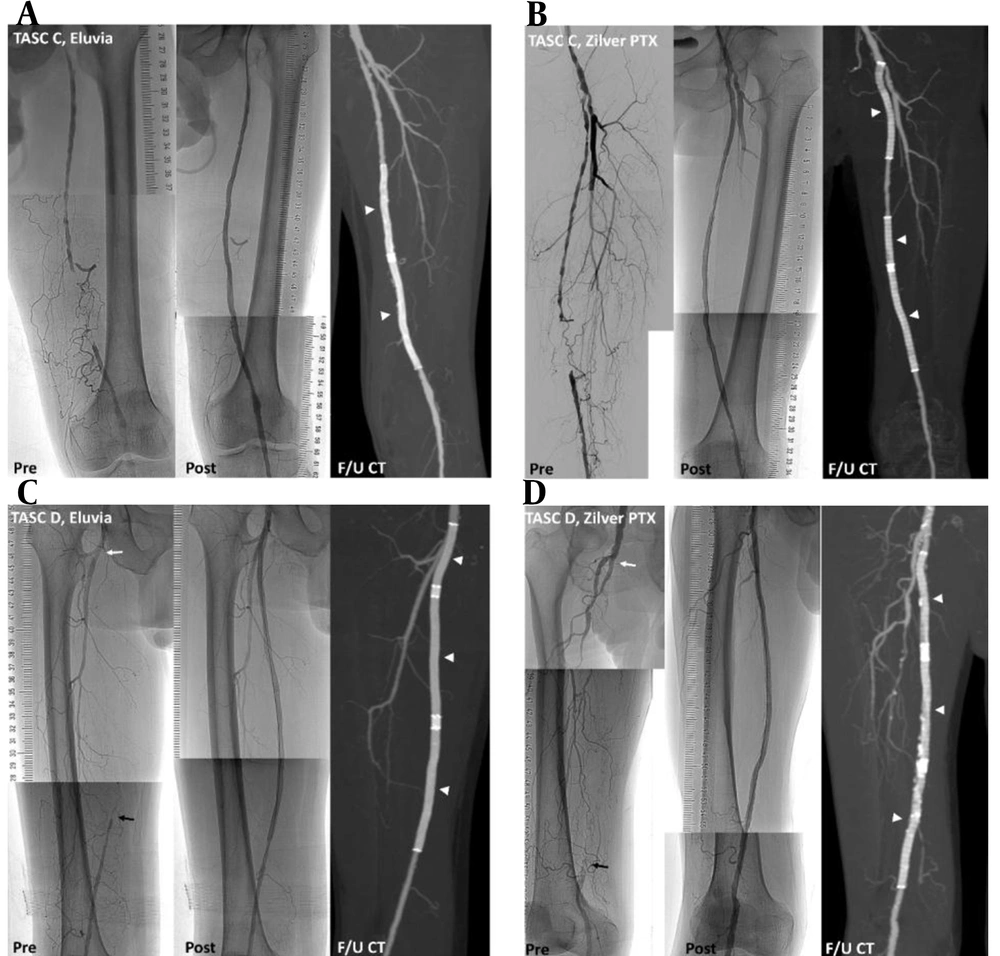
Representative cases successfully treated with paclitaxel-eluting stents (PES). Preprocedural angiography, postprocedural angiography, and follow-up CT scans acquired six months after the procedure (arrow heads) show preserved stent patency. A, A trans-Atlantic inter-society consensus document (TASC) C lesion in a 62-year-old male patient with ulcer and pain in the left big toe, treated with two Eluvia stents. B, A TASC C lesion in a 53-year-old male with 500-m claudication, treated with three Zilver PTX stents. C, A TASC D lesion in a 78-year-old male patient with 50-m claudication and total occlusion from the ostium (white arrow) to the distal superficial femoral artery (black arrow), treated with three Eluvia stents. D, A TASC D lesion in a 75-year-old male patient with 30-m claudication and total occlusion from the ostium (white arrow) to the proximal popliteal artery (black arrow), treated with three Zilver PTX stents.
4.3. One-year Outcomes and Adverse Events
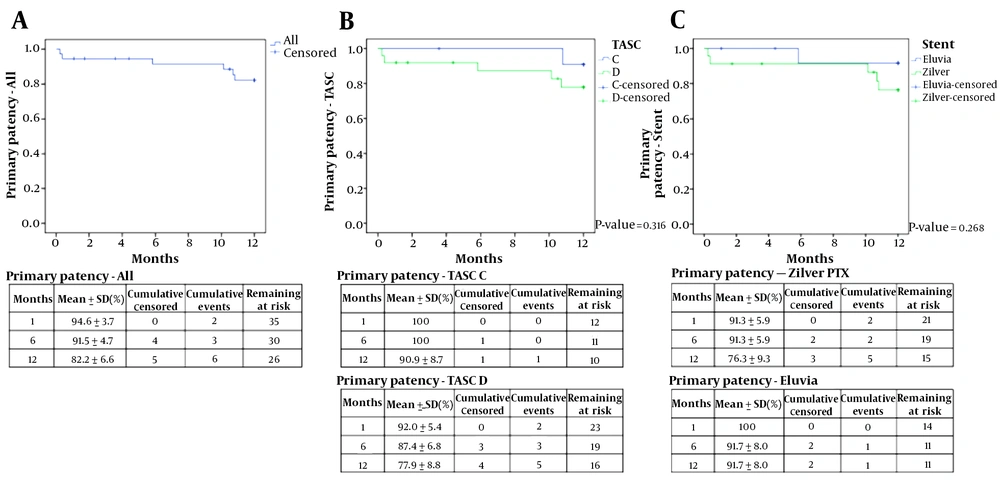
A, Primary patency (PP) at 12 months. B, Subgroup analysis of PP at 12 months for TASC C and TASC D lesions. C, Subgroup analysis of PP at 12 months for Zilver PTX and Eluvia stents (TASC, trans-Atlantic inter-society consensus document; SD, standard deviation).
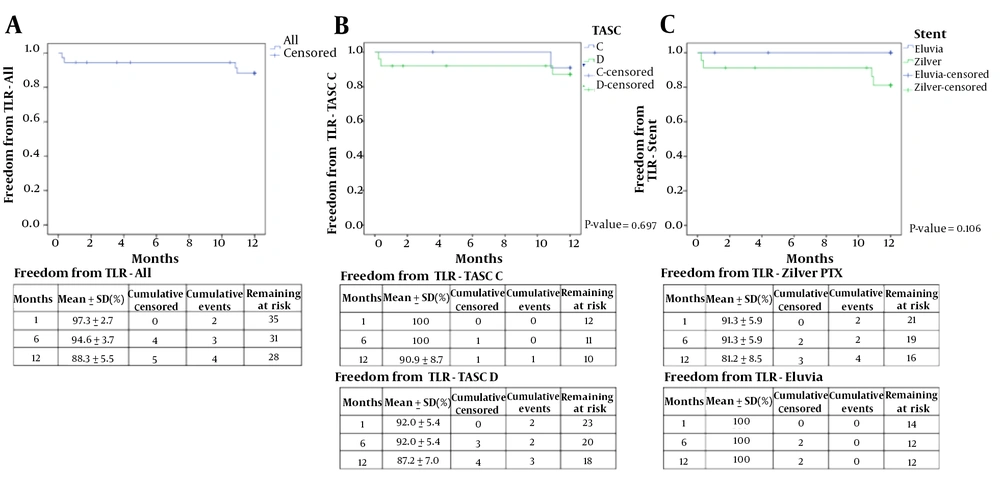
A, Freedom from target lesion revascularization (TLR) at 12 months. B, Subgroup analysis of freedom from TLR at 12 months for TASC C and TASC D lesions. C, Subgroup analysis of freedom from TLR at 12 months for Zilver PTX and Eluvia stents (TASC, trans-Atlantic inter-society consensus document; SD, standard deviation).
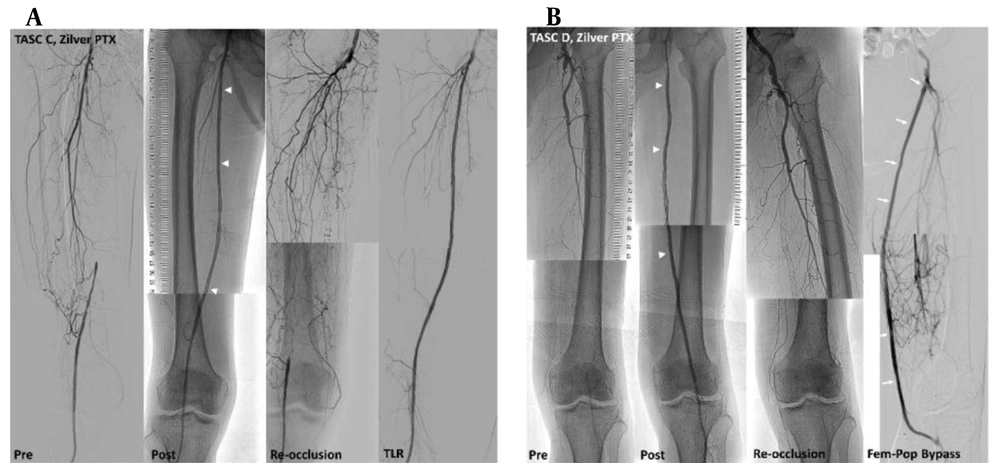
Cases of revascularization. A, A trans-Atlantic inter-society consensus document (TASC) C lesion in a 61-year-old male patient with 50-m claudication, treated with three Zilver PTX stents (arrowheads). About 10 months after the procedure, the patient complained of leg numbness, and the dorsalis pedis was not palpable. Revascularization was performed using drug-coated balloons and additional Zilver PTX stents. B, A TASC D lesion in an 83-year-old male patient with 20-m claudication and resting pain, treated with three Zilver PTX stents (arrowheads). During hospitalization after the procedure, the patient’s pain worsened, and revascularization for thrombotic total occlusion was performed. After nine months, he complained of toe color change; a femoropopliteal bypass (arrows) was performed for re-occlusion of the femoropopliteal artery.
| TASC C lesions | TASC D lesions | P-value | |
|---|---|---|---|
| Preprocedural ABI | 0.52 ± 0.13 (10) | 0.45 ± 0.10 (23) | TASC C/TASC D, P = 0.086 |
| Immediate postprocedural ABI | 0.88 ± 0.08 (7) | 0.89 ± 0.15 (21) | Pre-immediate (all), P < 0.001 |
| Six-month postprocedural ABI | 0.83 ± 0.14 (6) | 0.87 ± 0.14 (15) | Immediate/6 months (all), P = 0.401 |
| Twelve-month postprocedural ABI | 0.88 ± 0.06 (5) | 0.77 ± 0.18 (7) | 6 months/12 months (all), P = 0.519 |
Abbreviations: ABI, ankle-brachial index; TASC, trans-Atlantic inter-society consensus.
aValues are presented as mean ± standard deviation (n).
5. Discussion
| No. | Authors | Year | Study title | Inclusion criteria | No. of patients | Type of stent | No. of lesions | LL (cm) | Occlusion (%) | Ca+ (%) | PP (%) | fTLR (%) | MAE (%) |
|---|---|---|---|---|---|---|---|---|---|---|---|---|---|
| 1 | Bosiers et al. (8) | 2013 | Zilver PTX single-arm study | PAD, de novo, and restenotic lesions | 787 | Zilver PTX | 900 | 22.6 | 84 | 75 | 77.6 | 85.4 | 24.3 |
| 2 | Davaine et al. (9) | 2015 | STELLA- PTX for TASC C/D lesions | TASC C/D and de novo lesions | 45 | Zilver PTX | 48 | 25.2 | 56.3 | 63.6 | 11.1 | ||
| 3 | Iida et al. (20) | 2015 | Zephyr | PAD | 690 | Zilver PTX | 831 | 17 | 45 | 65 | 63 | 4.9 | |
| 4 | Bosiers et al. (21) | 2019 | Zilver Pass | TASC C/D and de novo lesions, ≥ 150 mm | 113 | Zilver PTX | 113 | 24.1 | 92 | 74.5 | 80.9 | ||
| 5 | Kichikawa et al. (22) | 2019 | Zilver PTX post-market study in Japan | PAD | 905 | Zilver PTX | 1080 | 14.6 | 42 | 85.5 | 90.6 | ||
| 6 | Muller-Hulsbeck et al. (13) | 2017 | MAJESTIC | PAD, 30-110 mm | 57 | Eluvia | 57 | 7.1 | 46 | 79 | 96.4 | 96.4 | 4 |
| 7 | Gray et al. (14) | 2018 | IMPERIAL | PAD, 30-140 mm | 465 | Zilver PTX | 309 | 8.2 | 31 | 67 | 77.5 | 91.9 | |
| Eluvia | 156 | 8.6 | 30 | 63 | 86.8 | 95.4 | |||||||
| 8 | Bisdas et al. (23) | 2018 | PAD | 62 | Eluvia | 62 | 20 | 79 | 42 | 87 | 87 | 8 | |
| 9 | Soga et al. (15) | 2020 | PAD and de novo, 30 - 200 mm | 48 | Zilver PTX | 12 | 9.7 | 8 | 83.3 | 91.7 | |||
| Eluvia | 36 | 11.6 | 17 | 100 | 100 | ||||||||
| 10 | Soga et al. (16) | 2020 | Japanese patients in the IMPERIAL RCT | PAD, 30-140 mm | 84 | Zilver PTX | 28 | 8.7 | 17.9 | 82.1 | 84.6 | 92.8 | 7.7 |
| Eluvia | 56 | 9.1 | 19.6 | 60.7 | 90.9 | 98.2 | 1.8 | ||||||
| 11 | The present study | TASC C/D, ≥ 150 mm | 34 | Zilver PTX | 23 | 25 | 74 | 57 | 76.3 | 81.2 | 8.7 | ||
| Eluvia | 14 | 24.1 | 86 | 29 | 91.7 | 100 | 0 |
Abbreviations: No., number; PAD, peripheral arterial disease; LL, lesion length; Ca+, calcium level exceeding the moderate level; PP, primary patency; fTLR, freedom of target lesion revascularization; MAE, major adverse event.


