IgAN is recognized as the most common form of chronic glomerular disease, with complex contributing factors. It leads to end-stage renal disease in 20 - 40% of patients, and the recurrence rate is increasing, which suggests a heavy socioeconomic burden (
14). Examinations for renal diseases commonly include morphological analyses, mainly Doppler ultrasound and renal CT to observe the size and shape of the kidneys (
15,
16). Considering the limitations of these two methods, the detection rate is not satisfactory, and the identification rate is low. Generally, VTQ is an emerging technique to identify patients by detecting the morphological features. However, there is still limited information on the efficacy of VTQ in the clinical diagnosis of IgAN.
Today, more and more scholars are paying attention to the clinical application of VTQ (
17,
18). Some studies discovered that the VTQ values were abnormal in various nephropathies, such as chronic glomerulonephritis, renal proximal tubule damage, and other renal disorders. A study on chronic glomerulonephritis indicated that the mean VTQ value of the right kidney significantly decreased in patients with IgAN compared to the control group (
19). Another study by Bob et al. proposed that the VTQ values reduced in patients with chronic kidney disease (
20). Although the VTQ values have been measured for these renal diseases, the VTQ values for IgAN remain unclear.
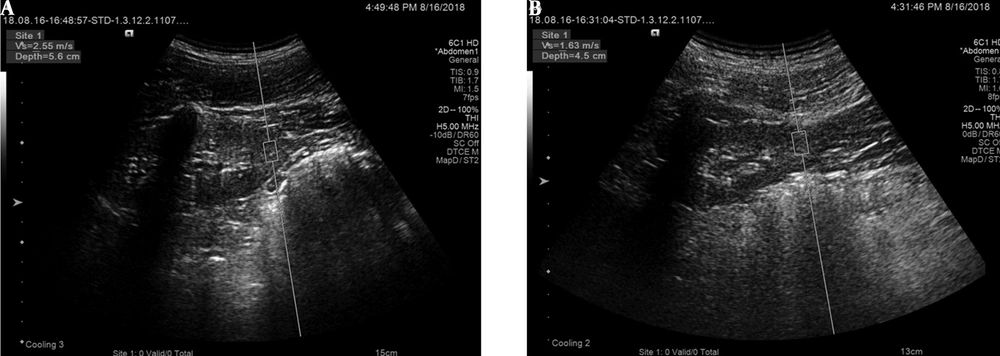
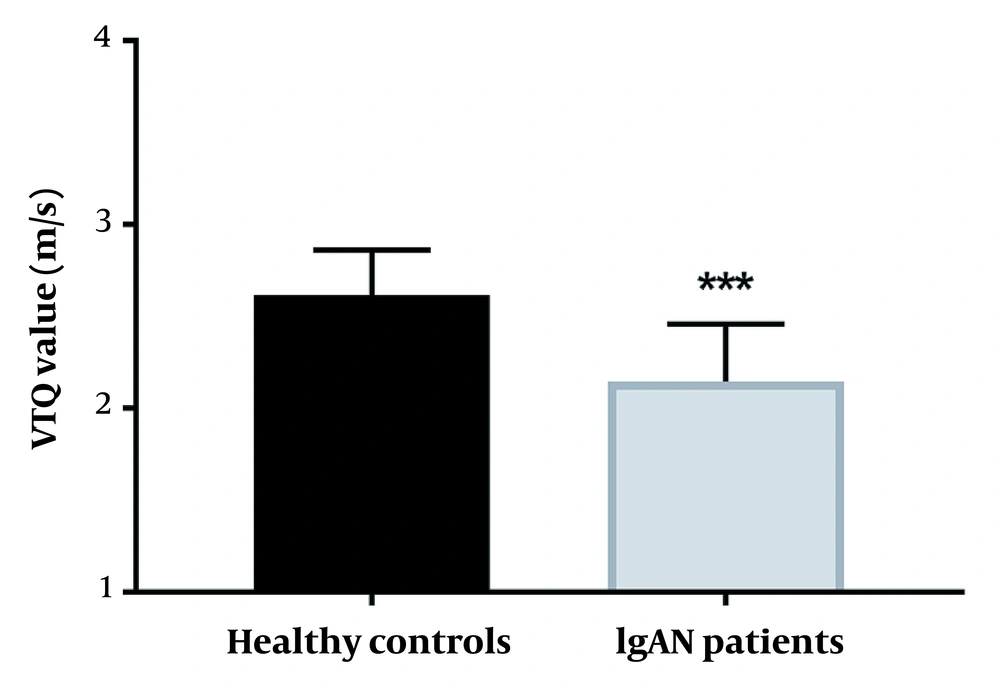
In this study, the mean renal parenchymal VTQ value of patients with IgAN was significantly lower than that of the control group; therefore, the hardness of renal parenchyma decreased due to renal impairment caused by IgAN. Compared to previous findings, the decrease in VTQ values in IgAN was consistent with the corresponding values for other types of nephropathy. The RI value and peak velocity were significantly different between the two groups. However, the renal volume and renal parenchymal thickness were undifferentiated between the IgAN patients and healthy controls. The difference in VTQ values between patients with IgAN and healthy controls suggested that renal parenchymal VTQ values might be used as a predictor.
Given the differences in VTQ values between patients with IgAN and the controls, the association between these values and other characteristics of IgAN was further analyzed. The results of multiple linear regression analysis showed that renal parenchymal thickness, peak flow velocity of interlobular arteries, and Lee et al.’s grade were correlated with renal parenchymal VTQ values, suggesting the possible association of renal parenchymal VTQ values with IgAN (
13). The VTQ values were related to the clinicopathological characteristics of many other diseases and applied in clinical examinations. For instance, shear wave velocity detected by VTQ was associated with the mass size and histological grade in women with invasive ductal breast cancer (
21). In patients with renal damage, the combination of VTQ value with urinary β2-microglobulin level may be useful in the diagnosis of gouty kidney damage (
22). These results indicated that renal parenchymal VTQ values might be associated with the progression of IgAN. Based on the present and previous findings, VTQ might be an effective screening method for disease development.
Extensive growth in research in the last few decades has made it possible to examine IgAN using the VTQ technique. For instance, the VTQ values could differentiate between benign and malignant thyroid lesions by providing quantitative elasticity measurements (
23). In advanced chronic liver disease, the VTQ value may be a predictor in clinics, with specificity of 80.8% and sensitivity of 73.7% (
24). In severe renal interstitial fibrosis, the AUC for VTQ was 0.954 in the patient group versus the control group, indicating the prognostic value of VTQ in screening renal disorders (
25). Inconsistent with the aforementioned observations, the current study showed that the VTQ value could distinguish IgAN patients from healthy individuals.
In the current study, the diagnostic efficacy of the VTQ value was evaluated based on the ROC curve analysis. The results indicated that the renal parenchymal VTQ value might play an essential role in distinguishing IgAN patients from healthy individuals, with high sensitivity and specificity. A previous study reported that the VTQ level was 2.69 ± 0.72 m/s in the right kidney and 2.48 ± 0.73 m/s in the left kidney, which exceeded the VTQ value (2.26 ± 0.69) in IgAN patients (
19). In glomerulonephritis, the VTQ value of the parenchyma was 1.55 m/s, while in this study, the VTQ value was 2.26 m/s in IgAN patients; the significant difference between the groups suggests that the VTQ value could distinguish IgAN from glomerulonephritis (
26). Accordingly, the VTQ value can be useful in differentiating IgAN from other renal diseases.
The present study had a major limitation. Based on the study design, enrollment of the participants was not useful for the assessment of VTQ efficacy in differentiating IgAN from other renal parenchymal disorders, since IgAN was compared with healthy individuals. Future research needs to compare other glomerular and renal parenchymal diseases with IgAN. Other limitations of this study include the small sample size and lack of comparison of the diagnostic performance of VTQ with conventional ultrasonography and Doppler ultrasonography.
In conclusion, as IgAN progresses, the renal parenchymal VTQ value decreased, indicating the clinical value of VTQ examination in IgAN. The renal parenchymal VTQ value could distinguish IgAN patients from normal people, with high sensitivity and specificity.


![The results of receiver operating characteristic (ROC) curve analysis indicated the diagnostic value of virtual touch quantification (VTQ) values and the combination of renal parenchymal thickness, peak velocity, and VTQ for differentiating patients with immunoglobulin A nephropathy (IgAN) from healthy individuals. A, The VTQ values showed a high diagnostic accuracy in screening IgAN patients from normal people (area under the curve [AUC] = 0.909, sensitivity = 0.828, specificity = 0.867); B, The AUC of combined renal parenchymal thickness, peak velocity, and VTQ values was 0.930, with sensitivity of 0.892 and specificity of 0.867.](https://brieflands.com/journals/ijradiology/articles/129454/figures/iranjradiol-129454-i002-F3-preview.webp "The results of receiver operating characteristic (ROC) curve analysis indicated the diagnostic value of virtual touch quantification (VTQ) values and the combination of renal parenchymal thickness, peak velocity, and VTQ for differentiating patients with immunoglobulin A nephropathy (IgAN) from healthy individuals. A, The VTQ values showed a high diagnostic accuracy in screening IgAN patients from normal people (area under the curve [AUC] = 0.909, sensitivity = 0.828, specificity = 0.867); B, The AUC of combined renal parenchymal thickness, peak velocity, and VTQ values was 0.930, with sensitivity of 0.892 and specificity of 0.867.")



