


1. Background
2. Objectives
3. Patients and Methods
3.1. Patients
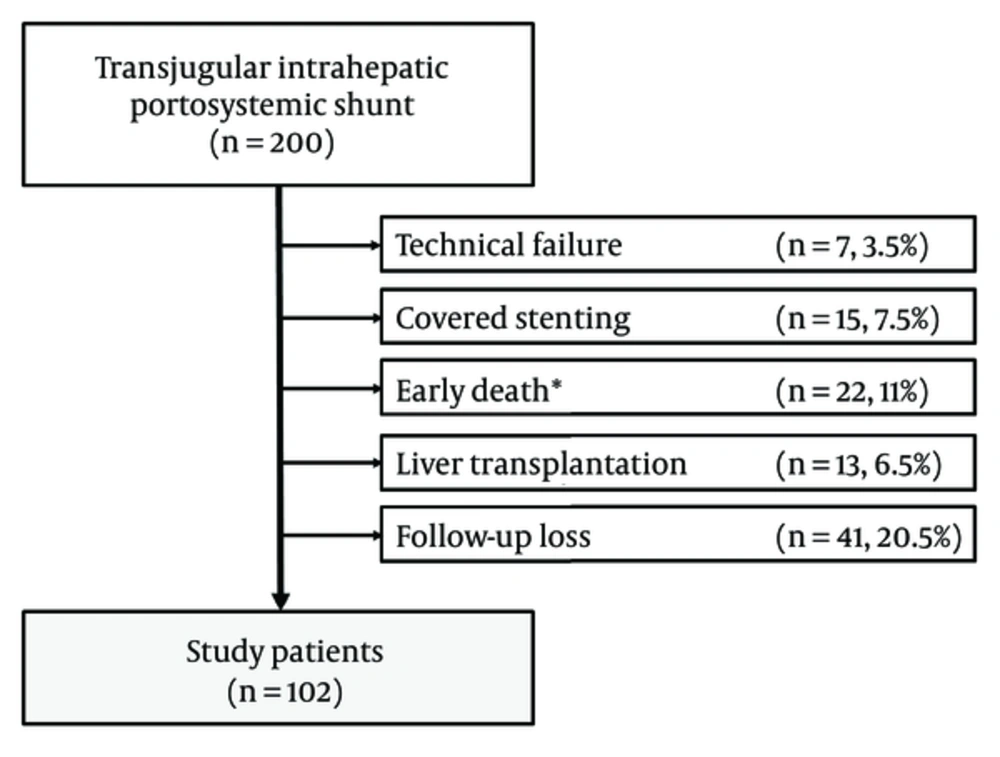
Flowchart of the selection of consecutive patients who underwent transjugular intrahepatic portosystemic shunt (TIPS) between January 1999 and December 2012
| Characteristic | Total (N = 102) |
|---|---|
| Age,y | 60.1 ± 11.8 |
| Sex, male/female | 80/22 |
| Underlying liver disease | |
| Viral (HBV/HCV) LC | 62 (55/7) |
| Alcohol LC | 30 |
| Cryptogenic LC | 6 |
| Othersb | 4 |
| Child–Pugh score | 7.7 ± 1.8 |
| Child–Pugh classification (A/B/C) | 31/53/18 |
| MELD score | 13.5 ± 4.1 |
| Indication | |
| Variceal bleeding | 83 |
| Refractory ascites | 19 |
Abbreviations: HBV, hepatitis B virus; HCV, hepatitis C virus; LC, liver cirrhosis; MELD, model for end-stage liver disease.
aValues are mean ± standard deviation or number of patients.
bNonalcoholic steatohepatitis and autoimmune disease.
3.2. Transjugular Intrahepatic Portosystemic Shunt
3.3. Clinical Follow-Up
3.4. Study Endpoints and Definitions
3.5. Statistical Analysis
4. Results
4.1. Technical Outcomes
4.2. Complications
4.3. Stent Patency
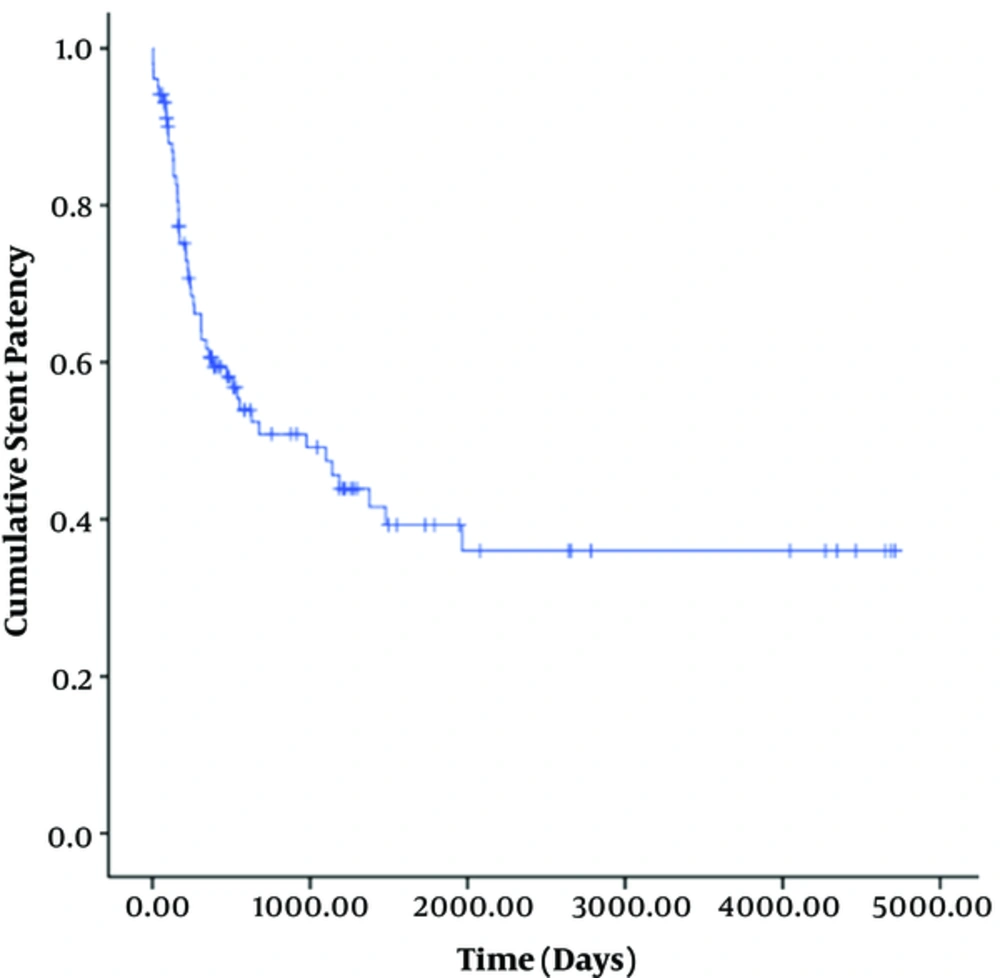
Kaplan-Meier curve showing the cumulative rates of primary stent patency
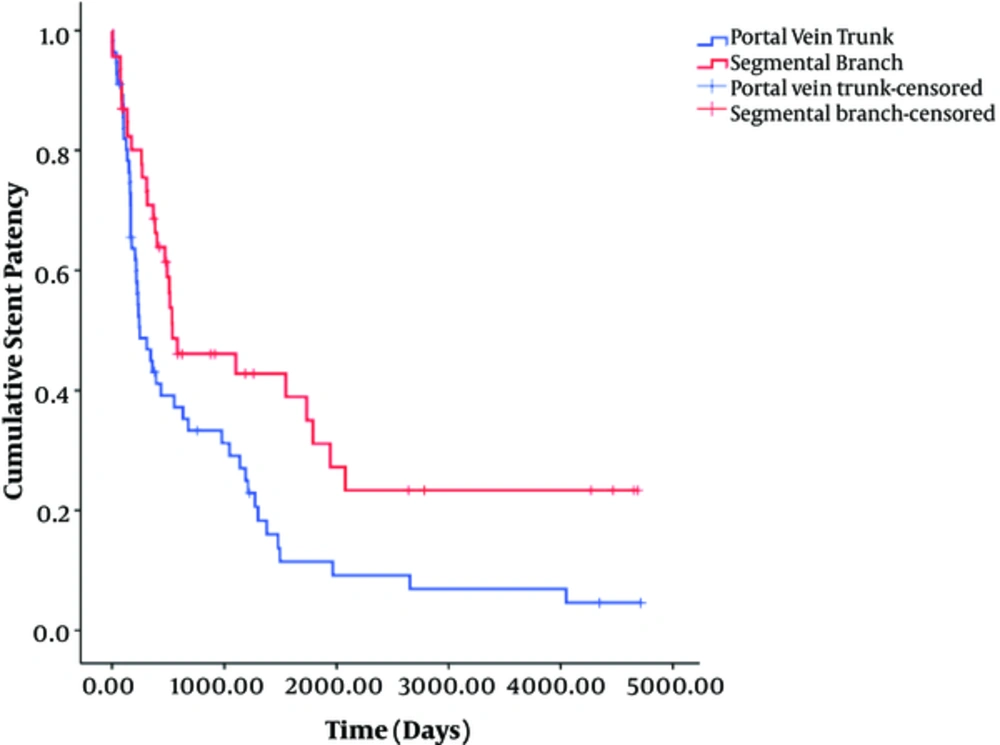
Kaplan-Meier curves showing the cumulative rates of primary stent patency according to portal vein access
| Variable | Stent Dysfunction | Without Stent Dysfunction | P-Value |
|---|---|---|---|
| Mean age, y | 0.142 | ||
| < 60 | 25 | 31 | |
| ≥ 60 | 26 | 20 | |
| Sex | 0.771 | ||
| Male | 39 | 41 | |
| Female | 12 | 10 | |
| Hepatic encephalopathy | 0.412 | ||
| Yes | 41 | 35 | |
| No | 10 | 16 | |
| Indication | 0.808 | ||
| Variceal bleeding | 44 | 39 | |
| Refractory ascites | 7 | 12 | |
| Child-Pugh class | 0.086 | ||
| A | 12 | 19 | |
| B/C | 30/9 | 23/9 | |
| MELD score | 0.854 | ||
| < 13 | 28 | 23 | |
| ≥ 13 | 23 | 28 | |
| Pressure gradient | 0.747 | ||
| < 12 mm Hg | 33 | 33 | |
| ≥ 12 mm Hg | 18 | 18 | |
| Stent | 0.068 | ||
| Wallstent | 41 | 26 | |
| Zilver | 10 | 25 | |
| Portal vein entry site | 0.007 | ||
| Portal vein trunk | 35 | 21 | |
| Segmental branch | 16 | 30 |
MELD, model for end-stage liver disease
| Variable | Standard Error | Odds Ratio | 95% Confidence Interval | P-Value |
|---|---|---|---|---|
| Age ≥ 60 years | 0.346 | 0.660 | 0.335 - 1.300 | 0.230 |
| Child-Pugh class B and C | 0.454 | 0.479 | 0.197 - 1.167 | 0.105 |
| Portal vein trunk access | 0.345 | 2.561 | 1.302 - 5.036 | 0.006 |
| Wallstent | 0.405 | 1.102 | 0.498 - 2.438 | 0.811 |
4.4. Patients' Survival
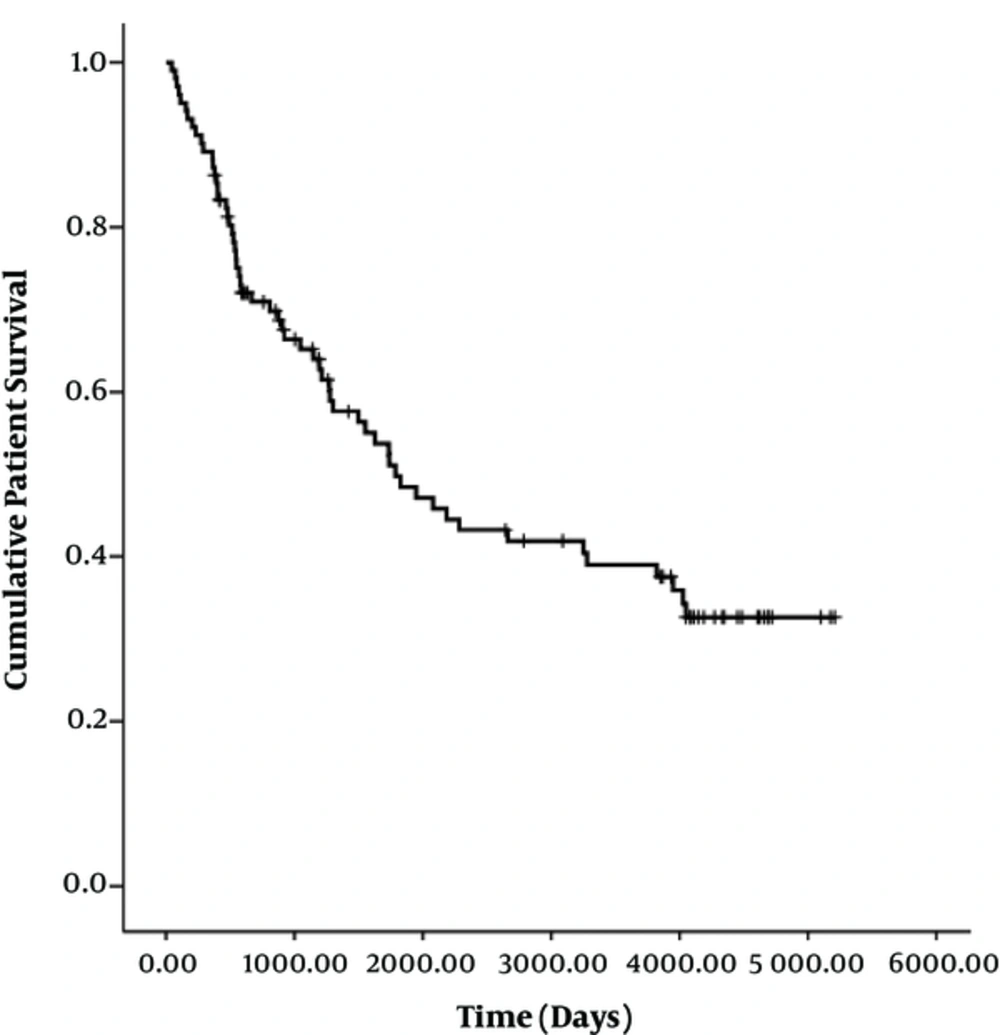
Kaplan-Meier curve showing the cumulative rates of patient survival
| Characteristic | Portal Trunk (n = 56) | Segmental Branch (n = 46) | P-Value |
|---|---|---|---|
| Mean age, y | 60.2 ± 11.2 | 59.9 ± 12.5 | 0.892 |
| Sex, male/female | 46/10 | 34/12 | 0.315 |
| Underlying liver disease | 0.808 | ||
| Viral (HBV/HCV) | 35 (31/4) | 27 (24/3) | |
| Alcohol | 17 | 13 | |
| Cryptogenic | 3 | 3 | |
| Othersb | 1 | 3 | |
| Child-Pugh score | 7.7 ± 1.8 | 7.7 ± 1.7 | 0.984 |
| Child-Pugh classification (A/B/C) | 19/27/10 | 12/26/8 | 0.654 |
| MELD score | 14 ± 4.4 | 12.8 ± 3.5 | 0.160 |
| Indication | 0.214 | ||
| Variceal bleeding | 48 | 35 | |
| Refractory ascites | 8 | 11 | |
| Type of stent | 0.002 | ||
| Wallstent | 44 | 23 | |
| Zilver | 12 | 23 | |
| Pressure gradient | |||
| Before TIPS | 22.9 ± 6.9 | 24.2 ± 8.0 | 0.370 |
| After TIPS | 9.7 ± 3.6 | 10.8 ± 5.5 | 0.236 |
| TIPS-associated HE | 16 | 10 | 0.431 |
| Follow-up timec | 2088.4 ± 1688.1 (44-5207) | 1643.9 ± 1581.5 (73-5173) | 0.176 |
| Outcome (survival/death) | 20/36 | 24/22 | 0.095 |
Abbreviations: HBV, hepatitis B virus; HCV, hepatitis C virus; HE, hepatic encephalopathy; MELD, model for end-stage liver disease.
aValues presented as mean ± standard deviation or number of patients.
bNonalcoholic steatohepatitis and autoimmune disease.
cData in parentheses are ranges.


