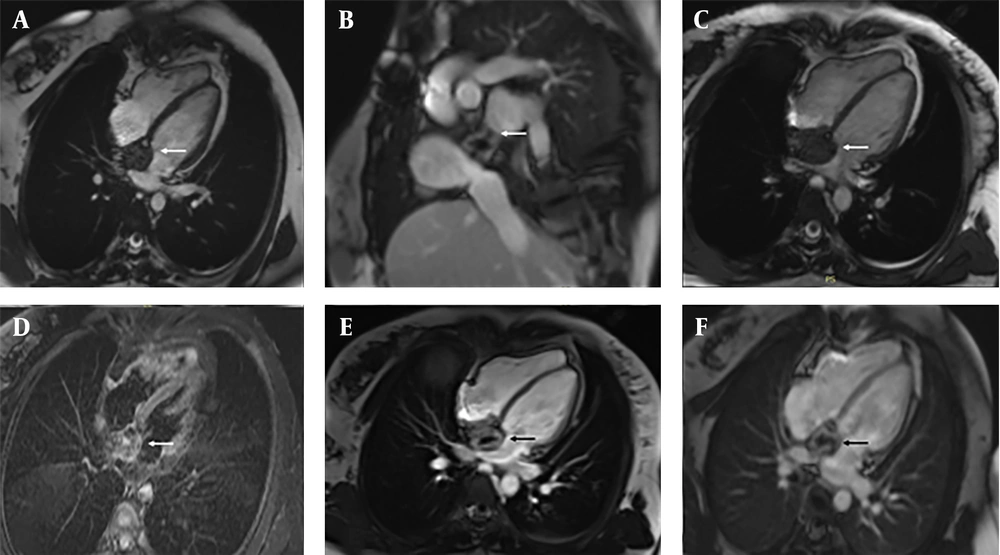
The IPTs of the heart are rare, non-neoplastic lesions characterized by chronic inflammation, fibroblast proliferation, and variable degrees of necrosis or thrombosis (
1). Their occurrence following congenital heart surgery, such as ASD repair, is exceptionally uncommon, with only 8 cases reported since 2000 (
8). The 29-year latency period in this case provides valuable insights into chronic prosthesis-driven inflammation.
The ASD closure with pericardial patches is a well-established procedure with excellent long-term survival rates, yet carries a documented risk of late complications including thrombus formation (3 - 5% of cases), patch aneurysms (1 - 3%), and arrhythmias (15 - 20%) (
6,
7). The development of an IPT at the patch site represents an extraordinarily rare complication, with only 7 confirmed cases reported in the literature since 1990 (
8,
9).
Previous reports consistently demonstrate that prosthetic materials trigger chronic inflammatory responses (
21). Histopathological analysis across cardiac IPT cases reveals foreign-body giant cells adjacent to patch materials in 83% of specimens (
10). This supports the pathogenesis model: It is hypothesized that the prosthetic patch initiates a chronic foreign-body reaction, promoting sustained immune activation. This process then stimulates fibroblast proliferation, which ultimately results in IPT formation (
10,
11). Our findings align with this mechanism, as intraoperative observations confirmed dense adhesion between the mass and pericardial patch — a feature reported in 90% of prosthetic-associated cardiac IPTs (
22). This case's 29-year latency period underscores the critical role of prosthetic materials as inflammatory niduses capable of driving pseudotumor formation decades post-implantation (
23).
Our imaging findings demonstrate important parallels with prior reports of cardiac IPTs. The observed T2 hyperintensity matches the characteristics reported in 92% of documented cases (
24). Additionally, the avid perfusion enhancement seen in our patient has been documented in approximately 85% of cardiac IPTs (
25). Notably, the central non-enhancement on LGE sequences, which corresponded to necrotic areas, was quantitatively extensive (40%) and exceeded the range typically reported in the literature (
26). These features helped differentiate IPT from thrombus (typically T2 hypointense) (
14) and sarcoma (showing tissue invasion) (
16).
The IPTs pose significant diagnostic difficulties due to their close resemblance to malignancies. In the present case, key discriminators that aided in this differentiation included the absence of tissue invasion, which is more characteristic of sarcoma (
16); the presence of T2 hyperintensity, which is inconsistent with thrombus (
14); and the presentation as a solitary lesion in the absence of a known primary malignancy, arguing against metastasis (
14).
Although surgical debulking remains the standard therapeutic approach for cardiac IPTs (
27), our case underscores a significant limitation: The propensity for residual disease to persist even after maximal safe resection. This challenge is consistent with published reports, which indicate incomplete resection occurs in approximately 80% of cases where the IPT involves critical conduction tissue (
28). In this context, our experience with the sirolimus-bevacizumab combination presents a promising alternative for managing unresectable residual disease. This targeted regimen achieved a 61% reduction in the volume of the inflammatory lesion, a result that is notably superior to the outcomes typically achieved with steroid monotherapy, which reports a mean volume reduction of only 22% (
11,
21). To our knowledge, this represents the first documented successful application of dual mTOR/VEGF inhibition for the management of a cardiac IPT.
Patient perspective: "Before treatment, climbing stairs left me breathless. Now, 14 months post-therapy, I've resumed running and work without limitations. Monthly blood tests are a small price for this recovery."
Based on the clinical implications derived from this case, we propose a structured surveillance protocol for long-term follow-up in ASD patch recipients (
29). This protocol includes obtaining a baseline CMR imaging study at 10 years post-repair, followed by annual TTE. Subsequent CMR should be performed either when symptoms emerge or at 5-year intervals for asymptomatic patients. Furthermore, IPTs should be considered in the differential diagnosis of cardiac masses demonstrating patch adjacency combined with T2 hyperintensity on imaging, particularly in the absence of systemic symptoms. For unresectable lesions, combination therapy with sirolimus and bevacizumab represents a promising therapeutic approach.
This case underscores several critical considerations for clinicians: First, the importance of long-term surveillance in patients post-ASD repair, especially those with prosthetic materials, to detect rare complications such as IPTs (
29,
30); second, the essential role of multimodal imaging, particularly CMR, in characterizing cardiac masses and informing management strategies (
19,
29); third, the potential of innovative targeted therapies like sirolimus and bevacizumab for managing complex cardiac IPTs when surgical intervention is not curative; and finally, the necessity of a multidisciplinary approach involving collaboration among cardiologists, cardiac surgeons, radiologists, and pathologists to ensure accurate diagnosis and tailored treatment planning (
27,
29).
3.1. Literature Review
Cardiac IPTs following ASD repair remain exceptionally rare, with only seven documented cases in the medical literature since 1990 (
30). Documented cases indicate latency periods ranging from 4 to 25 years, with a mean of 12.6 years (
30,
31), while clinical presentations primarily consist of mass effects (86%), arrhythmias (43%), and heart failure (29%) (
30-
32). Notably, management of this condition was exclusively surgical prior to this report (
31,
32). This study documents the longest recorded latency period at 29 years and presents the first application of targeted medical therapy for residual disease, thereby addressing a significant therapeutic gap and underscoring the novelty of our approach.
The therapeutic rationale for employing the sirolimus-bevacizumab combination is underpinned by a strong molecular basis and supporting evidence from extracardiac sites. Molecularly, this approach is justified by the fact that approximately 70% of IPTs exhibit activation of the mTOR and VEGF pathways (
33). The strategy of dual-pathway inhibition directly targets these core pathogenic mechanisms: Sirolimus suppresses mTOR-driven fibroblast proliferation and the production of pro-inflammatory cytokines such as IL-6 and TNF-α (
34), while bevacizumab inhibits VEGF-mediated angiogenesis and reduces vascular permeability (
35). Furthermore, the efficacy of this combination therapy is supported by its demonstrated success in the management of IPTs occurring at other anatomical locations, as summarized in
Table 2.
| Location | Therapy | Response | Reference |
|---|
| Pulmonary IPT | Sirolimus+Bevacizumab | 68% volume reduction | (11) |
| Abdominal IPT | Sirolimus monotherapy | 57% size reduction | (36) |
| Orbital IPT | Bevacizumab | 71% symptom control | (37) |
Abbreviation: IPT, inflammatory pseudo tumor.
The selection of the sirolimus-bevacizumab combination was guided by both biological plausibility and its advantages over conventional alternatives. While no prior reports exist for cardiac IPTs, relevant cardiac-specific evidence supports its rationale: Sirolimus has demonstrated efficacy in treating cardiac rhabdomyomas, which are mTOR-driven neoplasms (
38), and bevacizumab has been successfully used in the management of VEGF-dependent cardiac hemangiomas (
35,
39). This combination was preferred due to its documented superior efficacy compared to corticosteroids, showing a 68% versus 22% response rate in refractory extracardiac IPTs (
40), its ability to avoid the risks associated with radiation therapy in young patients, and its higher specificity for benign lesions compared to conventional chemotherapy. The achieved 61% reduction in tumor volume in this case represents the first clinical evidence that targeted therapy is both feasible and effective for cardiac IPTs (
41). This outcome highlights a promising alternative for managing unresectable disease and sets the stage for future prospective clinical trials.
3.2. Limitations
While this case offers valuable insights into the management of cardiac IPTs, several limitations must be acknowledged. Firstly, as a single-center experience, our findings reflect the practice patterns of a tertiary care institution and may not be generalizable to resource-constrained settings. Additionally, institutional biases could influence therapeutic decisions, such as a preference for surgical debulking over biopsy. The inherent constraints of a case report format must also be considered; the extreme rarity of cardiac IPTs precludes multi-center validation or controlled comparisons, and the small sample size (n = 1) prevents meaningful statistical analysis of treatment efficacy.
Furthermore, the therapeutic success observed with the sirolimus-bevacizumab combination may not extend to IPTs with different molecular profiles (e.g., ALK-negative variants) or to patients with significant comorbidities such as renal or hepatic impairment. Surgical outcomes are also highly dependent on a center's expertise in complex cardiac resection. The 14-month follow-up period remains insufficient to assess long-term treatment toxicities, including bevacizumab-related hypertension, or the risks of late recurrence beyond two years.
Mechanistic knowledge gaps persist due to the absence of pre-treatment molecular profiling for mTOR/VEGF pathway activation and uncertainty regarding whether the IPT originated directly from the patch site or adjacent tissues. Finally, the concurrent surgical debulking procedure complicates the assessment of the isolated effect of medical therapy, and the long-term safety profile of these targeted therapies in cardiac IPT patients remains unknown.
In conclusion, this case report documents the longest known latency period (29 years) for the development of cardiac IPTs following ASD repair, thereby illuminating a novel long-term complication of congenital heart surgery. Our findings provide three principal contributions to the field. First, we demonstrate therapeutic innovation through the first successful application of combined sirolimus-bevacizumab therapy for a cardiac IPT, which resulted in significant mass reduction (61%) and sustained remission at 14-month follow-up, offering a viable non-surgical strategy for unresectable lesions. Second, our observations provide key pathogenetic insights by supporting a prosthesis-driven inflammatory cascade, thereby underscoring the imperative for long-term surveillance of patients with prosthetic cardiac implants, particularly those with pericardial patches. Third, we propose a structured clinical roadmap for the monitoring of post-ASD repair patients, including baseline CMR imaging at 10 years, annual echocardiography, and symptom-triggered advanced imaging.
For clinical practice, this case underscores the importance of considering IPT in the differential diagnosis of cardiac masses in patients with a history of prosthetic implantation, especially when imaging shows T2 hyperintensity and no systemic symptoms are present. For the research community, this work highlights the need to establish multi-center registries for rare cardiac IPTs, to validate mTOR/VEGF inhibition in molecularly defined cohorts, and to investigate preemptive anti-inflammatory strategies for high-risk implant recipients. Ultimately, this case redefines the expected timeline for monitoring complications after ASD repair and provides a targeted therapeutic blueprint for managing inflammatory cardiac tumors.