


1. Context
Healthcare systems, especially hospitals, face many challenges, including labor shortages, a growing elderly population with a high prevalence of chronic diseases (1), increasing costs (2), growing demand for personal care (3), and shortages of specialized personnel, including physicians and nurses, in many countries (4). These challenges make it difficult to provide healthcare services. One of the policy sectors with the highest investment in new technologies is healthcare, where AI has substantial potential for analyzing medical records and designing treatment plans (5), and it helps to overcome these challenges (1). Artificial intelligence (AI) also has an important role in combating pandemics such as COVID-19 (4), optimizing hospital resources, and reducing mortality rates during pandemic peaks (6). Moreover, the combination of molecular docking and AI can be a validated method for identifying unique therapeutic plans to prevent COVID-19 (7).
The global spread of pandemics has forced hospitals to adopt these technologies in decision-making processes (8). Most AI applications focus on analysis, diagnosis, and treatment, including self-treatment and prevention, while reducing personal contacts and hospital visits. Smart hospitals rely on optimized and automated processes based on information technology, especially the Internet of Things (IoT), to improve existing patient care methods and help create a better environment for patients (9). Pahlevanynejad et al. (2021) illustrated that designing an intelligent system for monitoring patients with chronic conditions based on AI and fuzzy expert systems can shift chronic care from passive hospital treatment to personalized remote monitoring (10).
The integration of AI in hospitals represents a paradigm shift in the delivery of medical care (3) and has played a fundamental role in transforming healthcare systems by changing care and business models (1). For instance, robotic-assisted surgery in hospitals will be integrated with AI (11). In developing a smart hospital vision, hospitals should consider four service areas: care processes and coordination, logistics services, and organizational design (2). Today, machine learning and deep learning algorithms are used to diagnose diseases, analyze medical images, predict treatment trends, and manage hospitals (12, 13). Successful implementation of AI in clinical settings requires appropriate infrastructure, such as AI knowledge, data quality, data access, regulation, and financial resources (14). However, uncertainty in the use of AI remains high. High investment and unclear regulatory frameworks are among the barriers to AI adoption in smart hospitals (1).
Accordingly, the characteristics of pioneer hospitals that have implemented AI and achieved international rankings in this field are highly important because these hospitals can serve as models for other hospitals. Given the importance of this issue and the limited number of studies conducted in this field, the main purpose of the present study was to examine the characteristics of pioneer hospitals in AI, focusing on the radiology department.
1.1. Literature Review
The impact of AI in medicine occurs in three areas: healthcare systems, including the reduction of medical errors and telemedicine; physicians, including diagnostic systems and rapid and accurate image interpretation; and patients, including the possibility of tracking patient data to improve health (15). For instance, one application of AI in diabetes management includes machine learning and deep learning, which require sufficient data for specific diabetes diseases and the maintenance of patient data privacy (16). Furthermore, AI helps identify diseases, including ophthalmic conditions such as diabetic retinopathy (17). AI and machine learning algorithms are also applied to detect and classify leukemia (18).
An empirical study in three hospitals in China found that social power, as a factor influencing AI adoption, was related to the learning algorithm capabilities of AI systems. The adoption of AI systems with high learning algorithm capabilities in healthcare systems was more strongly influenced by non-knowledge-based power factors, such as reward power (5). Research findings suggest that hospitals will make significant progress in intelligent AI by 2032 to enhance key administrative, diagnostic, and therapeutic processes, which will improve the efficiency and quality of care (1). According to Kastengren et al. (2025), 79% of US hospitals applied predictive AI models provided by their electronic health record (19). Technological factors are the most influential features affecting AI adoption in the healthcare supply chain, followed by environmental, human, and organizational dimensions (20). Effective use of digital technologies in healthcare requires an integrated framework that supports adoption and scale-up (21).
1.2. Radiology
AI plays a crucial role in diagnostic and therapeutic processes by assisting physicians with predictive models, medical image analysis, and personalized diagnosis and treatment (22), including deep learning-based segmentation and classification systems for optical coherence tomography (23). AI in magnetic resonance imaging (MRI) can use medical image data to recognize specific patterns and increase accuracy (22, 24). Clinical implementation of AI tools first occurred in radiology departments. Radiologists work within a standard technical framework, such as DICOM, that facilitates the seamless adoption of AI tools capable of effectively processing and interpreting imaging data. Because patients typically interact with radiology departments in some way, radiologists are key participants in the diagnostic decision-making process (25). Radiology has attracted substantial attention in deep learning because of its digital nature and abundance of structured data, such as medical images and radiology reports (26).
A case study of AI implementation in radiology at a medical center in the Netherlands called Southern showed challenges at multiple levels: At the technology level, limited AI applications without a standard user interface; at the workflow level, limited interaction with radiologists; and at the individual and organizational levels, different expectations and limited experience with AI. Coordinated change activities at different levels are essential to facilitate AI implementation in clinics (27). Another challenge of using AI in radiology is its high cost. Three companies, Viz.AI, Aidoc, and MaxQ AI, have received US Food and Drug Administration approval in radiology AI. Viz.AI developed an algorithm that detects stroke in angiography and alerts physicians. Aidoc developed deep learning algorithms for computed tomography scan evaluation of acute pathologies, such as intracranial hemorrhage. Aidoc reviews the radiologist's imaging queue and identifies cases with suspicious pathology for further investigation. MaxQ AI received approval for a similar triage algorithm for intracranial hemorrhage in 2018 (28).
Neuroimaging and chest imaging, as well as computed tomography and MRI modalities, are the main areas of focus for AI products in radiology, reflecting their high clinical demand and complexity. Deep learning models for processing radiological data include classification, segmentation, report generation, and language analysis (29). Many centers worldwide use advanced AI systems in radiology, such as Mayo Clinic, Massachusetts General Hospital, and the University of Tokyo Hospital. The most common use of AI imaging in COVID-19 is the diagnosis of pneumonia (30). Virtual and augmented reality technologies in interventional radiology have growing applications in education and guidance for treatment processes. They can also help improve the validity, safety, and efficiency of interventional procedures in the future (31). Table 1 displays some applications of AI in radiology in two main areas: image-based diagnosis and system handling.
Table 1.Applications of Artificial intelligence in Radiology
| No. | Title of Paper | Ref. | Used for Image-Based Diagnosis | System Handling Used |
|---|---|---|---|---|
| 1 | Medical professionals' adoption of AI-based medical devices: UTAUT model with trust mediation; AI4COVID-19: AI enabled preliminary diagnosis for COVID-19 from cough samples via an app | (22, 24) | Using medical image data to recognize specific patterns and increase accuracy | |
| 2 | The future of radiology: The path towards multimodal AI and superdiagnostics | (25) | Identifying potential patient problems, focusing on the most critical and complex aspects of patient care, improving decision-making, and supporting a more efficient and accurate diagnostic process | |
| 3 | Artificial Intelligence in Radiology: A Call for Thoughtful Application | (28) | Stroke diagnosis in angiography and alerting the doctor | |
| 4 | Artificial Intelligence-Empowered Radiology--Current Status and Critical Review | (29) | Neuroimaging and chest imaging | |
| 5 | Radiology Implementation Considerations for Artificial Intelligence (AI) Applied to COVID-19 | (30) | Accurate diagnosis of pneumonia in COVID-19 | |
| 6 | The use of artificial intelligence in radiology: new possibilities for diagnostic imaging. A literature review | (32) | Neuroimaging and chest imaging: Detecting subtle abnormalities and automating the generation of radiology reports from chest X-rays | |
| 7 | ChatGPT and assistive AI in structured radiology reporting: A systematic review | (33) | Transforming radiology reports, increasing accuracy, standardizing and optimizing healthcare resources, converting unstructured data into structured radiology templates, generating reports from image data, creating reports based on the radiologist's description of imaging findings, and simplifying reports for better patient understanding | |
| 8 | Developing, Purchasing, Implementing and Monitoring AI Tools in Radiology: Practical Considerations. A Multi-Society Statement From the ACR, CAR, ESR, RANZCR, and RSNA | (34) | Advances in the diagnosis, quantification, and management of various medical conditions; supporting tools in high-volume radiology screening suites, such as mammography | Better and earlier detection of breast cancer associated with better overall outcomes and increased productivity for radiologists, reduced length of stay, improved emergency department throughput, reduced imaging examination time, and return on investment |
| 9 | Modelling radiological features fusion and explainable AI in pneumonia detection: A graph-based deep learning and transformer approach | (35) | Advances in the diagnosis, quantification, and management of various medical diseases; supporting machine learning techniques to improve diagnostic accuracy in medical imaging and recognition of images related to pneumonia diagnosis by deep learning models |
1.3. Ethical Issues
Effective implementation of AI requires consideration of regulatory, ethical, and educational issues (32). Integrating AI-based algorithms into radiology workflows is a multifaceted challenge spanning operational, technical, clinical, and regulatory domains. The challenges of using AI relate to both the clinical use of AI and the companies that provide radiology AI applications. Technical challenges include integration, and an important consideration for the operational framework is addressing the needs of the diverse stakeholder groups interested in and involved with AI in clinics. Overcoming these barriers requires strategic planning, educational initiatives, and careful consideration of implications for radiologist workload (36).
Although AI has the potential to transform radiology, significant barriers to implementation in clinical settings remain. The most important barrier is the inability to integrate clinical information with previous and simultaneous imaging examinations, which is described as diagnostic errors that require model training and development of algorithms related to patient background information (37).
2. Evidence Acquisition
This study was a narrative review performed according to SANRA guidelines (38). Because the main focus of this article was to determine the characteristics of pioneer hospitals in AI, only studies related to this topic were included. The initial search yielded 487 records. After duplicates were removed and records were screened, 92 full texts were assessed, and 41 papers were selected for the final study.
2.1. Search Strategy
The research process involved the following steps. We searched PubMed, Google Scholar, and ScienceDirect between January 2019 and June 2025 using the keywords ('artificial intelligence' OR 'AI') AND ('pioneer hospital' OR 'pioneer hospital') AND ('adoption' OR 'implementation') AND ('radiology').
2.2. Eligibility Criteria
The inclusion criteria were peer-reviewed articles, books, reports, and selected grey literature written in English and related to the research aim from 2019 to 2025. The exclusion criteria were irrelevant, duplicate, and non-English papers.
2.3. Definition of Pioneer Hospitals
To ensure reproducibility and reduce subjectivity, we defined criteria for pioneer hospitals in AI adoption, including Mayo and Cleveland AI-related innovations derived from their presence in international rankings, such as Newsweek's World's Smartest Hospitals list (39, 40). These criteria were applied systematically across all included hospitals. Only relevant hospitals were classified as pioneers (Table 2).
Table 2 presents the characteristics of some top-ranked hospitals in AI.
Table 2.Characteristics of Pioneer Hospitals in Artificial Intelligence
| No. | Name of Center | Characteristics | Reference |
|---|---|---|---|
| 1 | Mayo Clinic | Innovations in cardiovascular medicine and oncology; Mayo Clinic CIM center innovations based on omics to prevent, discover, and cure rare diseases and cancers | (41, 42) |
| 2 | Cleveland Clinic | Innovation in a machine learning decision support system for personalizing radiotherapy doses to improve the accuracy and effectiveness of cancer treatments | (43) |
| 3 | Karolinska | Advances from telehealth to AI, robotics, and digital imaging reduced examination time; one of the most transparent hospitals in the world, with high survival rates and very low complication rates; supported by a technology platform called CRAB, which accurately shows how many patients have recovered or have been protected from harm among critically ill and injured patients | (44, 45) |
2.4. Data Extraction and Analysis
To ensure methodological consistency between the evidence and results, we adopted a structured data extraction and synthesis approach. After selecting hospital characteristics, two independent reviewers confirmed common features among pioneer hospitals, such as leadership, innovation, transparency levels, and hospital size, through discussion and consensus.
2.5. Quality and Bias Assessment
We evaluated risk of bias and reliability based on study design and transparency of reporting. We used grey literature cautiously and clearly marked it with access dates.
2.6. Limitations
In addition to peer-reviewed papers, we used relevant grey literature, such as websites and white papers, to obtain recent developments related to the features of AI-driven pioneer hospitals because such data were not available in academic journals. Moreover, because AI developments are rapid relative to the production of articles, the latest achievements were more accessible through websites. Therefore, to minimize bias, we checked information from various sources to ensure that it was up to date and accurate. We also cited all non-peer-reviewed sources with access dates and websites. However, not all required information was available on the websites, and in-depth analysis was not possible.
3. Results
The 2025 World's Smartest Hospitals ranking by Newsweek and Statista features 28 countries for outstanding work in implementing new medical technologies, with the United States, Brazil, Mexico, Germany, Saudi Arabia, and Singapore among the countries featured this year (39, 40). Mayo Clinic has various innovations in cardiovascular medicine and oncology that have been translated from peer-reviewed research into clinical practice using AI (41, 42). Cleveland Clinic has also translated its AI research into clinical innovations, such as a deep learning framework for individualized radiotherapy dose prediction (43).
At Cleveland Clinic, the Center for Artificial Intelligence (C4AI) focuses on congenital heart disease, and the Center for Diagnostics and Artificial Intelligence (CDAI) has broad goals in research, education, and clinical and operational improvement. These centers represent Cleveland Clinic's multifaceted approach to using AI to improve patient care and advance medical research (46).
Johns Hopkins Hospital's Data Science and Artificial Intelligence Institute (DSAI) focuses on research and education in various areas, including precision medicine (47). The establishment of DSAI represents a significant investment by Johns Hopkins to become a leader in AI and data science in healthcare. Massachusetts General Hospital's Surgical AI Innovation and Laboratory (SAIIL) is dedicated to rethinking how surgery is performed through AI (48).
Stanford Health Care's AI for Health Initiative and RAISE Health demonstrate the use of AI in an ethical and effective way to improve patient health (49).
Karolinska University Hospital in Sweden uses AI-enhanced healthcare across a wide range of medical activities, including the discovery of lung cancer, radiotherapy for cancer, and detection of dementia (50). This hospital is one of the most transparent hospitals in the world, with high survival rates and very low morbidity levels. Supported by a CRAB technology platform, it shows how many patients have recovered or have been protected from harm among critically ill and injured patients. The hospital has high transparency, supports learning together rather than evaluating doctors' performance in isolation, and has developed a culture of collaborative learning (44).
In this study, hospital type, innovation, transparency, strong leadership, learning, and hospital size were identified as characteristics of pioneer hospitals worldwide (Figure 1).
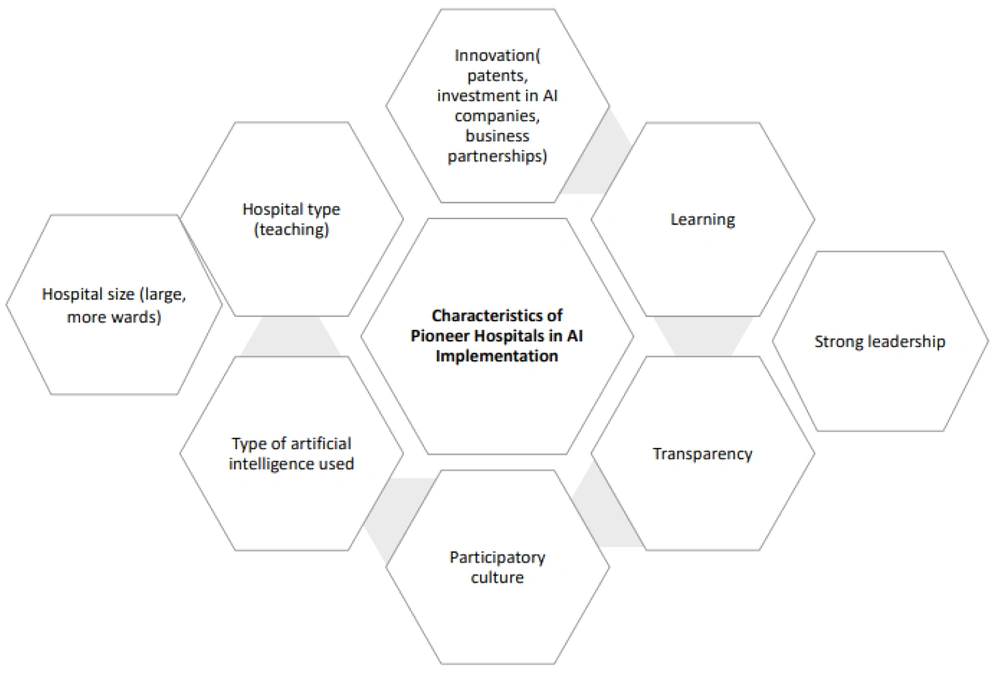
Figure 1.
Summary of studies characterizing pioneer hospitals in AI - authors
4. Conclusions
This study examined pioneer hospitals in AI, focusing on the radiology department. These hospitals had specific characteristics in leadership, investment, financing, and invention. Recent research indicates that US hospitals are rapidly adopting AI (51), and they use approximately 65% of predictive AI models (19). Hospitals with large bed sizes, outpatient surgical departments, private nonprofit ownership, educational status, and membership in health systems are more likely to adopt various forms of AI (51). Furthermore, according to the American Hospital Association Information Technology, medium, large, and urban hospitals, compared with small and rural hospitals, used predictive AI at high levels between 2023 and 2024 (52). Hospital transparency is another characteristic of pioneer hospitals (15).
Based on the literature review and case study characteristics of pioneer hospitals in AI, we extracted data related to hospital characteristics. Two characteristics were most frequently repeated among first-ranked hospitals: strong leadership and innovation. Pioneer hospitals have strong teams that actively promote AI initiatives and allocate strategic and significant investments to digital innovation. They also allocate financial, human, and infrastructure resources to AI research and development, often establishing specialized centers or laboratories and collaborating with technology companies and startups.
Because radiologists have an important role in diagnostic and treatment processes (22, 53) and interact with patients as key participants in diagnostic decision-making (25), AI implementation and integrated adoption of AI tools have many advantages, including facilitating the processing and interpretation of medical data. Furthermore, radiology education through AI can provide new methods for teaching radiology topics remotely, especially in areas where access to radiologists is limited (33). However, studies have shown that the healthcare sector, especially radiology, faces several technological, workflow, and organizational challenges, including complex information technology infrastructure, lack of automated data processing, and insufficient infrastructure. Various stakeholders, including physicians and managers, also have limited knowledge about how to optimally deploy AI (27).
This study examined the characteristics of pioneer hospitals that have implemented AI, with a particular focus on radiology departments. The literature review and analysis suggest that hospitals seeking to implement AI should adopt a comprehensive strategy, vision, and clear digital strategy and should assess their readiness in terms of data infrastructure, employee engagement, and leadership support before beginning large-scale AI projects. In addition, participation of key stakeholders from the beginning of planning for an AI project is essential, and any hospital can use this approach in its long-term strategy to become smarter. Our study of pioneer hospitals in AI worldwide showed that AI implementation is accompanied not only by advanced technology but also by strong leadership, a participatory culture, and transparency.
In the pioneer hospitals studied, radiology departments used AI tools that help with image analysis, workload prioritization, and reporting, which may lead to faster diagnoses and potentially better patient outcomes. Other departments, like radiology, can also use AI in their practice, such as pathology laboratories that use AI to analyze slides while considering ethical issues in the use of AI.


