
1. Background
Artificial intelligence (AI) has advanced substantially and is poised to drive a digital revolution across numerous fields, with healthcare as a primary beneficiary (1). In medicine, AI-based technologies are increasingly integrated into multiple aspects of patient care, from diagnostics to clinical decision-making, and accumulating evidence supports their potential to enhance efficiency and safety (2, 3). Radiology, in particular, has emerged as a leading frontier for medical AI, with rapidly expanding applications in image analysis (4). The integration of AI into radiology represents one of the most promising advances in modern healthcare, with the potential to improve diagnostic accuracy, optimize workflows, and personalize patient care (5, 6). For instance, deep learning algorithms can rapidly and accurately analyze large volumes of imaging data, assisting radiologists in detecting pathologies and predicting outcomes while reducing human error (7, 8). A landmark 2020 study by McKinney et al. also demonstrated that AI-based software outperformed human radiologists in screening mammograms for breast cancer (9).
Despite these technological advances, the successful implementation of AI in clinical practice ultimately depends on patient acceptance and trust (6, 10). Since the earliest use of AI in healthcare, concerns regarding data privacy, accountability, and the potential dehumanization of treatment have been raised and continue to persist (6, 10, 11). Understanding how AI should be applied to align with patient expectations is, therefore, a pressing priority. Several studies have highlighted the need for comprehensive patient education, emphasizing that AI should be framed as a complement to, rather than a replacement for, human radiologists (8, 12). Furthermore, patient perspectives are not uniform; they are influenced by demographic factors such as age, education, and prior exposure to digital health technologies. A 2024 study by Choudhury et al. found that patients with lower digital literacy expressed greater skepticism, whereas younger and more technology-oriented individuals were more open to AI integration (13). These insights are crucial for guiding the development of AI systems that are aligned with patients' needs and priorities. However, evidence on patient perceptions of AI implementation in radiology remains limited (10, 14).
To address these multifaceted concerns within a specific cultural context, this study adapts and validates the questionnaire developed by Ongena et al. (15) for use in the Iranian healthcare system. This research aims to identify the primary factors influencing patient trust, procedural understanding, and overall acceptance of AI in radiological settings within the Middle East, a region with distinct sociocultural dynamics. The findings will provide valuable guidance for policymakers, radiologists, and AI developers, supporting a more patient-centered and culturally sensitive approach to AI integration in healthcare.
2. Objectives
The present study aimed to culturally adapt a standardized questionnaire for measuring patient perspectives on AI in radiology within the Iranian healthcare system.
Specifically, this study sought to:
1) Assess the psychometric properties, including reliability and construct validity, of the Persian version of the questionnaire using CFA.
2) Identify the underlying latent dimensions that characterize patient perspectives on AI in radiology, including personal interaction, being informed, procedural knowledge, efficiency, and distrust and accountability.
3) Determine the relative strength of association between each latent dimension and the overall construct of patient perspectives.
The findings provide a validated instrument for future research and support patient-centered approaches to AI implementation in radiology.
3. Methods
3.1. Study Design and Setting
This cross-sectional study assessed patients' perspectives on the use of AI in radiology through the cultural adaptation and validation of the questionnaire developed by Ongena et al. The study was conducted from June 2024 to December 2024 in the diagnostic imaging departments, including CT, MRI, conventional radiology, and sonography, of 4 major public hospitals selected from 4 distinct geographical regions of Tehran: north, south, east, and west. These hospitals are tertiary referral centers serving broad and diverse catchment areas.
Data were collected in the waiting areas of these departments. Trained researchers invited eligible patients with pre-scheduled imaging appointments to participate, explained the study aims, obtained informed consent, and administered the questionnaire via face-to-face structured interviews to ensure comprehension and completeness. To minimize potential selection bias related to prior attitudes toward AI, the initial contact and invitation were framed broadly around patient experiences with new technologies in radiology. Only after a patient expressed interest in participating was the full purpose of the study, specifically its focus on AI, explained, followed by the obtaining of written informed consent. Each interview lasted approximately 15 to 20 minutes. Of 370 distributed questionnaires, 347 were completed and included in the analysis after data cleaning.
3.2. Study Participants and Sampling
Participants were adult patients aged 17 years or older who attended diagnostic imaging services in Tehran public hospitals. The inclusion criteria were as follows: 1) adequate literacy to understand and answer the questionnaire, 2) ability to communicate verbally, and 3) willingness to participate and provide informed consent.
A convenience sampling approach was used because of the high daily patient flow and broad demographic diversity in Tehran public hospitals. Before recruitment, hospitals were purposively selected based on location to cover the 4 primary geographical directions of Tehran: north, south, east, and west. This strategy helped ensure that the aggregated sample included patients from a wide spectrum of the city's socioeconomic, cultural, and ethnic backgrounds, as these large public hospitals serve as primary or tertiary referral centers for their respective sectors. Although individual participant recruitment was nonprobabilistic, strategic site selection provided a robust basis for assessing city-wide patient perspectives within the public healthcare system. Public hospitals perform most radiological examinations and serve people from a wide range of socioeconomic and geographic backgrounds. Thus, the selected sites reflected the typical patient experience in Tehran’s public healthcare system, and the findings offer valuable insight into prevailing attitudes within this large and diverse urban population.
3.3. Sample Size Calculation
The sample size was determined based on recommendations for CFA, which typically require 5 to 10 participants per estimated parameter or questionnaire item to achieve stable model estimation. The adapted questionnaire consisted of 39 items, suggesting a minimum sample size of 195 to 390 participants. The final sample of 347 valid responses met these requirements and provided sufficient statistical power for reliable estimation of factor loadings and model fit indices. This sample size also exceeds the minimum of 300 often recommended for structural equation modeling (SEM) studies to ensure stable and generalizable results.
3.4. Conceptual Framing of AI for Participants
Recognizing that patients often have limited direct interaction with radiologists, it was essential to provide a clear and consistent conceptual framework for AI’s role. Before administering the questionnaire, researchers provided the following standardized and neutral explanation: "Artificial intelligence (AI) in radiology refers to computer systems that can assist in analyzing medical images, such as X-rays, CT scans, or MRIs. These systems can help radiologists by highlighting areas of potential concern, prioritizing cases, or providing second opinions. We are interested in your views on how such technology might be used in your care." This explanation intentionally presented AI as a tool that assists the radiologist, rather than as an autonomous decision-maker, to anchor participants’ understanding in a realistic and clinically relevant scenario.
3.5. Data Collection Tool and Technique
The questionnaire used in this study was adapted from the instrument developed and validated by Ongena et al. (15) to assess patients’ perspectives on AI in radiology. The adaptation process followed established methodological guidelines for cross-cultural instrument translation and validation.
The English version of the questionnaire was first translated into Persian by 2 independent bilingual translators familiar with medical terminology. The translations were reviewed by a panel consisting of a methodologist, a psychometric evaluation expert, and 2 radiology specialists to ensure conceptual and linguistic equivalence. Discrepancies were discussed until a consensus version was reached. This version was then back-translated into English by a translator who was blinded to the original questionnaire. The back-translated version was compared with the original to confirm semantic consistency. The back-translated version was systematically compared with the original by the research team and methodology experts. Any semantic discrepancies identified were discussed and resolved by consensus within the expert panel, which consisted of a methodologist, a psychometric evaluation expert, and radiology specialists, to ensure conceptual equivalence before finalizing the Persian version for pilot testing. The adaptation and validation process followed the COSMIN guidelines for cross-cultural translation and psychometric validation of patient-reported outcome measures (12).
The content validity of the translated questionnaire was assessed by an expert panel of 5 specialists. The panel included 2 radiology specialists, each with more than 10 years of clinical experience in diagnostic imaging; 1 health services management researcher; 1 methodologist with experience in questionnaire development; and 1 psychometric evaluation expert. All panel members held graduate degrees, including 3 PhD degrees and 2 master's degrees. They were purposively selected based on their expertise in radiology, health services research, or measurement. Three panel members had prior experience conducting formal content validity assessments. The panel reviewed each of the 39 items for relevance, clarity, and necessity using a 4-point Likert scale. Scale-level content validity was calculated: The mean content validity index was 0.89, and the mean content validity ratio was 0.82 (content validity index ≥ 0.78; content validity ratio ≥ 0.62). Item-level content validity index/content validity ratio values were not recorded during this initial adaptation.
A pilot test was then conducted with 20 patients to evaluate clarity, readability, and cultural appropriateness. Based on this feedback, the expert panel made minor linguistic modifications to optimize clarity and cultural appropriateness while preserving the original meaning of each item.
The same 5-factor structure as the original validated instrument was retained, encompassing 1) personal interaction, 2) efficiency, 3) being informed, 4) distrust, and 5) accountability.
3.6. Statistical Analysis
Data were analyzed using IBM SPSS Statistics, version 21.0 (IBM Corp., Armonk, NY, USA), for descriptive statistics and IBM SPSS Amos, version 18.0 (IBM Corp.), for CFA. Descriptive statistics, including mean, SD, and frequency distributions, were calculated to summarize participants’ demographic characteristics and item-level responses.
Internal consistency reliability was assessed using Cronbach’s alpha, with values of 0.70 or higher considered acceptable. Construct validity was examined through SEM limited to CFA to confirm the 5-factor structure of the adapted questionnaire.
Model fit was evaluated using several goodness-of-fit indices: the chi-square/degree of freedom ratio (χ2/df), RMSEA, incremental fit index (IFI), and CFI. Acceptable model fit was defined as χ2/df < 3, RMSEA < 0.08, and CFI and IFI > 0.90. All statistical tests were 2-tailed, and a P value < 0.05 was considered statistically significant.
3.7. Ethical Considerations
This study adhered to the ethical principles of human research and was approved by the ethics committee of the related university, with the ethical approval code IR.IAU.TNB.REC.1403.028. Informed consent was obtained from all participants, and they were assured that their personal information would remain confidential.
4. Results
Table 1.
Construct Definitions and Mapping From the Original to the Persian Version
| Number of Items | Original Construct (Ongena et al.) | Persian Construct (This Study) | Definition |
|---|---|---|---|
| 15 (Q1-Q15) | Distrust and Accountability | Distrust and Accountability | Patient skepticism about AI replacing human oversight and concerns about who is responsible when AI makes an error |
| 8 (Q16-Q23) | Procedural Knowledge | Procedural Knowledge | Patient understanding, or lack thereof, of how AI works in radiology, including the need for clear explanations |
| 7 (Q24-Q30) | Personal Interaction | Personal Interaction | Patient preference for maintaining human contact, communication, and trust with radiologists |
| 5 (Q31-Q35) | Efficiency | Efficiency | Patient perception of AI's ability to improve speed, reduce waiting times, and optimize workflow |
| 4 (Q36-Q39) | Transparency | Being Informed | Patient desire to be told when AI is used in their own diagnosis or treatment |
4.1. Patients' Characteristics
The final analysis included 347 patients from the diagnostic imaging departments of hospitals in Tehran who completed the questionnaire. The demographic characteristics of the participants are presented in Table 2. Most participants were female (63.0%; n = 233). The mean age was 47.01 years (SD = 19.09), with a range of 20 to 90 years. Regarding educational background, most participants had a university degree (70.3%; n = 260), whereas a small percentage were illiterate (3.8%; n = 14). Regarding employment status, 33.0% (n = 122) were employees, 25.1% (n = 93) were self-employed, and 18.7% (n = 69) were homemakers.
Table 2.
Demographic Information of the Participants a
| Characteristics | Values |
|---|---|
| Gender | |
| Male | 137 (37) |
| Female | 233 (63) |
| Education | |
| Illiterate | 14 (3.8) |
| Primary | 8 (2.2) |
| Middle school | 21 (5.7) |
| High school diploma | 67 (18) |
| University | 260 (70.3) |
| Employment | |
| Worker | 37 (10) |
| Employee | 122 (33) |
| Self-employed | 93 (25.1) |
| Retired | 49 (13.2) |
| Homemaker | 69 (18.7) |
| Marital status | |
| Married | 251 (67.8) |
| Single | 119 (32.2) |
| Age (y) | |
| Mean ± SD | 47.01 ± 19.09 |
| Range (min - max) | 20 - 90 |
a Values are expressed as No. (%) unless otherwise indicated. Abbreviations: max, maximum; min, minimum; SD, standard deviation.
4.2. Descriptive Statistics and Factor Analysis
The questionnaire’s 39 Likert-scale items were grouped into 5 key factors to assess patient perspectives. For all factors, higher scores indicate more negative attitudes toward AI in radiology. The results for each domain are summarized below and in Table 3.
Table 3.
Summary of Domain Scores and Reliability Analysis a
| Domains | Mean | SD | Median | IQR | Cronbach Alpha |
|---|---|---|---|---|---|
| Distrust and Accountability | 3.30 | 0.34 | 3.53 | 1.47 | 0.91 |
| Personal Interaction | 3.77 | 0.42 | 3.79 | 1.14 | 0.88 |
| Being Informed | 3.56 | 0.21 | 3.75 | 1.25 | 0.82 |
| Procedural Knowledge | 4.12 | 0.11 | 4 | 0.88 | 0.85 |
| Efficiency | 3.56 | 0.21 | 3.75 | 1.25 | 0.84 |
a Abbreviations: IQR, interquartile range; SD, standard deviation.
Distrust and Accountability (Questions 1 - 15): This factor assessed skepticism about AI replacing human oversight. With a mean score of 3.30 (SD = 0.34), patients demonstrated a moderate level of distrust. This was reflected in the finding that more than half of the participants (51.6%) agreed that AI should not operate independently, highlighting substantial concerns regarding the reliability and accountability of AI systems.
Procedural Knowledge (Questions 16 - 23): This domain represented the most prominent concern among patients and had the highest mean score of 4.12 (SD = 0.11). This strong negative perception is related to a lack of understanding of AI processes. Nearly half of the participants (48.9%) expressed a strong desire for clear explanations, indicating that understanding how AI works is critical for patient acceptance.
Personal Interaction (Questions 24 - 30): Patients placed a high value on human connection, as indicated by a mean score of 3.77. Half of the respondents specifically emphasized that AI should not reduce their communication with radiologists. The SD of 0.42 suggests mixed views on this topic; although some patients were comfortable with AI’s role, others were more cautious about losing personal interaction.
Efficiency (Questions 31 - 35): In contrast to other concerns, patients were less negative regarding AI’s potential to improve efficiency, and this domain had the lowest mean score of 3.27 (SD = 0.37). Although 46.5% acknowledged potential benefits, a notable proportion (22.2%) were concerned that gains in speed might compromise accuracy or personalized care.
Being Informed (Questions 36 - 39): Patients demonstrated a strong desire to be informed, with a mean score of 3.56 (SD = 0.21). Most participants (59.2%) wanted to be informed when AI was involved in their care. This suggests that, although patients may feel somewhat aware of AI’s role, there is a clear demand for communication about its use in their specific diagnosis and treatment.
4.3. Reliability Analysis
The questionnaire demonstrated excellent reliability, with an overall Cronbach alpha of 0.92, indicating high internal consistency. All subscales exceeded the acceptable threshold of 0.70 (Table 3).
The CFA indicated a good fit of the 5-factor model to the data (χ2/df = 2.009; RMSEA = 0.066; CFI = 0.911; IFI = 0.903) (Table 4). All factors demonstrated satisfactory internal consistency, and most item loadings exceeded 0.50, confirming the adequacy of the model structure. However, a few items showed relatively low standardized loadings, such as Item Q8 (loading = 0.05) within the Being Informed dimension. Although this item was retained in the current model to maintain comparability with the original questionnaire, it may require revision or removal in future validation studies to further improve construct reliability and model fit.
Table 4.
Confirmatory Factor Analysis and Model Fit Indices
| Fit Index | Accepted Value | Value |
|---|---|---|
| Chi-square (χ2) | 1400.087 | |
| χ2/df | 1 < x < 3 | 2.009 |
| P-value | < 0.05 | < 0.001 |
| Root mean squared error of approximation | < 0.08 | 0.066 |
| Incremental fit index | > 0.90 | 0.903 |
| Comparative fit index | > 0.90 | 0.911 |
The path coefficients from the CFA, illustrated in Figure 1 and detailed in Table 5, indicate the relative strength of the association between each factor and the overall construct of patient perspectives. Personal interaction (path coefficient = 0.98) and being informed (path coefficient = 0.81) showed the strongest associations with the overall latent construct, whereas efficiency (path coefficient = 0.07) showed a minimal association.
Table 5.
Factor Loadings and Path Coefficients
| Latent Factor | Path Coefficient | Residuals (e) | Factor Loading Range |
|---|---|---|---|
| Distrust and Accountability | 0.53 | e40 | 0.05 - 0.56 |
| Being Informed | 0.81 | e44 | 0.23 - 0.59 |
| Efficiency | 0.07 | e43 | 0.42 - 0.67 |
| Personal Interaction | 0.98 | e42 | 0.41 - 0.65 |
| Procedural Knowledge | 0.61 | e41 | 0.19 - 0.70 |
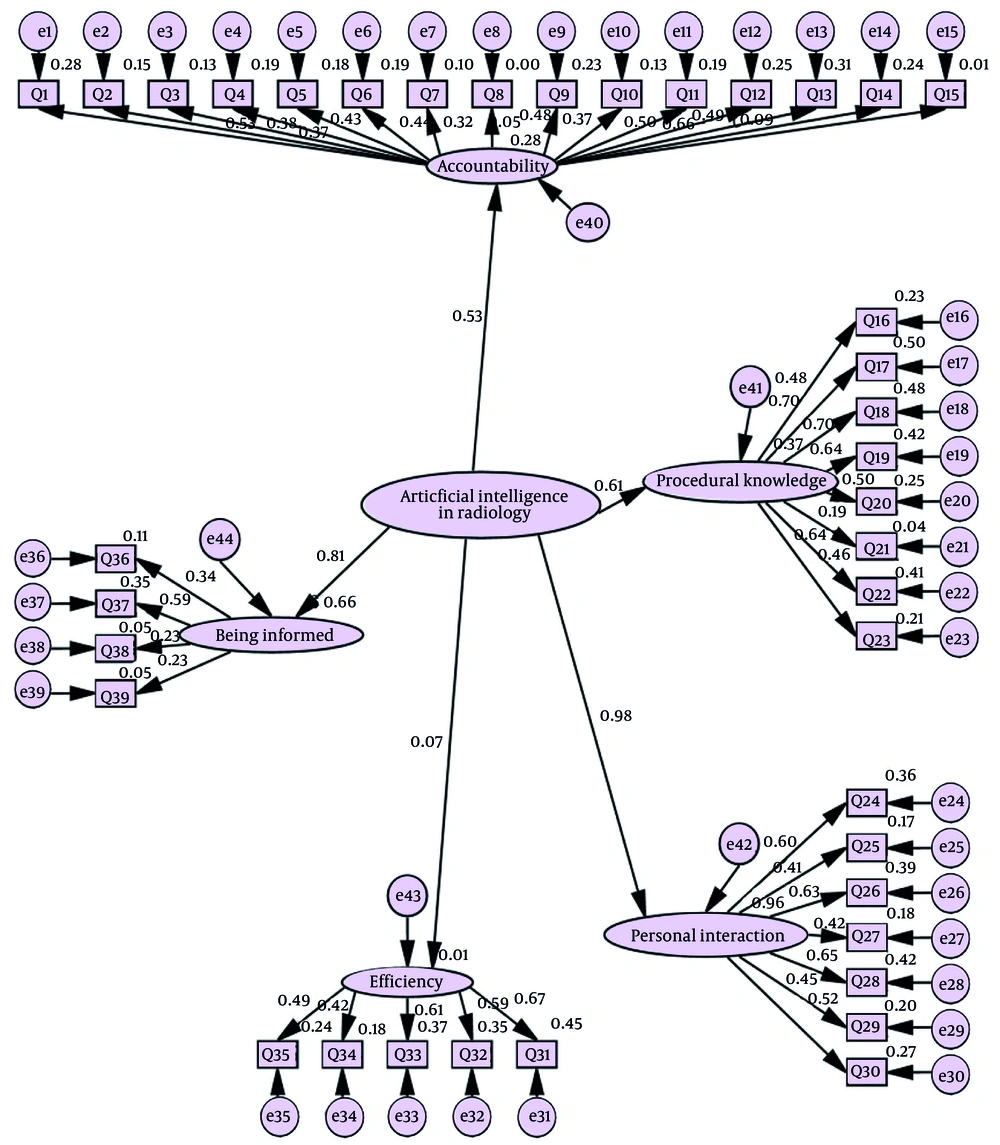
Figure 1.
CFA results with the relative importance of various factors influencing patient perspectives on AI in radiology. Ovals represent latent constructs: Distrust and Accountability, Procedural Knowledge, Personal Interaction, Efficiency, and Being Informed. Rectangles represent observed questionnaire items (39 items, abbreviated for space). Single-headed arrows show standardized factor loadings (path coefficients) from each latent construct to its items. Double-headed arrows show covariances between constructs. The model assumes that each item loads only on its intended factor, error terms are uncorrelated, and multivariate normality is present.
4.4. Confirmatory Factor Analysis and Model Fit
Confirmatory factor analysis was conducted to evaluate the 5-factor structure of the adapted 39-item questionnaire. The model demonstrated acceptable fit to the data (Table 4). All factor loadings and path coefficients are presented in Table 5.
Examination of standardized factor loadings indicated that most items loaded adequately on their respective factors (≥ 0.40). However, 3 items had loadings below the conventional threshold of 0.40 (Hair et al.): Q8 (0.05) in Distrust and Accountability, Q39 (0.23) in Being Informed, and 1 Procedural Knowledge item (0.19). Despite these low loadings, the 3 items were retained for 2 reasons. First, this study aimed to validate the original 39-item instrument cross-culturally; removing items would preclude direct comparison with the original Dutch sample and other international validations. Second, each item captures a conceptually distinct aspect of its respective construct that is not covered by other items (eg, Q8 measures relative trust in AI vs. radiologists; Q39 measures the desire for personal notification). Although 3 items showed low loadings, retaining them ensured structural alignment with the original scale for international comparisons. Overall, the fit indices and high subscale reliability confirm that this 39-item version is valid and reliable for research purposes.
4.5. Latent Factors and Their Contributions
The path coefficients from the CFA (Table 5) show varying strengths of association between each latent factor and the overall construct. Personal interaction, with a path coefficient of 0.98, and being informed, with a path coefficient of 0.81, showed the strongest associations, followed by procedural knowledge, with a path coefficient of 0.61, and distrust and accountability, with a path coefficient of 0.53. Efficiency, with a path coefficient of 0.07, showed the weakest association.
1) Personal Interaction: Patients placed critical importance on maintaining human connection, trust, and communication with healthcare professionals, even within AI-integrated care. This was supported by high loadings on interpersonal trust items, such as Q28 = 0.65 and Q29 = 0.60.
2) Being Informed: Transparency was a top priority; patients had a fundamental desire to be informed about AI use in their care. Item Q37 (0.59) was a key indicator, whereas Q39 (0.23) performed poorly and may require review.
3) Efficiency: Patients were far less concerned with operational optimization than with human-centered elements and procedural understanding. Item Q31 (0.67) was the most relevant measure of this construct.
4) Distrust and Accountability: Concerns regarding responsibility for AI-driven decisions were substantial but not paramount. Items Q1 and Q13, with loadings > 0.50, captured these concerns well, but Q8 (0.05) performed very poorly and should be reconsidered in future iterations.
5) Procedural Knowledge: Patients’ acceptance of AI was tied to their understanding of how it works. High loadings on Q21 (0.64) and Q22 (0.61) reinforce that transparency in the process is key, whereas Q16 (0.48) could be refined for greater clarity.
5. Discussion
This study aimed to culturally adapt, validate, and standardize a Persian version of the patient perception questionnaire on AI in radiology, originally developed by Ongena et al. The results showed that the adapted instrument has satisfactory psychometric properties and can be reliably used to assess Iranian patients’ attitudes toward the use of AI in diagnostic imaging.
The CFA supported the 5-factor model structure comprising personal interaction, efficiency, being informed, distrust, and accountability, consistent with the original questionnaire. The model fit indices (χ2/df = 2.009; RMSEA = 0.066; IFI = 0.903; CFI = 0.911) indicated an acceptable model fit, confirming that the adapted questionnaire adequately represents the underlying constructs. Cronbach alpha values for all subscales exceeded 0.70, confirming strong internal consistency and reliability.
Although most items demonstrated satisfactory factor loadings (> 0.50), 1 item (Q8) in the Distrust and Accountability dimension showed a relatively low loading of 0.05. This item was retained in the model to preserve comparability with the original instrument but should be reconsidered or refined in future validation studies to enhance model strength and construct validity.
Among the 5 dimensions, personal interaction and being informed showed the strongest associations with patients’ overall perceptions of AI in radiology, with path coefficients of 0.98 and 0.81, respectively. These results align with findings from Ongena et al. (15) and Lennartz et al. (10), who reported that patient acceptance of AI depends heavily on maintaining clear communication and trust between patients and clinicians. One possible interpretation is that the Iranian healthcare context places a strong cultural emphasis on the physician–patient relationship; however, this hypothesis was not directly tested and should be examined in future cross-cultural comparative studies.
The scores for efficiency (mean = 3.27; SD = 0.37) indicate that most participants acknowledged the potential benefits of AI in improving diagnostic accuracy, reducing waiting times, and supporting radiologists. At the same time, participants expressed caution, suggesting that they value human oversight as an essential component of medical decision-making. This pattern is consistent with international studies indicating that patients view AI as a supportive rather than an autonomous tool (16, 17).
The Distrust and Accountability domain received moderate scores (mean = 3.30; SD = 0.34), implying that patients in this sample had some reservations about safety, transparency, and responsibility for errors. Although the present findings do not directly test the effects of ethical or regulatory frameworks, they suggest that such frameworks may be relevant for addressing patient concerns.
From a practical perspective, the validated Persian questionnaire provides a standardized tool for assessing patient perceptions of AI in radiology. It is intended for research purposes and attitude assessment, not for individual clinical decision-making. The questionnaire can assist researchers and hospital administrators in evaluating patient readiness for AI adoption and identifying barriers to implementation. It may also support longitudinal studies tracking changes in patient attitudes as AI becomes more prevalent in clinical practice.
5.1. Cross-Cultural Comparison
The findings of this study align with international research on patient attitudes toward AI in radiology. The strong influence of personal interaction (0.98) and being informed (0.81) in the Iranian cohort mirrors results from Saudi Arabia using the same validated questionnaire, in which patients similarly favored physicians over AI for these domains (18).
Globally, a 43-country study found that 72.9% of patients wanted physicians to make final decisions with AI assistance, whereas only 4.4% accepted AI alone (19). This preference for human–AI collaboration supports the finding that personal interaction was the strongest predictor of patient perspectives. The importance of being informed in the present study is consistent with research from Malta, where 92.1% of patients wanted to be informed when AI was used, and the United Arab Emirates, where 85.8% cited insufficient information as a barrier (20, 21). Concerns about distrust and accountability, with a path coefficient of 0.53 in the present study, are also reflected internationally, with 63% of Irish patients assigning joint responsibility for errors to both AI and radiologists. These comparisons suggest that although cultural nuances exist, core patient expectations, including human oversight, transparency, and clear accountability, are consistent across diverse healthcare settings.
5.2. Limitations
This study has several limitations. The sample was drawn from patients attending 4 major public hospitals geographically dispersed across Tehran. Although this purposive site selection ensured considerable intra-city diversity, the findings may not be fully generalizable to patients in rural areas, those using private healthcare facilities, or patients in other provinces. However, because large public hospitals in Tehran provide a significant proportion of diagnostic imaging services for a highly heterogeneous urban population, the results offer valuable insight into prevailing attitudes within Iran’s largest and most diverse urban center. In addition, although the consent process was designed to initially mask the specific focus on AI to reduce self-selection bias, the number of patients who declined participation before consent was not systematically recorded. Therefore, potential selection bias cannot be definitively quantified or ruled out, particularly if patients with more favorable prior views of technology or AI were more likely to agree to participate. However, the high completion rate of 93.8% among those who did consent suggests very good engagement after enrollment.
In addition, the cross-sectional design captured perceptions at a single time point, and responses may evolve as AI applications become more integrated into clinical workflows. Future research should therefore include participants from various regions, hospital types, and educational backgrounds and consider longitudinal designs to explore how trust and acceptance develop over time. Another limitation is that the questionnaire addressed AI in radiology generically, without distinguishing between modalities such as sonography, which involves direct patient contact, and CT/MRI, which involves no direct patient contact. Future research should develop modality-specific items. The study also did not measure comprehensive socioeconomic status or prior AI knowledge beyond basic demographics. Although general AI awareness was assumed and standardized explanations were provided, unmeasured variation in these factors may have affected responses. Future studies should include validated socioeconomic status and AI literacy assessments. Moreover, 3 items had loadings below 0.40, including Q8 = 0.05, Q39 = 0.23, and 1 Procedural Knowledge item = 0.19. Although these items were retained for cross-cultural comparability, their poor performance indicates that the questionnaire requires further refinement. Future studies should revise or remove these items. Finally, additional psychometric indices, such as composite reliability and average variance extracted, were not calculated in the present study; future validation studies should incorporate these metrics to further evaluate convergent validity and construct reliability.
5.3. Conclusions
The Persian version of the patient perception questionnaire on AI in radiology demonstrated strong validity and reliability, confirming its 5-factor structure through CFA. The findings indicate that personal interaction and being informed are the dimensions most strongly associated with patient perspectives in this Iranian cohort, whereas efficiency shows minimal association. These results describe how Iranian patients conceptualize AI in radiology, generally viewing its potential positively while expressing strong preferences for human oversight, being informed, and clear accountability. As a validated instrument, this questionnaire provides a reliable tool for future research to further explore these associations and guide patient-centered approaches to AI implementation in radiology.