
1. Background
Down syndrome (DS) is the most common chromosomal aneuploidy to result in a live birth (1). In the past two decades, second-trimester maternal serum screening for DS has been the most common strategy for the prenatal diagnosis of chromosomal aneuploidies. More recently, the screening for and diagnosis of chromosomal abnormalities have been increasingly performed in the first trimester. With improvements and technological advances in ultrasound, it is now possible to identify many fetal structural anomalies at 11 to 13+6 weeks’ gestation (2, 3).
Recent studies suggest that the detection rates for trisomy 21 (T21) may be improved with the incorporation of additional markers such as the nasal bone (NB) status. In the case of DS, the NB may be absent in the first trimester as a result of delayed ossification. In order to determine the risk of T21 in case of fetal NB abnormalities, the most important indicator is the NB absence in the first trimester (4,5). During this period, biochemical markers in the serum, combined with the sonographic measurement of nuchal translucency and the presence/absence of the NB, can achieve a DS detection rate of 97.5% at a false-positive rate of 5% (2).
Every woman has a risk of carrying a fetus/baby with DS. In order to calculate the individual risk, it is necessary to take into account the background or a priori risk and multiply this by a series of factors or likelihood ratios (LR). These factors or LRs depend on the results of a series of screening tests carried out during the course of the pregnancy to determine the patient-specific risk. The LR for the absence of the fetal NB during the first trimester of gestation is calculated by dividing the percentage of the NB absence rate in chromosomally abnormal fetuses by the percentage of the NB absence rate in normal fetuses.
Meanwhile, fetal NB absence of normal fetuses in the first trimester differs significantly in mothers of different ethnic origins (6). This suggests that corrections need to be considered for maternal ethnicity to ensure the fairness of fetal NB screening in multiracial populations (7). Likewise, the morphometry of the splanchnocranium of the NB, in particular, differs between the adults of various ethnic origins (8). It would, therefore, be important to assess ethnic variations and racial factors in the first-trimester visualization of the fetal NB before introducing this marker into routine screening programs for aneuploidy in people of different ethnicities. Based on the category of the fetal medicine foundation (FMF) the Iranian population belongs to White (Middle Eastern) ethnic group of the mother. Due to this the normal or abnormal comparative values for this marker is unknown for this group of the mothers (7).
2. Objectives
Our objectives in this study were to: 1) determine whether the rates for the absence of the NB for normal fetuses in a predominantly Iranian population were similar to those previously reported in other countries; 2) estimate the LR for the absence of the NB in pregnancies for this ethnicity; and 3) compare the LR for the absence of the NB with the previously published data from different populations.
3. Patients and Methods
From March 2010 to July 2011, the fetal facial profile was examined by ultrasonography in mothers living in the North-West provinces of Iran (Azerbaijani ethnicity) in order to visualize the NB image. Gestational age was based on the last menstrual period and confirmed by the first-trimester ultrasound ranging between 11 and 13 weeks and 6 days of gestation. Pregnancies with any detected/suspicious anatomical or genetic fetal anomalies and pregnancies of artificial reproduction techniques were excluded from the data analyses. This prospective study included 767 randomly selected women carrying 767 fetuses for the screening of the nonexistence/ hypoplastic fetal NB/T21. Informed consent for study purposes was obtained from all the patients, and they were subsequently enrolled. The study was reviewed and approved by the ethics in research and investigation committee of Tabriz university of medical sciences.
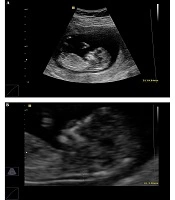
The fetal NB was visualized by using transabdominal ultrasound machine (Philips 4000, USA) in an adequately magnified mid-sagittal view of the fetal profile, with an angle of incidence between the ultrasound beam and the line traced from the front to the chin of the fetus at about 45° or 135° (9). Only the fetal head and upper thorax were included in the screen for the NB measurement or its presence/absence (Figure 1). In this view, three bright lines are noticeable: the superficial line, in the anterior part, the echoes from the skin of the top of the nose, posteriorly, the echoes from the skin of the nose, and deeper, the echoes from the NB. When the NB line appears as a thin line and less echogenic than the overlying skin, it suggests that the NB is not yet ossified; and it is, therefore, classified as being absent. When the NB was judged as absent, another operator would immediately check the fetal profile in order to confirm the finding. In this position, the skin of the nose produces an echogenic line, which can be misinterpreted as the NB. To avoid this mistake, the ultrasound transducer was gently tilted from side to side, with an angle of approximately 45° to the fetal face, to ensure that the NB would not falsely to be absent. After the NB was clearly apparent, the bony part of the nasal bridge was measured by placing the calipers in the out-to-out position. Each increment in the distance between the calipers is considered only 0.1 mm (Figure 1). All the ultrasound examinations were performed with one ultrasound machine (without using other brands) by 2 sonographists experienced in fetal morphological evaluation. Each pregnancy was followed up until the time of delivery or termination of the pregnancy.
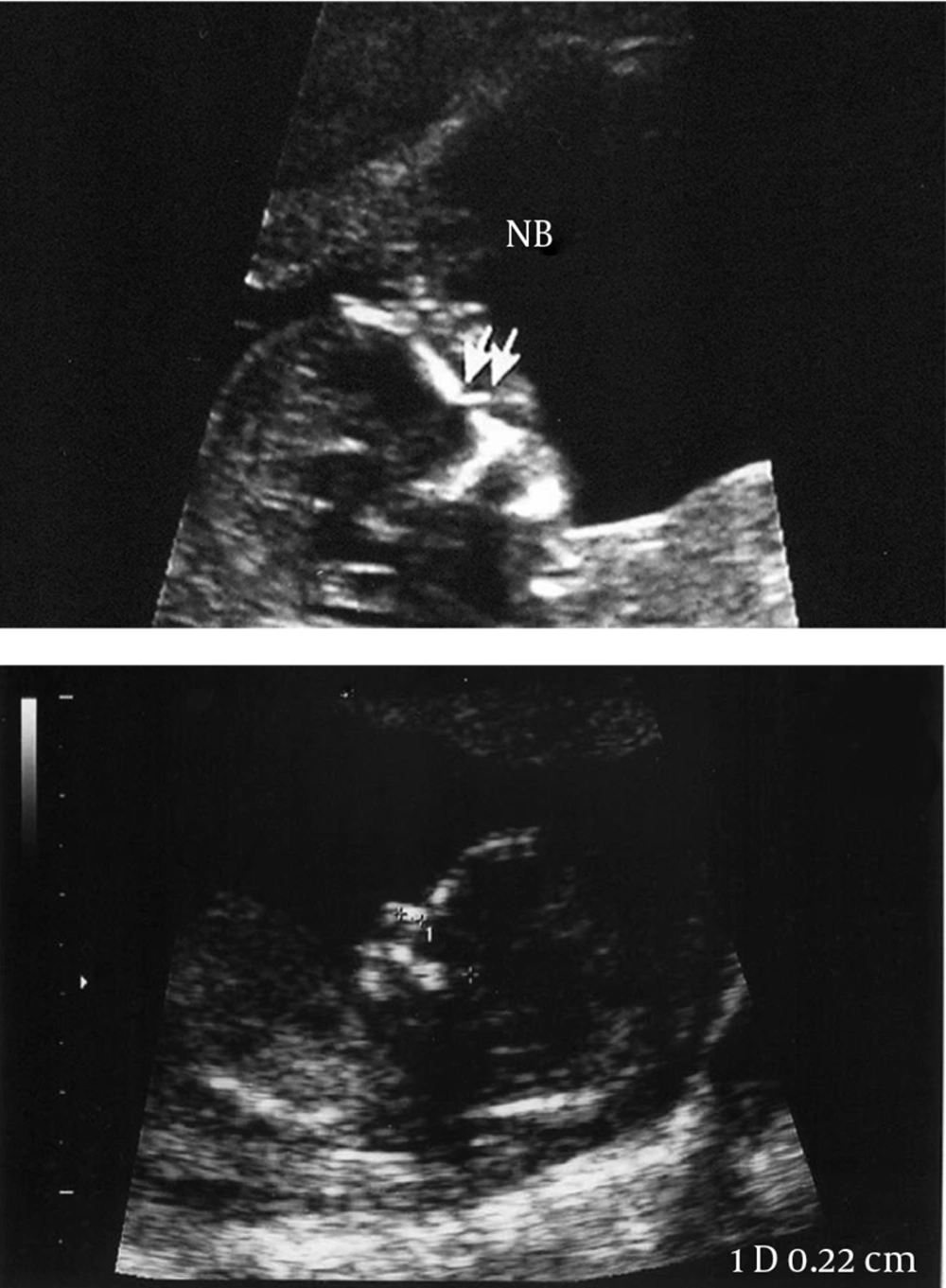
Figure 1.
Ultrasound image showing the nasal bone with the length measurement of the nasal bone.
One of our aims in the current study was to determine the LR for the NB absence in chromosomally normal fetuses. The LRs were determined for the NB absence by dividing the occurrence of hypoplasia in T21 fetuses to its occurrence in the euploid group. The incidence of the absent NB in the T21 fetuses in this study was derived from previously published reference values with regard to those ethnic groups that have phenotypic similarity to the ethnicity of the people included in this study.
The length of the NB was also evaluated for the percentiles of 1, 3, 5, 50, 95, 97, and 99% in the fetuses of 11, 12, 13, and 14 weeks old, independently.
4. Results
All mothers included in this study belonged to the same ethnic origin from the North-West (Turkish-speaking) provinces of Iran. The examination of the fetal profile was possible in all (767) cases and of these, the NB was absent in 2/767 (0.26%) fetuses. These fetuses were followed up to see whether or not any abnormalities could be detected, and they were all completely normal after birth. Fourteen mothers had a history of anomalies in their previous pregnancies. Twelve mothers had a positive family history for a previous fetal malformation. The average maternal age was 26.2 ± 5.3 years (15-47). The mean crown-rump lengths of the fetuses of 11 to 13 weeks and 6 days gestational age were 46.8 ± 7.4, 59.2 ± 4.7, 69.9 ± 4.9, and 79.6 ± 3.4 mm, respectively. The minimum was 40 mm and the maximum was 84 mm in this study.
We also evaluated the NB presence or absence along with the measurement of the length of the NB in this population. The mean length of the NB was 3.6 ± 0.69 mm (1.3-5.1) for the fetuses of 11-13 weeks and 6 days gestational age. Because of the differences in the range of the NB length, the length of the NB was calculated for the percentiles of 1, 3, 5, 50, 95, 97, and 99% in the fetuses of 11, 12, 13, and 14 weeks gestational age, depicted in Table 1.
Table 1.
Length of the Nasal Bone for the Percentiles of 1, 3, 5, 50, 95, 97, and 99% in the Fetuses of 11, 12, 13, and 14 Weeks Gestational Age a
| Gestational age, w | Mean ± SD, mm | Percentile 1 | Percentile 3 | Percentile 5 | Percentile 50 | Percentile 95 | Percentile 97 | Percentile 99 |
|---|---|---|---|---|---|---|---|---|
| 11 | 3.2 ± 0.42 | 2.6 | 2.7 | 2.7 | 3.1 | 4.02 | 4.3 | NC b |
| 12 | 3.6 ± 0.52 | 2.1 | 2.8 | 2.9 | 3.6 | 4.6 | 4.7 | 4.8 |
| 13 | 3.9 ± 0.57 | 2.9 | 2.97 | 3 | 4 | 4.9 | 5 | NC b |
| 14 | 4.6 ± 0.35 | 4 | 4 | 4 | 4.8 | NC b | NC b | NC b |
a Data are presented as %.
b Because of the low number of patients, these values were not Calculable (NC).
The calculation of the LR was performed using the equation presented above. The occurrence of the NB absence in the T21 fetuses was derived from previous studies. Published studies of the first-trimester NB assessment for aneuploidy were identified through a MEDLINE search. In this study, we chose the mean value of 65% among the values reported previously (Table 2) (10). The percentage of the NB absence in the normal fetuses was calculated according to the results obtained in this study (0.26 %). Using the equation mentioned above, the value of the LR of the NB absence was 250 in the normal fetuses of the Iranian population living in the north-west provinces.
Table 2.
Incidence of the Absent Nasal Bone in Trisomy 21 and Chromosomally Normal Fetuses Based on Ethnic Groups a
| Author | Year | Country | Trisomy 21 (%) | Normal (%) |
|---|---|---|---|---|
| Cicero et al. (1) | 2001 | USA | 43 of 59 (73) | 3 of 603 (0.5) |
| Otano et al. (11) | 2002 | Argentina | 3 of 5 (60) | 1 of 175 (0.6) |
| Zoppi et al. (12) | 2003 | Italy | 19 of 27 (70) | 7 of 3463 (0.2) |
| Orlandi et al. (13) | 2003 | Italy | 10 of 15 (67) | 10 of 1000 (1.0) |
| Viora et al. (14) | 2003 | Italy | 8 of 10 (80) | 24 of 1733 (1.4) |
| Senat et al. (15) | 2003 | France | 3 of 4 (75) | 4 of 944 (0.4) |
| Wong et al. (16) | 2003 | Hong Kong | 2 of 3 (67) | 1 of 114 (0.9) |
| Cicero et al. (17) | 2003 | England | Caucasian: 146 of 220 (66.4) | 78 of 3125 (2.5) |
| Afro-Caribbean: 7 of 9 (77.8) | 8 of 77 (10.4) | |||
| Asian: 8 of 11 (72.7) | 1 of 103 (6.8) | |||
| Cicero et al. (18) | 2004 | England | 229 of 333 (69) | 129 of 5223 (2.5) |
| Orlandi et al. (19) | 2005 | Italy | 8 of 15 (53) | 9 of 2396 (0.4) |
| Sonek et al. (20) | 2006 | USA | 282 of 412 (68) | 185 of 15048 (1.2) |
| Moon et al. (21) | 2006 | Korea | 8 of 15 (53) | 16 of 6456 (0.2) |
| Has et al. (22) | 2008 | Turkey | 3 of 9 (33.3) | 7 of 1798 (0.39) |
| Total | 779 of 1138 (65.68) | 482 of 40513 (1.2) |
a Data are presented as No. of Total (%).
5. Discussion
Zoppi et al. (12) remarked that the ultrasound sign of an absent NB seems to be a promising marker for T21, either alone or in association with the nuchal translucency test, on condition that its reliability is proven in studies carried out on larger general series.
The present study demonstrates that maternal ethnic origin affects the rate of the visualization of the fetal NB in ultrasound examination at 11-14 weeks of gestation in chromosomally normal fetuses in comparison to the results of the other studies with different ethnic origins.
The fetal NB first becomes histologically apparent at a crown-rump length of 42 mm, which corresponds to 11 weeks gestation (23). When performing fetal NB evaluation in order to determine the risk for T21, the NB absence is the most important index in the first trimester (4). To obtain the rate of the risk, it is necessary to calculate the LR. For this reason, we need to know the rate of the NB absence in fetuses with DS in addition to the occurrence of the NB absence in normal fetuses. There are many reports of the NB absence in the investigations of fetuses with DS in previous studies. Since there are characteristic differences among races in the shape and the size of the nose (24), it is probable that the assessment of the rate of the NB absence in normal fetuses is important in order to calculate the LR of the NB absence in normal fetuses in different regions with their own ethnic characteristics.
The mean length of the NB in this study was 3.6 ± 0.69 mm (1.3 - 5.1 mm). Based on the results of a study by Cossi et al. (25) on Brazilian fetuses, the rate of the NB length in fetuses of 11 - 14 weeks gestational age in the percentile of 50% was 1.69 - 2.94 mm, respectively. Orlandi et al. (13) found the range of 2.48 - 3.12 mm for the NB length and 45-84 mm for the length of the crown to rump in fetuses of 11 - 14 weeks gestational age. Meanwhile, the standard range of the NB length for fetuses of 11 - 14 weeks gestational age was reported as 1 and 3.7 mm in the 2.5% percentile, respectively (13).
According to the data mentioned above, the length of the NB is different between the fetuses of various populations and ethnicities and these factors may affect the measured NB length. Hence, the variation which is reported in the different studies in relation to the length of the NB seems predictable. A study on Turkish people, with a similar ethnic background to the Iranian population, reported that the mean length of the NB in fetuses of 11-14 weeks old was 2.5 - 3.4 mm (26). This finding is close to the size of the NB in the fetuses from the north-west provinces of Iran evaluated in the present study. On the other hand, in a study performed in Latin America, this value was 1.3 - 1.9 mm for the fetuses of the same gestational age (27).
Cicero et al. (5) found that the rate of the NB absence was 73% (43/59) for fetuses with T21. Meanwhile, chiming in with the present study, the authors reported 3 (0.5%) cases of the NB absence among 603 fetuses with normal karyotype. These values, in similar researches, were reported between 0.2% and 10.4% among groups of normal fetuses. In contrast, the values for the absence of the NB in fetuses with DS were reported between 33% and 80% in some other studies (1, 4, 5, 18, 22, 28, 29). The absence of the NB in fetuses of 11 - 14 weeks old was seen in 3 of 5 fetuses with DS and 1 of 175 (0.6 %) of fetuses with normal chromosomes (11). Prefumo et al. (7) found that the NB hypoplasia was more common in the euploid fetuses of the women of African descent when compared with either Asian or Caucasian populations. Cicero et al. (18) also found an increased incidence of the absent fetal NB in the first trimester in women of Afro-Caribbean and Southern Asian descent. The NB was absent in 2.5%, 9.0%, and 5.0% of the Caucasian, Afro-Caribbean, and Southern Asian populations, respectively. In the chromosomally abnormal group, the NB absence was observed in 229/333 (68.8%) cases with T21 and in 95/295 (32.2%) cases with other chromosomal defects. The LRs for T21 with the NB absence were 31.3, 8.8, and 14.2, respectively, in these three populations (18). The results of previous studies supported the fact that actual LRs may differ with the inclusion of additional affected fetuses, amongst ultrasound centers with different levels of expertise, and amongst study populations based on their ethnicity or with higher or lower fetal aneuploidy risk.
The absence of the NB rate in chromosomally normal fetuses in our study was 0.26%, similar to the range reported for whites (0.2% to 0.5%) and close to one-fortieth of what was reported for African-Caribbean’s (10.4%) (Table 2) (1, 24, 26). Most of the studies performed regarding this issue are limited in their general applicability to the Middle-Eastern populations. Moreover, these studies contained few women of Middle-Eastern origin, and in some of them, the mothers’ group was not defined; the group could have consisted of mothers from different ethnic backgrounds. Therefore, the results of the current study could be helpful with respect to future research on Iranian fetuses or those ethnicities that have some similarities with Iranian people. On the other hand, it is obvious that the range of the NB absence for aneuploidy fetuses does not differ much from that seen among the fetuses of normal genotyping (Table 2). Furthermore, ethnicity has no significant effect on the values reported for the NB absence in fetuses with DS between studies performed on different ethnic origins. These values (represented by %) are very close to each other and are within the same narrow range. As a result, the evaluation of the NB absence in fetuses with DS has no significant effect on comparing the values reported for the NB absence in normal fetuses from different ethnic origins.
Prefumo et al. (7) also suggested that the inability to visualize the NB in a normal fetus in the first trimester of pregnancy also depends on the woman’s ethnic origin. This is in agreement with the ethnic differences in the biometry of the NB observed in adults, and more recently, in second-trimester fetuses (8, 17). Similar findings could be assumed according to the data achieved in the present work. It is well known that the nose of Iranian people is somewhat bigger compared to Asian’s or African’s noses. This fact is also obvious in our study based on the size of the NB in the fetuses measured during 11 - 14 weeks of pregnancy. For this reason, the size of the NB in normal fetuses of 11 - 14 weeks gestational age was predictable and was similar to that reported for fetuses in a study done in Turkey (26), whose population has the same ethnic origin.
Since the number of DS cases available to us was too low to obtain reliable statistics and because in the literature, the NB absence in different races has a very narrow and close range (it is not very widespread), in our study the occurrence of the NB absence was extracted from averages reported by previous researches (Table 2) performed on 41651 fetuses in various centers. As was mentioned previously, considering the low standard deviation (SD) of the NB absence observed in the DS fetuses in multi-centric large studies, it appears that the calculated LR in this study is fully referable and can, thus, be used as a valid screening criterion.
In this regard, the findings of literature review suggest that specific first-trimester LR for the NB absence of T21 should be calculated for the mothers of various ethnic backgrounds. A further investigation about the prevalence of the NB absence in healthy Iranian fetuses recruiting a larger population is recommended. However, it seems that the achieved 0.2% in this study is reliable considering the statistical similarities obtained for similar races from the neighboring country, Turkey. The difference in and the distinct lower occurrence of the NB absence in comparison to the Caribbean, Southeast Asian, and even European races is evidence of a better evolution and a more complete growth of the NB in this region, especially if we consider that the measured average in this study is large compared to other populations. This makes up for the fact that the size of the studied population was small and the consistency reassures us that the acquired results are relatively reliable.
Based on the relatively large average NB length measured in this study compared to other populations, it seems that the small size of the NB in fetuses with DS compared with normal fetuses could be a valuable screening criterion for later stages of pregnancies in these fetuses. Therefore, measuring this ratio is recommended for the low-risk Iranian population. Meanwhile, the low prevalence of the NB absence in normal fetuses is compatible with the larger size of the NB in Iranian people compared to other communities and these two factors corroborate each other. However, in this study, the fact that the rate of the absence of the NB in T21 fetuses was imported from other studies is one of our salient limitations, which warrants further consideration. Because of the NB absence rarity in the normal fetuses of this study population, it seems that the differential power of the criterion (NB absence) for Iranians living in these provinces could be high enough by comparison to other populations. Also, given that this study was not a multi-centric study, generalizing the results of a certain portion of Iranian people to the whole population should be done with some caution. Therefore, the use of this feature as a reliable screening tool is especially highly valued in these areas in comparison with other communities.
Since the NB is a small bifid structure and is quite difficult to identify by ultrasonography, the reproducibility of the fetal NB measurement might be problematic. Some studies have shown only fairly reproducible results (15, 30), while others have demonstrated good intra-observer and inter-observer reproducibility (31, 32). Proper training and standardization of the measurement technique with strict adherence to the criteria are of importance in avoiding false results (33). Nevertheless, the measurement of the NB length in Iranian fetuses is found to be feasible in the majority of first-trimester pregnancies, especially in those in the north-west provinces of Iran. The reference range of the NB length in normal fetuses is established so that basic data can be recorded for further studies regarding the NB presence/absence in screening for various chromosomal abnormalities, including DS, within the Iranian population.