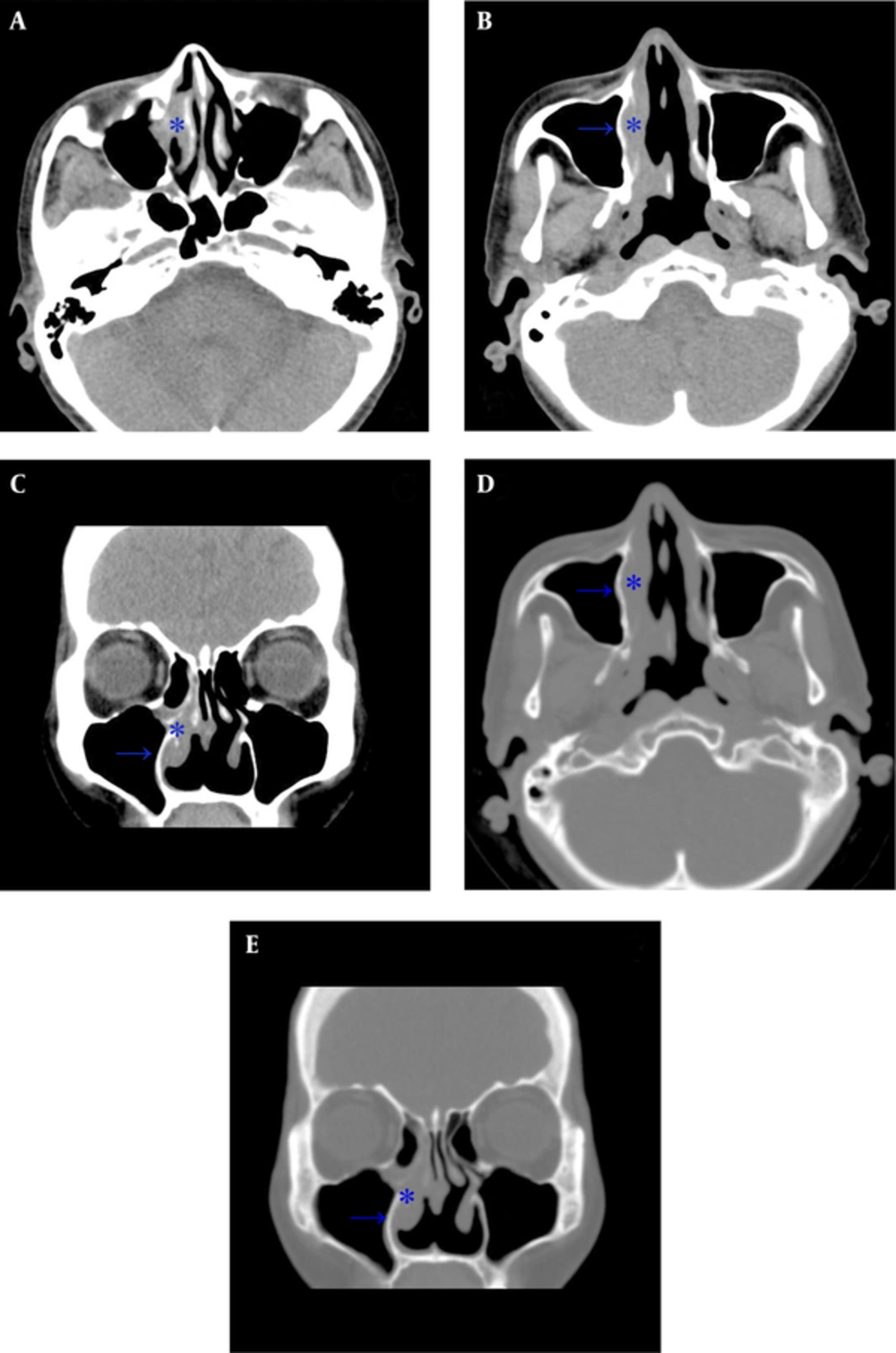
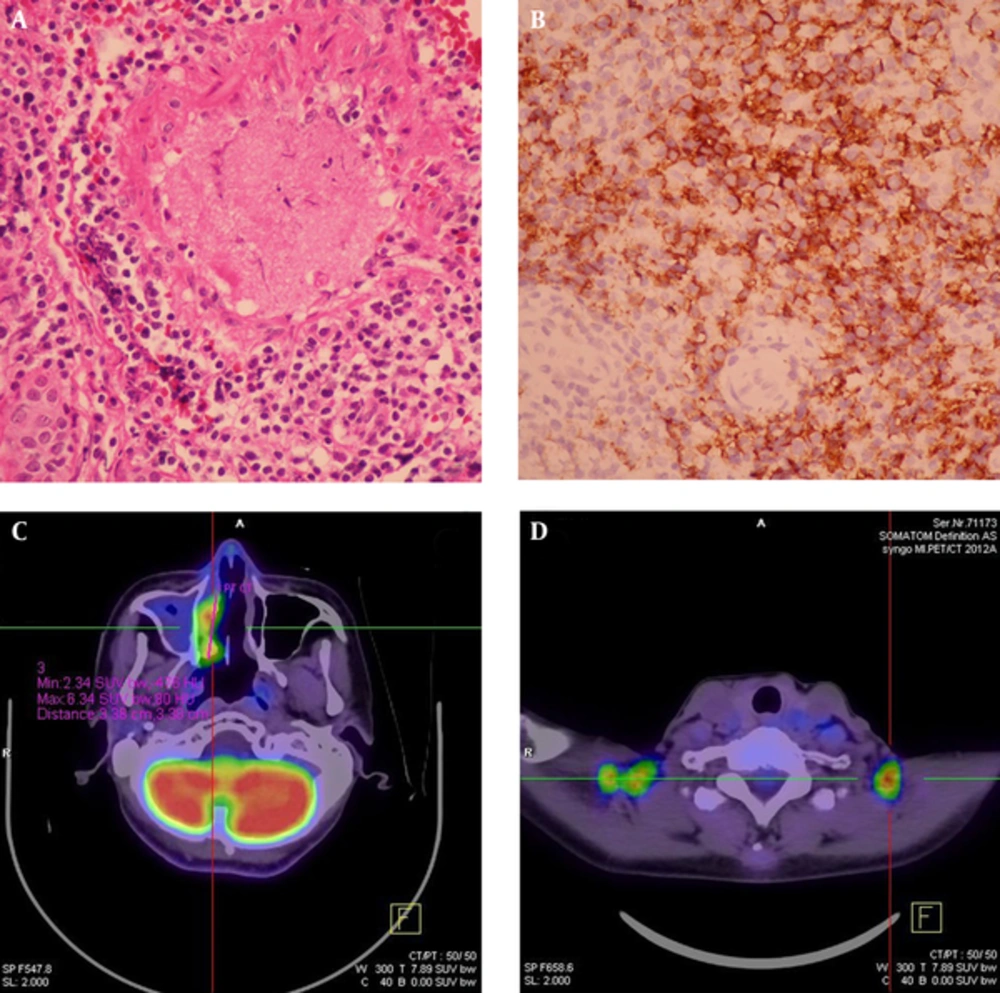
Nasal-type ENKTL is a rare type of lymphoma that is endemic to East Asia and parts of central and South America. The male-female ratio is approximately 3: 1, and disease occurrence peaks in the fifth decade of life. It is the most common histologic subtype of nasal lymphomas in Asian patients (
1).
The differential diagnoses of nasal-type ENKTL include cocaine abuse, trauma, infection, inflammatory disease, and other neoplastic processes. Initial diagnostic studies may aid in the delineation of this disease process through the elimination of other diagnoses (
7). For example, nasal obstruction, refractory sinusitis, ulcer, and epistaxis due to a destructive mass involving the midline facial tissues hint at nasal lymphoma. Laboratory evaluation may demonstrate an elevated white blood cell count and positive culture result secondary to concomitant sinusitis. CT and magnetic resonance imaging (MRI) may reveal an extensive soft tissue mass obliterating the nasal passages and surrounding sinuses with additional involvement and erosion of adjacent alveolar bone, hard palate, or orbits (
8).
While these are not specific, some clues help us to distinguish the tumor from other benign disease. First, in patients with persistent symptoms of sinusitis despite ‘adequate’ treatment, a high index of suspicion should be exercised for more sinister conditions. Second, apart from refractory sinusitis symptoms, these patients also had the red-flag B symptoms of fever and weight loss (
9). Third, CT scan may notice contrast enhancement, bone erosion, and adjacent soft tissue extension. If no prominent mass is noted, such as an infiltrative pattern, the presence of nasal cavity mucosal thickening alone without sinus wall thickening may indicate nasal-type ENKTL, which is differentiated from chronic rhinosinusitis in that it shows both nasal cavity mucosal and sinus wall thickening (
6).
Our case demonstrates nasal-type ENKTL symptoms can be superimposed by chronic sinusitis symptoms. This case has refractory sinusitis symptoms, but this is reasonable because of the patient’s history with nasal septal deviation and chronic hypertrophic rhinitis status post-septoturbinoplasty with septal perforation and positive culture result. Another challenge is that prior chronic hypertrophic rhinitis results in nasal cavity mucosal thickening with sinus wall thickening, which obscures the natural presentation of nasal-type ENKTL. In our opinion, the most important perspective is that the positive culture result decreases the possibility of nasal-type ENKTL.
Surgical procedures such as FESS, turbinectomy, or the Caldwell-Luc procedure are useful for harvesting adequate biopsy specimens for the pathological examination of sinonasal lymphoma (
10). However, some authors suggest that routine histopathological examination of FESS material has little clinical value and question if this procedure should be performed (
11). In this case, routine histopathological examination of FESS material helped to avoid missing the diagnosis. It is suggested that routine histopathological examination of FESS material may be adapted to Asian patients because of the relatively higher prevalence of nasal tumor.
The optimal treatment modality of nasal-type ENKTL has not yet been clearly established, as it is an extremely rare entity. Currently, the recommended treatment modality for nasal-type ENKTL is the combination of anthracycline-based CHOP (cyclophosphamide, doxorubicin hydrochloride, vincristine sulfate, and prednisone) chemotherapy with local radiotherapy, which has been demonstrated to slow local progression in early-stage disease (
12). This patient underwent the recommended treatment modality: a combination of anthracycline-based CHOP chemotherapy with local radiotherapy.
There is still no perfect parameter to monitor treatment efficacy and disease progression. For example, the international prognostic index (IPI) is widely used but often underestimates the severity of nasal-type ENKTL (
13). Measuring circulating EBV DNA in the peripheral blood is a simple way to help make a differential diagnosis, monitor treatment efficacy, and follow the disease progression. Nasal lymphomas of T-cell or B-cell origin have only a weak association with EBV, which further strengthens the argument for the etiological role of EBV in NK-cell tumors. Wegener granulomatosis is EBV negative, while lymphomatoid granulomatosis is EBV positive (
14). The disease activity and tumor volume can also be monitored by measuring the amount of circulating EBV DNA, as a high titer is correlated with extensive disease, unfavorable response to therapy, and poor survival (
15).
Other parameters have been reported to correlate with the prognosis and new staging systems. The absolute monocyte count (AMC)/absolute lymphocyte count (ALC) prognostic index, incorporating variables associated with the tumor microenvironment and host immunity, may offer a better risk stratification for patients with nasal-type ENKTL when superimposed on the IPI, and the baseline monocyte count is helpful in determining the prognosis in nasal-type ENKTL patients (
4).
Nasal-type ENKTL is a rare and aggressive disease but is the most common histologic subtype of nasal lymphomas in Asian patients and accounts for most (70%) of the ENKTLs in Taiwan (
16). Most (80 - 90%) patients present with nasal obstruction, sinusitis, ulcer, and epistaxis due to a destructive mass involving the midline facial tissues. Other patients with an infiltrative pattern may have refractory chronic sinusitis or typical ‘B’ symptoms and nasal cavity mucosal thickening without sinus wall thickening in radiological features. These principles are inapplicable to this case, which demonstrated that the malignancy can be superimposed by benign inflammatory disease, which can be entirely supported by clinical presentation and radiological features. It is suggested that routine histopathological examination of FESS material may have little clinical value in Western countries, but further investigation is required to achieve a better understanding of the value of routine histopathological examination of FESS material outside of the Western countries.