TIPSS is the treatment of choice to manage the complications of portal hypertension, such as variceal hemorrhage or refractory ascites, when conservative or endoscopic procedures have failed. TIPSS creation significantly reduces the risk of bleeding from esophageal or gastric varices (
8,
9), and is superior to conservative therapy in treating refractory ascites (
10). However, establishing a TIPSS is associated with a significantly higher risk of hepatic encephalopathy (
8,
10,
11), as blood from the GI tract bypasses the liver and detoxification is significantly reduced. Nevertheless, hepatic encephalopathy following TIPSS creation can be managed conservatively in the majority of cases.
The technical success rate of establishing a proper shunt between the PV and the IVC has risen to approximately 95% over the years, due to the development of sophisticated tools, including low-profile balloons and stents (
12,
13). Meanwhile, several stents or stent grafts have been evaluated for TIPSS creation. In the early days, stents such as balloon-expandable Palmaz stents were used with technical success rates ranging between 75% and 95% (
14-
16). Subsequently, self-expanding stents such as the Wallstent have been evaluated (
16,
17), and more recently, stent grafts such as the VIATORR have been used (
18,
19). Compared to bare-metal stents, the long-term patency rates of stent grafts are higher, as no pseudointimal hyperplasia occludes the tract lumen. However, those grafts require larger vascular sheaths and, due to their rigidity, they can be difficult to place in patients with very tortuous or angled vessels.
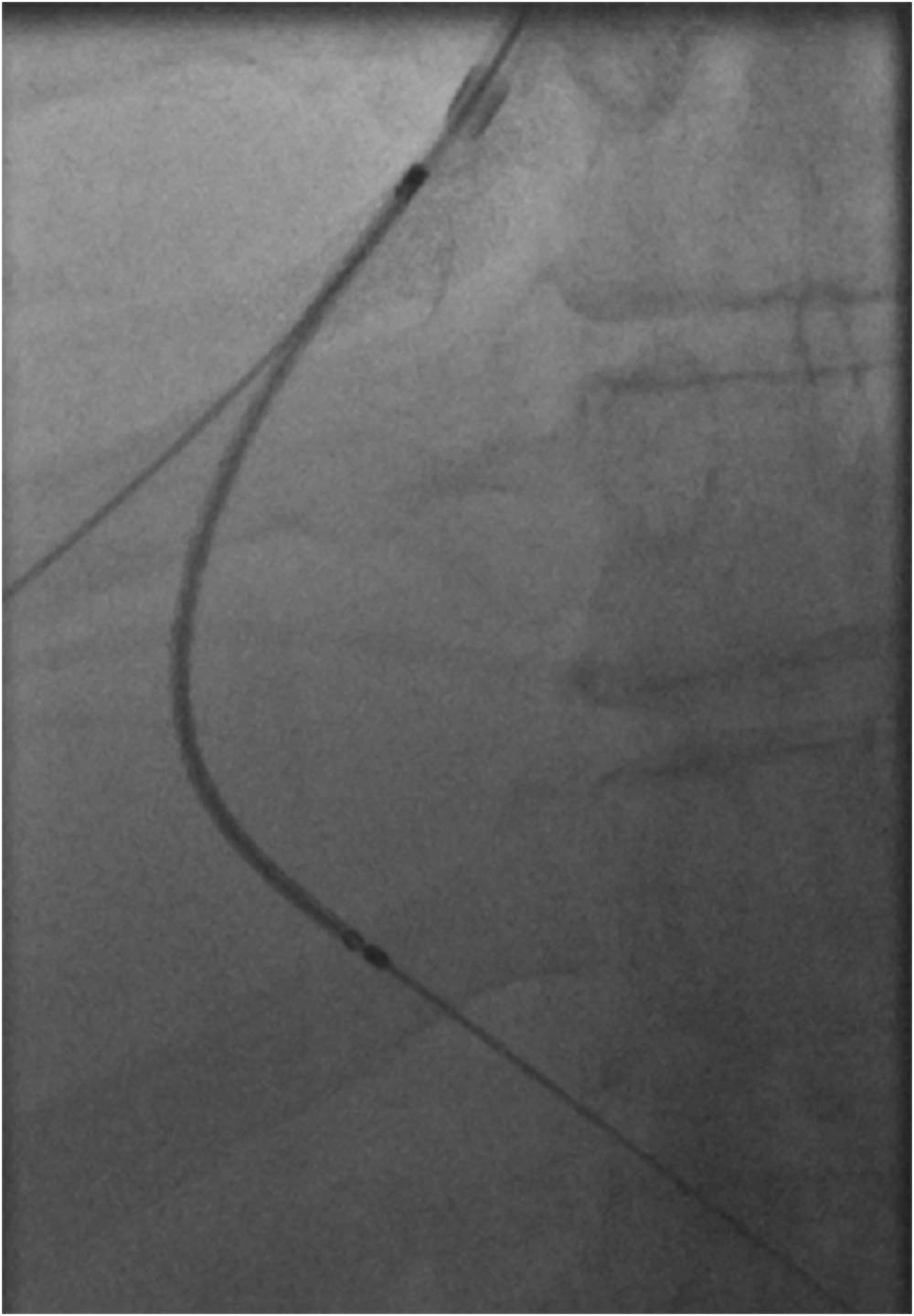
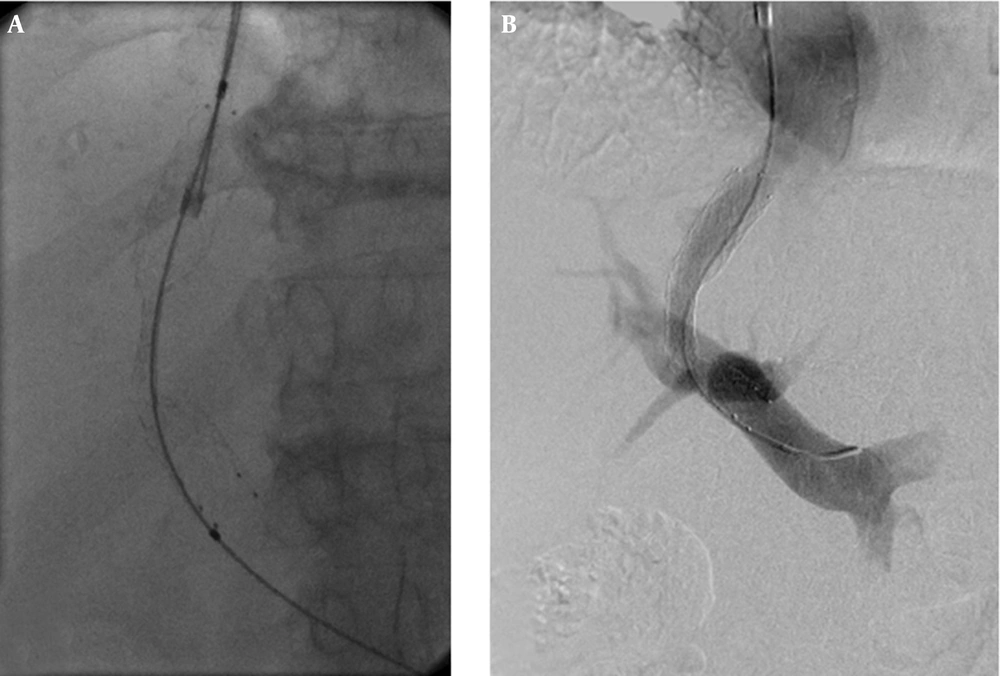
In this paper, we describe our experience with a 6F self-expanding nitinol stent system. In order to enhance its visibility, radiopaque tantalum markers are fixed to the stent at both ends, which can be helpful during abdominal interventions, especially in obese patients or when using a flat-panel (digital) angiography unit (
20). Due to its low profile and flexibility, this stent system can be introduced even if the transhepatic tract is very sloped. Furthermore, this system can be advanced through the pre-dilated liver parenchyma without the sheath having to be placed within the portal vein, making TIPSS establishment much easier, at least in some cases. When using, for example, a 9F vascular sheath, a second wire can be placed through the sheath for anchoring and stabilizing the vascular sheath in the liver vein (
Figure 1). This is advantageous when the angle between the liver veins and the IVC is close to 90°, or when the IVC is found to be dilated.
We exclusively chose stents with a diameter of 12 mm, to have the option of creating single shunts with a large diameter in order to avoid the implantation of a second, parallel shunt (
21). In one patient, it was necessary to dilate the stent with a 12 mm balloon in order to sufficiently lower the pressure gradient. In 25 of 26 patients, we were able to reduce the portosystemic pressure gradient to ≤ 12 mmHg, which is considered the therapeutic goal, at the time of TIPSS creation (
22,
23). Thus, the low-profile sinus-SuperFlex-Visual stent was demonstrated to be powerful enough to achieve the therapeutically required pressure reduction. In one patient, we did not dilate the tract after stent placement, as our specific goal in this case was merely to embolize the variceal veins, which were the source of repetitive bleeding. We did not dilate the tract, due to preexisting hepatic encephalopathy, and we did not choose an abdominal percutaneous approach for coil embolization, due to ascites.
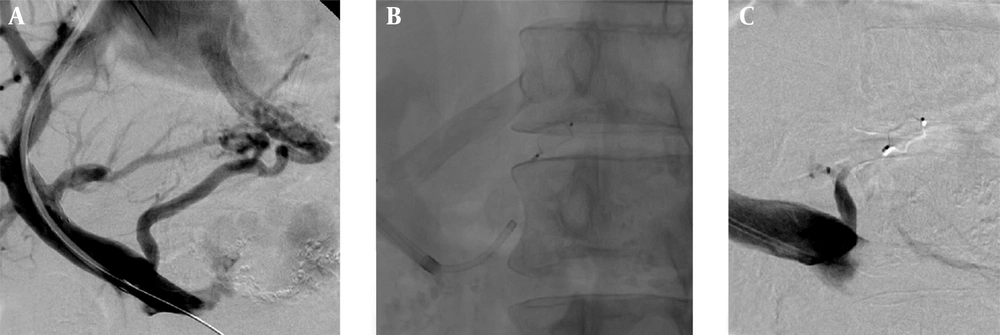
Additional embolization of variceal (esophageal and/or gastric) veins was performed in five of our 26 patients. In those five patients, the variceal veins still presented with the relevant shunting, although a TIPSS was created successfully and the portosystemic pressure had been lowered significantly, to below the threshold of 12 mmHg. As the indication for TIPSS creation in these patients was recurrent bleeding, we intended to lower the risk of re-bleeding by performing this additional procedure (
24). In four of these five patients, coil embolization was performed, and in one patient, an amplatzer plug was inserted (
Figure 3A - C). In all patients, the varices no longer opacified after the intervention.

We observed relevant periprocedural complications in five of our 26 patients that were procedure-related rather than stent-related. One liver hematoma was caused in the course of the multiple punctures required to establish portal venous access, and by a prolonged PTT of > 160 seconds due to unintentional excessive administration of heparin. In another patient, stent occlusion occurred within 24 hours after TIPSS creation. This early stent occlusion was likely due to the stent length chosen for the procedure; the stent did not completely cover the liver vein, which has been described as a reason for TIPSS failure by other groups (
4,
16). A re-intervention with the implantation of two additional stents was necessary, and no further adverse events were noted thereafter in this patient. Another patient with acute tract occlusion was treated with the additional implantation of a VIATORR stent. A patient with hepatic encephalopathy was managed by a change in diet. One patient with cardiac decompensation six months after TIPSS creation was treated using a TIPSS reduction stent system. Two days later, this patient underwent OLT, and subsequently performed well. Overall, three patients died within one week after TIPSS creation, attributable to their limited general conditions (multiorgan failure, ARDS, pneumonia) rather than to the TIPSS creation. By and large, the rate of adverse effects was concordant with the rate of TIPSS-related complications already published in the literature (
25,
26). Apparently, those side effects were procedure-related rather than graft-related.
With regard to long-term follow-up, four of the 26 patients in this study succumbed to their underlying advanced liver disease within one year after TIPSS insertion. In addition, three patients exhibited late-onset TIPSS occlusions (at 12, 12, and 39 months after TIPSS creation). Overall, the long-term disease courses and late complications were found to be comparable to those reported by other groups (
6,
7). Therefore, the TIPSS procedure is regarded as a highly effective bridge to liver transplantation, especially in patients with complications resulting from severe portal hypertension, and who are candidates for OLT. Indeed, seven of the 26 patients in this study underwent OLT at a mean time of 9.4 months after TIPSS creation. The shunt did not impair liver transplantation in any of these patients, which is in line with the results obtained in other studies (
27,
28).
There are several limitations to our analysis that should be discussed. First, the data presented in this paper were analyzed retrospectively. Initially, our intention was to “only” treat the patients, not to evaluate or compare the function of different stent devices. Thus, there was no matched control group. Prospective, randomized trials focusing on patient survival are needed in order to compare the sinus-SuperFlex-Visual stent to other stent systems, and to avoid bias due to incomplete follow-up and retrospective analysis. Second, seven of the 26 patients escaped long-term follow-up due to a change of residence or referral back to their home hospital after successful TIPSS placement. Third, although the majority of our TIPSS patients most likely resembled each other with respect to their underlying conditions (i.e. alcoholism, viral hepatitis, cryptogenic cirrhosis, etc.), we cannot rule out that the stent system described in our analysis might be less beneficial in special subgroups of patients.
In conclusion, the sinus-SuperFlex-Visual stent system was found to be easily deployed even in the presence of disadvantageous vascular anatomy. The radiopaque markers made the stent well-visualized in all patients. The achieved rate of pressure gradient reduction (from a mean of 20.9 mmHg to a mean of 8.2 mmHg) was clinically sufficient to treat symptoms resulting from portal hypertension, and the rate of adverse effects was found to be similar to that of previously published data.