Early diagnosis of the inflammatory process in MS patients provides a chance for patients to initiate therapy using immunomodulatory drugs. This might prevent the disease from progression and helps to control the illness. Another advantage of early diagnosis is the reduced treatment costs, which is of great importance.
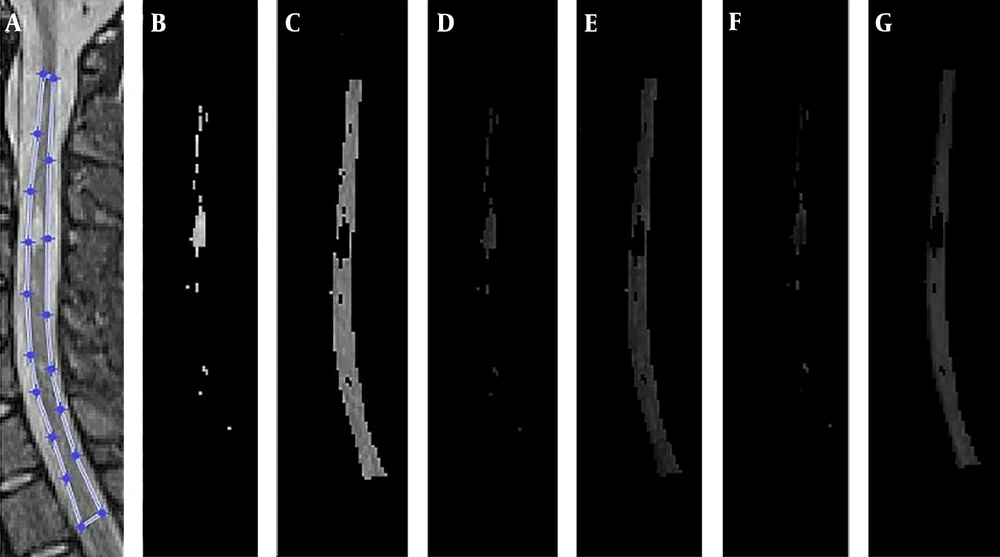
In this study, the LCR and LNR of three pulse sequences (T2, STIR, and PSIR) in cervical spinal cord were compared. As it can be seen in
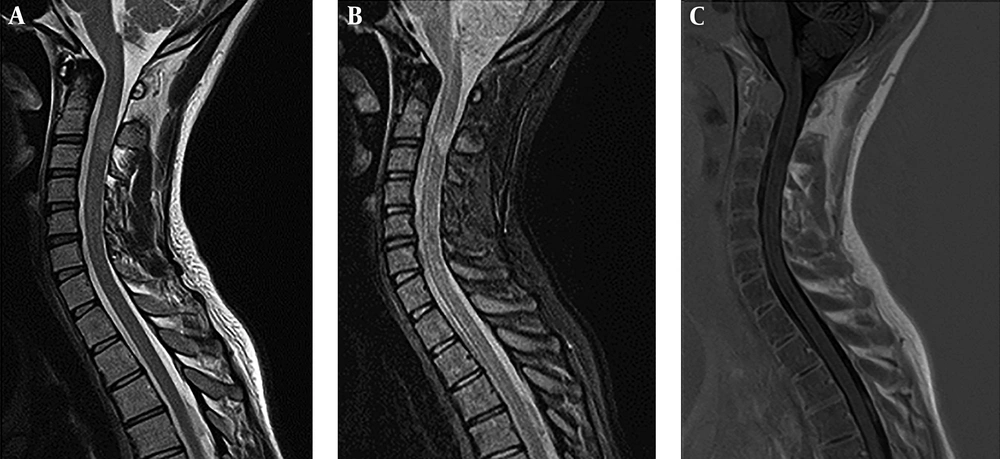
Figure 1 the legions are hyperintense in T2 and STIR and hypointense in PSIR. Visually one might conclude that PSIR creates a good contrast between the lesion and cord in comparison with T2. The intensity of T2 and PSIR were reverse. According to
Tables 2 and
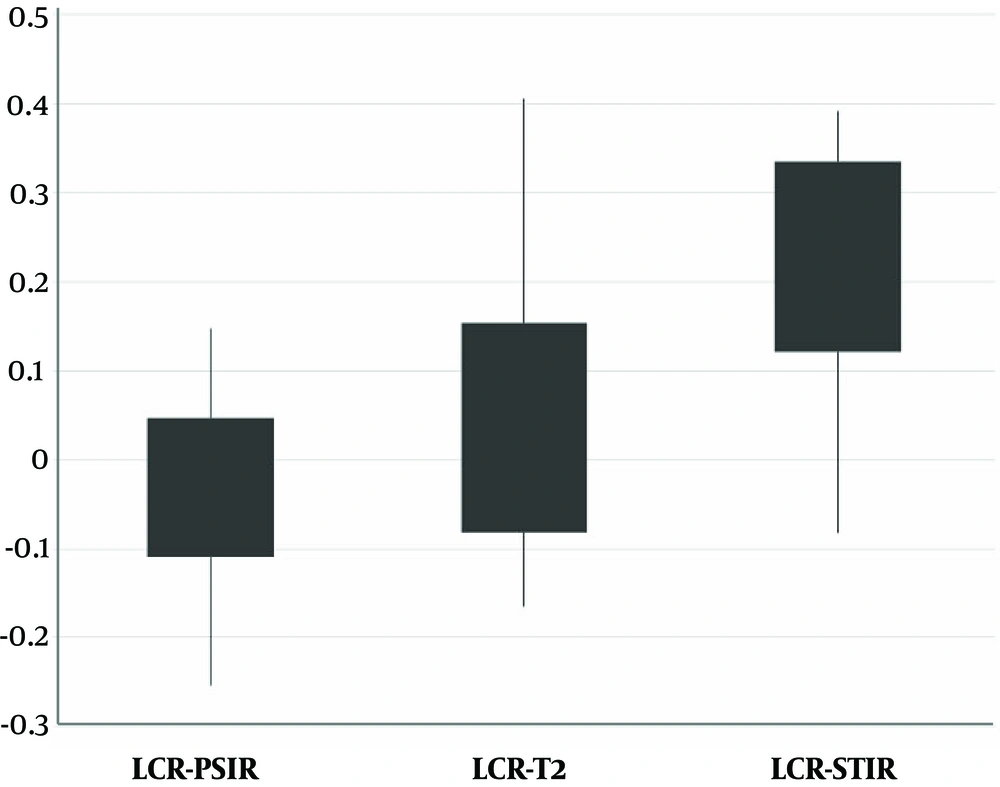
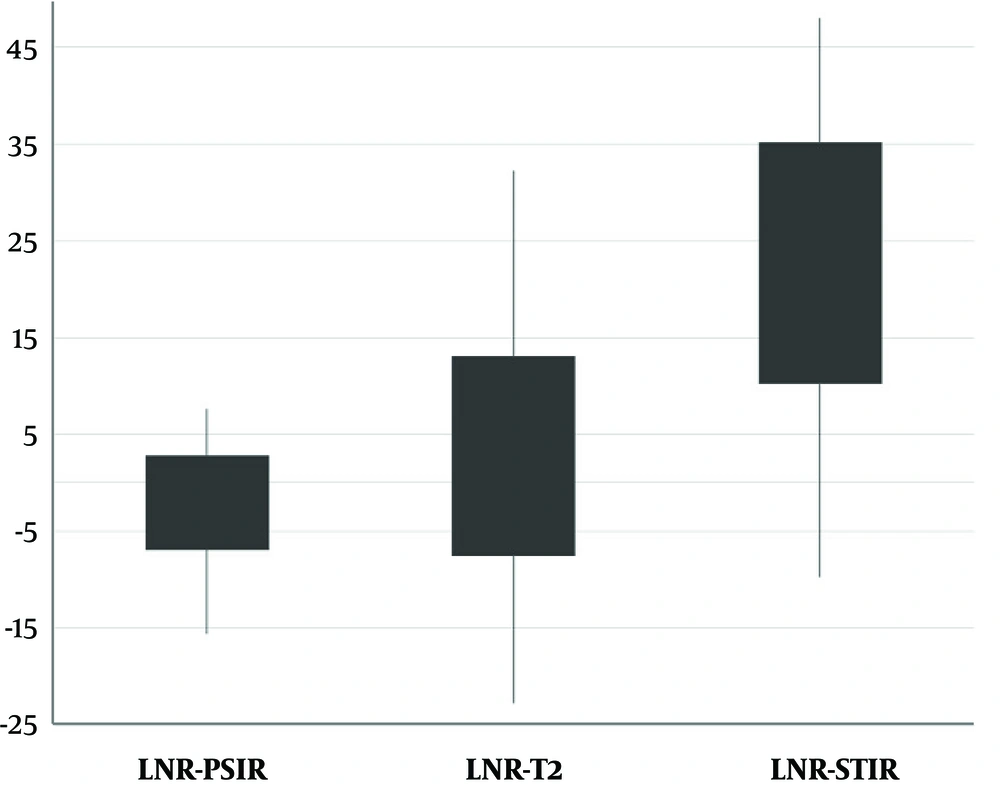
3, LCR and LNR of T2 and PSIR were significantly different and T2 indices were significantly larger than PSIR. This difference was due to the negative value of LCR and LNR of PSIR, if the absolute value of LCR and LNR were considered to cancel the effect of intensity, there would be no significant difference between T2 and PSIR LCR (P = 0.79) and LNR (P = 0.66) for detecting MS plaques. According to
Figures 3 and
4, and
Tables 2 and
3, STIR had a significantly different LCR and LNR, hence it can be concluded that STIR was better in the diagnosis of cervical cord MS plaques. This superiority can be seen in
Figure 1 since the MS plaques can be easily detected.
Different studies have compared these pulse sequences. For the first time, in 1996, Lycklama a Nijeholt et al. compared the cervical cord MRI imaging using cardiac-triggered dual-echo spin-echo and magnetization transfer-prepared gradient-echo (MT-GE) pulse sequences in MS diagnosis. It revealed that the MT-GE technique was superior in comparison to spin-echo technique, but LCR ratio of the MT-GE images was equal to that of T2-weighted images (
24).
In 2013, Nayak et al. compared T2 and STIR pulse sequences in the detection of spinal cord MS plaques. This was a subjective comparison showing that STIR is better than T2 (
25).
Alcaide-Leon et al. in 2016 compared the sensitivity and specificity of T2, STIR and PSIR pulse sequences in the diagnosis of spinal cord MS plaque. This study revealed that STIR and SPIR had the same sensitivity and specificity in cervical cord MS diagnosis but better than T2. However, in thoracic spine STIR was better than PSIR (
26).
The results of this study are in line with studies conducted by Nayak et al. and Alcaide-Leon et al. in terms of STIR superiority with respect to T2 in cervical cord MS plaques. However, Alcaide-Leon et al., considered the same superiority for STIR and PSIR in cervical cord region, contrary to our study that objectively showed that STIR is superior to the PSIR.
In 2008, Poonawalla et al. compared T1-weighted inversion recovery, STIR, and dual fast spin echo in the diagnosis of cervical spinal cord lesions. They found that T1-weighted inversion recovery had advantages in comparison with the other studied pulse sequences (
27).
In a review article in 2015, Kearney et al. stated that although both STIR and PSIR could accurately distinguish the lesions from normal tissue as a result of enhanced contrast between lesions and the surrounding tissue, STIR might be subjected to artifacts, such as flow artifacts, hence PSIR is better than STIR in detecting cervical spine lesions (
28).
The results of our study were not compatible with studies performed by Poonawalla et al. (
27) and Kearney et al. (
28). This difference could be attributed to the field strength of the MRI devices. In their studies, they used 3 T MRI machine and we used a 1.5 T MRI device. Besides, Poonawalla et al. (
27) used a phased sensitive reconstruction in their T1- weighted inversion recovery imaging, which may have led to some differences in their results in comparison with our results.
For further research, we suggest performing another study with the same pulse sequences for thoracic cord lesions, to find out if STIR sequence is superior to other sequences in all parts of the spinal cord. Also, we are planning another study to find out if STIR sequence could be totally replaced with T2 sequence in spinal cord MS lesion detection.
In conclusion, to detect MS plaques in the cervical spinal cord using 1.5 T MRI machine, STIR sequence has higher sensitivity and specificity, hence it is superior to T2 weighted and PSIR sequences.