Following clinical assessment, endoscopy is often the first tool for diagnosis and treatment of acute GI hemorrhage (
6). However, it is difficult to diagnose GI hemorrhage using endoscopy in the absence of active bleeding, particularly at the site of the small bowel, which is not easily accessible. In cases of severe bleeding, localizing the bleeding site by endoscopy is hard and the effect of endoscopic treatment depends heavily on the experience of the endoscopist. The failure rate of endoscopic diagnosis or treatment can be as high as 32% (
7). Iron supplements, octreotide, and thalidomide are the main clinical medicine. However, it was reported that the effect of thalidomide alone or combined with oestrogen and progestin in treating hemorrhagic AD was not satisfactory (
8). Enhanced CT is a useful modality for the diagnosis of GI hemorrhage, but it may fail when the bleeding rate is relatively low (
9).
TAE plays an important part in diagnosing and treating GI bleeding. It allows accurate localization and immediately selective embolization for treatment, which may be more significant for patients with hemodynamic instability. The successful localization of the bleeding source by angiography depends heavily on the rate of bleeding. Generally, to enable diagnosis and treatment of GI hemorrhage, the bleeding rate is supposed to be over 0.5 mL/min during the examination (
10).
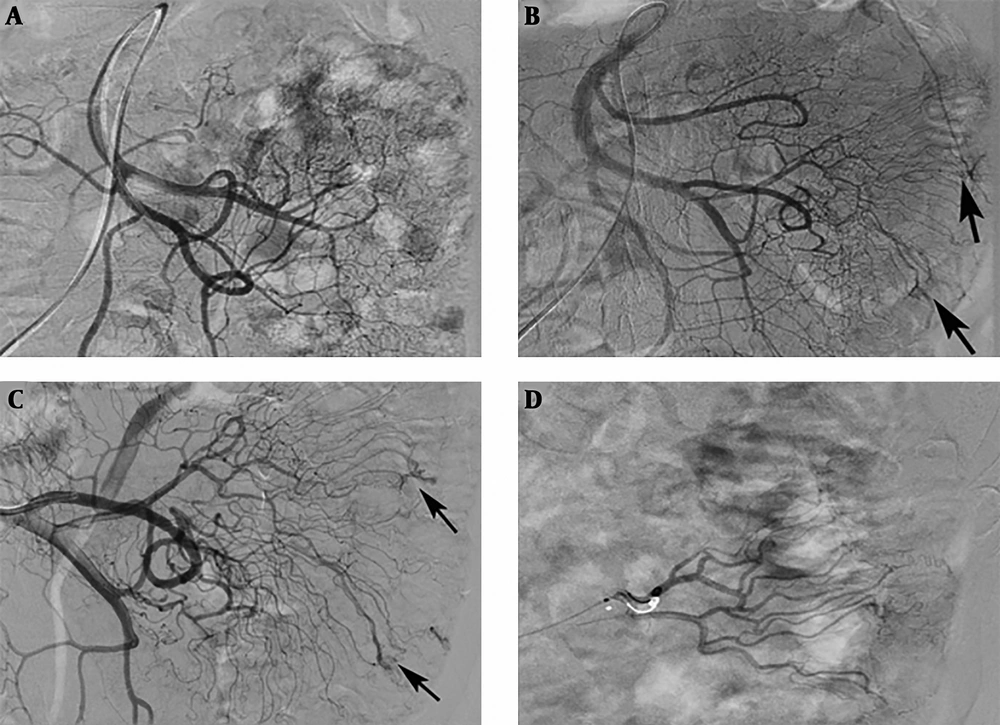
The angiographic findings of AD may include tortuous vascular tufts and broadening or narrowing of blood vessels, an early venous phase, and signs of extravasation of contrast medium. But these are not features and are nonspecific in most cases. It is necessary to exclude diseases such as inflammatory bowel disease (IBD) and diverticular disease. It was reported that signs of increased staining of bowel loops and skip lesions are highly suggestive of IBD (
11). A persistent vitellointestinal artery can be observed in patients with chronic GI hemorrhage due to Meckel’s diverticula (
12).
In patients with repeated melena and chronic anemia, small AD lesions may be missed on angiography due to the vasoconstriction or vasospasm of the vessels responsible for the bleeding. In that case, superselective catheterization of the suspected vessels is required for diagnosis and treatment. Furthermore, repeated angiography can be performed to identify the lesions within several days, if necessary.
Transcatheter arterial embolization is an important tool for treating active GI bleeding, particularly when endoscopic therapy has failed and the patient is not eligible for surgery (
13). Immediately following determination of the bleeding source by angiography, intraarterial embolization can be performed to stop bleeding by embolizing the abnormal vessels with materials such as coils, PVA particles, ethylene vinyl alcohol copolymer (onyx) glue, n-butyl cyanoacrylate (NBCA) and gelatin sponge particles (
14-
16). Although the occurrence rate of rebleeding is approximately 20% in patients with lower GI bleeding, immediate hemostasis can be successfully achieved by embolization at a rate as high as 96% (
17). However, the risk of acute or chronic ischemia of the bowel due to excess embolization should be carefully considered. For this reason, microcatheters were chosen to superselect the specific anomalous vessels for the embolization procedure. As AVM and DL have higher bleeding rates than AE and the supplying arteries are relatively large, more kinds of embolic materials can be used in the embolization of AVM and DL than AE. In cases in which arteriovenous fistulas of AVM are very large, PVA or gelatin sponge particles should be avoided. The value of embolization is more notable for AVM and DL, but less for AE (
1). The lesions of AVM and DL are usually more extensive than angioectasia. Endoscopic treatment is not suitable for the treatment of AVM due to the existence of arteriovenous fistulas, but it is more often used in the management of AE. In cases of DL and AE that endoscopic treatment fails to achieve hemostasis, angiographic embolization can be a preferential option.
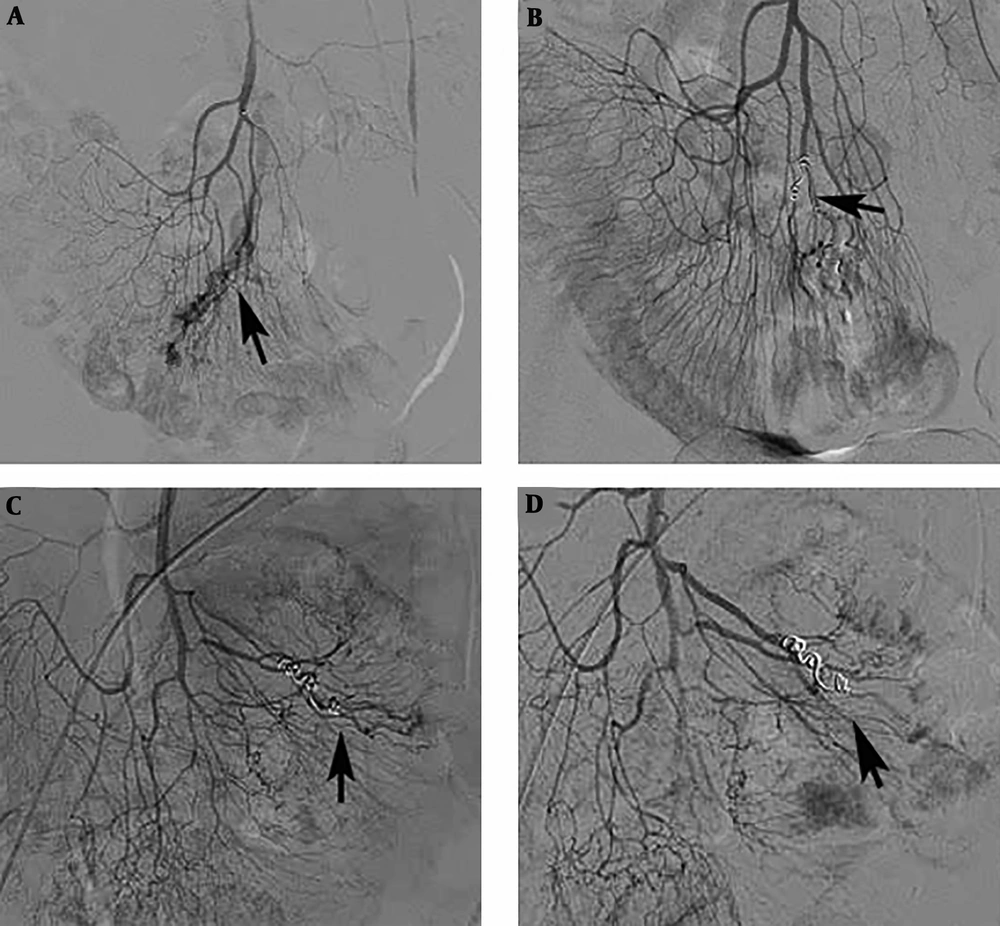
To our knowledge, there are no guidelines for choosing embolic material to treat GI bleeding, and the selection is up to the operator. Pushable microcoil is the most widely used embolic material. In the present study, PVA particles (350 - 560 µm or 150 - 350 µm) were used as the dominant embolic agent. PVA particles are considered as a type of permanent embolic material, relative to gelatin sponge particles. The smaller PVA particles are more likely to reach the terminal branches of the vessels responsible for bleeding. PVA should not be used in cases that there are large arteriovenous fistulas or the artery anastomosis network is not good. However, the risk of intestinal ischemia increases if reflux into non-target vessels occurs. If the responsible arteries are relatively large and the bleeding rate is high, or in cases of rebleeding, PVA particles alone are not enough, and other embolic materials such as coils should be combined to reinforce the embolization. Onyx and glue may be a promising liquid embolic agent; however, controlling the glue penetration in vessels may be difficult and great experience with this technique may be required (
15,
16).
Enterotomy is another method to manage AD. Nevertheless, most of the patients cannot accept surgery for reasons of large operative trauma, or are not eligible for surgery due to relative poor tolerance. If the bleeding cannot be controlled by endoscopy and TAE, surgery is supposed as the final therapeutic option. However, it may be hard to detect all lesions and to determine the true bleeding source during surgery. To achieve successful surgical resection, the preoperative or intraoperative localization of the lesions is required. TAE can serve as a useful tool for localization of GI bleeding origin by preoperatively implanting coils in the target vessels. The coil is not only palpable but also detectable under fluoroscopy during open surgery (
14). Embolized coils can be retained in the responsible vessels for both treatment and localization purposes, which helps obtain additional time for determining optimal preoperative management for patients.
The present study has several limitations. First, it was a retrospective study. Second, the number of patients was relatively small due to rarity of the disease. Third, histologic proof of the diagnosis was unavailable. Moreover, the variety of clinical conditions of patients, lesions, embolic material, and techniques may be other limitations of the study.
In conclusion, for patients with refractory and repeated gastrointestinal hemorrhage due to angiodysplasia, TAE seems to be an effective alternative option when endoscopic examination and treatment do not work.