
1. Background
According to the regulations of the Ministry of Health and Medical Education, faculty members have seven duties. One of these tasks is regarded as research activities that play an important role in the improvement of the university’s research and faculty member ranking. Sometimes, the faculty members are not at the desired level in the research, or active researchers mention some factors that reduce or inhibit their research activities. Therefore, considering the importance of the research role of faculty members, barriers in this direction should be identified.
Research plays an important role in the development of countries (1, 2), is the main driving force of a society on the path of progress, and is mentioned as one of the important indicators of growth (3). Research experts agree on solving social, economic, and cultural problems through scientific research. Furthermore, the indicators, such as the amount of national investment in research, ratio of the number of researchers to the population, number of published articles, and industrial, economic, and social development of communities, are indebted to scientific research (3, 4). The importance of using research experiences and research results in education, especially in medical sciences, has been emphasized in numerous studies (5). In addition, research and research productivity affect the quality of students’ education (6).
The importance of research is such that the statistics of science production in the world show that the first seven countries in science production are the first seven countries in the world in terms of facilities, and the differences between developed and backward countries are related to their facilities, conditions, and research contexts (7). The quality and quantity of scientific production are some of the indicators of scientific progress for any country. As a result, the scientific development of societies is one of the effective factors in the human development index (8). In developing countries, research is not performed at the desired level, and unlike in developed countries, the human resources, budget, and facilities spent on research are negligible (4).
Universities and higher education institutions are among the most important routes for the production of science in any country (9) and are considered the most important places for the production of science with possession of the most intellectual and spiritual capacities; therefore, organizing academic research is one of the most important factors in the comprehensive development of society (4). In recent years, universities have changed from traditional teaching universities to research universities to accommodate rapid advances in knowledge and technology (10). A commonly recommended strategy for increasing research use in clinical practice is identifying barriers to change and then tailoring interventions to overcome the identified barriers (11).
Previously, in research at the medical universities, the factors, such as lack of preparation and cultivation of research spirit in the pre-university education system, low-cost allocation to research, lack of sufficient mastery of various research methods, lack of preparation of questionnaires and statistical tests, a limited amount of effort and searching spirit, preference for easier ways to achieve goals in the general public, lack of welfare of faculty members to do research, the nonapplication of research results, Activity in daily executive time-consuming work, the uncertainty of the position of the private sector, and difficulty and length of the process of preparing the necessary materials in the research (2), have been reported as obstacles to performing research from the perspective of faculty members. Since the research is performed at different universities based on a variety of facilities and conditions, the limitations and obstacles that faculty members of any university might face will also be different, and domains identified as barriers to research can be used to aid the development of behavior change interventions.
2. Objectives
According to the discussed topics, the current study aimed to investigate research barriers from the perspective of faculty members of Dezful University of Medical Sciences, Khuzestan, Iran.
3. Methods
This cross-sectional study was conducted on all faculty members of Dezful University of Medical Sciences in 2018. Since the census provided more comprehensive information to the researcher, the census method was used to collect the data. The total number of faculty members at Dezful University of Medical Sciences is 85, of which 50 subjects participated in the study. The data collection tool in this study was a questionnaire that was previously used in a study titled “Investigation of Research Problems and Barriers to Science Production from the Perspective of Faculty Members of Semnan University of Medical Sciences”. Similar studies were used to design the questionnaire. In the aforementioned study, to determine the validity of the questionnaire, the opinions of three research experts were obtained, and the necessary corrections were made. Cronbach’s alpha coefficient was used to determine the internal stability of the questionnaire. Cronbach’s alpha for the four domains and the total of 39 items in the questionnaire was within the range of 0.76 - 0.84 (7).
The questionnaire has two parts; the first part included demographic information and variables of age, gender, degree, field of study, work experience, and school of service; the second part included a questionnaire containing 39 items in four domains of barriers to preparation and compilation of a research plan, barriers to the implementation of a research plan, administrative and managerial barriers of a research plan, and individual barriers of a research plan. Each domain has several items as follows:
(1) Obstacles to preparing and compiling a research plan with 13 items, including the uncertainty of research needs and priorities at the university, insufficient up-to-date information resources, unfamiliarity of librarians with research resources and their reduced collaboration with researchers, lack of useful databases in the university, lack of access to studies conducted in the country, confidentiality of information and statistics and lack of access to statistical information, contradictions in the statistics provided by different units, lack of resources in the library, lack of printing and reproduction equipment, unclear guidelines for preparing and compiling a research plan, lack of advice before developing a research project, failure to provide timely advice at the time of referral despite coordination, and failure to provide timely advice at the time of visit without coordination
(2) Obstacles to the implementation of a research plan with 7 items, including not knowing how to implement the plan, lack of supervision, continuous control, and guidance in project implementation, lack of funds and budget, lack of proper research space, lack of timely financial support during the implementation of the project, dissatisfaction of main contributors with delays in payment of fees, and dissatisfaction of colleagues and questioners with delays in timely payment of expenses.
(3) Administrative and managerial barriers to a research plan, including accounting problems and payment of the project budget, lack of awareness of the individual responsible for paying the project costs of the implementation process of activities, lack of knowledge of accounting officials about the relevant laws, insufficient knowledge of university administrators about research-related problems, lack of acceptance of the results of research projects by university administrators, lack of timely preparation of equipment required for research projects, lack of encouragement of researchers in conducting research, lack of attention to the creativity of faculty members and researchers, preference for education to research in the university, and university management neglect of research issues
(4) Individual barriers to a research plan, including not researching one of the criteria for evaluation and promotion, individuals’ resistance to changes due to research results and new ideas, numerous tasks and different university expectations from faculty members, tiresome research process, financial and economic problems, weakness of teamwork in the university, insufficient research skills, and lack of sufficient financial incentive to research
There were five options to respond to each variable of the Likert scale, including very low, low, medium, high, and very high, with scores of 1 to 5, respectively. The questionnaires were given to faculty members, and out of 85 individuals, 50 participants completed the questionnaire. After collecting the questionnaires, the obtained data were statistically analyzed using the SPSS software (version 21). Independent t-test was used to compare the means in the two groups, and analysis of variance was used to compare the means in more than two groups. Due to the low sample size in the groups, the hypotheses were tested using nonparametric equivalents of these tests (Mann-Whitney test and Kruskal-Walli’s test). The P-value in parametric and nonparametric tests was almost the same, and the significance of these tests was equal; therefore, in order to increase the power, the results of parametric tests were reported. Significance level was considered 5%.
4. Results
The mean age of the participants in the study was 43.7 ± 9.26 years. Additionally, 25 (50%) and 25 (50%) subjects were male and female. Moreover, 34 (68%), 13 (23%), and 3 (6%) participants were working in the Medical School, Nursing School, and Paramedical School, respectively. In terms of education, 20 (40%) and 30 (60%) participants were paramedical and medical, respectively, of whom 14 (28%), 30 (60%), and 6 (12%) participants were master’s degree holders, specialists, and subspecialty physicians, respectively. In terms of work experience, 9 (18%), 26 (52%), and 15 (30%) subjects had less than 5 years of experience, within 5 - 10 years of experience, and more than 10 years of experience, respectively. There was no significant relationship between the age and gender of faculty members in both male and female groups with research barriers and problems in four domains. In addition, no significant relationship was observed between the school of work with four domains of barriers and research problems. However, significant relationships were noticed between the field of study with the domains of barriers and research problems (only in the second domain, obstacles to the implementation of the project) (Table 1).
Table 1.
Relationship Between Field of Study and Domains of Barriers and Research Problems
| Questionnaire Items | Mean and SD of the Medical Field | Mean and SD of Paramedical Fields | P-Value a |
|---|---|---|---|
| Obstacles to preparing and compiling a research plan | 33.5 ± 9.2 | 28.9 ± 8.3 | 0.21 |
| Obstacles to implementing a research plan | 30.5 ± 7.2 | 23.5 ± 5.8 | 0.03 |
| Administrative and managerial obstacles | 34.5 ± 7.9 | 31.9 ± 7.4 | 0.5 |
| Individual obstacles | 28.6 ± 4.4 | 26.5 ± 5.3 | 0.37 |
aSignificant at 0.05.
Work experience had a significant relationship with the first domain of research barriers and problems (i.e., obstacles to preparing and compiling a research plan). Accordingly, with the increase in work experience, faculty members will have further opinions about the barriers and obstacles to preparing and compiling a research plan (Table 2).
Table 2.
Relationship Between Work Experience and Domains of Barriers and Research Problems
| Questionnaire Items | Mean and SD of Work Experience of Under 5 Years | Mean and SD of Work Experience Within 5 - 10 Years | Mean and SD of Work Experience of Over 10 Years | P-Value a |
|---|---|---|---|---|
| Obstacles to preparing and compiling a research plan | 25.1 ± 9.8 | 32.3 ± 8.1 | 34.8 ± 8.6 | 0.03 |
| Obstacles to implementing a research plan | 23.8 ± 5.9 | 23.3 ± 5.4 | 23.3 ± 5.6 | 0.96 |
| Administrative and managerial obstacles | 28.3 ± 9.6 | 34.6 ± 7.6 | 34.4 ± 7.04 | 0.10 |
| Individual obstacles | 25.2 ± 5.5 | 28.4 ± 4.4 | 28.2 ± 5.2 | 0.23 |
aSignificant at 0.05.
In general, the number of registered projects of faculty members participating in the research had a negative and significant relationship with research barriers and problems (P = 0.003, r = -0.24). In addition, other dimensions and domains of research barriers and problems had a negative and significant relationship with the number of registered projects (Table 3).
Table 3.
Relationship Between the Number of Registered Projects with Domains of Barriers and Research Problems
| Questionnaire Items | Number of Registered Projects | |
|---|---|---|
| P a | r | |
| Obstacles to preparing and compiling research plan | 0.018 | -0.18 |
| Obstacles to implementing research plan | 0.02 | -0.27 |
| Administrative and managerial obstacles | 0.01 | -0.33 |
| Individual obstacles | 0.0000 | -0.36 |
| Total | 0.003 | -0.24 |
aSignificant at 0.05.
4.1. Obstacles to Preparing and Compiling Research Plan
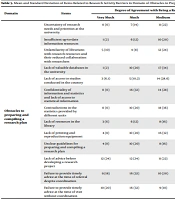
The mean value of the scores in the domain of obstacles to preparing and compiling a research plan was 2.36 ± 1.01 (Table 4). The most important item in this domain was a lack of consultation before developing a research project (3.34 ± 1.29). The least important items in this domain were insufficient up-to-date information resources (2.22 ± 1.01), the confidentiality of information and statistics (2.82 ± 1.04), and contradictions in the statistics provided by different units (2.64 ± 0.94) (Table 5).
Table 4.
Mean and Standard Deviation of the Domains of Barriers and Research Problems
| Questionnaire Items | Mean ± Standard Deviation |
|---|---|
| Obstacles to preparing and compiling a research plan | 2.36 ± 1.01 |
| Obstacles to implementing a research plan | 3.03 ± 0.91 |
| Administrative and managerial obstacles | 2.97 ± 0.76 |
| Individual obstacles | 3.12 ± 1.08 |
| Total | 107.27 ± 21.11 |
Table 5.
Mean and Standard Deviation of Items Related to Research Activity Barriers in Domain of Obstacles to Preparing and Compiling Research Plan
| Domain | Items | Degree of Agreement with Being a Research Barrier, No. (%) | Mean ± Standard Deviation | ||||
|---|---|---|---|---|---|---|---|
| Very Much | Much | Medium | Low | Very Low | |||
| Obstacles to preparing and compiling a research plan | Uncertainty of research needs and priorities at the university | 0 (0) | 7 (14) | 11 (22) | 18 (36) | 14 (28) | 2.22 ± 1.01 |
| Insufficient up-to-date information resources | 1 (2) | 6 (12) | 10 (20) | 15 (30) | 18 (36) | 2.14 ± 1.1 | |
| Unfamiliarity of librarians with research resources and their reduced collaboration with researchers | 5 (10) | 4 (8) | 12 (24) | 12 (24) | 17 (34) | 2.36 ± 1.30 | |
| Lack of valuable databases in the university | 1 (2) | 10 (20) | 17 (34) | 14 (28) | 8 (16) | 2.64 ± 1.04 | |
| Lack of access to studies conducted in the country | 3 (6.1) | 5 (10.2) | 14 (28.6) | 12 (24.5) | 15 (30.6) | 1.20 ± 2.37 | |
| Confidentiality of information and statistics and lack of access to statistical information | 0 (0) | 16 (32) | 14 (28) | 15 (30) | 5 (10) | 2.82 ± 1.04 | |
| Contradictions in the statistics provided by different units | 0 (0) | 10 (20) | 18 (36) | 16 (32) | 6 (12) | 2.64 ± 0.94 | |
| Lack of resources in the library | 3 (6) | 6 (12) | 8 (16) | 27 (54) | 6 (12) | 2.46 ± 1.05 | |
| Lack of printing and reproduction equipment | 4 (8) | 10 (20) | 16 (32) | 13 (26) | 7 (14) | 2.82 ± 1.15 | |
| Unclear guidelines for preparing and compiling a research plan | 4 (8) | 10 (20) | 8 (16) | 19 (38) | 9 (18) | 2.62 ± 1.23 | |
| Lack of advice before developing a research project | 12 (24) | 12 (24) | 11 (22) | 11 (22) | 4 (8) | 3.34 ± 1.29 | |
| Failure to provide timely advice at the time of referral despite coordination | 9 (18) | 16 (32) | 10 (20) | 11 (22) | 4 (8) | 3.30 ± 1.23 | |
| Failure to provide timely advice at the time of visit without coordination | 10 (20) | 16 (32) | 9 (18) | 11 (22) | 4 (8) | 3.31 ± 1.24 | |
4.2. Obstacles to Implementation of Research Plan
In the second domain with the title of obstacles to the implementation of a research plan, the mean value of the scores was 3.03 ± 0.91 (Table 4). A lack of supervision, continuous control, and guidance in project implementation and lack of proper research space had the least and greatest influences on research activities, with mean scores of 3.26 ± 1.40 and 3.6 ± 1.18, respectively (Table 6).
Table 6.
Mean and Standard Deviation of Items Related to Research Activity Barriers in Domain of Obstacles to the Implementation of Research Plan
| Domain | Items | Degree of Agreement with Being a Research Barrier, No. (%) | Mean ± Standard Deviation | ||||
|---|---|---|---|---|---|---|---|
| Very Much | Much | Medium | Low | Very Low | |||
| Obstacles to the implementation of a research plan | Not knowing how to implement the plan | 4 (8) | 9 (18) | 17 (34) | 14 (28) | 6 (12) | 2.82 ± 1.12 |
| Lack of supervision, continuous control, and guidance in project implementation | 14 (28) | 9 (18) | 8 (16) | 14 (28) | 5 (10) | 3.26 ± 1.40 | |
| Lack of funds and budget | 17 (34) | 9 (18) | 10 (20) | 14 (28) | 0 (0) | 3.58 ± 1.23 | |
| Lack of proper research space | 14 (28) | 17 (34) | 5 (10) | 14 (28) | 0 (0) | 3.62 ± 1.18 | |
| Lack of timely financial support during the implementation of the project | 10 (20) | 16 (32) | 9 (18) | 15 (30) | 0 (0) | 3.42 ± 1.13 | |
| Dissatisfaction of main contributors with delays in payment of fees | 5 (10) | 21 (42) | 11 (22) | 12 (24) | 1 (2) | 3.34 ± 1.11 | |
| Dissatisfaction of colleagues and questioners with the delay in timely payment of fees | 4 | 21 | 16 | 8 | 1 | 3.38 ± 0.92 | |
4.3. Administrative and Managerial Barriers to Research Plan
The mean value of this domain was 2.97 ± 0.76 (Table 4). The preference for education to research in the university (2.78 ± 1.34) and lack of attention to the creativity of faculty members and researchers (3.74 ± 1.08) had the least and greatest influences on research activities, respectively (Table 7).
Table 7.
Mean and Standard Deviation of Items Related to Research Activity Barriers in Domain of Administrative and Managerial Barriers to Research Plan
| Domain | Items | Degree of Agreement with Being a Research Barrier, No. (%) | Mean ± Standard Deviation | ||||
|---|---|---|---|---|---|---|---|
| Very Much | Much | Medium | Low | Very Low | |||
| Administrative and managerial barriers to a research plan | Accounting problems and payment of the project budget | 7 (14) | 17 (34) | 16 (32) | 8 (16) | 2 (4) | 3.38 ± 1.05 |
| Lack of awareness of the individual responsible for paying the project costs of the implementation process of activities | 3 (6) | 14 (28) | 21 (42) | 11 (22) | 1 (2) | 3.14 ± 0.90 | |
| Lack of knowledge of accounting officials about the relevant laws | 2 (4) | 14 (28) | 17 (34) | 11 (22) | 6 (12) | 2.90 ± 1.07 | |
| Insufficient knowledge of university administrators about research-related problems | 11 (22) | 18 (36) | 7 (14) | 11 (22) | 3 (6) | 3.46 ± 1.23 | |
| Lack of acceptance of the results of research projects by university administrators | 17 (34) | 10 (20) | 6 (12) | 15 (30) | 2 (4) | 3.50 ± 1.34 | |
| Lack of timely preparation of equipment required for research projects | 12 (24) | 17 (34) | 12 (24) | 7 (28) | 2 (4) | 3.60 ± 1.12 | |
| Lack of encouragement of researchers in conducting research | 15 (30) | 17 (34) | 9 (18) | 3 (6) | 6 (12) | 3.64 ± 1.30 | |
| Lack of attention to the creativity of faculty members and researchers | 14 (28) | 18 (36) | 10 (20) | 7 (14) | 1 (2) | 3.74 ± 1.08 | |
| Preference for education to research in the university | 8 (16) | 8 (16) | 7 (14) | 19 (38) | 8 (16) | 2.78 ± 1.34 | |
| University management neglect of research issues | 16 | 8 | 6 | 15 | 5 | 3.30 ± 1.45 | |
4.4. Individual Barriers to Research Plan
In the last domain, with the title of individual obstacles, the mean value of the scores was 3.12 ± 1.08 (Table 4). The weakness of teamwork in the university (4.32 ± 0.74) and numerous tasks and different university expectations from faculty members (4.30 ± 0.99) had the greatest influence on research activities. Furthermore, the least important item in this domain was not researching one of the criteria for evaluation and promotion (1.92 ± 1.15) (Table 8).
Table 8.
Mean and Standard Deviation of Items Related to Research Activity Barriers in Domain of Individual Barriers to Research Plan
| Domain | Items | Degree of Agreement with Being a Research Barrier, No. (%) | Mean ± Standard Deviation | ||||
|---|---|---|---|---|---|---|---|
| Very Much | Much | Medium | Low | Very Low | |||
| Individual barriers to a research plan | Not researching one of the criteria for evaluation and promotion | 4 (8) | 0 (0) | 7 (14) | 16 (32) | 23 (46) | 1.92 ± 1.15 |
| Individuals’ resistance to changes due to research results and new ideas | 5 (10) | 3 (6) | 16 (32) | 14 (28) | 12 (24) | 2.50 ± 1.22 | |
| Numerous tasks and different university expectations from faculty members | 28 (56) | 14 (28) | 4 (8) | 3 (6) | 1 (2) | 4.30 ± 0.99 | |
| Tiresome research process | 14 (28) | 11 (22) | 14 (28) | 7 (14) | 4 (8) | 3.48 ± 1.26 | |
| Financial and economic problems | 15 (30.6) | 11 (22.4) | 15 (30.6) | 7 (14.3) | 1 (2) | 3.65 ± 1.13 | |
| Weakness of teamwork in the university | 24 (48) | 18 (36) | 8 (16) | 0 (0) | 0 (0) | 4.32 ± 0.74 | |
| Insufficient research skills | 17 (34) | 10 (20) | 7 (14) | 15 (30) | 1 (2) | 3.54 ± 1.30 | |
| Lack of sufficient financial incentive to research | 20 | 12 | 15 | 2 | 1 | 3.96 ± 1.03 | |
5. Discussion
The results of the study regarding the opinions of the faculty members of Dezful University of Medical Sciences in the present study showed that a set of factors, including obstacles to the preparation and compilation of a research plan, obstacles to project implementation, administrative and managerial obstacles, and individual obstacles affect the course of research activities. Among these factors, the least important barrier was the domain of Obstacles to preparing and compiling a research plan, and the most important barrier was the individual domain (Table 4). The individual domain, executive domain, administrative and managerial domain, and preparation and compilation of the research project domain have been of the utmost importance, respectively.
5.1. Obstacles to Preparing and Compiling Research Plan
A lack of consultation before developing a research project was the most important obstacle to preparing and compiling a research plan. In a study performed by Ogunsola et al. (6) to examine barriers to research among faculty members at the College of Medicine, University of Lagos, Nigeria, one of the top barriers to research was a lack of mentoring (42.9% strongly agreed). In the present study, insufficient up-to-date information resources was the least important item; however, in Ogunsola et al.’s study, a lack of resources (financial and nonfinancial; 57.1% and 32.9% strongly agreed, respectively) was the top barrier to research. The domain of obstacles to the preparation and compilation of the research project in this study was recognized as the least important barrier to conducting research (2.36 ± 1.01), which is consistent with the results of Naghizadeh Baghi et al.’s study in reviewing the opinions of faculty members of Ardabil University of Medical Sciences, Ardabil, Iran (12).
5.2. Obstacles to Implementation of Research Plan
In the domain of obstacles to the implementation of the plan with 7 items, with the mean value of 3.03 ± 0.91, the greatest and least influences on research activities were reported for lack of proper research space and lack of supervision, continuous control, and guidance in project implementation, respectively. In a study conducted by Stewart et al. (13) to survey the European Society of Clinical Pharmacy Members’ research involvement and associated enablers and barriers, the barriers to the clinical pharmacy research aspirations of the participants were insufficient collaboration, lack of knowledge, skills, and training, an unsupportive environment in practice, insufficient time, and limited resources and funding opportunities, which are in line with the results of the present study.
5.3. Administrative and Managerial Barriers to Research Plan
In the third domain, with 10 items, the preference for education to research in the university and lack of attention to the creativity of faculty members and researchers had the least and greatest influences on research activities, respectively. Rezaian et al. performed a study at Rafsanjan University of Medical Sciences, Kerman, Iran, and concluded that organizational and administrative factors play the most important role in performing or not performing research (14). According to the results of the aforementioned study, another barrier to research was the cumbersome administrative regulations, which is consistent with the results of the present study. In Nikrooz et al.’s study (15), the existence of cumbersome administrative regulations was mentioned as a factor that hinders the implementation of student research projects from the students’ perspective.
5.4. Individual Barriers to Research Plan
In the individual domain, as individual obstacles with 8 items, with the mean value of 3.12 ± 1.08, the most item was the weakness of teamwork in the university and numerous tasks and different university expectations from faculty members, and the least important item was not researching one of the criteria for evaluation and promotion. In the present study, numerous teaching hours that do not allow professors to research and a significant percentage of the faculty members’ time were spent on teaching and providing clinical services, which is consistent with findings of Karimian et al. and Hajsalehi et al.’s study (4, 16). Hosseini-Parandar referring to Abedini's research states that personal barriers (i.e., a lack of time and having numerous jobs), compared to organizational barriers (i.e., teaching numerous courses, lack of facilities and equipment, and challenging administrative requirements related to research projects), have a greater impact on the unwillingness to research (17). Nevertheless, in Ogunsola et al.’s study, a lack of time (0% strongly agreed) was the bottom perceived barrier (6).
In a study conducted by Safdari et al. at Birjand University of Medical Sciences, Khorasan, Iran, among the research barriers, managerial-organizational barriers, and nonapplication of research results in the improvement of community affairs have the highest scores, which contradicts the results of the present study (9). In Sammie Rad and Ghasemi’s study, intra-organizational factors were the most important barrier to conducting research which contradicted the results of the present study. From the perspective of the faculty members of Qazvin University of Medical Sciences, Qazvin, Iran, the most important barrier to conducting research was reported as the lack of a centralized research system for coordinating research activities (18). In the current study, the mean score of different individual obstacles showed that a lack of teamwork and long teaching hours are the most important barriers; however, in Safdari et al.’s study (19), among individual obstacles, tensions and problems outside the university affected their role in conducting research. In addition, in Safdari et al.’s study, faculty member were interested in research activities and participation in team research, which is consistent with the results of this study. Present study showed lack of teamwork was mentioned as an important barrier to research which shows the interest of faculty members in teamwork.
5.5. Conclusions
The results of this study showed that researchers are interested in group research. Due to the busy schedule of professors, the faculty members suggested that the research project should be considered an educational course. It is suggested that research managers use the results of this study. Meanwhile, it is recommended that research managers provide timely credits, budgets, and facilities, provide the necessary tools and resources, create a communication space between the faculty members of the university, provide material and spiritual encouragement, and show appreciation to take measures to remove barriers to research and improve the research level of universities.